



3,946 products added recently
Math Rubrics
Math Rubrics are essential tools for evaluating students' proficiency in mathematics. They consider accuracy, method, reasoning, and presentation. By outlining specific expectations, you guide students toward comprehensive understanding and proper application of mathematical concepts. Math Rubrics can be adapted for various topics and grade levels. Enhance your math assessments with these structured evaluation tools.

 Show filters


Geometry Project: Transformation Design with Assessment Rubric (Rotation, Reflection, and Translation)
Math, Geometry, Graphing, Grade 4, 5, 6, 7, 8, Rubrics, Teacher Tools
This Geometry Project: Transformation Design resource will be fun to do with students as they perform several transformations, create their own designs, and describe their process clearly in words. Students will: - Create a design using translations, rotations, and reflections - Demonstrate their knowledge of translations, rotations, and reflections in their write-up MARKING RUBRIC INCLUDED This project requires students to use creative and logical thinking skills, organization, careful calculating methods, and neat drawing/colouring. It is a great project to use as a summative assessment for a transformation and graphing unit or to show parents at conferences. Student Instructions: Step 1: Design a simple shape (5-9 vertices) that is not completely symmetrical. Step 2: Draw it somewhere on your grid and color it GREEN. Step 3: You are going to do at least 9 transformations in any order you want (3 of each type). Color any rotations RED Color any reflections YELLOW Color any translations BLUE Try to make an interesting and beautiful design as you do the transformations. Step 4: Write or type up an explanation of your design: I started with my shape in the centre of my page. I reflected it over a line 2 spaces above it. Then I rotated it 1⁄4 turn clockwise around the pink center of rotation. Next I did 3 translations. One was right 2, down 4......... Grades to Use With: This math project could work in grades 4-8 in regular math classes depending on when you teach transformations and ordered pairs. It could also be used in high school special education classes. Standards: CCSS8.G.A.1 Verify experimentally the properties of rotations, reflections, and translations: CCSS8.G.A.3 Describe the effect of dilations, translations, rotations, and reflections on two-dimensional figures using coordinates. If you enjoy this math project, check out some others in my store: Geometry Project: Park Design with Area, Perimeter, and Volume (with Budgeting!) Math Mini Unit: Converting Scores into Percentages Math Project: Create Your Dream Store
Author Grace Under Pressure
Tags Geometry Project, Transformation Design, Graphing, Translation, Rotations, Reflection, Geometry, Ordered Pairs, Middle School Math, Grade 8 Math, Geometry Logo Project, Reflection Logos Geometry, Geometric Transformation Projects
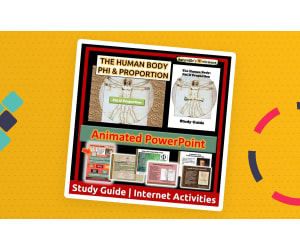
Human Body and Golden Ratio PowerPoint and Study Guide
Math, Grade 4, 5, 6, 7, 8, Projects, Activities, Presentations, Teacher Tools, Quizzes and Tests, Rubrics, Workbooks, Worksheets & Printables
Introduction to the Golden Ratio and the Human Body PowerPoint and Study Guide Lesson The Golden Ratio, or Phi, and the Human Body is a unique math PowerPoint exploration of the human body and Leonardo da Vinci's famous Vitruvian Man drawing. Academic connections are made with math, art and history. Another famous name for the Golden Ratio is the divine proportion, a proportion of beauty found throughout nature, science, art, and architecture. This lesson can be completed in one or two classes depending on how long teachers want to spend on projects. Learners will become enthralled by the idea of how math can be beautiful and learn to treat it like a treasure hunt by looking for the golden ration everywhere around them in art, nature and even their own bodies! Go down as many learning rabbit holes with NatureGlo's MathArt Library Golden Ratio and Human Body page. On this page you'll get videos, project ideas and curated website links. Enjoy the exploration! Student Objectives Students will: Complete the PowerPoint lesson Complete the study guide for the lesson. Watch the curated educational videos from the MathArt Virtual Library Website. Complete the journal in the study guide including a drawing with written descriptions. Complete the quiz. Choose and do a chosen project. Order, Outline and Steps Read the Quick Start guide that comes with the curriculum. Go through the PowerPoint lesson with the students. Students complete the study guide during or after the PowerPoint lesson. Students select and complete a chosen projects about the topic. Grades & Ages Grades 4 - 8 Ages 10 - 14 Implementation Format PowerPoint Study guide Use of Internet Activities Projects Answer Key - INCLUDED Number of Pages - 33 File Types - PowerPoint and PDF files Length of Lesson - At least one lesson, or, optionally two or more lessons
Author NatureGlo's eScience
Rating
Tags Golden Ratio, Human Body, Divine Proportion, Math Activities, Math Projects, Leonardo Da Vinci

Famous Mathematician: Math Research Project 5th 6th 7th 8th Grade
Research, ELA, Writing, Formal Writing, Social Studies, Biographies, Math, Grade 5, 6, 7, 8, Worksheets & Printables, Worksheets, Writing Prompts, Drawing Templates & Outlines, Teacher Tools, Rubrics, Activities, Projects
Here is a ready-to-print middle school math research project about famous mathematicians for your students in 5th through 8th grade. Each student will pick a famous mathematician, complete research about their life and mathematical discoveries, and create an organized project with paragraphs & visuals to share their learning. How to Use: • Print a 12-page project booklet for each pupil. • Page 2 has instructions for the project including a website for selecting famous mathematicians, places to write due dates, and a checklist to keep students organized. • Page 3 has seven different paragraph prompts for students to research. Each student must pick at least four prompts to have in their unique project. • Pages 4-6 are graphic organizers for your students to use for research notes. • Pages 7-9 are templates for students to use for writing their paragraphs. • Page 10 is for students to draw a portrait of their mathematician. • Page 11 is for students to show diagrams and formulas of the math that their mathematician discovered. • Page 12 is a title page for the project. • Page 13 is a rubric to use to assess the completed project. During several weeks of classes, your students will complete research, write & proofread paragraphs, and draw the visual pieces of their project. They can present their projects to each other, and you can use the rubric to assess them. Grades to Use With: This project is designed for middle school students in 5th, 6th 7th, or 8th grade who are learning about mathematicians, biography writing, library research skills, and writing expository paragraphs. It could also be used in high school special education classes where appropriate. What's Included: 13-Page PDF: Ready to Print and Use! Complete Teacher Instructions 2 Pages of Student Instructions & Writing Topics 6 Student Graphic Organizers for Note-Taking & Paragraph Writing 2 Student Templates for a Mathematician Portrait and Math Sketches Project Title Page Marking Rubric
Author Grace Under Pressure
Rating
Tags Math Project, Math Research Project, Famous Mathematicians, Mathematicians, Famous Mathematicians Project, Biography Project, Middle School Math Project, Math Research

Math Journal Rubric Assess Middle School Math Word Problems & Journals
Math, Grade 5, 6, 7, 8, Rubrics, Teacher Tools
Math Journal Rubric: A Guide to Assess Middle School Mathematical Practice Standards and Math Written Responses This is a useful tool for middle school math teachers; it is specifically designed for grades 5 through 9. With a focus on word problems in math subjects, this rubric can add a new way of assessing your students' math skills at the middle/intermediate levels. The rubric includes 4 evaluation categories: Process: This assesses the strategy implemented by a student to find solutions. Vocabulary: This measures how effectively students use relevant math terms during explanations. Completeness: Students are evaluated based on how accurately they detail each step leading towards solution. Creative Representation: Students are encouraged to include corresponding diagrams or images along with their solutions to demonstrate their understanding. Each evaluation category has four levels of achievement: not yet meeting, minimally meeting, fully meeting, and exceeding. You can use this rubric to mark any open-ended math word problem prompt! I have my students do a math journal prompt once or twice a month, and this is an easy way to assess that work and look for problem areas and growth. If you would like a bundle of 20 Middle School Math Journal Prompts , that is also available in my store. Alignment with Mathematical Practice Standards (1-8) This tool aligns with and makes assessment of many of the Mathematical Practice Standards easy and efficient. For example: CCSSMP1 (Make sense of problems and persevere in solving them), CCSSMP2 (Reason abstractly quantitatively), and CCSSMP3 (Construct viable arguments & critique others). Grades to Use With: This math rubric is designed to be used in the middle grades (5-9) to assess Mathematical Practice Standards and your students' ability to share their ideas about math in pictures, numbers, and words. What's Included: 2 page PDF: Title Page and Math Journal Rubric: ready to print and use immediately!
Author Grace Under Pressure
Rating
Tags Math Journal, Rubric, Mathematical Practice Standards, Word Problems, Math Rubric, Math Assessment, Math Ideas, Middle School Math, Math Evaluation, Math Journal Rubric