german adjective endings worksheet with answers
- Grades
- Middle School, High School
- Pages
- 11
- File type
- Answer key
- Included


- Subject
- Foreign Languages, German
- Topic
- German, grammar
- Resource types
- Worksheets & Printables
- Answer key
- Included
About this resource
What's inside this resource
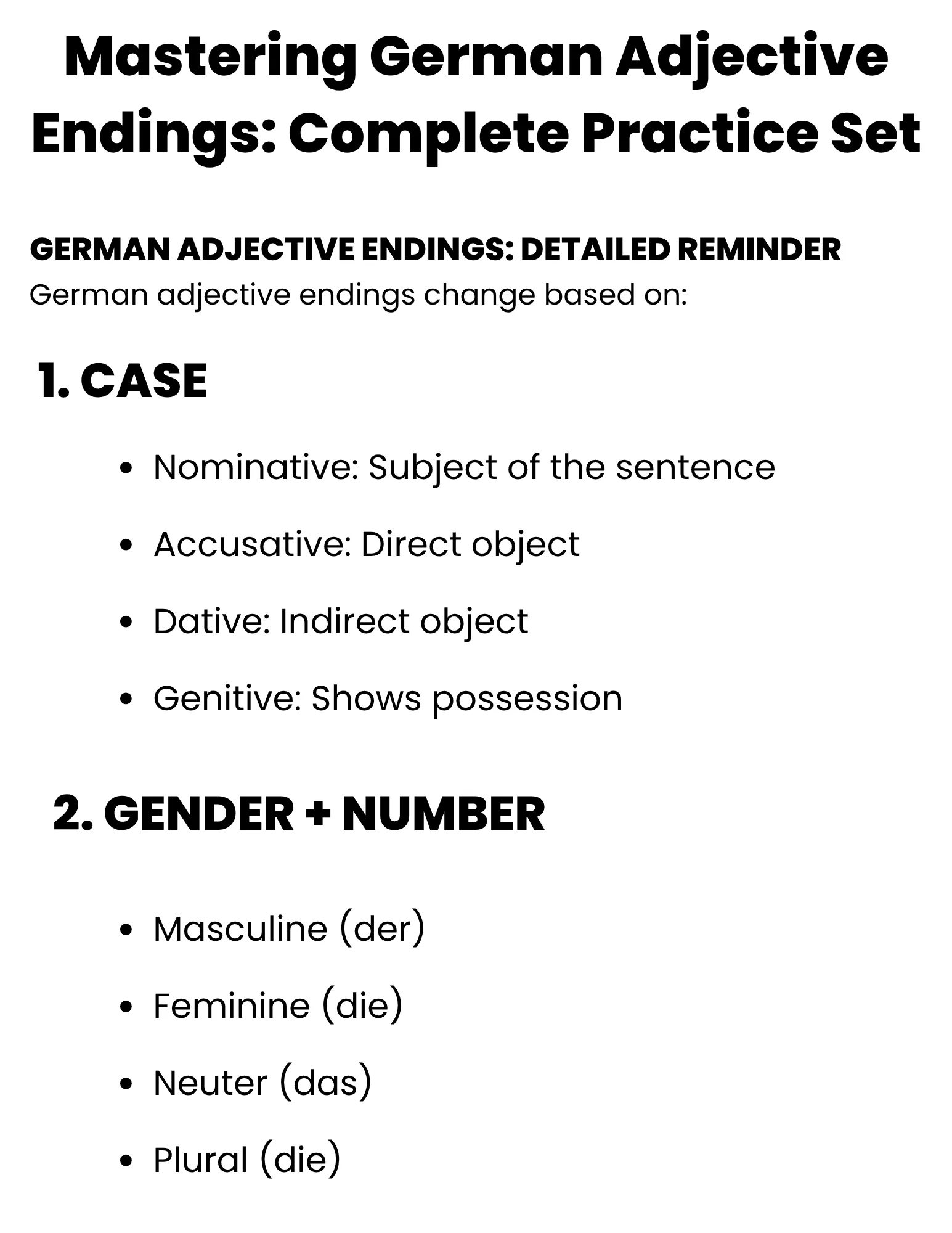
This resource is a complete grammar practice set designed to help students confidently learn and apply German adjective endings based on case, gender, and article type. It provides detailed explanations, structured exercises, and answer keys, making it ideal for both classroom and independent study.
Introduction
Mastering German adjective endings can be one of the most confusing parts of German grammar for learners. This resource breaks it down clearly, featuring a quick-reference guide and four focused exercises that cover all the key rules through hands-on practice.
Objective
To provide A1–B1 German learners with a solid understanding and practical application of adjective endings in the nominative, accusative, and dative cases, using a variety of articles (definite, indefinite, none).
Order, Outline, and Steps
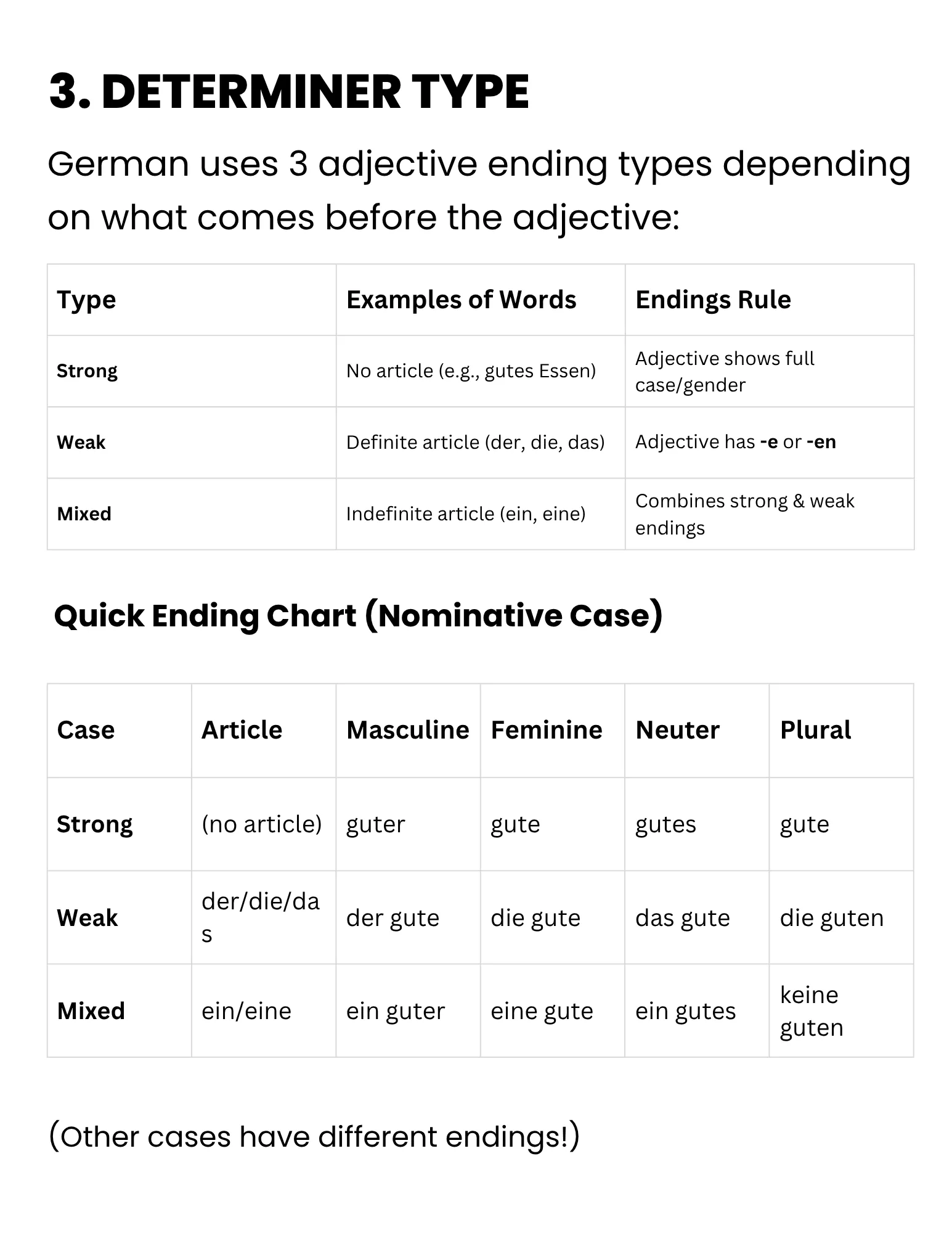
Quick grammar guide with a reference chart and rules
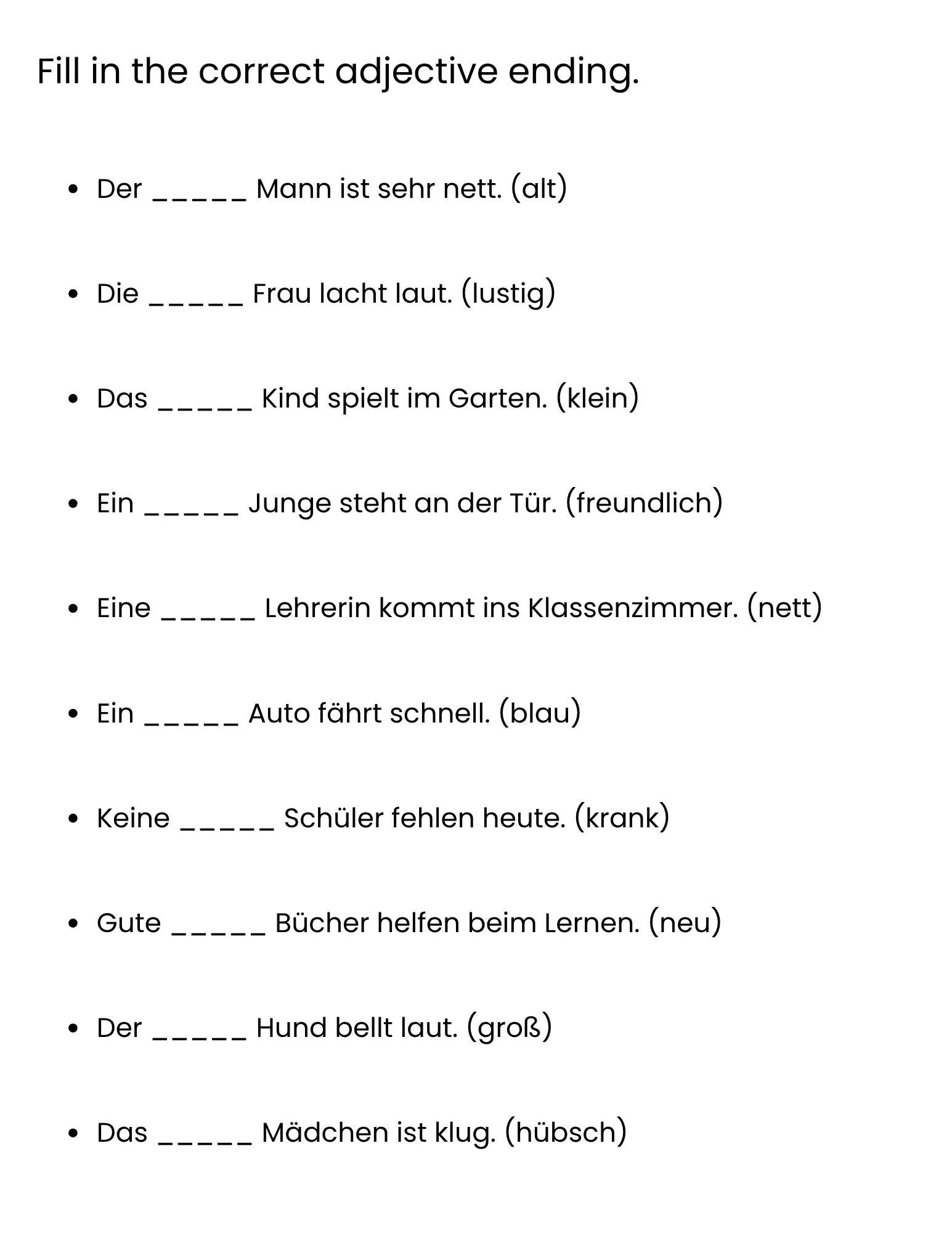
Exercise 1: Nominative case (10 examples)
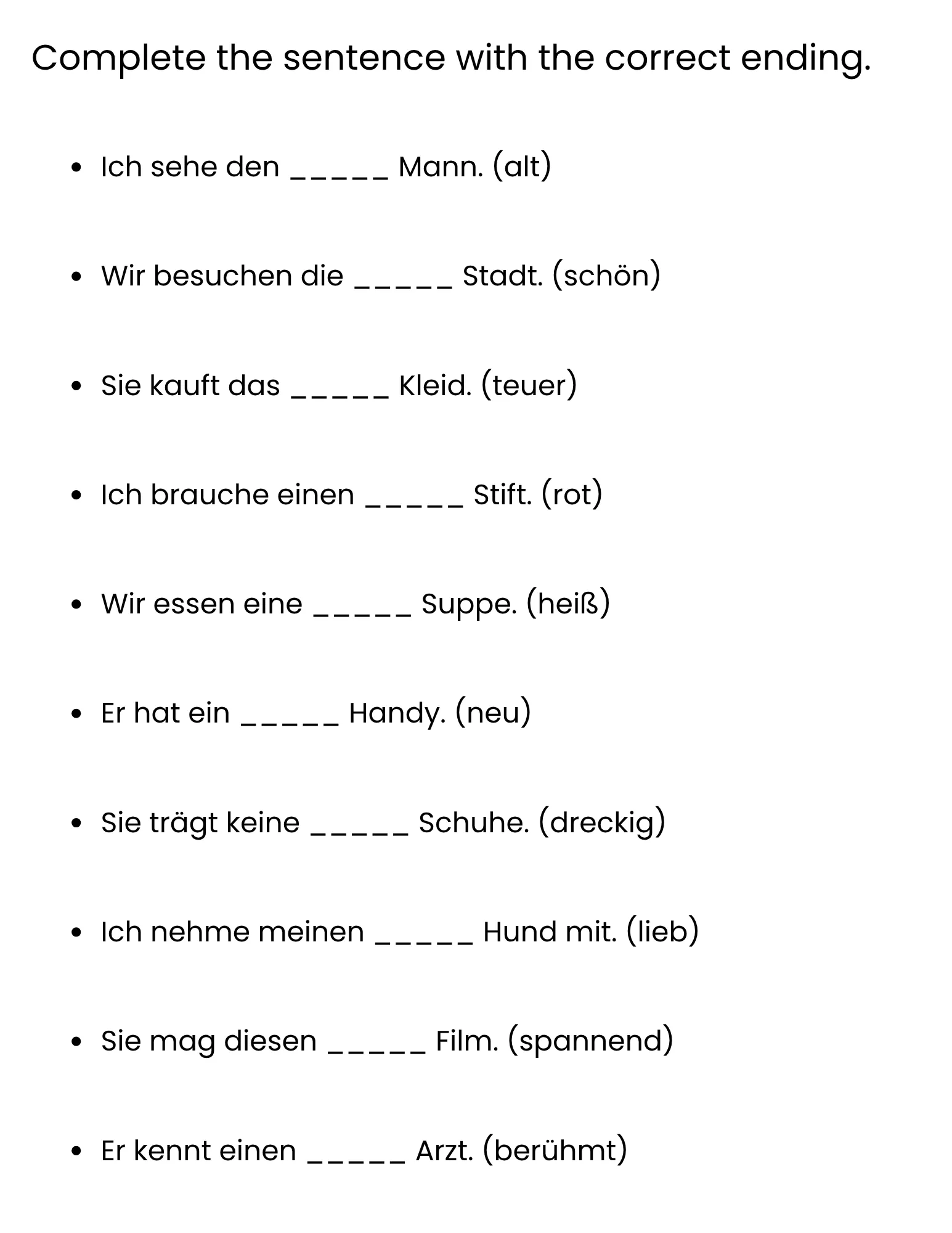
Exercise 2: Accusative case (10 examples)
Exercise 3: Dative case (10 examples)
Exercise 4: Mixed article types (10 examples)
Answer keys for all exercises
Grades or Ages
Best for: Ages 13+
Levels: A2–B1 (with teacher support, suitable for late A1 learners)
Ideal for high school, college students, or adult learners
Implementation Format
Printable worksheets (PDF)
Digital-friendly format (can be used on tablets or in LMS systems)
Ready to use in class, as homework, or for remote learning
Answer Keys
✓ Included at the end of the resource for easy grading or self-correction
How to Use and Variations
Use one exercise per lesson or assign all four as a unit
Perfect for test prep, grammar review, or flipped classroom models
Add color-coding or sentence expansion for advanced learners
Can be laminated for reuse or used as a station activity
Standards
Aligned with Common European Framework of Reference (CEFR) A1–B1 goals:
Grammar accuracy
Vocabulary application
Sentence structure and communication
File Types
PDF (A4 and US Letter versions available)
Related resources
More resources teachers may find useful
24 related resources were found using this product's title, contributor, categories and tags.


In the classroom
Teaching tips & learning objectives

Learning objectives
Apply the correct German adjective ending based on grammatical case (nominative, accusative, dative), gender, and number.
Distinguish strong, weak, and mixed adjective-ending patterns depending on whether a definite article, indefinite article, or no article precedes the noun.
Check completed exercises against an included key and correct any missed endings.

Teaching tips
The quick-reference chart on page 2 only spells out the full ending pattern for the nominative case — walk students through how those same endings shift for the accusative (Exercise 2) and dative (Exercise 3) before assigning those pages independently.
Assign Exercises 1 through 3 in order, since each isolates a single case, and save Exercise 4 for last since it mixes all three determiner types together as a cumulative check.
Point out page 10's own bracketed note on 'extra' (a word that is often left undeclined in everyday German) as a teachable exception to the standard ending rules.

Skills covered
Case-based adjective declension — students supply the correct ending across four exercises that isolate the nominative, accusative, and dative cases in turn.
Determiner-type recognition — students apply different ending rules depending on whether a definite article (der/die/das), an indefinite article (ein/eine), or no article precedes the adjective.
Self-directed error correction — students compare completed exercises against the included key, matched question-by-question to each exercise.
Good to know
Questions teachers ask about this resource
What is the difference between the first three exercises and the final one?
Exercises 1 through 3 each isolate a single grammatical case — nominative, accusative, and dative in turn — so students practice one pattern at a time before Exercise 4 mixes definite-article, indefinite-article, and no-article endings together in the same set of sentences.
How can students verify their own work after finishing an exercise?
A matching set of correct endings for all four exercises appears at the back of the resource, in the same order as each exercise's ten questions, so students can self-check exercise by exercise.

No reviews yet
Downloaded this resource? Tell other teachers how it went.
Resource details
Concepts & topics
Core concepts
 Core concepts
German adjective declension
Grammatical case (nominative, accusative, dative)
Strong / weak / mixed determiner types
 Topics
Explore related searches
More to explore
You may also like