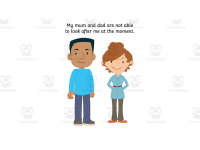
Going into Foster Care Social Story



- Grades
- Not Grade Specific
- Pages
- 101
- File type
- Preparation
- Print ready


- Subject
- Special Education Needs (SEN), Social Skills
- Topic
- Foster care, Family transition
- Resource types
- Activities
- Preparation
- Print ready
Product description
From the author
Social story to explain a little about the situation to a child who is going into foster care. A child going into foster care can be supported by letting them know you are there for them and that they are not alone.
The point of a social story is to use a patient and reassuring tone to teach children about social situations in a way that can be easily understood. Social stories can be useful for any child who is struggling to understand a situation or concept or needs help to understand a social skill or social cue, expectations, perspectives, common responses or is troubled about an upcoming event but social stories are particularly useful for children on the autistic spectrum for whom social cues can be challenging and who often suffer anxiety if they do not know what to expect from a situation.
These books should be used over and over to reinforce the point so I would suggest either putting the pages into a display book or laminating and binding them.
Included is a 20 page PDF printable social story. There are 3 versions - one for a child who has been taken from both parents and then for a child who has been taken from their mom or dad.
Clipart images courtesy of Kari Bolt Clip Art
Related resources
More resources teachers may find useful
24 related resources were found using this product's title, contributor, categories and tags.



In the classroom
Teaching tips & learning objectives

Learning objectives
- Name feelings connected with a move into foster care.
- Identify trusted adults to talk with.
- Recognize coping ideas suited to the child’s situation.

Teaching tips
Choose the version that matches the child's own family structure: two-parent (American or British spelling), dad-only, mom-only, or mum-only
Reread the story with the child when doing so is helpful; laminating the pages or placing them in a display book keeps the copy durable for repeat use
Use the story's own prompts as a starting point for a calm conversation about feelings, since it specifically names a foster family, social worker, or teacher as someone the child can talk to

Skills covered
Emotional vocabulary — the story names specific feelings such as sadness and anger and validates them as okay to feel.
Understanding a life transition — sequential pages walk through what foster care is, why it is happening, and that it is not the child's fault.
Coping-strategy awareness — the story lists concrete actions, such as looking at photos or writing letters, for when the child misses their parents.
Good to know
Questions teachers ask about this resource
How should I choose and use a version?
Choose the family wording that best fits the child, then read together and connect the story with the arrangements explained by their care team.

No reviews yet
Downloaded this resource? Tell other teachers how it went.
Resource details
Concepts & topics
Core concepts
 Core concepts
Foster care transition
Emotional coping strategies
Social story format
Family structure variants
 Topics
Explore related searches
More to explore