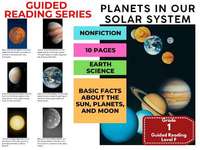
Guided Reading Level F - Planets in Our Solar System



ELA, Resources for Teachers, Reading Comprehension, Reading, Language Development, Pre-Reading, Vocabulary, Science, Earth and Environmental Sciences, Space
Kindergarten, Grade 1, 2
Worksheets & Printables, Worksheets, Teacher Tools, Centers, Activities, Literacy Readers, Quizzes, Quizzes and Tests, Assessments


About This Product
This Guided Reading Book - Planets in Our Solar System (Level F) includes:
Guided Reading Color Label (front cover x1)
This is a quick way to match the book’s demands to what students can generally handle..
The overall goal is to use the level/color to pick books for several smaller groups. To qualify for a certain level, a student is expected to read a book from that level with about 90–94% accuracy.
If a student is consistently accurate and understands, move up a level. If the student is struggling at that level, drop down and add more support.
Each student will improve at completely different rates, but it is generally one of the best ways to check progress across the class.
DOWNLOAD THE CATALOG TO VIEW ALL GUIDED READING BOOKS AVAILABLE (SORTED LEVELS A-Z)
COMPANION VIDEO NOW AVAILABLE (EMBEDDED AFTER PREVIEW PICTURES IN PRODUCT DESCRIPTION)
Pre-Reading Question (x1)
The teacher says the question aloud, either while showing the cover or the first page.
Students share what they already know or make sensible guesses based on the cover. Encourage them to use the target vocabulary where possible.
Write a few of their ideas on the board so you can return to them during or after the reading.
Vocabulary Words (x5)
Introduce the five words one at a time. Say each word aloud, have students repeat it, and then ask if anyone already knows what it means.
Read the meaning together and briefly connect each word to a picture, action, or gesture so it feels more memorable.
Ask students to flip through the book and point to any pages where they spot the vocabulary words.
While reading, pause when one of the words appears, or reread the sentence so students clearly notice and understand it in context.
Optional: Ask students to raise their hands whenever they see or hear one of the new words.
Guided Reading Pages (x10)
Check the book snapshot below for:
Primary topic — decide whether students need a quick introduction or extra background first.
What this lesson teaches best — choose 1–2 key points to focus on during the session.
Learning goals — keep in mind what students should be able to understand or say by the end.
Key vocabulary — review and reinforce these throughout the lesson.
Questions overview — look ahead so you know what students will be asked and whether any extra support is needed.
Run the lesson
You may already have looked at a few pages together, but it can help to revisit some of the pictures first to build meaning.
Depending on your time and how confident the group is with guided reading, you may want to read the whole book aloud to them first.
Students can then whisper-read or partner-read while you listen in. If time allows, you can also read as a group, with each student taking a page.
Use the guided reading prompts to support them, such as:
“Check the picture—does it make sense?”
“Point under the words.”
“Try the first sound.”
“Reread the sentence smoothly.”
It can be helpful to focus more closely on one student each session, rotating over time, so you can better judge whether they are ready to move up or may need more support at their current level.
Comprehension Questions (back cover x3)
This is where you check that students understood the text, not just the words on the page.
Start by letting students answer by pointing to a page or picture and saying a short sentence.
After they respond, follow up with: “Show me where you found that in the text.”
In larger groups, let partners discuss their answer first for 10–20 seconds, then invite 2–3 students to share.
Differentiation tips
Emerging speakers / struggling readers: oral response + pointing
On-level: oral response in a full sentence
Higher: one written sentence or a drawing with labels
Book Snapshot
Title: Planets in Our Solar System
Genre: Nonfiction (informational)
Subject: Science
Primary Topic: Basic facts about the Sun, the planets, and the Moon
Estimated Guided Reading Level (A–Z): F
What This Book Teaches Best
Introduces the Sun as a star at the center of the solar system that gives light and heat to the planets.
Teaches the order of the planets, from Mercury to Neptune, with one main fact about each one.
Builds science vocabulary naturally through the text, including words like craters, surface, giant, unique, and reflects.
Helps students compare planets using simple details such as color, temperature, rings, winds, and clouds.
Learning Goals
Students will identify the Sun’s job in the solar system using details from the text.
Students will name the planets in order from Mercury to Neptune as shown in the book.
Students will describe at least three planets using facts from the text.
Students will explain what makes one planet “unique” in the book.
Students will tell what the Moon does at night, according to the text.
Key Vocabulary From the Text
craters — deep holes in the ground
surface — the outside layer of something
giant — very, very big
unique — special and different from others
reflects — bounces light back
Discussion Prompts
Pre-reading question: What do you already know about the Sun, the Moon, and the planets?
Comprehension question: Which planet does the book say is the smallest?
Comprehension question: What is Saturn famous for?
Comprehension question: What does the Moon reflect at night?
1. Best Printing Method (Recommended)
Booklet printing is the best option if your printer or PDF viewer supports it.
This method usually places the pages in the correct order automatically and makes folding much easier.
Settings to use:
Print mode: Booklet
Paper size: Letter or A4
Orientation: Landscape
Print on both sides: Yes
Flip on: Short edge
Scaling: Fit to printable area
Booklet subset:
First, print front sides only
Then, print back sides only
This will automatically:
Pair the pages correctly
Place the cover on the outside
Help everything line up properly for folding
After printing, fold the pages in half and staple along the spine.
2. If “Booklet” Printing Is Not Available
You can still print the book correctly by using manual duplex printing.
Step-by-step:
Open the PDF.
Click Print.
Use these settings:
Orientation: Landscape
Pages per sheet: 1
Print on both sides: Yes
Flip on: Short edge
Print all pages.
Since each PDF page already contains two facing book pages, the pages should still fold neatly into a book.
Thousands of Cored Education products are included with your TeachSimple membership.
Download links and encyclopedia index available here.
Resource Tags
0 Reviews
Check out these other great products