How to Write an Essay: What is a Narrative Essay?

- Grades
- Grades 5–8
- Pages
- 24
- File type
- Answer key
- Included


- Subject
- ELA, Writing
- Topic
- Narrative essay, Essay writing
- Resource types
- Lesson Plans
- Answer key
- Included
- Standards
- CCSS.W.6.3
Product description
From the author
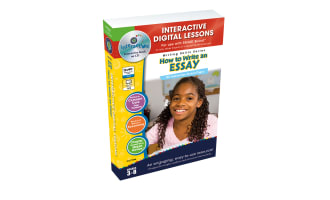
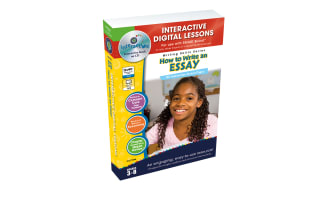
Rooted in the earnest desire to simplify the essay writing process for students, this resource decomposes every step of essay composition. Devised as an autonomous chapter from the expansive lesson plan 'How to Write an Essay,' this instructional handbook propounds a novel approach for elucidating and streamlining what often arises as a daunting assignment.
The key is in simplicity, and this teaching resource impeccably delivers it. This 24-page PDF guide offers lucid yet captivating content tailored specifically for grade 5-8 students. Adhering to Bloom's Taxonomy principles, it ensures seamless flow from one topic to another, thereby serving perfectly fit for group learning or guiding small group activities.- Imagine leading student cognition of narrative essays beyond basic definition. The module not only provides simple definitions but delves into various stages of essay writing - selecting topics, building arguments, crafting climactic conclusions - leaving no stones unturned.
- The real treasure lies in its explicit segments on four widespread types of essays along with recap sessions around essential elements such as verbs, adjectives, and pronouns that are useful across all subjects requiring proficient written communication skills.
You'll marvel at the ease with which evaluation can be executed using this bundle owing not just to individual word puzzle exercises & comprehension quizzes but also through detailed scoring rubrics enabling smooth tracking of learner progress.
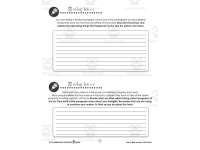
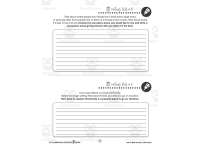
Additionally,it incorporates six full-colored graphic organizers offering visual aids aimed towards easy grasp of key concepts while steering your class towards completion their own engaging narratives successfully. An added benefit is its compliance with Common Core State Standards, reassuring reliability and effectiveness.
Choose 'How To Write An Essay: What is a Narrative Essay?' for its intricate design and effective structure that make teaching essay writing an achievable and less intimidating task.
Related resources
More resources teachers may find useful
24 related resources were found using this product's title, contributor, categories and tags.


In the classroom
Teaching tips & learning objectives

Learning objectives
Identify the defining features of a narrative essay, including chronological order, action verbs, and sensory details.
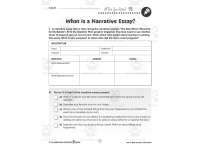
Plan a narrative essay using a Skeleton Plan graphic organizer that sequences an experience's key events.
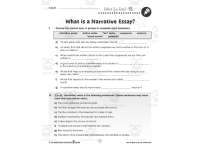
Classify writing prompts by essay type (narrative, persuasive, informative, descriptive).

Teaching tips
Use the rubric for narrative writing; adapt its narrative-specific criteria before scoring the persuasive, informative or descriptive prompts. It scores ideas, organization, style and conventions on four levels.
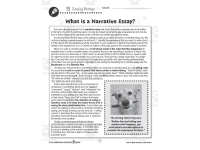
Model the 'mind movie' technique from the reading passage before assigning writing tasks, since it's the resource's central strategy for teaching descriptive, sequential storytelling.
Treat chronological order and five paragraphs as the scaffold used in this packet, not requirements for every narrative essay. The rubric itself allows flashback. Use precise verbs where useful, without treating every form of be as poor writing.

Skills covered
Narrative structure — students sequence an experience's events chronologically using a Skeleton Plan graphic organizer.
Action-verb usage — students identify and circle action verbs in sentences and are taught to minimize 'state-of-being' verbs like is/was/were.
Essay-type classification — students sort writing prompts and vocabulary into narrative, persuasive, informative, and descriptive categories.
Good to know
Questions teachers ask about this resource
Why are other essay types represented in a narrative-focused chapter?
Some tasks ask students to distinguish narrative, persuasive, informative, and descriptive purposes. Those comparisons sit alongside the main reading and planning work on narrative writing.

No reviews yet
Downloaded this resource? Tell other teachers how it went.
Curriculum
Standards, concepts & topics
Standards
 Standards
- CCSS.W.6.3 — Write narratives to develop real or imagined experiences or events using effective technique, relevant descriptive details, and well-structured event sequences. a. Engage and orient the reader by establishing a context and introducing a narrator and/or characters; organize an event sequence that unfolds naturally and logically. b. Use narrative techniques, such as dialogue, pacing, and description, to develop experiences, events, and/or characters. c. Use a variety of transition words, phrases, and clauses to convey sequence and signal shifts from one time frame or setting to another. d. Use precise words and phrases, relevant descriptive details, and sensory language to convey experiences and events. e. Provide a conclusion that follows from the narrated experiences or events.
Core concepts
 Core concepts
Narrative essay
Writing process
Action verbs
Essay types
Graphic organizers
 Topics
More to explore
You may also like