Intro to Metric Conversions – 5th Grade Math




- Grades
- Grade 5
- Pages
- 64
- File type
- Microsoft PowerPoint
- Editable
- Yes


- Subject
- Math, Measurements
- Topic
- Metric conversions, Decimal shifts
- Resource types
- Presentations
- Editable
- Yes
- Standards
- 5.MD.A.1
Product description
From the author
This is a 64-slide lesson for 5th grade math students’ introduction to converting within metric measurements.
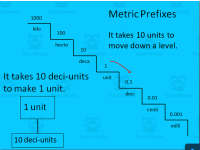
One of the first slides will show examples of the units for length, capacity, and mass. The staircase type chart for converting between metric measurements is shown with metric prefixes. The staircase uses a mnemonic sentence. I suggest you make a copy for students to have during the lesson.
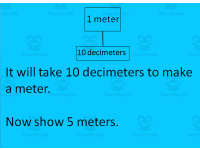
The metric prefixes are modeled with base ten blocks and then modeled with a number line. A flow chart type model is then used to show how to convert between metric units and when to multiply and when to divide. There are many examples for you to show students as well as several problems for them to do on their own. These models are then compared to the staircase and the slides talk about moving up and down the staircase which moves the decimal in the number.
Finally more problems for students to complete using any of the devices shown in the lesson. This lesson covers the Common Core Standard 5.MD.A.1 Convert among different-sized standard measurement units within a given measurement system (e.g., convert 5 cm to 0.05 m), and use these conversions in solving multi-step, real world problems.
Related resources
More resources teachers may find useful
24 related resources were found using this product's title, contributor, categories and tags.
In the classroom
Teaching tips & learning objectives

Learning objectives
Order the metric prefixes (kilo, hecto, deca, unit, deci, centi, milli) using the mnemonic 'King Hector Doesn't Usually Drink Chocolate Milk'
Use a staircase model to convert between metric units of length, mass, and capacity
Convert metric measurements involving whole numbers, fractions, and decimals (e.g., 50 centigrams to 0.5 grams, 200 meters to 0.2 kilometers)

Teaching tips
Have students copy the staircase and mnemonic onto their own paper early in the lesson, since the slides return to referencing 'the staircase' throughout later problems
Pause after each 'What pattern do you see?' slide (slides 44 and 48) to let students propose the decimal-shift rule themselves before the next slide reveals it
Use the multi-level conversions (e.g., 200 meters to kilometers, moving three levels) as a checkpoint for students who have mastered single-level conversions

Skills covered
Metric unit ordering — students sequence the metric prefixes from kilo to milli using a staircase model and mnemonic.
Unit conversion — students convert measurements of length, mass, and capacity between metric units, including whole-number, fractional, and decimal results.
Multi-step conversion — students apply the decimal-shift pattern across multiple staircase levels (e.g., meters to kilometers) rather than a single step.
Good to know
Questions teachers ask about this resource
How can I check understanding beyond moving a decimal point?
Ask students to explain why the numerical value grows or shrinks when the unit changes, using the staircase or another model to show the factor involved.
Does the exit ticket have a separate answer key?
The lesson includes worked conversion examples, but the final two-question exit ticket has no separate completed key.

No reviews yet
Downloaded this resource? Tell other teachers how it went.
Curriculum
Standards, concepts & topics
Standards
 Standards
- 5.MD.A.1 — Convert among different-sized standard measurement units within a given measurement system (e.g., convert 5 cm to 0.05 m), and use these conversions in solving multi-step, real world problems.
Core concepts
 Core concepts
Metric prefixes
Staircase conversion model
Decimal-shift pattern
Liters and cubic centimeters
 Topics
Explore more
Categories this resource belongs to
Explore related searches
More to explore
You may also like