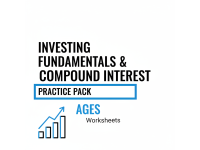
Investing Fundamentals & Compound Interest Practice Pack

Math, Money, Statistics, Measurements, Order Of Operations, Trigonometry, Time, Multiplication and Division, Division, Multiplication
Worksheets & Printables, Workbooks, Worksheets, Word Searches, Teacher Tools, Lesson Plans, Quizzes and Tests, Quizzes, Tests, Assessments


About This Product
Complete Set: Compound Interest Practice Pack. With this no-preparation, complete unit, you’ll transform your students’ passive consumption of investments into sound capital allocation.
Looking for something more than just a “piggy bank” way to teach your students about finances? The curriculum is designed specifically to teach students how and why they can create wealth through investing. It breaks down stocks and stock markets into simple components, demonstrates how inflation erodes purchasing power without anyone being aware, and mathematically proves the power of compounding through real-life practice examples.
Students will develop a firm understanding of investing based upon the learning experiences included in this program, which can be used for multiple subject areas including Math, Economics, Personal Finance, and Life Skills. This is an excellent resource for several weeks of instruction on investment literacy as it provides all of the necessary ingredients (theory, practice, and case studies) to achieve successful learning outcomes.
WHAT WILL YOU FIND IN THIS 32-PAGE PACK?
PHASE ONE: Core content and theory – This section includes a 9-page “student textbook” that communicates the foundational concepts using academic terminology, generalized real-world analogies where applicable.
Covers the following topics: The reality of inflation; the asset classes (i.e., stocks, bonds reals); the difference between simple versus compound interest; the Rule of 72; risk and diversification; behavioral finance (e.g., loss aversion, fear-of-missing-out [FOMO]); and dollar-cost-averaging.
PHASE TWO: Student workbook (10 sheets) - A total of 13 pages worth of rigorous practice questions. Starting with simple terminology and building to an increasingly sophisticated portfolio synthesis.
Worksheet #1 – The anatomy of an investment.
Worksheet #2 –The time-value-of-money and inflation.
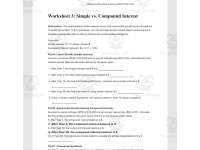
Worksheet #3 – Simple versus compound interest.
Worksheet #4 – The compound-interest formula in action.
Worksheet #5 – The Rule of 72.
Worksheet #6 – Risk, reward, and volatility.
Worksheet #7 – Stock-market mechanics.
Worksheet #8 – Mutual funds and ETFs.
Worksheet #9 – The impact of time (early vs. late).
Worksheet #10 – Building your first portfolio.
PHASE THREE: Visual and teacher resources – Everything you need to properly teach and support your students on the curriculum.
3 impactful pedagogical visuals that can be projected and/or printed relating to compound interest, asset classes, and the Rule of 72.
Complete, step-by-step Teacher’s Answer Key covering all ten questions in the workbook.
Sound implementation guide for Teachers, including module pacing, instructional notes, and other valuable insights related to “expected cognitive friction points.”
This isn't simply a lesson plan; This is an entire educational program that will teach young people to have real financial intelligence.
Key Terms: Teach Teenagers How to Invest, Compound Interest Project, Financial Literacy Curriculum, Personal Financial Literacy Unit, Stock Market For Kids, Middle School Math, High School Economics, Homeschooling, No Preparation Needed (Print and Go), Digital Learning, and Money Management.
Why Do Parents and Schools Appreciate It?
Provides Life-Long Knowledge: This unit provides students with the knowledge and skills needed to understand investing, create wealth, and achieve financial stability beyond what they learned in textbooks.
Total Unit; No Additional Preparation Needed: This is a complete curriculum with everything needed, including theory, worksheets, visuals, answer keys, and a teacher guide! By using this complete package, more than 10-20 hours of planning can be saved by teachers.
Real Comprehension: By combining theory with real-life examples and thorough practice, this unit gives students the knowledge they need to know how to calculate for financial growth and what risks are associated with financial growth rather than just memorizing formulas to solve for financial growth.
Engaging as well as Challenging: The language in this unit is challenging, but when students use the step-by-step format and apply these concepts to real-life examples (like comparing two different investors), students will find these topics very interesting and easy to understand.
Target Student Audience Assessment:
A comprehensive assessment of the material's content and language, mathematical difficulty, etc.:
Grade Level of Main Target Audience: 8 - 10 grades. Although the PDF shows 7-9 grades, the vocabulary/academic terminology in the document is more suitable to eighth (8th) & ninth (9th) graders (as opposed to seventh (7th) graders). The level of math skills required to understand this material would be appropriate for eleventh (11th) and twelfth (12th) graders as an introductory course to economics or mathematics.
Additional Targeted Audiences:
Gifted and Talented Middle School Students (6-7 grades)
High School Economics or Personal Finance Electives (11-12th grades) - Use This Material As An Introductory Unit
Parents Who Homeschool Their Children With A Curriculum Focused On Life Skills Or Financial Literacy
This Product has been copyrighted by Syed Hammad Rizvi. You may only use this Resource in your Personal Use, and only in a Single Classroom. This means you cannot alter, redistribute, or sell it. In other words, you cannot put this Resource on the Internet, where others can access and download it permanently or temporarily.
If you would like to share this Resource with your colleagues, please purchase additional licenses from Teachsimple. Thank you for your understanding, and thank you for complying with these terms of use.
Syed Hammad Rizvi is pleased to provide this Product to you.
Resource Tags
0 Reviews
Check out these other great products