Lesson 4.2 - Conservation of Energy
- Grades
- Grades 6–12, Middle School, High School
- File type
- Multiple File Types
- Editable
- Yes


- Subject
- Science, Chemistry, Physics
- Topic
- Energy conservation, Systems
- Resource types
- Lesson Plans, Teacher Tools
- Editable
- Yes
About this resource
What's inside this resource
Take your teaching experience to the next level with our expertly created resource, designed specifically for Integrated Chemistry & Physics education. This extensive digital package provides a multitude of materials that explain the concept of energy conservation and its real-world application.
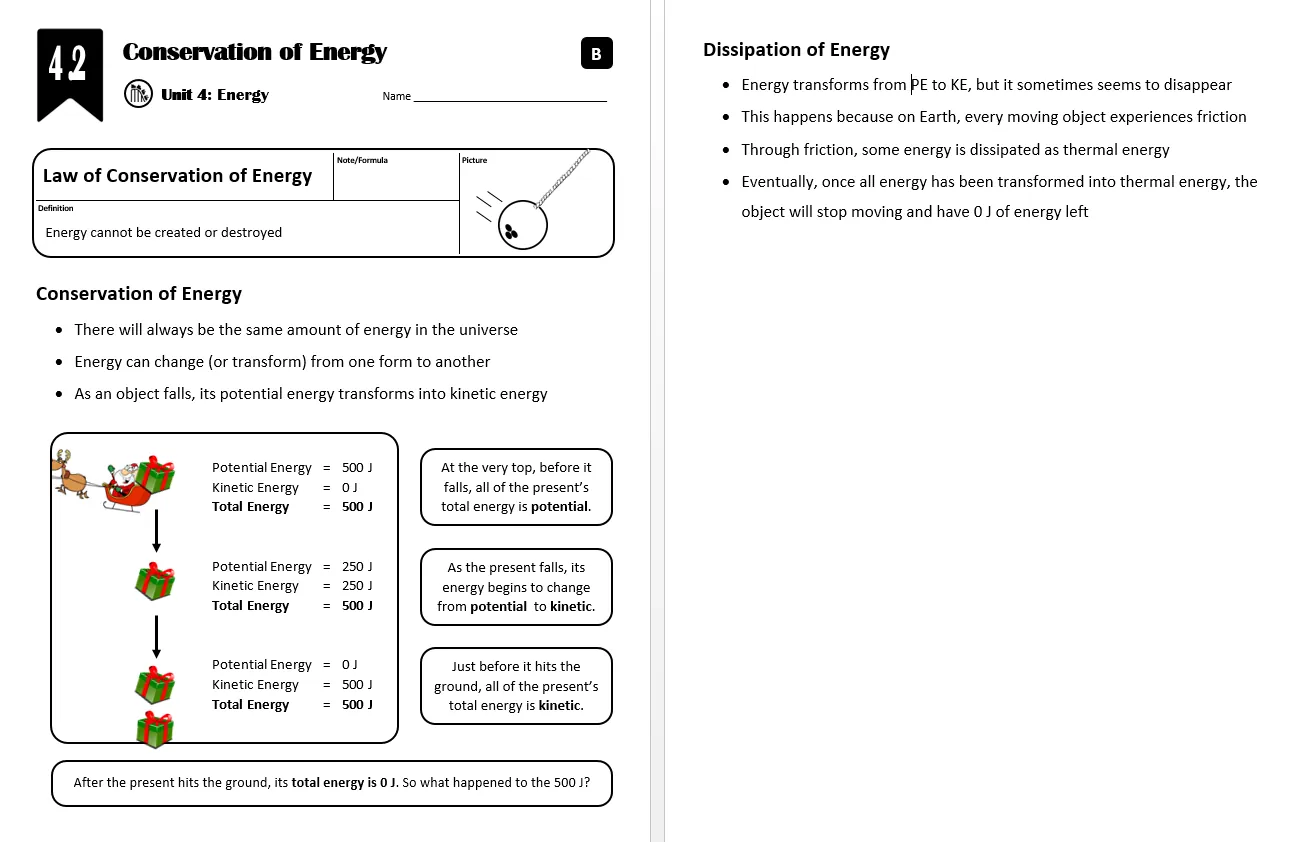
This comprehensive resource includes:- Educational notes addressing energy conservation in systems, available in an interactive fill-in-the-blank version (A version) and completed version (B version).
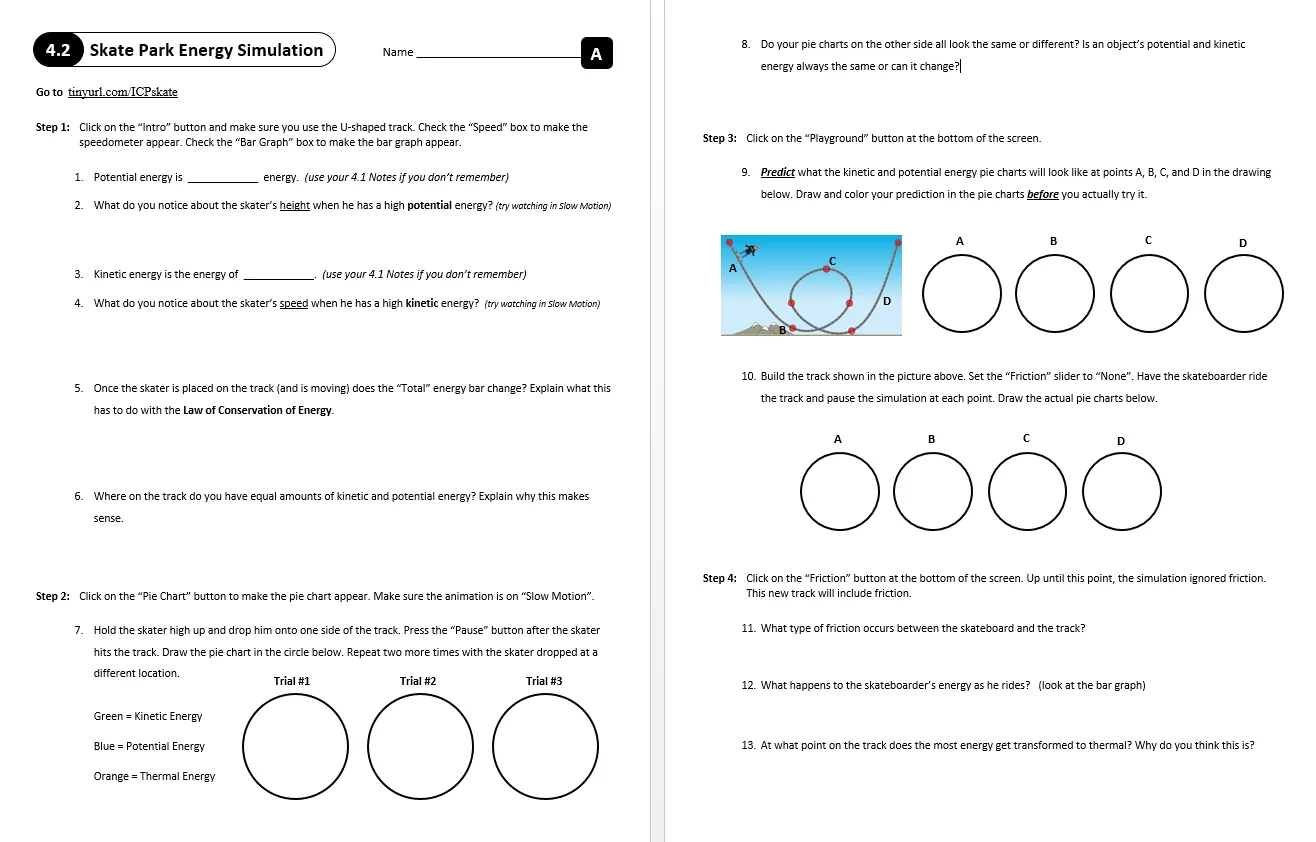
- A captivating Energy Skate Park Simulation for displaying the transformative process encompassing various forms of energy.
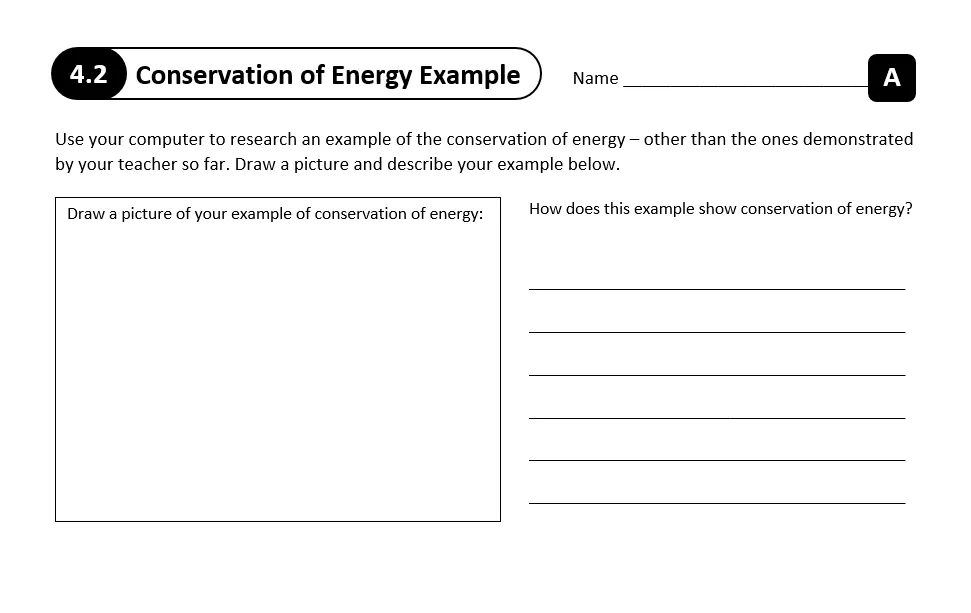
- Intriguing activities to encourage students' creativity by finding tangible examples of energy conservation within their daily life, backed up by a lab activity focusing on kinetic and potential energies.
- A structured PowerPoint known as Objectives & Starter Questions to effectively spark class discussions or quizzes.
- Detailed PowerPoint Notes for presenting material to students smoothly.
The aforementioned contents are designed in accordance with 2016 Indiana State Standards ICP.4.2 and ICP.4.3, suiting different learning environments including full-class instruction, small group work, or individual assignments. The files included come in .docx (editable), .pptx (editable PowerPoint), and .pdf (non-editable) formats, compatible with popular software like Microsoft Word & PowerPoint or Adobe Reader.
Note: All editable materials can be adjusted to fit your teaching preferences with the right software. Non-editable .pdf files, however, require a PDF viewer like Adobe Reader. It's recommended to check software compatibility before purchase and download.Ideal for Grade 6 to 12 students, this one-stop solution in the realms of Chemistry and Physics education combines comprehensive theoretical input with practical activities. Introduce Lesson 4 - Conservation of Energy in your curriculum today!
Reference: The pronouns 'you', 'your' are intended for educators or teachers.
Related resources
More resources teachers may find useful
24 related resources were found using this product's title, contributor, categories and tags.

In the classroom
Teaching tips & learning objectives

Learning objectives
Recognise the Law of Conservation of Energy and state that energy cannot be created or destroyed
Describe how energy transforms between potential and kinetic forms as an object falls, keeping the total constant
Explain the roles of friction and thermal energy in energy transfer, and why a rolling object eventually stops

Teaching tips
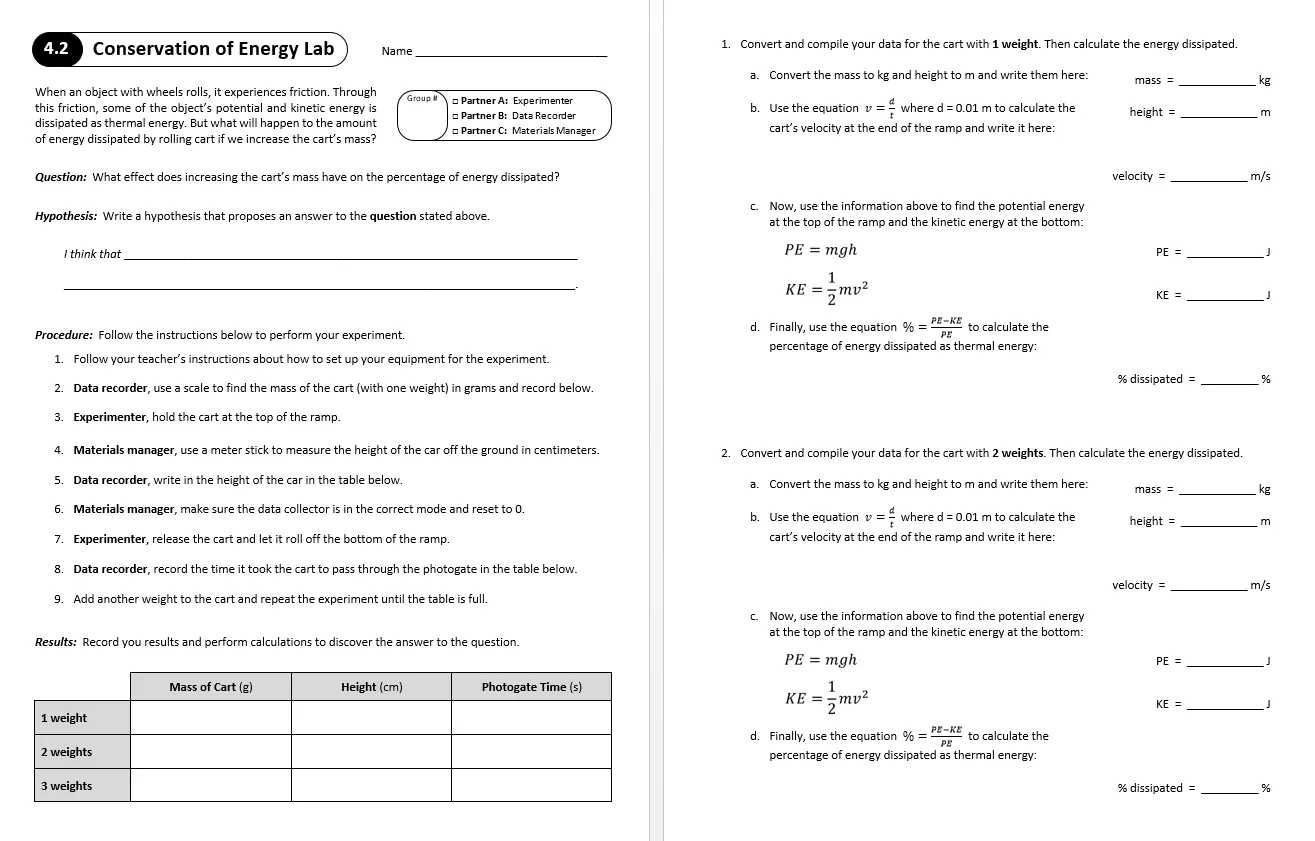
The lab needs equipment: a ramp, a cart, three weights, a scale, a metre stick and a photogate with a data collector. Check availability before planning the lesson around it.
The marked lab copy carries a full worked data set — 400 g, 750 g and 1,100 g, each released from 45 cm — so the calculation sequence can be modelled on the board, or the whole analysis run on paper, where the equipment is not available.
The three partner roles are printed as tick boxes on the lab header, which makes group assignment part of the handout rather than something to organise separately.

Skills covered
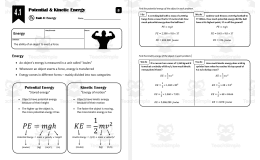
Energy transformation reasoning — students track a falling object's total energy staying at 500 J while the split between potential and kinetic reverses, then account for where the energy goes after impact.
Experimental procedure — a nine-step lab has students set up a ramp, mass the cart, measure release height, run it through a photogate and repeat with added weights.
Unit conversion inside a formula — grams become kilograms and centimetres become metres before the values are substituted into v = d/t, potential energy and kinetic energy calculations.
Good to know
Questions teachers ask about this resource
What equipment does the lab call for?
A ramp, a cart, three weights, a scale, a metre stick and a photogate with a data collector. Students record mass in grams, release height in centimetres and the photogate time, then convert and calculate. The marked copy carries a complete worked data set — 400 g, 750 g and 1,100 g all released from 45 cm — so the analysis can be modelled or run on paper where that equipment is not on hand.
How do the A and B versions differ?
For the notes, A leaves the key terms blank and B prints them in: "Energy transforms from PE to KE, but it sometimes seems to ___________" on one, "seems to disappear" on the other. The skate park simulation also ships as an A and a B, each with its own marked copy.
Where does the skate park simulation run?
Online, through a link printed at the top of the sheet: "Go to tinyurl.com/ICPskate". The worksheet then walks students through the Intro screen with the speedometer and bar graph checked on, the pie chart view in slow motion, and the Playground screen where they predict the energy split at four labelled points before trying each one.

No reviews yet
Downloaded this resource? Tell other teachers how it went.
Resource details
Concepts & topics
Core concepts
 Core concepts
Conservation of energy
Potential and kinetic energy
Energy dissipation
Friction
Lab investigation
 Topics
Explore more
Categories this resource belongs to
Explore related searches
More to explore
You may also like