Multiply by 7 Worksheets with Answer Keys



- Grades
- Grades 2–3, Elementary
- Pages
- 71
- File type
- Answer key
- Included


- Subject
- Math, Multiplication and Division, Multiplication
- Topic
- multiplication worksheets, multiples of 7
- Resource types
- Worksheets & Printables, Worksheets
- Answer key
- Included
About this resource
What's inside this resource
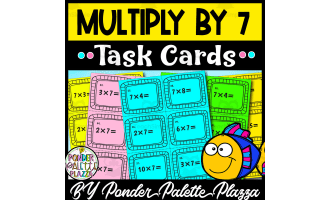
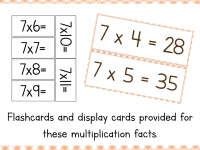
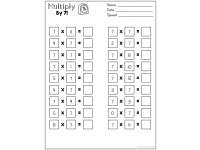
Multiplication facts for the seven times table are drilled through roughly two dozen worksheet formats bundled into one packet: timed fact-recall sheets, a fill-in crossword built from a word bank of spelled-out products, a joke-cracking code puzzle, matching and cut-and-paste answer sorting, two pages of word problems plus a page for writing original ones, a maze, three color-by-number pages, and cut-and-glue activities such as Apple Tree Math, Fruit Bowl Multiplication, Balloon Math, and Kite Math. A 20-question timed test and a full fill-in multiplication chart round out the practice. Every activity in the packet, including the maze and the story problems, has a matching answer-key page with the correct products already filled in. Two leftover instruction lines from what looks like a shared template still refer to "the four times tables" and colouring "multiples of four," even though every fact and answer in the file uses 7.
Related resources
More resources teachers may find useful
24 related resources were found using this product's title, contributor, categories and tags.


In the classroom
Teaching tips & learning objectives

Learning objectives
- Recall seven-times-table facts (7x0 through 7x12) fluently under timed conditions
- Translate a word problem into a multiplication equation and solve it (e.g. "three boxes of seven pieces of candy")
- Evaluate whether a given multiplication equation is correct, identifying miscalculated or reversed products

Teaching tips
- Use the three timed "Multiply By 7!" sheets on separate days to track fluency growth, since each reorders the same facts differently rather than repeating one layout
- Assign "Right and Wrong" as an error-analysis task, having students explain why a circled equation is correct or an X'd one is wrong, rather than just marking it
- Save the cut-and-glue activities (Apple Tree Math, Fruit Bowl Multiplication, Kite Math) for a lower-stakes practice day, since they require scissors and glue rather than pencil-only work

Skills covered
- Seven-times-table recall — students solve products from 7 × 0 through 7 × 12 in varied layouts.
- Fact fluency — timed practice sheets build speed with the same facts presented in different orders.
- Multiplication reasoning — story problems ask students to represent equal groups with a multiplication equation before solving.
Good to know
Questions teachers ask about this resource
The intro page says this resource helps students practice "the four times tables" - is this actually the 4s or the 7s packet?
It is the 7s packet. Every fact, worksheet, and test question in the file uses the seven times table; the "four times tables" line and the maze's "color all multiples of four" instruction were not updated for this 7s edition.
Is the multiplication quilt activity meant to be done individually or as a whole class?
Either. The instructions say the squares can be combined into one large class quilt as students complete them, or collected as individual squares across all the times tables to build a personal quilt.

No reviews yet
Downloaded this resource? Tell other teachers how it went.
Curriculum
Standards, concepts & topics
Standards
 Standards
- 3.OA.A.1 — Interpret products of whole numbers, e.g., interpret 5 × 7 as the total number of objects in 5 groups of 7 objects each. For example, describe a context in which a total number of objects can be expressed as 5 × 7.
- 3.OA.A.3 — Use multiplication and division within 100 to solve word problems in situations involving equal groups, arrays, and measurement quantities, e.g., by using drawings and equations with a symbol for the unknown number to represent the problem.1
- 3.OA.A.4 — Determine the unknown whole number in a multiplication or division equation relating three whole numbers. For example, determine the unknown number that makes the equation true in each of the equations 8 × ? = 48, 5 = � ÷ 3, 6 × 6 = ?.
- 3.OA.D.9 — Identify arithmetic patterns (including patterns in the addition table or multiplication table), and explain them using properties of operations. For example, observe that 4 times a number is always even, and explain why 4 times a number can be decomposed into two equal addends.
- 2.OA.C.3 — Determine whether a group of objects (up to 20) has an odd or even number of members, e.g., by pairing objects or counting them by 2s; write an equation to express an even number as a sum of two equal addends.
- 2.OA.C.4 — Use addition to find the total number of objects arranged in rectangular arrays with up to 5 rows and up to 5 columns; write an equation to express the total as a sum of equal addends.
- 3.OA.B.5 — Apply properties of operations as strategies to multiply and divide.2 Examples: If 6 × 4 = 24 is known, then 4 × 6 = 24 is also known. (Commutative property of multiplication.) 3 × 5 × 2 can be found by 3 × 5 = 15, then 15 × 2 = 30, or by 5 × 2 = 10, then 3 × 10 = 30. (Associative property of multiplication.) Knowing that 8 × 5 = 40 and 8 × 2 = 16, one can find 8 × 7 as 8 × (5 + 2) = (8 × 5) + (8 × 2) = 40 + 16 = 56. (Distributive property.)
- 3.OA.C.7 — Fluently multiply and divide within 100, using strategies such as the relationship between multiplication and division (e.g., knowing that 8 × 5 = 40, one knows 40 ÷ 5 = 8) or properties of operations. By the end of Grade 3, know from memory all products of two one-digit numbers.
Core concepts
 Core concepts
- times tables
- multiplication facts
 Topics
Explore more
Categories this resource belongs to
Explore related searches
More to explore
You may also like