Multiply a 5-digit by a 1-digit number using the Standard Algorithm






- Grades
- Grade 5, Elementary
- Pages
- 18
- File type
- Answer key
- Included


- Subject
- Math, Common Core, Multiplication and Division
- Topic
- worksheets, Jeff's Notebooks
- Resource types
- Worksheets & Printables, Worksheets
- Answer key
- Included
- Standards
- 5.NBT.B.5
About this resource
What's inside this resource
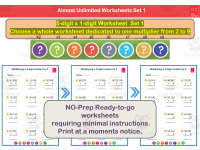
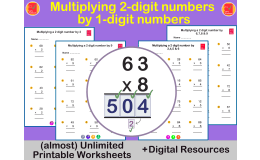
These (almost unlimited) worksheets provides practice with multiplying a 5-digit number by a 1-digit number with the standard algorithm. You have worksheets dedicated to one of the multipliers from 2 to 9 plus also worksheets with a mix of multipliers which could be used to assess where your students need to practice more or as assessment tool after completing work on the individual multipliers
At the click of a button you have a new worksheet - in fact (almost) unlimited. The benefits of these automatically generated worksheets are numerous. They allow students to practice key skills as often as needed throughout the year.
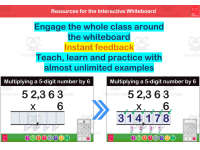
The Interactive Teaching Pages for whole class teaching on a whiteboard or one-to-one tuition on a computer lets you proceed through the standard algorithm step by step. You start by selecting the multiplier (2, 3, 4, 5, 6, 7, 8, or 9) and then press a buttons to change the multiplicand. As you enter each digit of the answer line you get immediate feedback if correct or not. You have unlimited examples to practice with.
These printables require no preparation on your part. Just print and use anytime. With answers automatically generated every time you create a new worksheet it makes them ideal for substitute teachers on short notice. Give your students the repetition they need to master alll the topics contained in this resource. These no-frills worksheets will help them build a critical foundation for math success.
Lastly, it's essential to note that these resources are compatible PDF documents. They operate seamlessly with the official Adobe Acrobat Reader on both Windows and Mac.
You may also find the following useful:
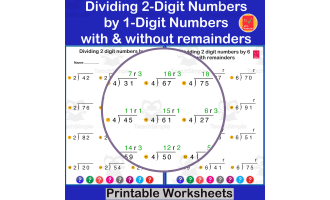
Divide 2-digit numbers by 1-digit numbers with & without remainders
Divide 3-digit by 1-digit numbers with or without remainders
Divide 4-digit by 1-digit numbers with or without remainders
Multiply a 2-digit by a 1-digit number using the Standard Algorithm
Multiply a 3-digit by a 1-digit number using the Standard Algorithm
Multiply a 4-digit by a 1-digit number using the Standard Algorithm
Related resources
More resources teachers may find useful
24 related resources were found using this product's title, contributor, categories and tags.
In the classroom
Teaching tips & learning objectives

Learning objectives
Multiply a 5-digit number by a 1-digit number using the standard algorithm
Record unit values and carry-over digits accurately, column by column, on the answer line
Build multiplication fluency through repeated randomised question sets for any multiplier from 2 to 9
Apply a chosen multiplier consistently across twelve varied 5-digit multiplicands

Teaching tips
Follow the guide's printing routine: print one master copy of the question sheet with its answers page for correcting, then run off a question sheet per pupil
Open with the teaching pages on the whiteboard — pupils supply each digit and carry-over while the green ticks confirm correct entries before independent practice
Work through Set 1's single multipliers in sequence, then use Set 2's mixed ranges to see which multipliers still need practice or as a follow-up assessment
Regenerate a new randomised sheet for any multiplier whenever a pupil needs another round — no two presses give the same questions

Skills covered
Standard-algorithm multiplication — pupils multiply 5-digit numbers such as 20,912 and 98,955 by a single digit, working column by column.
Carrying and place value — the teaching pages require entering the unit value and then the carry-over for each column of the answer line.
Multiplication fact recall — every question rests on rapid 1-digit facts from x2 through x9, chosen with the worksheet buttons.
Self-checking from feedback — green ticks appear for correct entries on the teaching pages, and a missing tick signals an error to try again.
Good to know
Questions teachers ask about this resource
What is the difference between Worksheet Set 1 and Worksheet Set 2?
Set 1 gives all twelve questions on a page the same multiplier, chosen with a button from 2 to 9. Set 2 assigns a mixed range across the page, such as 3, 4, 5 and 6 or 6, 7, 8 and 9, which suits diagnosing or assessing across multipliers.
Can I generate more than one worksheet for the same multiplier?
Yes — each button press randomises the twelve 5-digit numbers, so you can create as many new sheets as you want for any single multiplier or mixed range.
How do the interactive teaching pages respond to pupils' entries?
As each digit or carry-over is entered on the answer line, a green tick appears when it is correct; no tick appears for an error, and the pupil can try that entry again.

No reviews yet
Downloaded this resource? Tell other teachers how it went.
Curriculum
Standards, concepts & topics
Standards
 Standards
- 5.NBT.B.5 — Fluently multiply multi-digit whole numbers using the standard algorithm.
Core concepts
 Core concepts
Multiplication
Standard algorithm
Place value
Multi-digit numbers
 Topics
Explore more
Categories this resource belongs to
Explore related searches
More to explore
You may also like