My Strengths and Weaknesses – Social Skills Activity




- Grades
- Grades 3–6, Elementary, Middle School
- Pages
- 18
- File type
- Preparation
- Print ready


- Subject
- Life Skills, Special Resources, Writing, ELA, Social Emotional Learning (SEL)
- Topic
- Strengths, Challenges
- Preparation
- Print ready
Product description
From the author
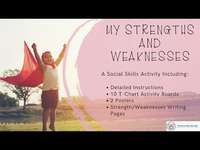
Do you have students who struggle to understand their Strengths and Weaknesses? Some students feel they are the best at everything, while others feel they are good at nothing. Understanding one's Strengths and Weaknesses is an important part of having good self awareness and to be a good team or group member. This activity will help you teach and support your students in understanding what Strengths and Weaknesses are and what their specific Strengths and Weaknesses are, across a variety of topics. Use the posters to define and discuss Strengths and Weaknesses, then have students complete the desired T-charts to brainstorm their own Strengths and Weaknesses in the given area and finally, have students pick a Strength or a Weakness to write about.
Related resources
More resources teachers may find useful
24 related resources were found using this product's title, contributor, categories and tags.


In the classroom
Teaching tips & learning objectives

Learning objectives
Identify personal strengths and weaknesses within specific everyday contexts, such as schoolwork, sports, and friendship, using a two-column chart.
Distinguish between a strength and a weakness after a class discussion introducing the two terms.
Write a short reflection describing a strength, an area to develop, or both.

Teaching tips
Use the two discussion poster pages to introduce and define "strengths" and "weaknesses" as a whole-class conversation before handing out the topic worksheets, since the writing-page instructions assume that discussion happens first.
Cut out the individual writing pages and paste them onto larger paper so students can add a drawing alongside their written reflection, as the file itself suggests.
Let students choose a strength, an area to develop, or both for the writing response, as the directions allow. Focus on particular skills and supports rather than treating weaknesses as fixed labels.

Skills covered
Self-reflection — students identify their own strengths and weaknesses within nine specific everyday contexts using a two-column chart.
Vocabulary distinction — students learn to tell a "strength" apart from a "weakness" through the introductory discussion posters.
Written reflection — students compose a short written piece describing a strength, an area to develop, or both on the dedicated writing pages.

No reviews yet
Downloaded this resource? Tell other teachers how it went.
Resource details
Concepts & topics
Core concepts
 Core concepts
Self-awareness
Strengths and weaknesses
Social-emotional learning
 Topics
Explore related searches
More to explore
You may also like