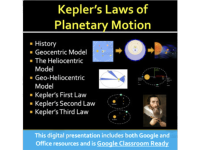
Kepler's Laws of Planetary Motion - Google Slides and PowerPoint Lesson



- Grades
- Grades 11–12
- File type
- Multiple File Types
- Answer key
- Included


- Subject
- Science, Physics, Space
- Topic
- Kepler's laws, Planetary motion
- Resource types
- Presentations
- Answer key
- Included
Product description
From the author
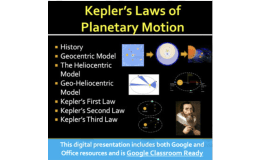
Kepler’s Laws of Planetary Motion is a lesson on historical planetary models, orbital vocabulary and Kepler’s three laws. It includes teacher and student PowerPoint files, a PDF presentation copy and a Word student outline.
The Additional Resources document supplies five video links. A separate page gives Google resource access instructions; the videos and any linked exit ticket require separate access. Use the teacher copy to guide completion of the student notes and discuss the orbit diagrams.
Related resources
More resources teachers may find useful
24 related resources were found using this product's title, contributor, categories and tags.

In the classroom
Teaching tips & learning objectives

Learning objectives
State Kepler's three laws and explain what each one claims about an orbit
Trace the sequence of models from geocentric, through heliocentric, to Brahe's geo-heliocentric compromise, and say what each placed at the centre
Explain why a planet moves faster near the Sun using the equal-areas law and the conservation of angular momentum, L = mvr

Teaching tips
Display the teacher presentation and pause for students to complete guided notes in the student slides or Word outline. Use the diagrams for labeling and discussion.
Open the Additional Resources document before teaching and check the five video links you intend to use.
Use the planetary data table for a follow-up comparison of orbital radius, period and velocity relative to Earth.

Skills covered
Applying Kepler's three laws — students meet each law as a statement and then as a diagram, with the first law shown on an ellipse with the Sun at one focus.
Connecting a law to its underlying physics — the equal-areas law is followed by an angular momentum slide giving L = mvr with every symbol defined.
Interpreting a data table — planetary radius, period and velocity are all given relative to Earth's, so the third-law relationship can be tested against real values.
Good to know
Questions teachers ask about this resource
Are the videos and online activities files in this download?
The package supplies resource links and Google access instructions. The five videos and any linked online exit ticket require separate access; native PowerPoint and Word lesson files are included.

No reviews yet
Downloaded this resource? Tell other teachers how it went.
Resource details
Concepts & topics
Core concepts
 Core concepts
Kepler's laws
Planetary motion
Heliocentric model
Angular momentum
Orbits
 Topics
Explore more
Categories this resource belongs to
Explore related searches
More to explore
You may also like