search
user.png
vertical menu

Binary Covalent Compounds Naming, Senior Chemistry

Binary Covalent Compounds Naming, Senior Chemistry preview
Binary Covalent Compounds Naming, Senior Chemistry preview 2
Binary Covalent Compounds Naming, Senior Chemistry preview 3

Binary Covalent Compounds Naming, Senior Chemistry preview 4

Look Inside · 9 pages · answer key included

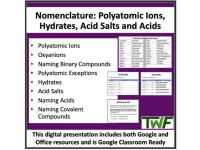
Nomenclature slides cover: polyatomic ions, hydrates, acid salts and acids, listing 8 topics with sample slide previews
Opening slide to preview the lesson's topic sequence
Polyatomic ions notes: most contain oxygen plus one element and are called oxyanions, with a common polyatomic ions table
Reference table students can keep for naming practice
Oxyanion forms: prefix and suffix rules per-, -ate, -ite and hypo- for one more, normal, one less and two less oxygen atoms
Direct instruction on oxyanion naming patterns
Oxyanion examples: nitrate and nitrite, perchlorate through hypochlorite, and sulfate, sulfite and thiosulfate with formulas
Worked examples applying the prefix and suffix rules
Naming compounds with polyatomic ions: write the metal with roman numeral, then the ion name, keeping its ending, not -ide
Step-by-step rule to model before practice
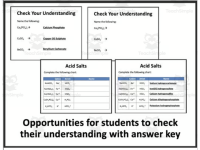
Check your understanding: students name three ionic compounds with polyatomic ions, Ca3(PO4)2, CuSO4 and BeCO3
Quick formative check after the naming rules
Naming and formula writing practice: students name Mg(ClO2)2 and Ca(CN)2, then write two formulas from ion charges
Two-way practice with ion charges given as scaffolds
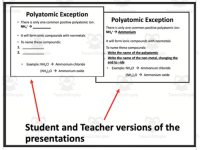
Polyatomic exception: ammonium (NH4+) naming steps with -ide endings, shown with ammonium chloride and ammonium oxide
Notes on the one common positive polyatomic ion

Answer key included

Answer key included
Attributes
Grades

Grade 10, 11, 12

Editable
Yes
Rating
Add To Collection
Add to collection Add to collection

About This Product

Nomenclature-Polyatomics & Covalent Compounds - Senior Chemistry Lesson

Your lesson covers the nomenclature of polyatomic compounds and covalent compounds. In order, the lesson teaches about; Polyatomic Ions, Oxyanions, Naming Binary Compounds, Polyatomic Exceptions, Hydrates, Acid Salts, Naming Acids, and Naming Covalent Compounds.

Your lesson includes the teacher and student version of the presentation, an auto-graded exit ticket, and a student lesson handout so the students can record the notes on a more condensed medium.

This lesson is designed to be your go-to resource, whether you're in a traditional classroom or a virtual one. With both a teacher version and a student version, it seamlessly fits into your lesson plans, making learning engaging and adaptable.

Assessment made easy

We've included an auto-graded Exit Ticket and a quiz with an answer key because I know you don't have an excess of time. I know you don't, because I don't and I know I'll do whatever I can to reduce my grading time.

Whether you use PowerPoint or Google Slides, prefer Word or Google Docs, this lesson has you covered. This lesson comes in both Office and Google formats for your convenience.

The student version of the presentation has strategically placed blanks for them to fill in as you're teaching. It keeps them active and engaged, encourages discussion, and leaves more time for those "aha" moments.

0 Reviews

Explore related searches
you may also like...

Check out these other great products