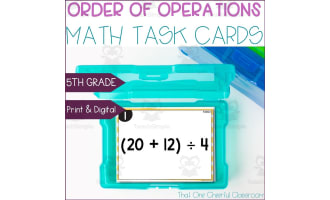
Order of Operations Games with Scoot Task Cards


About This Product
Are you searching for a dynamic and engaging way to improve your students' proficiency in problem-solving, specifically with order of operations? Look no further! Introduce them to our innovative Scoot game, a captivating activity designed to sharpen their mathematical abilities and make learning a thrilling adventure.
This comprehensive set includes 24 meticulously crafted task cards, each presenting a unique problem involving order of operations. The carefully designed tasks cater to a range of difficulty levels, ensuring that students of all abilities can participate and grow. The accompanying materials include a detailed 1-page instruction guide, complete with examples that provide clear and concise explanations of how to solve equations with variables on both sides. This guide serves as an invaluable resource for both teachers and students, enabling them to grasp the concepts with ease.
To facilitate seamless gameplay, we provide answer sheets for students to record their solutions. By encouraging them to match their answers to the corresponding question numbers, they develop a systematic approach to problem-solving and reinforce their understanding of order of operations.
The Scoot game introduces an element of excitement and movement into the classroom. Here's how it works: Each student receives a question card placed strategically on their desk, along with an answer sheet and a pencil. As they delve into the problems, they tackle each task diligently, carefully noting their solutions on the answer sheet. To add a touch of suspense and maintain a brisk pace, a specific time limit, such as 2 minutes, can be allocated for each question. When the time is up, the teacher announces "SCOOT," signaling students to swiftly move to the next desk, leaving their previous question card behind. This seamless transition ensures that students are continuously engaged and challenged as they progress through the tasks.
Once all students have completed the activity, the answers are reviewed as a group. This collaborative approach encourages discussions and provides opportunities for students to learn from one another. By sharing different problem-solving strategies and analyzing solutions together, students develop a deeper understanding of order of operations and refine their critical thinking skills.
The versatility of the task cards extends beyond the Scoot game. Educators can explore alternative approaches, such as the "EXIT SLIP" method, where students select a card and solve the problem before leaving the class. The task cards can be printed on colored cardstock and laminated, ensuring their durability and enabling you to utilize them year after year.
What's Included
Pdf with:
Instructions
Reference sheet
Task cards
Answer sheet
Solutions
COMMON CORE STANDARDS:
CCSS 5.OA.A.1
Use parentheses, brackets, or braces in numerical expressions, and evaluate expressions with these symbols.
CCSS 6.EE.A.1
Write and evaluate numerical expressions involving whole-number exponents.
Resource Tags
0 Reviews
Check out these other great products