4th Grade Science Worksheets on Photosynthesis


Science, Nature & Plants, Life Sciences, Earth and Environmental Sciences, Earth Sciences, Biology


About This Product
Photosynthesis Lesson, Worksheets, and Experiment
How Plants Make Food - 3rd & 4th Grade Science Lesson
I created this resource to give students a clear and enjoyable introduction to photosynthesis. The lesson blends reading, discussion, and a hands-on experiment so students can see how plants make their own food in a way that feels real and meaningful. I put this resource together because photosynthesis is one of those topics that becomes much easier to understand when students can read about it and observe it in action. This set offers a mix of activities that help students explore the idea from different angles.
What’s inside?
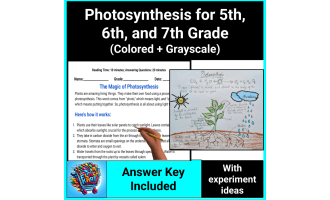
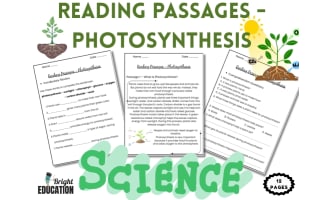
A short reading passage that explains photosynthesis
Seven comprehension questions with an answer key
A step by step experiment using black gram seeds
Follow-up discussion questions to guide class conversation
Safety notes and cautions for the experiment
Two anchor charts that break the process into small pieces
A quick True/False activity with answers
A diagram activity where students label the photosynthesis process
A story-writing page where students write from the point of view of a plant
Complete answer keys to all the questions are included in this resource
Resource features:
I designed this set with 3rd and 4th graders in my mind. The reading level and activities are approachable for that age group. The experiment inside the resource is simple enough for students to complete in small groups, but still gives them something meaningful to observe. I have written all the instructions clearly. Each activity in this resource builds on the previous one so students can connect ideas as they go. This resource also blends science with literacy, drawing, and creative thinking, which makes it easy to fit into a variety of lesson plans or science centers.
Ways to use it:
Reading activity: Have students read the passage and answer the questions independently or with partners.
Vocabulary work: Create a small word wall or glossary for science terms.
Hands-on learning: Set up the seed experiment as a class or rotate it through small groups.
Science journals: Encourage students to record their predictions and observations throughout the experiment.
Art activity: Students can draw and label the parts of a plant involved in photosynthesis.
Writing prompt: Let students write a short story from the perspective of a plant creating its own food.
Group talk: Compare observations, discuss results, and talk through what might have caused them.
Extensions: Students can look at different types of plants and explore how sunlight and environment affect their growth.
Usefulness for teachers, homeschoolers, and parents
This resource works well as a mini-unit as it requires very little preparation. The activities give students different ways to understand the process of photosynthesis. This resource is suitable for a wide range of learners. It supports reading comprehension, science vocabulary, and basic scientific inquiry skills, all while keeping instructions simple enough for independent use. The experiment uses easy to find materials, and the activities make it simple to incorporate science into home learning or family projects.
photosynthesis, 3rd grade science, 4th grade science, anecdotal activity, photosynthesis story, hands-on learning, plant science, reading comprehension, science experiments, STEM, elementary education, homeschool science, nature study, scientific inquiry, vocabulary building, cross-curricular learning, environmental education, chlorophyll experiment, plant growth, science journaling, critical thinking, observation skills, teaching resource, environmental science, anchor charts, photosynthesis experiment
Resource Tags
0 Reviews
Check out these other great products