Plants of Antarctica: Fact Cards, Reading and Activities
Third to fifth graders read about the few plants and lichens that survive in Antarctica, study eight cut-apart fact cards, then show what they learned through vocabulary, sorting, comparing and a field guide drawing.


- Grades
- Grades 3–7, Middle School, Elementary
- Pages
- 7
- File type
- Answer key
- Included


- Subject
- Social Studies, Geography
- Topic
- Antartica, social studies lesson
- Resource types
- Lesson Plans, Teacher Tools
- Answer key
- Included
- Standards
- CCSS.RI.3.1 CCSS.RI.3.2 +27
About this resource
What's inside this resource
Antarctic hair grass and Antarctic pearlwort, the only two flowering plants that grow naturally in Antarctica, share this mini unit with the continent’s mosses, liverworts, lichens and snow algae. The reading, Plants at the Bottom of the World, explains that plants live on the small ice-free edge of the continent, mostly near the coast, and how growing low and resting under snow help them survive.
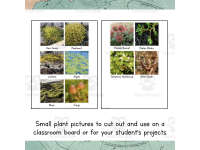
Eight fact cards follow on two cards-only pages, four to a page with dashed cut lines. Each card has a drawing, a label (flowering plant, plant without flowers, lichen or alga), where it lives, how it spreads, its size in metric with inches in parentheses and a short paragraph. The three lichen cards are labeled Not a plant, and one explains that a lichen is a fungus and an alga living together.
Activities come next. Students answer three quick-check questions, match four words to meanings, sort six facts about hair grass and pearlwort, explain why so few plants grow there, match problems to survival strategies and sort organisms into flowering plants, plants without flowers or not plants. A field guide drawing page and a home-plant comparison chart close the student pages, and the answer key covers all 21 items.
Related resources
More resources teachers may find useful
24 related resources were found using this product's title, contributor, categories and tags.

In the classroom
Teaching tips & learning objectives

Learning objectives
- Describe where plants grow in Antarctica using details from a reading and fact cards.
- Name Antarctica’s two native flowering plants and compare their features.
- Explain that mosses and liverworts spread by spores and that a lichen is a fungus and an alga, not a plant.

Teaching tips
- Read the passage aloud first and have students underline the five kinds of living things, as the key’s teacher tip suggests.
- Cut the fact cards apart and have students sort them by their labels before starting the plant-or-not sort.
- Expect lichen to be the tricky row in the plant-or-not sort; it looks like a plant but is a fungus and an alga.

Skills covered
- Reading for detail — students find where Antarctic plants grow and how mosses make new plants.
- Using informational cards — students read habitat, spreading and size facts for eight organisms, with sizes in centimeters and inches.
- Science vocabulary — students match peninsula, spores, lichen and cushion to their meanings.
Good to know
Questions teachers ask about this resource
Are lichens taught as plants?
No. The reading explains that a lichen is a fungus and an alga living together as partners, the three lichen cards are labeled Not a plant, and the plant-or-not sort uses lichen as its trick row. Snow algae are labeled plant-like.
What is on each fact card?
A drawing, the organism’s name and label, where it lives, how it spreads, a typical size such as 5 cm (2 in) and a short paragraph with one more fact, for example that pearlwort also grows high in the Andes.
Do students need outside research for any task?
No. Answers come from the reading and the cards, except the comparison chart, which asks students to pick a plant that grows near home and describe where it grows, its weather and whether it has flowers.

No reviews yet
Downloaded this resource? Tell other teachers how it went.
Curriculum
Standards, concepts & topics
Standards
 Standards
- CCSS.RI.3.1 — Ask and answer questions to demonstrate understanding of a text, referring explicitly to the text as the basis for the answers.
- CCSS.RI.3.2 — Determine the main idea of a text; recount the key details and explain how they support the main idea
- CCSS.RI.3.3 — Describe the relationship between a series of historical events, scientific ideas or concepts, or steps in technical procedures in a text, using language that pertains to time, sequence, and cause/effect.
- CCSS.RI.4.1 — Refer to details and examples in a text when explaining what the text says explicitly and when drawing inferences from the text.
- CCSS.RI.4.2 — Determine the main idea of a text and explain how it is supported by key details; summarize the text
- CCSS.RI.4.3 — Explain events, procedures, ideas, or concepts in a historical, scientific, or technical text, including what happened and why, based on specific information in the text.
- CCSS.RI.5.1 — Quote accurately from a text when explaining what the text says explicitly and when drawing inferences from the text
- CCSS.RI.5.2 — Determine two or more main ideas of a text and explain how they are supported by key details; summarize the text.
- CCSS.RI.5.3 — Explain the relationships or interactions between two or more individuals, events, ideas, or concepts in a historical, scientific, or technical text based on specific information in the text.
- CCSS.RI.6.1 — Cite textual evidence to support analysis of what the text says explicitly as well as inferences drawn from the text.
- CCSS.RI.6.2 — Determine a central idea of a text and how it is conveyed through particular details; provide a summary of the text distinct from personal opinions or judgments.
- CCSS.RI.6.3 — Analyze in detail how a key individual, event, or idea is introduced, illustrated, and elaborated in a text (e.g., through examples or anecdotes).
- CCSS.RI.7.1 — Cite several pieces of textual evidence to support analysis of what the text says explicitly as well as inferences drawn from the text.
- CCSS.RI.7.2 — Determine two or more central ideas in a text and analyze their development over the course of the text; provide an objective summary of the text.
- CCSS.RI.7.3 — Analyze the interactions between individuals, events, and ideas in a text (e.g., how ideas influence individuals or events, or how individuals influence ideas or events).
- CCSS.W.3.7 — Conduct short research projects that build knowledge about a topic.
- CCSS.W.3.8 — Recall information from experiences or gather information from print and digital sources; take brief notes on sources and sort evidence into provided categories.
- CCSS.W.4.7 — Conduct short research projects that build knowledge through investigation of different aspects of a topic.
- CCSS.W.4.8 — Recall relevant information from experiences or gather relevant information from print and digital sources; take notes and categorize information, and provide a list of sources.
- CCSS.W.4.9 — Draw evidence from literary or informational texts to support analysis, reflection, and research. a. Apply grade 4 Reading standards to literature (e.g., “Describe in depth a character, setting, or event in a story or drama, drawing on specific details in the text [e.g., a character’s thoughts, words, or actions].”). b. Apply grade 4 Reading standards to informational texts (e.g., “Explain how an author uses reasons and evidence to support particular points in a text”).
- CCSS.W.5.7 — Conduct short research projects that use several sources to build knowledge through investigation of different aspects of a topic.
- CCSS.W.5.8 — Recall relevant information from experiences or gather relevant information from print and digital sources; summarize or paraphrase information in notes and finished work, and provide a list of sources.
- CCSS.W.5.9 — Draw evidence from literary or informational texts to support analysis, reflection, and research. a. Apply grade 5 Reading standards to literature (e.g., “Compare and contrast two or more characters, settings, or events in a story or a drama, drawing on specific details in the text [e.g., how characters interact]”). b. Apply grade 5 Reading standards to informational texts (e.g., “Explain how an author uses reasons and evidence to support particular points in a text, identifying which reasons and evidence support which point[s]”).
- CCSS.W.6.7 — Conduct short research projects to answer a question, drawing on several sources and refocusing the inquiry when appropriate.
- CCSS.W.6.8 — Gather relevant information from multiple print and digital sources; assess the credibility of each source; and quote or paraphrase the data and conclusions of others while avoiding plagiarism and providing basic bibliographic information for sources
- CCSS.W.6.9 — Draw evidence from literary or informational texts to support analysis, reflection, and research. a. Apply grade 6 Reading standards to literature (e.g., “Compare and contrast texts in different forms or genres [e.g., stories and poems; historical novels and fantasy stories] in terms of their approaches to similar themes and topics”). b. Apply grade 6 Reading standards to literary nonfiction (e.g., “Trace and evaluate the argument and specific claims in a text, distinguishing claims that are supported by reasons and evidence from claims that are not”).
- CCSS.W.7.7 — Conduct short research projects to answer a question, drawing on several sources and generating additional related, focused questions for further research and investigation.
- CCSS.W.7.8 — Gather relevant information from multiple print and digital sources, using search terms effectively; assess the credibility and accuracy of each source; and quote or paraphrase the data and conclusions of others while avoiding plagiarism and following a standard format for citation.
- CCSS.W.7.9 — Draw evidence from literary or informational texts to support analysis, reflection, and research. a. Apply grade 7 Reading standards to literature (e.g., “Compare and contrast a fictional portrayal of a time, place, or character and a historical account of the same period as a means of understanding how authors of fiction use or alter history”). b. Apply grade 7 Reading standards to literary nonfiction (e.g. “Trace and evaluate the argument and specific claims in a text, assessing whether the reasoning is sound and the evidence is relevant and sufficient to support the claims”).
Core concepts
 Core concepts
- Antarctica
- Flowering plants
- Mosses and spores
- Lichens
- Plant adaptations
- Classification
 Topics
Explore more
Categories this resource belongs to
Explore related searches
More to explore
You may also like