Physical and Chemical Changes – Reading Passage


- Grades
- Grades 4–6, Elementary, Middle School
- Pages
- 7
- File type
- Answer key
- Included


- Subject
- ELA, Reading, Reading Comprehension, Science, Chemistry
- Topic
- physical and chemical changes, physical and chemical changes reading comprehension
- Resource types
- Worksheets & Printables, Worksheets
- Answer key
- Included
- Standards
- CCSS.RI.4.1 CCSS.RI.4.4 +1
About this resource
What's inside this resource
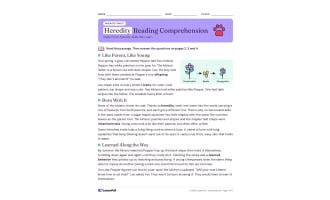
Is it still the same stuff, or did something new form? This free physical and chemical changes reading passage builds that question into one snowy Saturday for grades 4–6. Nora rolls a snowman, watches a cup of snow melt at 32°F, sees steam bead on a cold window, mixes a trail snack, watches Grandma stir honey into tea and watches mud settle in a bucket. A burning candle then shows both kinds of change at once. The two-page passage runs about 720 words, with a state-change diagram and a card of five signs of a chemical change, each paired with a real example.
Three question pages follow in seven sections. Students answer multiple-choice questions, name the state change in four everyday events, and sort six events as physical or chemical while writing the clue that decided it. They find the solute and solvent in seawater, soda water and hummingbird nectar, judge a classmate's claim that soda bubbles prove a chemical change, write three short explanations and finish with a vocabulary match.
- Grades 4–6: physical science, properties and changes of matter
- Seven pages: two passage pages, three question pages and two answer-key pages
- Teacher extras: a mix-ups card and a 10-minute salt-versus-baking-soda demo
- Free PDFs: full color and black and white
Related resources
More resources teachers may find useful
24 related resources were found using this product's title, contributor, categories and tags.


In the classroom
Teaching tips & learning objectives

Learning objectives
Tell a physical change from a chemical change by asking whether a new substance formed.
Name melting, freezing, evaporation, condensation and boiling from everyday examples.
Identify the solute and solvent in a solution, and recognize a suspension.

Teaching tips
Have students read both passage pages and study the diagram before starting, as the page 1 directions say.
Use the worked chocolate-bar example in Section 2 to show how to name a change from the diagram.
Check the mix-ups card on the key before Section 5; it covers why bubbles alone are not proof.

Skills covered
Classifying changes: students sort events such as a pancake browning or a vase breaking and record the clue behind each choice.
Reading a diagram: Section 2 asks students to use the state-change cycle to name what happens to water in four scenes.
Solutions vocabulary: students pick out the solute and solvent in three real solutions.
Good to know
Questions teachers ask about this resource
Is this reading passage free?
Yes. It is a free seven-page download in color and in black and white.
What grade level is it written for?
Grades 4–6. The passage is about 720 words and follows one character through everyday changes.
What types of questions are included?
Multiple choice, naming state changes, a physical-or-chemical sort with evidence, solute and solvent pairs, an agree-or-disagree claim, short written explanations and a vocabulary match.
Is there an answer key?
Yes. Two key pages give every answer, sample written responses, a card of common mix-ups and a short demo you can run in class.

No reviews yet
Downloaded this resource? Tell other teachers how it went.
Curriculum
Standards, concepts & topics
Standards
 Standards
- CCSS.RI.4.1 — Refer to details and examples in a text when explaining what the text says explicitly and when drawing inferences from the text.
- CCSS.RI.4.4 — Determine the meaning of general academic and domain-specific words or phrases in a text relevant to a grade 4 topic or subject area.
- CCSS.RI.4.3 — Explain events, procedures, ideas, or concepts in a historical, scientific, or technical text, including what happened and why, based on specific information in the text.
Core concepts
 Core concepts
physical change
chemical change
states of matter
solute and solvent
mixtures and suspensions
evidence of chemical change
 Topics
Explore more
Categories this resource belongs to
Explore related searches
More to explore
You may also like