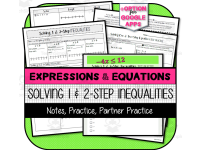
Solving 1 & 2-Step Inequalities: Notes, Practice, Partner Activity

- Grades
- Grade 7
- Pages
- 8
- File type
- Answer key
- Included


- Subject
- Math, Algebra
- Topic
- Solving inequalities, Notes
- Resource types
- Worksheets
- Answer key
- Included
- Standards
- 7.EE.B.4
Product description
From the author
This resource was developed to PARTIALLY meet the requirements of the 7th Grade Expressions and Equations Standards below.
CCSS.MATH.CONTENT.7.EE.B.4.B
Solve word problems leading to inequalities of the form px + q > r or px + q < r, where p, q, and r are specific rational numbers. Graph the solution set of the inequality and interpret it in the context of the problem. For example: As a salesperson, you are paid $50 per week plus $3 per sale. This week you want your pay to be at least $100. Write an inequality for the number of sales you need to make, and describe the solutions.
Related resources
More resources teachers may find useful
24 related resources were found using this product's title, contributor, categories and tags.



In the classroom
Teaching tips & learning objectives

Learning objectives
Solve one- and two-step inequalities using the same inverse-operation process as solving equations
Identify when multiplying or dividing both sides of an inequality by a negative number requires flipping the inequality symbol
Graph the solution set of a one- or two-step inequality on a number line

Teaching tips
Use the 'Predict' activity on the notes page (eight sample inequalities) as a quick formative check before moving to the full eight-problem practice set
Assign the partner practice as true paired work, since Partner A and Partner B receive different problems specifically so they can't simply copy each other's answers
Note that this resource assumes students already know how to solve one- and two-step equations; pair it with the vendor's companion equations resource first if that skill needs review

Skills covered
Inequality solving — students apply inverse operations to solve one- and two-step inequalities, following the same process used for equations.
Sign-flip recognition — students predict and confirm when multiplying or dividing by a negative number requires reversing the inequality symbol.
Peer error-checking — in the partner activity, students solve independent problems, compare answers with a partner, and analyze any mismatches for errors.
Good to know
Questions teachers ask about this resource
How does the partner activity keep both students accountable instead of one copying the other?
Partner A and Partner B are each given a different set of ten inequalities to solve on their own, then they compare final answers with each other; only mismatched answers get re-analyzed together, so both students have to actually solve their own set first.

No reviews yet
Downloaded this resource? Tell other teachers how it went.
Curriculum
Standards, concepts & topics
Standards
 Standards
- 7.EE.B.4
Core concepts
 Core concepts
One- and two-step inequalities
Inverse operations
Inequality sign flip
Graphing solution sets
 Topics
Explore more
Categories this resource belongs to
Explore related searches
More to explore
You may also like