The Moon - Origin, Orbits, and Influences -Senior Earth & Space Lesson



About This Product
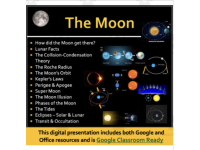
The Moon - Origin, Orbits, and Influences - This three-day senior Earth and Space lesson package includes the lesson (student and teacher versions of the presentation), an auto-graded Exit Ticket, EIGHT videos, and a student lesson handout as a document. The presentation is fun and applicable with many opportunities for inquiry-based learning and discussion. The presentation covers a lot of content and is meant to be delivered over a three-day stretch.
This lesson includes both Office and Google formats for ALL resources. The presentation is in PowerPoint and Google Slides while all documents contain Word and Google Doc versions.
Your resource is perfect for distance learning and integrates seamlessly with Google Classroom as I've included a link that will automatically create a copy of the resources and put them directly into your Google Drive with one click.
Download--> Open --> Click --> Assign to your students
Having both options allows you to use either without worrying about formatting issues as all the work has already been done for you. It safeguards you in case your department or school decides to go Google 100% and allows you as well as your students to access everything no matter where you are or what kind of equipment is being used.
In order, the lesson covers:
How did the Moon get there?
Lunar Facts
The Collision-Condensation Theory
The Roche Radius
The Moon’s Orbit
Kepler’s Laws
Perigee & Apogee
Super Moon
The Moon Illusion
Phases of the Moon
The Tides
Eclipses – Solar & Lunar
Transit & Occultation
Included in the lesson package is:
Google and Office versions of each resource
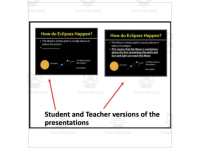
The teacher version of the presentation
The student version of the presentation
Auto-graded Exit Ticket
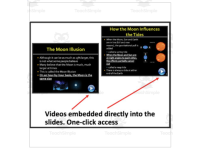
EIGHT videos embedded into the presentation
Student lesson handout
The student version of the presentation contains multiple blanks that need to be filled in throughout the lesson. These blanks are conveniently underlined and bolded on the teacher copy. I have found this to be the most effective means of keeping my students engaged and active without having them write everything out. This also leaves more time for discussion and activities.
This lesson can also be found within the Earth and Space - Space Unit Bundle which includes:
Lesson 1 - The Big Bang Theory
Lesson 2 - Celestial Objects
Lesson 3 - Astronomical Distances and Measurements
Lesson 4 - Electromagnetic Spectrum and Radiation
Lesson 5 - Stars - Classification and Spectroscopy
Lesson 6 - Earth’s Position In The Celestial Sphere
Lesson 7 - Our Solar System - From The Sun to The Oort Cloud
Lesson 8 - Kepler’s Laws of Planetary Motion
Lesson 9 - The Moon - Origin, Orbits, and Influences
Also, please visit my blog Teach With Fergy for my thoughts on teaching, learning, and everything in between.
Resource Tags
0 Reviews
Check out these other great products