Triangle Inequality Theorem PRACTICE ACTIVITIES
- Grades
- Grades 7–8
- Pages
- 4
- File type
- Answer key
- Included


- Subject
- Math, Geometry
- Topic
- Triangle inequality, Third side length
- Resource types
- Worksheets, Assessments
- Answer key
- Included
- Standards
- 7.G.A.2
Product description
From the author
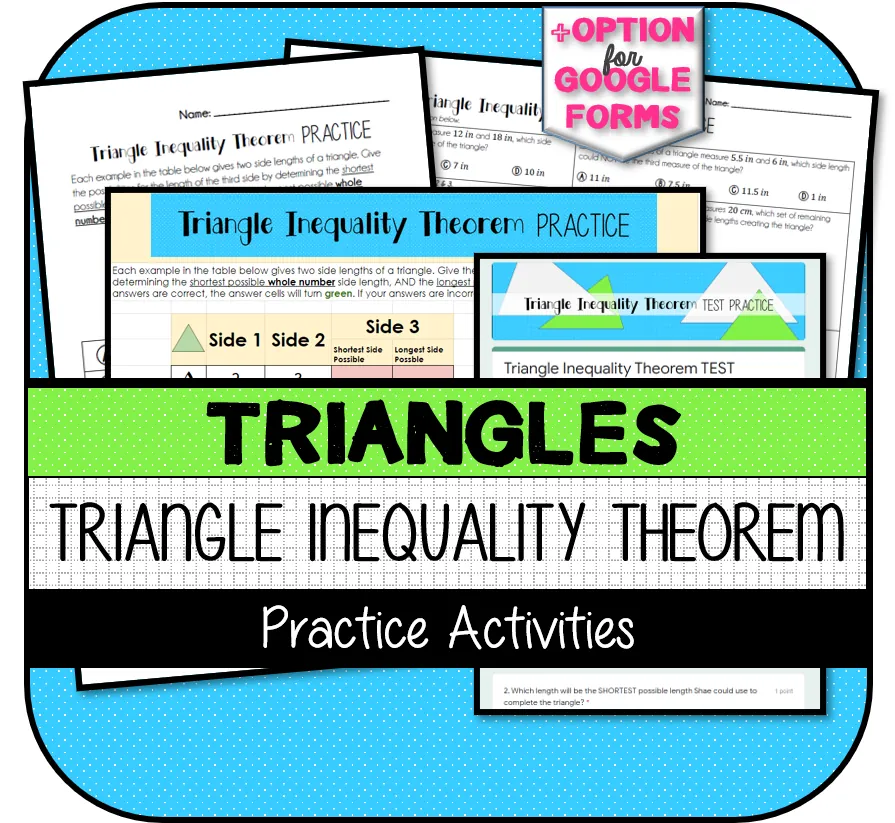
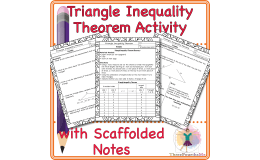
Use two activities to practise possible triangle side lengths. The first provides ten pairs of sides and asks for the shortest and longest possible whole-number third side. The second has ten multiple-choice questions, including contextual and conceptual items.
The four-page PDF includes directions, a two-per-page practice table, test practice and an answer key. Supplied links open a Google Sheet with red/green answer feedback and a Google Form for test practice. Online copying and live grading remain untested.
The activities address part of 7.G.A.2 by considering possible triangles; they do not supply the standard’s full drawing and construction work. Use is limited to the licensed teacher’s classroom under the included terms.
Related resources available separately
Activity
Related resources
More resources teachers may find useful
24 related resources were found using this product's title, contributor, categories and tags.
In the classroom
Teaching tips & learning objectives

Learning objectives
Student can determine the range of possible whole-number lengths for a triangle's third side given two known side lengths.
Student can apply the Triangle Inequality Theorem to real-world word problems (e.g., choosing valid straw lengths).
Student can state the Triangle Inequality Theorem in words.

Teaching tips
Assign the self-grading Google Sheets practice version first for students who need extra reps before the graded Google Forms test, as the resource itself recommends.
Use the word-problem items (e.g., the straw-length scenario) to check whether students can apply the theorem in context, not just compute a numeric range.
Review the conceptual multiple-choice question (which asks students to identify the theorem's correct statement) as a quick check for understanding before assigning the numeric problems.

Skills covered
Triangle Inequality Theorem application — students calculate the shortest and longest possible whole-number third side given two known triangle side lengths.
Theorem-based reasoning under real constraints — students solve word problems (e.g., choosing valid straw lengths to complete a triangle) using the same inequality rule.
Theorem identification — students select the correct verbal statement of the Triangle Inequality Theorem from multiple-choice options.
Good to know
Questions teachers ask about this resource
Which digital version goes with each activity?
The practice table links to Google Sheets, while the multiple-choice test practice links to Google Forms. Both are described as self-grading; the PDF also contains printable activities and an answer key.

No reviews yet
Downloaded this resource? Tell other teachers how it went.
Curriculum
Standards, concepts & topics
Standards
 Standards
- 7.G.A.2 — Draw (freehand, with ruler and protractor, and with technology) geometric shapes with given conditions. Focus on constructing triangles from three measures of angles or sides, noticing when the conditions determine a unique triangle, more than one triangle, or no triangle.
Core concepts
 Core concepts
Triangle Inequality Theorem
Triangle geometry
 Topics
More to explore
You may also like