24 related resources

White Bird Discussion Questions
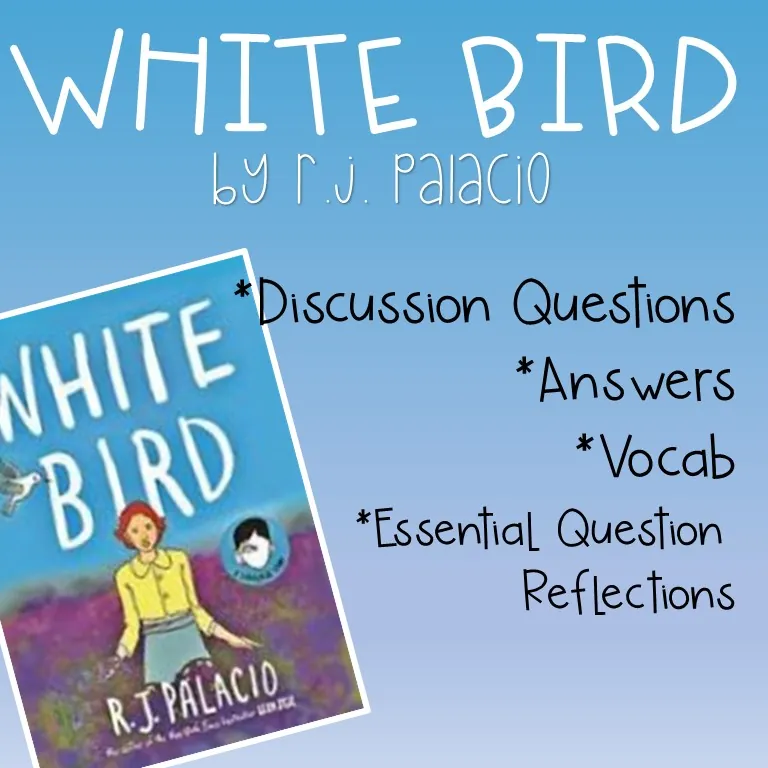
Chapter-by-chapter discussion questions on R. J. Palacio's White Bird, each printed with its response underneath, plus glossed vocabulary lists and four Essential Question Reflection prompts.
Grades
Grades 4–6, Elementary, Middle School
File type
Microsoft Word
Editable
Yes

Updated Feb 21, 2024

Subject
ELA, Literature
Topic
book companion, White Bird
Resource types
Worksheets & Printables, Novel Studies
Editable
Yes

About this resource

What's inside this resource

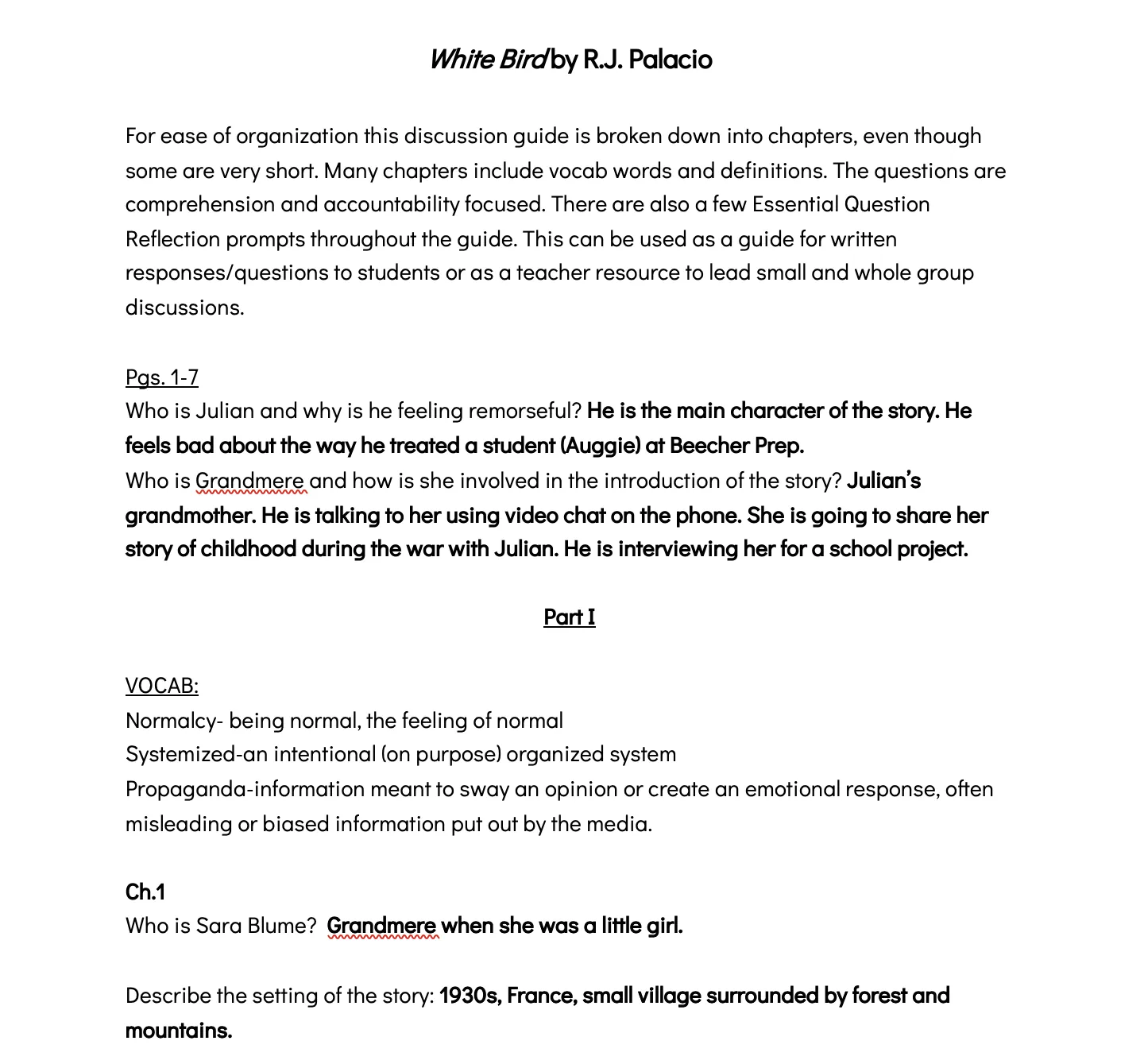
White Bird Discussion Questions is an instructional resource for educators to use when teaching the novel White Bird by R. J. Palacio to students. This literature guide supports reading comprehension for grade 4-6 students by providing them with discussion questions to respond to during and after their reading. Questions focus on vocabulary growth, character analysis, plot events, and critical thinking. The questions are organized to align with the chapters of White Bird, which allows educators to assign specific discussion questions as reading homework or use them for assessments after finishing the novel. By working through these thoughtful questions individually or in small groups, students will strengthen their understanding of the complex themes and symbolism in White Bird. The resource also contains an answer key for educators.
In the classroom

Teaching tips & learning objectives

Learning objectives

  • Recount the events of Sara Blume's story in order, from the 1930s village and the division of France into Occupied and Free zones through to liberation and her reunion with her father

  • Explain how named characters relate to one another - Sara and Tourteau, Vincent and his Nazi-employed father, Julien's mother and the Lafleurs

  • Use glossed historical vocabulary correctly when discussing the text, including propaganda, anti-Semitism, maquisard, gendarmes, rations and The Resistance

  • Interpret the book's central images, including why the story is called The White Bird and what "Vive l'humanite" means when Julien shouts it at Vincent

  • Form and defend a personal opinion in response to the Essential Question Reflection prompts, such as whether Sara's father was right to escape to Switzerland

Teaching tips

  • Each question carries its response on the same line block, so decide before printing whether students see the document or only hear the questions read aloud

  • The file is a Word document, which makes it straightforward to strip the responses into a student copy or to add answer space beneath each prompt

  • Vocabulary lists sit ahead of the chapter that uses each term, so front-loading them before reading gives students the words in the order the book needs them

  • The four Essential Question Reflection prompts are the natural pause points for discussion or a written response; one of them points to page 116 of the book for the passage in question

  • Several answers close with "discuss student answers" or "discuss student responses", marking the questions the guide intends to be opened up rather than settled

Skills covered

  • Chapter comprehension - students answer recall questions such as what the round-up was, how Sara escaped the school through the sewers and what happened to her teacher.

  • Character relationship tracking - questions ask who Tourteau is, how Vincent treats Sara, how Sara and Julien's relationship changes, and what Sara learns about the Lafleurs.

  • Historical vocabulary in context - each part supplies definitions for the terms the chapter uses, from Nazi and anti-Semitism to maquisard, gendarmes, rations and liberated.

  • Symbol and title interpretation - students explain why the book is called The White Bird and what Julien means by "Vive l'humanite" while beaten on the ground.

  • Personal response and opinion - the Essential Question Reflection prompts ask students to relate to Sara or Tourteau, to judge whether good people must fight, and to weigh Sara's father's decision to flee.

Good to know

Questions teachers ask about this resource

Can the guide be handed straight to students?

It is written teacher-facing: every question is immediately followed by its response. The opening note offers two routes - use it as a bank of prompts for written student responses, or read from it to lead small-group and whole-group discussion.

What do the Essential Question Reflection prompts ask for?

Personal judgement rather than recall. They ask students how they can relate to Sara or Tourteau and how they handled being made fun of, what Julien's mother says about good people fighting and whose responsibility it is to end it, what a year alone in a barn would be like, and whether Sara's father was right to escape to Switzerland.

Which vocabulary words does the guide define?

Terms are grouped under the chapter that first uses them - Part I chapter 3 alone glosses haven, immodest, Nazi, courtyard, polio, anti-Semitism and ominous, while later lists add maquisard, implore, kilometer, gendarmes, hayloft, Auschwitz, smuggle, confidant, co-conspirator, vermin, henchmen, humanity, The Resistance, rations and liberated.

No reviews yet

Downloaded this resource? Tell other teachers how it went.

Resource details

Concepts & topics

Core concepts

  • Reading comprehension

  • Novel study

  • Discussion questions

  • Vocabulary

  • World War II

Explore more

Categories this resource belongs to

Explore related searches

More to explore

You may also like