Bond Energy Practice – 16-Problem Chemistry Set



- File type
- Microsoft Word

- Subject
- Chemistry, Science
- Topic
- Bond Energy, Chemistry Practice
- Resource types
- Activities
From the author
About this resource
Resource includes 16 practice problems covering bond energies.
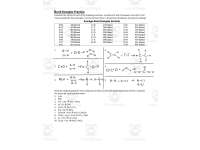
Students will practice calculation of the enthalpy of various reactions. They will do so through using the common bond energies between atoms.
Six of the questions are designed to use digitally drawn Lewis structures.
Ten formula entries suggest drawing Lewis structures as an optional aid.
The solutions to all questions are provided.
Related resources
More resources teachers may find useful
More resources on the same subject and topic.


In the classroom
Teaching tips & learning objectives

Learning objectives
Students will calculate the enthalpy of reaction (Hrxn) using the bond-energy method: bonds broken minus bonds formed.
Students will apply standard bond-energy values (e.g., C-H, O=O, N-H) to balanced chemical equations.
Students will determine molecular structure from a chemical formula or equation in order to count the bonds broken and formed.

Teaching tips
Have students complete the six diagram-based problems first, since the bonds are already identified, before moving to the ten equation-only problems that require structuring the molecule themselves.
Review the worked answer key's substitution step (e.g., 'Hrxn = H-H + O=O − 4(O-H)') with students before they check final answers, since most calculation errors happen at the bond-counting stage rather than the arithmetic.
Since the file is an editable Word document, remove or swap individual reactions to shorten the set or match a specific unit.

Skills covered
Bond-energy calculation — applying Hrxn = bonds broken − bonds formed to balanced chemical equations.
Molecular structure analysis — identifying and counting bond types (single, double, triple) in reactants and products.
Quantitative problem solving — substituting tabulated bond-energy values (kJ/mol) and completing multi-step arithmetic to reach a signed final answer.
Good to know
Questions teachers ask about this resource
What working is shown for each solved problem?
The full bond-energy substitution step, the arithmetic, and the final signed Hrxn value in kJ/mol — for example, problem 6 is shown as 'Hrxn = H-H + Cl-Cl − 2(H-Cl) = 436 + 242 − 2(431) = −184 kJ'.
How are the two sets of 6 and 10 problems different in format?
The first 6 problems are diagram-based, with the reaction's bonds already set up so students focus on the calculation. The remaining 10 are given only as chemical formulas or equations, so students must work out the molecular structure themselves before calculating.

No reviews yet
Downloaded this resource? Tell other teachers how it went.
Resource details
Concepts & topics
Core concepts
 Core concepts
Bond energy
Enthalpy of reaction
Hess's law method
Lewis structures
Exothermic and endothermic reactions
 Topics
Explore more
Categories this resource belongs to
Explore related searches




More to explore