Guillermo Del Toro Frankenstein Parents Guide


- Pages
- 3
- File type
- Preparation
- Print ready


- Subject
- ESL, Holidays, Vocabulary, Writing, Holiday & Seasonal, Language Development, English
- Topic
- ESL, English Second Language
- Resource types
- Writing Prompts, Worksheets
- Preparation
- Print ready
From the author
About this resource
ESL Movie Guide Worksheets on "Frankenstein" - Guillermo del Toro
This English Second or Foreign Language (ESL EFL TESOL) teaching resource is a 3 page printable PDF movie guide for "Frankenstein" (2025 film by Mexican Academy Award Film Director Guillermo del Toro; inspired by Mary Shelley's gothic novel) is designed to help English as a Second Language (ESL EFL TESOL) learners. This teaching resource can be ideal for post-movie activities and is ideal for lower secondary and secondary school students, from 7th to Year 13. This ESL EFL TESOL (English Second or Foreign Language) Movie Guide Activity can be great for newcomers and any English language learners, making it an amazing teaching toolbox to use in ESL EFL classrooms, language centres, or by tutors around the World.
Within this ESL EFL Movie Guide on "Frankenstein" (2025 film by Mexican Academy Award Film Director Guillermo del Toro; inspired by Mary Shelley's gothic novel), ESL EFL TESOL teachers can find the following English Second or Foreign Language (ESL EFL TESOL) film activities:
General Information – Students fill in key details about the film, including the director, genre, release year etc.
Vocabulary Builder – An activity dedicated to new words and phrases, to improve ESL EFL students’ English vocabulary
Character Analysis – Students describe the main characters, helping them practice descriptive language and comprehension.
Movie Timeline Activity – Students arrange scenes in chronological order to enhance their understanding of the storyline.
Favourite Scene Reflection – A writing activity where students describe and explain their favourite moments from the film.
Movie Review Writing – Learners express their opinions in a structured review, improving their evaluative writing skills.
Creative Writing Activity – Students imagine themselves as one of the characters and write three diary entries from that character’s perspective, deepening their connection with the storyline.
This ESL Teaching Resource (Movie Guide Activity) can be ideal for Halloween Activities
This "Frankenstein" (2025 film by Mexican Academy Award Film Director Guillermo del Toro; inspired by Mary Shelley's gothic novel) movie guide is designed to create an enjoyable and stimulating learning experience for intermediate advanced ESL students.
ESL with Alan is an amazing Teaching Resources Store which aims to support English as a Second or foreign Language (ESL EFL TESOL) Teachers, Educators and Tutors around the globe (be it online or offline) to achieve their students' learning objectives while creating an enjoyable and stimulating learning environment. Never Forget! Learning is fun, So should English! Always
Related resources
More resources teachers may find useful
More resources on the same subject and topic.


In the classroom
Teaching tips & learning objectives

Learning objectives
Take the director, genre, cast and year of release from a film's own titles and record them accurately
Notice ten unfamiliar English words while viewing and give a meaning for each
Write a short description of each of ten named characters, keeping them distinct from one another
Justify a personal opinion about a scene and extend it into a full review
Adopt a character's voice and retell three separate moments of the film as that character experienced them

Teaching tips
The character boxes carry three lines each rather than a full paragraph, which suits a quick who-is-who check straight after viewing
Ten of the boxes are named in advance, so a class can be told which characters to watch for before the film starts
The word bank and its meanings column are separate lists, so students can jot words during the film and look the meanings up afterwards
The diary task is the one piece that needs sustained writing; treating it as a follow-up lesson keeps the rest of the guide to a single session
Nothing on the sheets refers to the source novel, so any comparison with the original text has to be set up separately

Skills covered
Listening for unfamiliar vocabulary — students record ten new words heard in the film and match each to a meaning in the parallel list.
Distinguishing a large cast — ten named boxes require short descriptions that separate Victor Frankenstein from his Monster, Elizabeth Lavenza from Alma, and the Baron from Professor Krempe.
Ordering a narrative — the Movie Timeline section asks for the film's events laid out in sequence rather than summarised.
Justified opinion — the frames move from naming a scene to explaining the reason for the choice and then to a written review.
Perspective writing — three diary pages must be written as one character, covering a different day or scene on each page in that character's voice.
Good to know
Questions teachers ask about this resource
Which characters get their own box on the guide?
Ten are named on the sheet: Victor Frankenstein, Frankenstein's Monster, Elizabeth Lavenza, William Frankenstein, Captain Anderson, Baron Leopold Frankenstein, the Blind Man, Alma, Professor Krempe and Henrich Harlander. Each box has three ruled lines for the student's description.
Does the guide supply the vocabulary, or do students choose it?
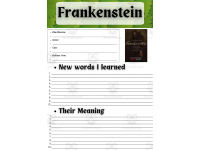
Students choose it. The sheet gives ten empty numbered lines headed "New words I learned" and ten more headed "Their Meaning", so each class ends up with its own word list drawn from what they actually did not know.
How much writing does the closing task expect?
Three diary pages. The instruction asks the student to imagine themselves as a character they connected with and to write one page per day or scene, retelling three moments from that character's point of view with their thoughts, emotions and experiences.

No reviews yet
Downloaded this resource? Tell other teachers how it went.
Resource details
Concepts & topics
Core concepts
 Core concepts
Movie guide
Vocabulary log
Character description
Point of view writing
 Topics
Explore more
Categories this resource belongs to
Explore related searches


More to explore