10 related resources

ESL Reading Comprehension + Writing Activity Worksheets - Brainrot

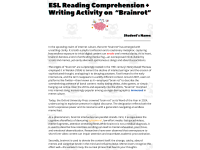
A reading passage traces the internet term "brainrot" from Thoreau's 1854 use in Walden to its 2024 Oxford Word of the Year status, paired with 19 comprehension questions and two opinion-essay prompts.
Year groups
Secondary and Sixth Form, Lower Secondary, Years 8–13
Pages
3
File type
PDF
Preparation
Print ready

Updated Aug 21, 2025

Subject
Formal Writing, Reading Comprehension, ESL, Vocabulary, Writing, Reading, English
Topic
ESL, English Second Language
Resource types
Writing Prompts, Worksheets, Worksheets & Printables
Preparation
Print ready

From the author

About this resource

ESL Reading Comprehension + Writing Activity Worksheets - Brainrot

This ESL EFL Teaching Resource on the "Brainrot" (3 PDF Worksheets Slides; Reading Comprehension + Writing Activity) can be ideal to improve Language skills in English. Ideal students for this ESL EFL TESOL Reading + Writing Activity are Foreign Students at middle and High School (7th-12th Grade; teens). Newcomers or any ESL Learner is also more than suitable for this ESL EFL TESOL TEFL (English as a Second or Foreign Language) Activity on the "Brainrot" (origins and background of this term + what brainrot is and consists of + examples of brainrot, such as Skibidi, Italian Brainrot etc. + impact). This Teaching Educational Resource Product can also be ideal for ESL EFL TESOL Centres worldwide or any English second language tutor.

Intermediate Advanced English as a Second or Foreign Language (ESL EFL TESOL TEFL) learners are suitable for this ESL EFL TESOL Teaching Resource on "Brainrot" (Worksheet; 3 PDF Printable slides)

In this English Second or Foreign Language (ESL EFL TESOL) Reading Comprehension + Essay Writing Activity Worksheet on "Brainrot" (origins and background of this term + what brainrot is and consists of + examples of brainrot, such as Skibidi, Italian Brainrot etc. + impact) activities are included:

  • 1 text on "Brainrot" (origins and background of this term + what brainrot is and consists of + examples of brainrot, such as Skibidi, Italian Brainrot etc. + impact)

  • 19 Questions related to the text (with related space where students can answer)

  • 2 essay prompts for a writing activity on "Brainrot" (writing an essay on your own personal opinion on brainrot; whether you think it can be harmful or not and why + pretending to travel to the past with a time machine and to explain what brainrot is)

This ESL, EFL (English Second or Foreign Language) Teaching Resource Reading + Writing Activity on "Brainrot" (origins and background of this term + what brainrot is and consists of + examples of brainrot, such as Skibidi, Italian Brainrot etc. + impact) is great for Intermediate Advanced English as a second or foreign language learners (ESL- EFL - TESOL). This English Second Language Worksheet on "Brainrot" (origins and background of this term + what brainrot is and consists of + examples of brainrot, such as Skibidi, Italian Brainrot etc. + impact) aims to train and Reading Comprehension + Writing Skills.

"Learning with Alan" is dedicated to provide high quality teaching resources and educational materials for ESL EFL TESOL teachers. It aims to support teachers, educators, and tutors in both online and offline environments, helping them achieve their teaching goals while creating a fun, stimulating atmosphere for learning English. Always remember: learning is fun, and so is English!

If you want to find more ESL, EFL, TESOL (English Second or Foreign Language) Teaching Resources and Educational Material click here Learning with Alan

In the classroom

Teaching tips & learning objectives

Learning objectives

  • Summarize how the meaning of "brainrot" changed from its 1854 literary use to its current internet-slang usage.

  • Define vocabulary in context (erode, ephemeral, immersed) and generate synonyms for a target word.

  • Construct a written opinion, supported by reasoning, on whether brainrot represents a genuine cultural concern.

  • Use evidence from an informational text to argue a true/false claim.

Teaching tips

  • Pre-teach or review "erode," "ephemeral," and "immersed" before assigning the vocabulary questions, since students must define or generate synonyms for them without a separate glossary.

  • Split the packet across two sessions — the 19 comprehension/vocabulary questions in one sitting, the two full essay prompts in another — rather than assigning all of it at once.

  • Preview page 2 before assigning it: the passage references a critic's warning about extremist symbolism appearing in some meme content, which is worth previewing for classroom fit.

Skills covered

  • Reading comprehension of an informational text — students answer content, sequence, and evidence-based questions drawn directly from the brainrot passage.

  • Vocabulary in context — students define and generate synonyms for words such as erode, ephemeral, and immersed as used in the passage.

  • Evidence-based argumentation — the two true/false questions require students to argue their answer using the text.

  • Opinion and persuasive essay writing — the two writing prompts ask students to state and support a position on brainrot's cultural impact.

Good to know

Questions teachers ask about this resource

How is the passage's advanced vocabulary practiced?

Three questions ask students to define "erode" and "ephemeral" from context and to generate three synonyms for "immersed," working directly from the passage rather than a separate glossary.

What do the two writing prompts ask students to do differently?

The first asks for a direct opinion essay on whether brainrot is a real danger, while the second reframes the same ideas as an explanation written for a 19th-century audience using a time-travel premise.

No reviews yet

Downloaded this resource? Tell other teachers how it went.

Resource details

Concepts & topics

Explore more

Categories this resource belongs to

Explore related searches

More to explore

You may also like