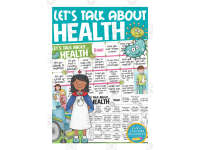
Let's Talk About Health – Class Board Game

- Year groups
- Years 2–4 (Key Stages 1–2)
- File type
- Preparation
- Print ready


- Subject
- ESL, Language Development, English
- Topic
- Board Game, Dice Game
- Resource types
- Games
- Preparation
- Print ready
From the author
About this resource
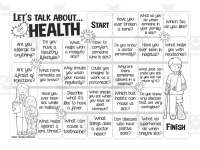
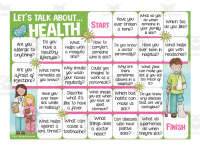
Let's Talk About Health is an engaging board game that teaches students about health and wellness. To play, simply print the colourful game board and grab a pair of dice. This versatile resource can be used in whole or small groups and suits a range of abilities.
Students take turns rolling the dice and moving ahead the corresponding number of spaces. They then read aloud and answer the health question written on the space they land on. Alternatively, their partner can respond instead or both students can write down their answers. It's also possible to assess individual progress by having students write both the questions and responses.
With a variety of question types and vocabulary focused on health, this simple yet entertaining game builds English language skills, content knowledge, speaking confidence, and more. Use it as a fun competition to see who reaches the end first or as a beneficial small group activity for targeted instruction and support. Let's Talk About Health brings health concepts to life in any classroom.
Related resources
More resources teachers may find useful
More resources on the same subject and topic.


In the classroom
Teaching tips & learning objectives

Learning objectives
Answer open questions about health, illness and hygiene aloud in English
Use health and medical vocabulary in context — allergic, lifestyle, remedies, paramedic, fever, contagious, injections
Recount personal experience in response to prompts such as "Have you ever broken a bone?" and "Have you ever been sick while on holiday?"
Give practical health advice, including why hands should be washed regularly and what to eat with an upset stomach
Describe a physical state in detail, as in "Describe what it's like to have a fever."

Teaching tips
The spaces split into questions about personal experience and questions that ask for an explanation, so a group that needs an easier start can be steered to the experience spaces first.
Several spaces carry a whole discussion rather than a one-line answer — "Can diseases also have positive sides?" and "Why are there sometimes clowns in a hospital?" both work as a full-class talking point.
Pre-teach the board's harder vocabulary: contagious, paramedic, remedies, injections and allergic all appear inside question text and gate the answer.
Because the same board is laid out twice, two groups can play side by side from one printing.
Questions about hospital stays, broken bones and illness in the family touch on personal history; offer students the option to answer about someone else or to pass.

Skills covered
Spoken response to open questions — students answer prompts such as "What do you do when someone in your family is sick?" in their own words.
Health and medical vocabulary in use — the board embeds allergic, lifestyle, mosquito bite, remedies, paramedic, fever, contagious, toothache and injections inside the questions themselves.
Giving health advice — spaces ask what helps against a sore throat, what to eat with an upset stomach, and why hands should be washed regularly.
Recounting personal experience — several spaces ask whether the student has broken a bone, been in hospital, or been sick while on holiday.
Speculative reasoning — playful spaces such as "What do superheroes do when they're sick?" push students past factual recall into invented explanation.
Good to know
Questions teachers ask about this resource
What kinds of questions does the board use?
Three kinds sit side by side. Some ask about personal experience ("Have you ever broken a bone?", "Have you ever been sick while on holiday?"), some ask for advice or explanation ("Why should you wash your hands regularly?", "What can cause a toothache?"), and a few are deliberately open ("Why are there sometimes clowns in a hospital?", "Can diseases also have positive sides?").
Do students need health vocabulary before they play?
Most spaces can be answered from everyday experience, but a handful put the vocabulary inside the question — contagious, paramedic, remedies, allergic and injections all appear in question text, so those words are worth introducing beforehand.

No reviews yet
Downloaded this resource? Tell other teachers how it went.
Resource details
Concepts & topics
Core concepts
 Core concepts
Health vocabulary
Speaking practice
Personal experience questions
Hygiene and illness
Board game
 Topics
Explore more
Categories this resource belongs to
Explore related searches


More to explore