Prepositions Of Time In On At Worksheets



- Year groups
- Years 2–4 (Key Stages 1–2)
- Pages
- 6
- File type
- Preparation
- Print ready


- Subject
- Maths
- Topic
- Time Prepositions Worksheets, In on at Worksheets
- Resource types
- Worksheets
- Preparation
- Print ready
From the author
About this resource
Introduction
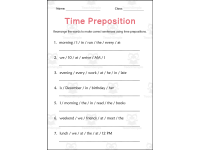
This set of Time Prepositions Worksheets helps learners practice using the correct prepositions in, on, and at when talking about time. Through a variety of activities, students learn how these prepositions are used with days, dates, months, parts of the day, and specific times.
What’s Included:
Fill-in-the-blank exercises using in, on, and at
Multiple-choice questions for selecting the correct time preposition
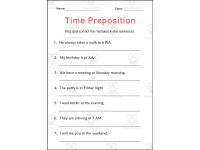
Sentence correction activities to identify and fix grammar mistakes
True or False exercises based on correct preposition usage
Sentence rearranging tasks to form correct sentences
Practical grammar practice focused on time expressions
Grades / Ages:
Ideal for Years 2–6
Implementation Format:
Perfect for grammar lessons, literacy centres, small group activities, independent practice, classroom assignments, or homework.
Answer Key:
Not included
File Type:
PDF (Non-editable)
Number of Pages:
6 pages total
Related resources
More resources teachers may find useful
More resources on the same subject and topic.


In the classroom
Teaching tips & learning objectives

Learning objectives
Choose between in, on and at according to whether the time expression is a clock time, a day or date, or a longer period
Apply the rule that months, seasons and parts of the day take in, while specific days and dates take on and clock times take at
Spot a wrongly used time preposition inside a written sentence and replace it with the correct one
Judge a complete sentence as right or wrong on the strength of its preposition alone, without rewriting it
Assemble a grammatical sentence from scrambled words, placing the time preposition in the right position

Teaching tips
The two gap-fill pages are near-identical in demand, so one works as a taught practice and the other as an unaided check a day later
The error-correction page is the sharpest diagnostic in the set: a student who fills gaps correctly but cannot spot "My birthday is at July" is pattern-matching rather than applying the rule
Draw the three-column rule on the board before the true-or-false page - at for clock times, on for days and dates, in for months, seasons and parts of the day - since that page gives no options to choose between
Sentence contexts are adult and workplace-flavoured (a scheduled flight, a report deadline, a museum's closing day), which suits an older or ESL learner more readily than a very young reader
Check the scrambled sentences on the last page before handing them out; several word lists contain a surplus word that needs removing rather than placing

Skills covered
Choosing time prepositions - students decide between in, on and at for expressions ranging from 8:00 AM and 7 PM to Friday afternoon, December and the holidays.
Recognising the pattern behind the choice - clock times take at, named days and dates take on, and months, seasons and parts of the day take in, a rule the six pages test from five different directions.
Proofreading for a grammatical error - one page presents sentences already containing a wrong preposition, such as "We have a meeting at Monday morning", for students to find and correct.
Judging usage without a prompt - the true-or-false page offers no options, so students must evaluate a finished sentence rather than select from a list.
Sentence construction - the closing page scrambles seven sentences and asks students to rebuild each one with its time preposition in the right place.
Good to know
Questions teachers ask about this resource
Which task types does the set move through?
Five distinct ones. Two pages are straight gap-fills, one gives three options to choose between, one asks students to find and correct a mistake already in the sentence, one asks for a true-or-false judgement on the usage, and the last scrambles the words for students to reassemble.
What sort of situations do the sentences describe?
Everyday adult and school routines rather than child-centred ones - a 6:30 AM wake-up, a Friday afternoon meeting, a flight scheduled for 6 AM, a wedding on October 12th, jogging in the evening and a museum closed on Mondays.
Which time expressions come up most often across the pages?
Clock times and parts of the day dominate - AM and PM times appear on every page, and "the morning", "the evening" and "the afternoon" recur throughout. Months, dates, named days, seasons and "the holidays" fill out the rest, so all three prepositions get repeated work.

No reviews yet
Downloaded this resource? Tell other teachers how it went.
Resource details
Concepts & topics
Core concepts
 Core concepts
Prepositions of time
In, on, at
Grammar conventions
Sentence correction
 Topics
Explore more
Categories this resource belongs to
Explore related searches


More to explore
You may also like