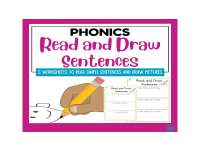
Read and Draw Sentences

- Year groups
- Years 1–2 (Key Stage 1)
- Pages
- 5
- File type
- Preparation
- Print ready


- Subject
- Phonics, Language Development, English
- Topic
- Phonics, Early Reading
- Resource types
- Worksheets & Printables
- Preparation
- Print ready
From the author
About this resource
Connecting printed words to meaning is an essential early reading skill. These worksheets give young learners practice reading simple sentences and illustrating the ideas described. Featuring CVC vocabulary and drawing prompts, the activities reinforce literacy foundations in an engaging way.
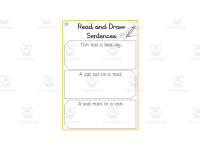
Each page displays 3 short sentences using basic sight words and repetitive consonant-vowel-consonant terms. After decoding each statement, students draw a picture below that represents the sentence. Sketching concepts like “A cat sat on a mat” reinforces comprehension.
Turning words into mental images strengthens the bond between reading and meaning. Visualising narrative situations also builds imagination and creativity. These materials are ideal for independent practice, centres or small groups. Parents and teachers can monitor student interpretation skills across the activities.
The sentences are intentionally crafted to be accessible, ensuring that learners at various stages of their reading journey can engage with the material comfortably. The emphasis is on comprehension and visual representation, allowing children to actively participate in the learning process.
Combining reading, vocabulary exposure and illustration, these worksheets help cement early literacy connections. Budding readers will delight in showing their sentence understanding through pictures. The reading-drawing tasks thoughtfully develop emergent skills that pave the way for reading fluency.
Resource includes two five-page PDF versions of the same activities, using Mum or Mum spelling: ten pages across the files.
Clipart images courtesy of Kari Bolt Children's Illustrator
Related resources
More resources teachers may find useful
More resources on the same subject and topic.


In the classroom
Teaching tips & learning objectives

Learning objectives
Decode short, regularly spelled one-syllable sentences built from common CVC words
Demonstrate comprehension of a decoded sentence by drawing a picture that represents its meaning
Build fluency with high-frequency short-vowel words through repeated sentence patterns

Teaching tips
Choose the American- or British-spelling version to match the classroom's usual spelling convention before printing, since both cover the same 15 sentences
Use one page per short guided-reading or literacy-centre rotation rather than assigning all five at once, since each page stands alone
Have students read each sentence aloud before drawing, since the task pairs decoding with a comprehension check

Skills covered
CVC decoding — students read short, regularly spelled sentences built from common consonant-vowel-consonant words such as cat, mat, pan, hob, and bug.
Reading comprehension check — students draw a picture that represents each sentence, showing they understood what they decoded rather than only sounding it out.
Sight-word recognition — short high-frequency words (has, a, on, in, is) repeat across the fifteen sentences, reinforcing quick recognition.
Good to know
Questions teachers ask about this resource
What is the difference between the two included versions?
Both cover the same five pages and fifteen sentences; one uses American spelling ('Mum has a map'), and the other uses British spelling ('Mum has a map').

No reviews yet
Downloaded this resource? Tell other teachers how it went.
Resource details
Concepts & topics
Core concepts
 Core concepts
CVC words
Decodable sentences
Reading comprehension
Topics
 Topics
Explore more
Categories this resource belongs to
Explore related searches


More to explore