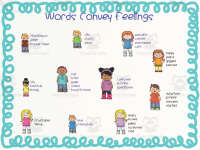
Words Convey Feelings – Anchor Chart Pair


- Year groups
- Years 1–3 (Key Stages 1–2)
- File type
- Preparation
- Print ready


- Subject
- Vocabulary, Language Development, English
- Topic
- Reading Anchor Chart, Vocabulary
- Resource types
- Anchor Charts
- Preparation
- Print ready
- England expectations
- Year 1 · Comprehension
From the author
About this resource
This resource is a set of 2 anchor charts teaching that words convey feelings. The first chart is complete. The second chart is fill in the blank. These charts work well on a bulletin board or inserted into students' interactive reading notebooks.
Related resources
More resources teachers may find useful
More resources on the same subject and topic.


In the classroom
Teaching tips & learning objectives

Learning objectives
Recognise and use varied vocabulary for the same broad emotion (e.g., 'giggled,' 'joyful,' 'beamed' for happy)
Distinguish near-synonym feeling words such as 'shy,' 'bashfully,' and 'timidly,' or 'frustrated' and 'angry'

Teaching tips
Post the completed chart near the writing area so students can pull precise feeling words instead of defaulting to 'happy' or 'sad.'
Use the blank/cloze version as a quick vocabulary recall check or independent fill-in activity.
Pair with a character-emotion activity in a read-aloud, having students select the word cluster that best matches a character's reaction.

Skills covered
Emotion vocabulary building — students select precise synonyms (e.g., 'fumed' vs. 'yelled' vs. 'mad') for a broad feeling category.
Word recall — students fill in blanked feeling words on a cloze version of the same chart from memory.

No reviews yet
Downloaded this resource? Tell other teachers how it went.
National Curriculum in England
National Curriculum in England expectations
England expectations
 England expectations
- Year 1 · Comprehension — England Year 1 English reading comprehension: discussing word meanings, linking new meanings to those already known.
Core concepts
 Core concepts
Emotion vocabulary
Synonyms
Feelings
 Topics
Explore more
Categories this resource belongs to
Explore related searches


More to explore