



3,554 products added recently
Guided Reading Activity
Enhance your guided reading sessions with activities that support students at various reading levels. This collection provides structured resources, including question prompts, discussion guides, and comprehension exercises. By incorporating these guided reading activities into your lessons, you can facilitate deeper understanding and encourage critical thinking among your students.

 Show filters


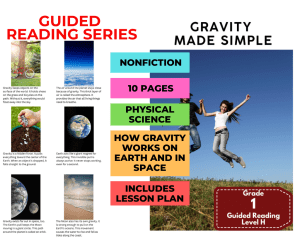
Guided Reading Level H - Gravity Made Simple
ELA, Resources for Teachers, Reading Comprehension, Reading, Science, Pre-Reading, Language Development, Vocabulary, Physics, Earth and Environmental Sciences, Kindergarten, Grade 1, 2, Worksheets & Printables, Worksheets, Teacher Tools, Centers, Activities, Literacy Readers, Quizzes, Quizzes and Tests, Assessments
This Guided Reading Book - Gravity Made Simple (Level H) includes: Guided Reading Color Label (front cover x1) This is a quick way to match the book’s demands to what students can generally handle.. The overall goal is to use the level/color to pick books for several smaller groups. To qualify for a certain level, a student is expected to read a book from that level with about 90–94% accuracy. If a student is consistently accurate and understands, move up a level. If the student is struggling at that level, drop down and add more support. Each student will improve at completely different rates, but it is generally one of the best ways to check progress across the class. DOWNLOAD THE CATALOG TO VIEW ALL GUIDED READING BOOKS AVAILABLE (SORTED LEVELS A-Z) Pre-Reading Question (x1) Teacher asks the prompt aloud, can be while showing the cover or first page. Students share what they already know, or make educated guesses from the cover. Prompt them to use the target vocabulary. Write some of their responses on the board to look back at during the reading. Vocabulary Words (x5) Introduce the five words, best doing it one at a time. Start by saying it, while students repeat and then see if anyone knows what it means before reading further. Read through the meaning and try to briefly connect each word to a picture or gesture so it’s meaningful. Ask students to flip through the book pages and point to where they see each of the vocabulary words. While reading the book pause upon coming across one of the vocab words or read the sentence twice to make sure students understand the word has appeared. Optional: Ask students to raise hands whenever they see/hear one of the new words. Guided Reading Pages (x10) Check the book snapshot (below) for: primary topic - do you need to prep extra reading or intro materials on this? what is taught best - decide on 1-2 bullets to focus on, use the prompt or words provided here for best results. learning goals - what you are checking for students to be able to do after the session, elicit answers using prompts or words provided. key vocabulary (see section above). questions overview - so you know what is coming up and if you need to prep extra materials to assist understanding. Run the lesson You may have already looked at a few of the pages together, but you can show them some of the pictures again first to set meaning. Depending on how much time you have and how familiar your students are with guided reading class, you may want to read the book aloud first with the group first. Students whisper or partner read, while you listen in. If time, do it as a group, one student reading a page each. Use the guided page’s prompts to coach: “Check the picture / does it make sense?” “Point under the words / try the first sound” “Reread the sentence smoothly”. Try to focus more on one student per session (rotating every time), so you can work out if they are ready to move up or need to move down a level. Comprehension Questions (back cover x3) This is your way to check that students didn’t just say the words, but actually understood the text. First, let students answer by pointing to the page/picture and saying a short sentence. After any answer, follow with: “Show me where you found that in the text.” In bigger groups, have partners answer first (10–20 seconds), then call on 2–3 students to share. Differentiation tips: Emerging speakers/struggling readers: oral + pointing On-level: oral in a full sentence Higher: one written sentence or draw + label Book Snapshot Title: Gravity Made Simple Genre: Nonfiction (informational) Subject: Science (Physical Science / Earth & Space Science) Primary Topic: How gravity works on Earth and in space Estimated Guided Reading Level (A–Z): H What This Book Teaches Best Gravity is a hidden, always-active force that pulls things toward Earth’s center. Gravity keeps objects on Earth’s surface—without it, things would float away. Gravity keeps the air close to Earth, forming the atmosphere that living things need to breathe. Gravity works in space too: Earth’s pull keeps the Moon in an orbit, and the Moon’s gravity affects ocean tides. Mass and gravity connect: more mass means a stronger gravitational pull, and weight measures gravity’s pull. Learning Goals Explain what gravity is and what it does to objects on Earth. Describe what happens when an object is dropped, according to the text. Tell how gravity helps keep objects (and air) close to Earth. Describe how Earth’s gravity affects the Moon’s orbit. Explain how the Moon’s gravity is connected to tides along the coast. Use the text to explain how mass relates to gravitational pull. Key Vocabulary From the Text gravity — a force that pulls things toward Earth. atmosphere — the thick layer of air around Earth. orbit — the path something takes around a planet. mass — how much matter is inside an object. tides — ocean water rising and falling along the coast. Discussion Prompts Pre-reading question: What do you think happens when you drop an object? Comprehension questions: What does the book say happens when an object is dropped? Comprehension questions: What does Earth’s pull do for the Moon’s path around Earth? Comprehension questions: What does the book say causes tides along the coast? Printing Tips 1. Best Printing Method (Recommended) “Booklet” Printing (Best if Available) If your printer or PDF viewer supports Booklet Printing , use this. Settings to use: Print mode: Booklet Paper size: Letter or A4 (either works) Orientation: Landscape Print on both sides: Yes Flip on: Short edge Scaling: Fit to printable area Booklet subset: First test: Front sides only Then: Back sides only This will automatically: Pair pages correctly Put the cover on the outside Align everything for folding After printing, fold in half and staple along the spine . 2. If “Booklet” Printing Is NOT Available You can still print this correctly with manual duplex printing . Step-by-step: Open the PDF. Choose Print . Set: Orientation: Landscape Pages per sheet: 1 Print on both sides: Yes Flip on: Short edge Print all pages . Because each PDF page already contains two facing book pages, the result will still fold cleanly into a book. Thousands of Cored Education products are included with your TeachSimple membership. Download links and encyclopedia index available here.
Author Cored Education
Rating
Tags Vocabulary, Reading Comprehension, Reading Passages, Leveled Reading, Nonfiction, Reading, Guided Reading, Gravity, Physics, Earth Science

Elephants: Guided Reading Level Q with Lesson Plan
ELA, Resources for Teachers, Reading Comprehension, Reading, Science, Language Development, Life Sciences, Earth and Environmental Sciences, Geography, Social Studies, Grade 3, 4, 5, Worksheets & Printables, Worksheets, Teacher Tools, Centers, Activities, Literacy Readers, Quizzes, Quizzes and Tests, Assessments, Lesson Plans
This Elephants (level q) guided reading book with lesson plan includes: Guided Reading Color Label (front cover x1) This is a quick way to match the book’s demands to what students can generally handle.. The overall goal is to use the level/color to pick books for several smaller groups. To qualify for a certain level, a student is expected to read a book from that level with about 90–94% accuracy. If a student is consistently accurate and understands, move up a level. If the student is struggling at that level, drop down and add more support. Each student will improve at completely different rates, but it is generally one of the best ways to check progress across the class. DOWNLOAD THE CATALOG TO VIEW ALL GUIDED READING BOOKS AVAILABLE (SORTED LEVELS A-Z) Pre-Reading Question (x1) Teacher asks the prompt aloud, can be while showing the cover or first page. Students share what they already know, or make educated guesses from the cover. Prompt them to use the target vocabulary. Write some of their responses on the board to look back at during the reading. Vocabulary Words (x5) Introduce the five words, best doing it one at a time. Start by saying it, while students repeat and then see if anyone knows what it means before reading further. Read through the meaning and try to briefly connect each word to a picture or gesture so it’s meaningful. Ask students to flip through the book pages and point to where they see each of the vocabulary words. While reading the book pause upon coming across one of the vocab words or read the sentence twice to make sure students understand the word has appeared. Optional: Ask students to raise hands whenever they see/hear one of the new words. Guided Reading Pages (x10) Check the book snapshot (below) for: primary topic - do you need to prep extra reading or intro materials on this? what is taught best - decide on 1-2 bullets to focus on, use the prompt or words provided here for best results. learning goals - what you are checking for students to be able to do after the session, elicit answers using prompts or words provided. key vocabulary (see section above). questions overview - so you know what is coming up and if you need to prep extra materials to assist understanding. Run the lesson You may have already looked at a few of the pages together, but you can show them some of the pictures again first to set meaning. Depending on how much time you have and how familiar your students are with guided reading class, you may want to read the book aloud first with the group first. Students whisper or partner read, while you listen in. If time, do it as a group, one student reading a page each. Use the guided page’s prompts to coach: “Check the picture / does it make sense?” “Point under the words / try the first sound” “Reread the sentence smoothly”. Try to focus more on one student per session (rotating every time), so you can work out if they are ready to move up or need to move down a level. Comprehension Questions (back cover x3) This is your way to check that students didn’t just say the words, but actually understood the text. First, let students answer by pointing to the page/picture and saying a short sentence. After any answer, follow with: “Show me where you found that in the text.” In bigger groups, have partners answer first (10–20 seconds), then call on 2–3 students to share. Differentiation tips: Emerging speakers/struggling readers: oral + pointing On-level: oral in a full sentence Higher: one written sentence or draw + label Book Snapshot Title: Elephants Genre: Nonfiction (informational) Subject: Life Science Primary Topic: Elephant species, adaptations, behavior, and threats Estimated Guided Reading Level (A–Z): Q What This Book Teaches Best Explains that scientists recognize three distinct species of elephants and describes physical differences (like ear shape and head shape) that fit their environments. Describes key body structures and functions (trunk muscles and “fingers,” tusks as elongated incisor teeth, sensitive skin). Shows behavioral adaptations for survival , including how elephants protect themselves from heat and insects by using water or mud. Highlights social organization and communication , including matriarchal herds and vocalizations such as trumpets, rumbles, and infrasound. Connects elephants to their ecosystems and conservation by explaining seed dispersal (African Forest elephants) and current threats like habitat loss and poaching for ivory. Learning Goals Describe the three elephant species named in the text and one physical difference mentioned between African and Asian elephants. Explain how elephants use their skin and what they do to protect themselves from heat and insects. Identify how the text describes an elephant’s trunk and list at least three things elephants use it to do. Explain what tusks are and give examples from the text of how tusks help elephants survive. Describe how elephants live in groups and how a matriarch helps keep a herd safe. Explain how African Forest elephants help plant new trees in the forest, according to the text. Key Vocabulary From the Text distinct — clearly different from something else. characteristic — an important feature that helps describe something. matriarchal — led by a female (mother) in the group. vocalizations — animal sounds used to communicate. endangered — in danger of disappearing because there are not many left. Discussion Prompts Pre-reading question: What do you already know about how elephants live and survive in their habitats? Comprehension questions: What are the three species of elephants that scientists recognize in the text? Comprehension questions: What does the text say elephants do to protect themselves from heat and insects? Comprehension questions: How do African Forest elephants help plant the next generation of trees in the forest? Printing Tips 1. Best Printing Method (Recommended) “Booklet” Printing (Best if Available) If your printer or PDF viewer supports Booklet Printing , use this. Settings to use: Print mode: Booklet Paper size: Letter or A4 (either works) Orientation: Landscape Print on both sides: Yes Flip on: Short edge Scaling: Fit to printable area Booklet subset: First test: Front sides only Then: Back sides only This will automatically: Pair pages correctly Put the cover on the outside Align everything for folding After printing, fold in half and staple along the spine . 2. If “Booklet” Printing Is NOT Available You can still print this correctly with manual duplex printing . Step-by-step: Open the PDF. Choose Print . Set: Orientation: Landscape Pages per sheet: 1 Print on both sides: Yes Flip on: Short edge Print all pages . Because each PDF page already contains two facing book pages, the result will still fold cleanly into a book. Thousands of Cored Education products are included with your TeachSimple membership. Download links and encyclopedia index available here.
Author Cored Education
Rating
Tags Reading Comprehension, Reading Passages, Reading, Guided Reading, Guided Reading Lesson Plan, Guided Reading Activity, Pre-reading, Science Lesson Plans, Life Science, Geography

Guided Reading Activities with Lesson Plans: Fiction Set 7 - Sports
ELA, Reading, Reading Comprehension, Common Core, ESL, Language Development, Pre-Reading, Vocabulary, Resources for Teachers, Grade 2, 3, Worksheets & Printables, Worksheets, Teacher Tools, Lesson Plans, Activities
Guided Reading Activities with Lesson Plans Fiction Set 7 Note: This download DOES NOT include the passages themselves. If you have not already done so, download in a format of your choice in the "reading links" section below. Overview The perfect companion materials for Cored Education reading comprehension downloads. This collection of guided reading lessons includes a wide array of engaging themes that aim to foster comprehension, vocabulary development, and creative thinking. Each lesson is crafted to be interactive and immersive, making learning enjoyable while promoting essential literacy skills. The lessons are designed for students to actively engage with both the material and the world around them, creating connections to their personal experiences while developing key skills. Includes Guided Reading Materials For: 1.Catch It, Dan 2.Feeling Left Out 3.Ian's Friday Nights 4.Aimee's Dilemma 5.A Great Team 6.Ana's Swimming Party 7.Touchdown Pythons 8.Sam's Passion 9.Where's My Board 10.Lacey the Runner Reading Links: This is the guided reading materials version and DOES NOT include the passages themselves. The passages related to this download are available here in GOOGLE Docs, GOOGLE Forms, GOOGLE Slides. PDF, PPT, WORD. Google Docs Google Forms Google Slides PDF PPT Word Details Pre-reading Discussions Each lesson begins with pre-reading questions that help activate prior knowledge and engage students in the theme of the lesson. This allows students to make personal connections with the content before diving into the reading material. Vocabulary Development Every lesson includes vocabulary exploration that introduces key terms students will encounter in the reading. These words are essential for understanding the passage, and activities encourage students to apply the new vocabulary in context. Comprehension Check After the reading, the lessons provide comprehension questions (typically multiple-choice) that assess students’ understanding of the story. These questions help students reflect on key events, characters, and concepts within the text, reinforcing their comprehension. Creative Writing Prompts To foster creativity, the lessons include writing activities that challenge students to apply what they've learned in imaginative ways. These prompts allow students to practice creative expression while reinforcing the lesson’s theme. Discussion Topics Each lesson ends with wrap-up discussion questions that encourage students to think critically and engage in group conversations. These discussions can enhance social learning and deepen understanding by connecting the lesson's content to broader real-world applications. Theme-Based Learning The themes (e.g., winter, nature walks, photography, flowers) are universally appealing and offer opportunities for cross-curricular connections with science, art, and environmental studies. This makes the lessons versatile for a wide range of teaching contexts. Student-Centered Approach The activities are designed to be interactive and student-driven, allowing them to explore the content through discussions, hands-on vocabulary practice, and personal reflections. This promotes active learning and keeps students engaged. FULL CATALOG OF DOWNLOAD LINKS HERE Grade 2/3 Links Fiction Set 1 - Nature Google Docs Google Forms Google Slides PDF PPT Word Guided Reading Materials Fiction Set 2 - Animals Google Docs Google Forms Google Slides PDF PPT Word Guided Reading Materials Fiction Set 3 - Food Google Docs Google Forms Google Slides PDF PPT Word Guided Reading Materials Fiction Set 4 - School Google Docs Google Forms Google Slides PDF PPT Word Guided Reading Materials Fiction Set 5 - Friends Google Docs Google Forms Google Slides PDF PPT Word Guided Reading Materials Fiction Set 6 - Family Google Docs Google Forms Google Slides PDF PPT Word Guided Reading Materials Fiction Set 7 - Sports Google Docs Google Forms Google Slides PDF PPT Word Guided Reading Materials Nonfiction Set 1 - Technology Google Docs Google Forms Google Slides PDF PPT Word Guided Reading Materials Nonfiction Set 2 - Nutrition Google Docs Google Forms Google Slides PDF PPT Word Guided Reading Materials Nonfiction Set 3 - Animals Google Docs Google Forms Google Slides PDF PPT Word Guided Reading Materials Reading Passages Overview Each passage is especially written for Grade 2-3 students, including key vocabulary required for this age group. Topics are varied and are accompanied by colorful graphics. Topics are meant to educate, yet entertain the modern student. These passages are perfect for the modern classroom. Whereas textbooks can become outdated in no time, any changes to technology or the world will result in updates to this product. Mixed Questions The mixed questions section of each lesson includes a variation of fivecomprehension, vocabulary and math questions. In addition, key reading strategies are frequently covered including cause & effect, summarizing, compare & contrast and making conclusions. Three of the questions will be MCQs and two will require a written response of some kind. Full answers and example responses appear at the end of the lesson. Spelling & Vocab Each reading passage contains a variety of words and phrases designed for Grade 2-3 students. Spelling and vocab activities provide the opportunity to build fluency with these words. As it can become quite mundane doing the same activities over and over, each lesson in a set will contain a different spelling and vocab activity . Writing Prompts Writing prompts are designed to continue the theme or lessons learned in the story. Students are persuaded to write in a variety of ways and each prompt includes several cues to help. As with the spelling/vocab section, writing prompts will vary. This includes research pieces, reading responses, poetry and creative writing prompts. Full Answer Keys Full answer keys and sample responses are provided so no matter how busy you are, you know you're covered! Mixed question answers provide evidence from the text, math questions contain the relevant workings. Answers are designed for use by the teacher, but also suitable as a handout to the student. Additional File One lesson will have an additional file. This is something fun to extend the lesson with. For similar downloads and other frees, do check out Cored Group on TeachSimple.
Author Cored Education
Tags Elementary, Reading, Comprehension, Vocabulary, Answers, Ccss, Guided Reading, Guided Reading Activity, Guided Reading Lesson Plans, Guided Reading Lesson Plan

Word Study and Vocabulary Strategies Guided Reading Lesson Plans
ELA, Reading, Writing, Elementary, Activities, Teacher Tools, Games, Projects, Assessments, Lesson Plans, Quizzes and Tests, Rubrics
Introduce or review (test prep!) your students’ word comprehension skills with this engaging 10-day mini-unit designed to make vocabulary learning interactive and effective! Perfect for upper elementary or middle school classrooms, this resource dives into Greek and Latin roots, word work strategies, guided reading and word comprehension through a variety of vocabulary activities and vocabulary games. What’s Included: Daily Lessons & Word Work: Explore prefixes, suffixes, Greek and Latin root words, dictionary and thesaurus skills, context clues, analogies, homophones, homonyms, homographs, synonyms, and antonyms through fun, hands-on activities, interactive notes, and creative projects. Vocabulary Activities & Games: Engage students with word work strategies like flashcards, sentence strip tasks, word art, creative writing and class sharing to reinforce understanding. Work Designed for Fun: Assignments (either classwork or homework) such as the “Make Your Own Word” Flip Book and creative writing tasks keep students motivated while reinforcing key concepts. Cumulative Test: Conclude the unit with a comprehensive Greek and Latin Roots Test (Day 11), complete with an answer key for easy grading or choose from different word part projects that include rubrics for assessment. Flexible Lesson Options: Expand the Unit: Add more practice, vocabulary games, or activities to focus on specific Greek and Latin roots or word comprehension strategies. Shorten the Unit: Focus only on Greek and Latin root words for a streamlined approach. Why Teachers Love It: Interactive & Fun: From word work activities to group study games, students will love the variety of vocabulary strategies and tools included. Adaptable for Every Classroom: Flexible design makes it easy to fit your schedule. Homework tasks can also double as in-class or center work for classrooms with limited homework policies. Prep Made Simple: Print-and-go packets, curated video resources, and minimal setup required! Teacher Prep Checklist: Print the “A Study of Words” packet for each student. Gather materials like sentence strips, index cards, and any required tech tools. Preview videos and websites from the Day-by-Day Plan. With this word work and vocabulary strategies mini-unit, you’ll empower students to unlock the meaning of words, improve their comprehension, and build essential vocabulary skills through fun and interactive word work strategies. Watch their confidence grow as they master etymology and the wonderful world of words!
Author Kel's Klass
Tags Greek And Latin Roots, Word Work, Homonyms, Homophones, Homographs, Synonyms, Antonyms, Analogies, Content Clues, Guided Reading Lesson Plans

Guided Reading Lesson Plan & Activities for Grade 9
Reading, ELA, Grade 9, Activities, Lesson Plans, Teacher Tools
A standard curriculum for 9th grade English language arts will feature a range of literary pieces from diverse cultures globally. Ninth graders typically do book reports, which enhance their reading comprehension and writing abilities, while also building upon the writing skills they developed in earlier grades. A few of the language arts tasks for 9th graders that your student should engage in are: - Understand how to recognize the characteristics and intentions of myths, along with comparing myths from various cultures. - Discover how to understand similes, dissect figurative language, and apply previous knowledge to forecast outcomes. - Investigating and composing on legendary figures. - Investigate the various thematic connections in the texts they read, including love, beauty, family, freedom, friendship, and the essence of human nature. - Read and comprehend progressively difficult texts that enhance knowledge in history, science, and various other subjects. - Write texts that showcase various perspectives. - Carry out research and gather data from various sources to back their claims. This comprehensive lesson outline features guided reading tasks for ninth grade that take around 90 minutes. Suggested answers are also included.
Author Bright Classroom Ideas Marketplace
Tags Guided, Reading, Lesson, Plan, Activities, Grade 9, Language
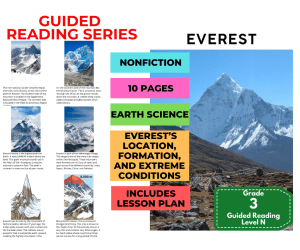
Guided Reading Level N - Everest (with Lesson Plan)
ELA, Resources for Teachers, Reading Comprehension, Reading, Science, Earth and Environmental Sciences, Social Studies, Geography, Life Sciences, Physics, Grade 2, 3, 4, Worksheets & Printables, Worksheets, Teacher Tools, Centers, Activities, Literacy Readers, Quizzes, Quizzes and Tests, Assessments, Lesson Plans
This Guided Reading Book - Everest (Level N) with lesson plan includes: Guided Reading Color Label (front cover x1) This is a quick way to match the book’s demands to what students can generally handle.. The overall goal is to use the level/color to pick books for several smaller groups. To qualify for a certain level, a student is expected to read a book from that level with about 90–94% accuracy. If a student is consistently accurate and understands, move up a level. If the student is struggling at that level, drop down and add more support. Each student will improve at completely different rates, but it is generally one of the best ways to check progress across the class. DOWNLOAD THE CATALOG TO VIEW ALL GUIDED READING BOOKS AVAILABLE (SORTED LEVELS A-Z) Pre-Reading Question (x1) Teacher asks the prompt aloud, can be while showing the cover or first page. Students share what they already know, or make educated guesses from the cover. Prompt them to use the target vocabulary. Write some of their responses on the board to look back at during the reading. Vocabulary Words (x5) Introduce the five words, best doing it one at a time. Start by saying it, while students repeat and then see if anyone knows what it means before reading further. Read through the meaning and try to briefly connect each word to a picture or gesture so it’s meaningful. Ask students to flip through the book pages and point to where they see each of the vocabulary words. While reading the book pause upon coming across one of the vocab words or read the sentence twice to make sure students understand the word has appeared. Optional: Ask students to raise hands whenever they see/hear one of the new words. Guided Reading Pages (x10) Check the book snapshot (below) for: primary topic - do you need to prep extra reading or intro materials on this? what is taught best - decide on 1-2 bullets to focus on, use the prompt or words provided here for best results. learning goals - what you are checking for students to be able to do after the session, elicit answers using prompts or words provided. key vocabulary (see section above). questions overview - so you know what is coming up and if you need to prep extra materials to assist understanding. Run the lesson You may have already looked at a few of the pages together, but you can show them some of the pictures again first to set meaning. Depending on how much time you have and how familiar your students are with guided reading class, you may want to read the book aloud first with the group first. Students whisper or partner read, while you listen in. If time, do it as a group, one student reading a page each. Use the guided page’s prompts to coach: “Check the picture / does it make sense?” “Point under the words / try the first sound” “Reread the sentence smoothly”. Try to focus more on one student per session (rotating every time), so you can work out if they are ready to move up or need to move down a level. Comprehension Questions (back cover x3) This is your way to check that students didn’t just say the words, but actually understood the text. First, let students answer by pointing to the page/picture and saying a short sentence. After any answer, follow with: “Show me where you found that in the text.” In bigger groups, have partners answer first (10–20 seconds), then call on 2–3 students to share. Differentiation tips: Emerging speakers/struggling readers: oral + pointing On-level: oral in a full sentence Higher: one written sentence or draw + label Book Snapshot Title: Everest Genre: Nonfiction (informational text) Subject: Science (Earth Science/Geography) Primary Topic: Mount Everest’s location, formation, and extreme conditions Estimated Guided Reading Level (A–Z): N What This Book Teaches Best Key facts about Mount Everest’s height and setting in the Himalayas in Asia. How mountain ranges form over long periods of time, including tectonic plate movement. How borders and regions connect to physical geography (Nepal/China border across the summit). How extreme environments change with altitude, including the “Death Zone” and low oxygen. How glaciers, weather, earthquakes, and erosion shape Everest and keep it changing. Learning Goals Describe where Mount Everest is located and what mountain system it is part of. Identify what the text says about the border between Nepal and China on Everest. Explain how Everest was formed using the book’s description of tectonic plates. Describe what the “Death Zone” is and why most living things cannot survive there long. Describe how glaciers create features on the mountain, including crevasses. Explain one way Everest is still changing today, using details from the text. Key Vocabulary From the Text summit — the very top point of a mountain. glacier — a huge, slow-moving river of ice. tectonic — related to Earth’s moving crust plates. crevasses — deep cracks in ice. erosion — wind, water, or ice wearing rock away. Discussion Prompts Pre-reading question: Where does the book say Mount Everest stands? Comprehension questions: What does the text say about where the Nepal–China border is on Everest? Comprehension questions: How does the text explain that Everest was formed long ago? Comprehension questions: What is one way the text says Mount Everest is still changing today? Printing Tips 1. Best Printing Method (Recommended) “Booklet” Printing (Best if Available) If your printer or PDF viewer supports Booklet Printing , use this. Settings to use: Print mode: Booklet Paper size: Letter or A4 (either works) Orientation: Landscape Print on both sides: Yes Flip on: Short edge Scaling: Fit to printable area Booklet subset: First test: Front sides only Then: Back sides only This will automatically: Pair pages correctly Put the cover on the outside Align everything for folding After printing, fold in half and staple along the spine . 2. If “Booklet” Printing Is NOT Available You can still print this correctly with manual duplex printing . Step-by-step: Open the PDF. Choose Print . Set: Orientation: Landscape Pages per sheet: 1 Print on both sides: Yes Flip on: Short edge Print all pages . Because each PDF page already contains two facing book pages, the result will still fold cleanly into a book. Thousands of Cored Education products are included with your TeachSimple membership. Download links and encyclopedia index available here.
Author Cored Education
Rating
Tags Reading Comprehension, Reading Passages, Reading, Guided Reading, Guided Reading Lesson Plan, Guided Reading Activity, Pre-reading, Social Studies Lesson Plans, Science Lesson Plans, Geography

Guided Reading Lesson Plan & Activities for Grade 5
Reading, ELA, Grade 5, Activities, Lesson Plans, Teacher Tools
Teaching guided reading in 5th grade is one of the most rewarding aspects of teaching this grade. The standards and text levels are more rigorous than in primary grades, and the students are much more independent. The books they read are more engaging, making the teaching experience enjoyable. When actively in the classroom, use a flexible approach that promotes student choice and variety, paired with explicit instruction and engaging reading practice. Try to teach reading in a way that promotes discussion and enjoyment of reading. Focus on three key areas: 1. Learning to Read: Developing or growing skills to decode and comprehend grade-level texts. 2. Reading to Learn: Acquiring the skills needed to extract details and information from a text or story and synthesizing it. 3. Reading to Analyze: Building on reading to learn by focusing on specific skills and then being able to write about them. This ebook contains a detailed 90-minute lesson plan and activities for your Grade 5 students. Suggested answers are provided as well.
Author Bright Classroom Ideas Marketplace
Tags Guided, Reading, Lesson, Plan, Activities, Language, Grade 5
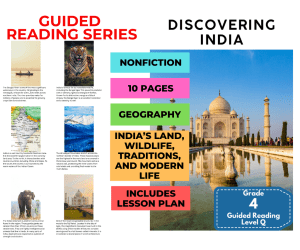
Discovering India: Guided Reading Level Q with Lesson Plan
ELA, Resources for Teachers, Reading Comprehension, Reading, Science, Geography, Social Studies, Technology, History, Life Sciences, Grade 3, 4, 5, Worksheets & Printables, Worksheets, Teacher Tools, Centers, Activities, Literacy Readers, Quizzes, Quizzes and Tests, Assessments, Lesson Plans
This Discovering India (level q) guided reading book with lesson plan includes: Guided Reading Color Label (front cover x1) This is a quick way to match the book’s demands to what students can generally handle.. The overall goal is to use the level/color to pick books for several smaller groups. To qualify for a certain level, a student is expected to read a book from that level with about 90–94% accuracy. If a student is consistently accurate and understands, move up a level. If the student is struggling at that level, drop down and add more support. Each student will improve at completely different rates, but it is generally one of the best ways to check progress across the class. DOWNLOAD THE CATALOG TO VIEW ALL GUIDED READING BOOKS AVAILABLE (SORTED LEVELS A-Z) Pre-Reading Question (x1) Teacher asks the prompt aloud, can be while showing the cover or first page. Students share what they already know, or make educated guesses from the cover. Prompt them to use the target vocabulary. Write some of their responses on the board to look back at during the reading. Vocabulary Words (x5) Introduce the five words, best doing it one at a time. Start by saying it, while students repeat and then see if anyone knows what it means before reading further. Read through the meaning and try to briefly connect each word to a picture or gesture so it’s meaningful. Ask students to flip through the book pages and point to where they see each of the vocabulary words. While reading the book pause upon coming across one of the vocab words or read the sentence twice to make sure students understand the word has appeared. Optional: Ask students to raise hands whenever they see/hear one of the new words. Guided Reading Pages (x10) Check the book snapshot (below) for: primary topic - do you need to prep extra reading or intro materials on this? what is taught best - decide on 1-2 bullets to focus on, use the prompt or words provided here for best results. learning goals - what you are checking for students to be able to do after the session, elicit answers using prompts or words provided. key vocabulary (see section above). questions overview - so you know what is coming up and if you need to prep extra materials to assist understanding. Run the lesson You may have already looked at a few of the pages together, but you can show them some of the pictures again first to set meaning. Depending on how much time you have and how familiar your students are with guided reading class, you may want to read the book aloud first with the group first. Students whisper or partner read, while you listen in. If time, do it as a group, one student reading a page each. Use the guided page’s prompts to coach: “Check the picture / does it make sense?” “Point under the words / try the first sound” “Reread the sentence smoothly”. Try to focus more on one student per session (rotating every time), so you can work out if they are ready to move up or need to move down a level. Comprehension Questions (back cover x3) This is your way to check that students didn’t just say the words, but actually understood the text. First, let students answer by pointing to the page/picture and saying a short sentence. After any answer, follow with: “Show me where you found that in the text.” In bigger groups, have partners answer first (10–20 seconds), then call on 2–3 students to share. Differentiation tips: Emerging speakers/struggling readers: oral + pointing On-level: oral in a full sentence Higher: one written sentence or draw + label Book Snapshot Title: Discovering India Genre: Nonfiction Subject: Social Studies (Geography/Culture) Primary Topic: India’s land, wildlife, traditions, and modern life Estimated Guided Reading Level (A–Z): Q What This Book Teaches Best Key geography facts about India’s location in Southern Asia, nearby borders, and surrounding waters. How landforms shape life in India, including the Himalayan Mountains and the Ganges River. Notable wildlife of India through examples like the Bengal tiger and the Indian elephant. Cultural traditions and everyday life, including spices used in meals and the celebration of Diwali. Modern India today, including transportation (auto-rickshaws) and major cities connected to technology and innovation. Learning Goals Students will describe where India is located and name details about its borders and southern waters. Students will explain how the Himalayan Mountains are described as protecting the inner plains. Students will explain why the Ganges River is important to people and farming in northern India. Students will describe key traits of the Bengal tiger and the Indian elephant using details from the text. Students will identify facts about the Taj Mahal, including where it is and features described in the book. Students will describe examples of Indian culture and modern life mentioned in the text (foods/spices, Diwali, transportation, cities). Key Vocabulary From the Text vast — very large in size. significant — very important. distinctive — easy to notice because it looks different. minarets — tall towers on a monument. diyas — small clay lamps used during Diwali. Discussion Prompts Pre-reading question: What are you hoping to learn about India as you read? Comprehension questions: What warm waters does the text say surround India to the south? Comprehension questions: According to the text, why is the Ganges River essential? Comprehension questions: What does the text say diyas symbolize during Diwali? Printing Tips 1. Best Printing Method (Recommended) “Booklet” Printing (Best if Available) If your printer or PDF viewer supports Booklet Printing , use this. Settings to use: Print mode: Booklet Paper size: Letter or A4 (either works) Orientation: Landscape Print on both sides: Yes Flip on: Short edge Scaling: Fit to printable area Booklet subset: First test: Front sides only Then: Back sides only This will automatically: Pair pages correctly Put the cover on the outside Align everything for folding After printing, fold in half and staple along the spine . 2. If “Booklet” Printing Is NOT Available You can still print this correctly with manual duplex printing . Step-by-step: Open the PDF. Choose Print . Set: Orientation: Landscape Pages per sheet: 1 Print on both sides: Yes Flip on: Short edge Print all pages . Because each PDF page already contains two facing book pages, the result will still fold cleanly into a book. Thousands of Cored Education products are included with your TeachSimple membership. Download links and encyclopedia index available here.
Author Cored Education
Rating
Tags Reading Comprehension, Reading Passages, Reading, Guided Reading, Guided Reading Lesson Plan, Guided Reading Activity, Pre-reading, Social Studies, Geography, History

Guided Reading Lesson Plan & Activities for Grade 4
Reading, ELA, Grade 4, Activities, Lesson Plans, Teacher Tools
Each child acquires reading skills in a unique manner and at their own pace, but you can assist in establishing a solid base through thoughtful, intentional teaching. Guided reading is a teaching method that includes small groups of 4-6 students collaborating with an instructor, concentrating on their specific reading skills and requirements. The small-group environment allows the teacher to monitor and customize teaching for every student. Years of studies indicate that this tight-knit method is impactful and successful. A key benefit of guided reading is its capacity to offer individualized teaching. In a small-group environment, educators can recognize every student's reading proficiency, strengths, and areas for improvement. This tailored method enables teachers to focus on particular skills and strategies essential for every child's growth. This comprehensive lesson outline will assist you in practicing guided reading with your fourth-grade students. The session lasts around 90 minutes, and the responses are included as well.
Author Bright Classroom Ideas Marketplace
Tags Guided, Reading, Lesson, Plan, Activities, Grade 4, Language

Guided Reading Lesson Plan & Activities for Grade 10
Reading, ELA, Grade 10, Activities, Lesson Plans, Teacher Tools
Guided reading is not a novel approach in the realm of education. It has existed for a long time and has been extensively studied. Fountas and Pinnell (1996) demonstrated that guided reading effectively enhances students' reading skills. This occurs by offering a well-organized and encouraging educational setting in which learners can develop their reading abilities under the supervision of an instructor. The aim of guided reading is to assist students in cultivating essential reading skills including decoding, fluency, segmenting, and understanding. These abilities can thrive through small group teaching, support, and feedback from educators. Guided reading enables teachers to address the individual requirements of every student according to their grade level. You will be more equipped to offer each student the specific assistance they require to enhance their reading abilities. This ebook includes an elaborate guided reading lesson plan for your 10th-grade students. Activities and suggested answers are also included.
Author Bright Classroom Ideas Marketplace
Tags Guided, Reading, Lesson, Plan, Activities, Grade 10, Language

Guided Reading Level M - Shanghai (with Lesson Plan)
ELA, Resources for Teachers, Reading Comprehension, Reading, Science, Earth and Environmental Sciences, Economics, Social Studies, Geography, Language Development, Grade 2, 3, 4, Worksheets & Printables, Worksheets, Teacher Tools, Centers, Activities, Literacy Readers, Quizzes, Quizzes and Tests, Assessments, Lesson Plans
This Guided Reading Book - Shanghai (Level M) with lesson plan includes: Guided Reading Color Label (front cover x1) This is a quick way to match the book’s demands to what students can generally handle.. The overall goal is to use the level/color to pick books for several smaller groups. To qualify for a certain level, a student is expected to read a book from that level with about 90–94% accuracy. If a student is consistently accurate and understands, move up a level. If the student is struggling at that level, drop down and add more support. Each student will improve at completely different rates, but it is generally one of the best ways to check progress across the class. DOWNLOAD THE CATALOG TO VIEW ALL GUIDED READING BOOKS AVAILABLE (SORTED LEVELS A-Z) Pre-Reading Question (x1) Teacher asks the prompt aloud, can be while showing the cover or first page. Students share what they already know, or make educated guesses from the cover. Prompt them to use the target vocabulary. Write some of their responses on the board to look back at during the reading. Vocabulary Words (x5) Introduce the five words, best doing it one at a time. Start by saying it, while students repeat and then see if anyone knows what it means before reading further. Read through the meaning and try to briefly connect each word to a picture or gesture so it’s meaningful. Ask students to flip through the book pages and point to where they see each of the vocabulary words. While reading the book pause upon coming across one of the vocab words or read the sentence twice to make sure students understand the word has appeared. Optional: Ask students to raise hands whenever they see/hear one of the new words. Guided Reading Pages (x10) Check the book snapshot (below) for: primary topic - do you need to prep extra reading or intro materials on this? what is taught best - decide on 1-2 bullets to focus on, use the prompt or words provided here for best results. learning goals - what you are checking for students to be able to do after the session, elicit answers using prompts or words provided. key vocabulary (see section above). questions overview - so you know what is coming up and if you need to prep extra materials to assist understanding. Run the lesson You may have already looked at a few of the pages together, but you can show them some of the pictures again first to set meaning. Depending on how much time you have and how familiar your students are with guided reading class, you may want to read the book aloud first with the group first. Students whisper or partner read, while you listen in. If time, do it as a group, one student reading a page each. Use the guided page’s prompts to coach: “Check the picture / does it make sense?” “Point under the words / try the first sound” “Reread the sentence smoothly”. Try to focus more on one student per session (rotating every time), so you can work out if they are ready to move up or need to move down a level. Comprehension Questions (back cover x3) This is your way to check that students didn’t just say the words, but actually understood the text. First, let students answer by pointing to the page/picture and saying a short sentence. After any answer, follow with: “Show me where you found that in the text.” In bigger groups, have partners answer first (10–20 seconds), then call on 2–3 students to share. Differentiation tips: Emerging speakers/struggling readers: oral + pointing On-level: oral in a full sentence Higher: one written sentence or draw + label Book Snapshot Title: World Cities: Shanghai Genre: Nonfiction (informational text) Subject: Social Studies (Geography) Primary Topic: Shanghai’s location, waterways, and key city features Estimated Guided Reading Level (A–Z): M What This Book Teaches Best Explains where Shanghai is located and why its place near the Yangtze River Delta and the East China Sea matters. Describes how the Huangpu River functions as a major waterway and supports large ships year-round because the water never freezes. Compares two parts of the city along the river—Pudong’s modern skyline and Puxi’s historic area, including the Bund. Connects landforms to city development by explaining Shanghai’s flat, alluvial plain and limited land. Highlights how waterways and islands shape life and trade, including Suzhou Creek, Chongming Island habitats, and a deep-water port for global shipping. Learning Goals Identify Shanghai’s location on the eastern coast of China using details from the text. Explain why the Huangpu River is important for ships, based on the book’s description. Describe how Pudong and Puxi are different, using evidence from the text. Describe Shanghai’s landform (an alluvial plain) and tell what that means for mountains or hills in the main city area. Explain how islands and waterways support wildlife, neighborhoods, and trade in and around Shanghai. Describe Shanghai’s climate and seasons as stated in the book. Key Vocabulary From the Text vital — very important. waterway — a river or channel ships can travel on. district — a part of a city. alluvial — made from soil rivers leave behind over time. tributary — a smaller river or stream that flows into a larger river. Discussion Prompts Pre-reading question: What places in a city might be built near water, and why? Comprehension questions: Where does the text say Shanghai is located? Comprehension questions: What does the text say makes the Huangpu River important for large ships? Comprehension questions: What details does the book give about Shanghai’s climate and seasons? Printing Tips 1. Best Printing Method (Recommended) “Booklet” Printing (Best if Available) If your printer or PDF viewer supports Booklet Printing , use this. Settings to use: Print mode: Booklet Paper size: Letter or A4 (either works) Orientation: Landscape Print on both sides: Yes Flip on: Short edge Scaling: Fit to printable area Booklet subset: First test: Front sides only Then: Back sides only This will automatically: Pair pages correctly Put the cover on the outside Align everything for folding After printing, fold in half and staple along the spine . 2. If “Booklet” Printing Is NOT Available You can still print this correctly with manual duplex printing . Step-by-step: Open the PDF. Choose Print . Set: Orientation: Landscape Pages per sheet: 1 Print on both sides: Yes Flip on: Short edge Print all pages . Because each PDF page already contains two facing book pages, the result will still fold cleanly into a book. Thousands of Cored Education products are included with your TeachSimple membership. Download links and encyclopedia index available here.
Author Cored Education
Rating
Tags Reading Comprehension, Reading Passages, Reading, Guided Reading, Guided Reading Lesson Plan, Guided Reading Activity, Pre-reading, Social Studies Lesson Plans, Geography, Economics
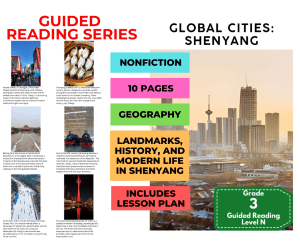
Guided Reading Level N - Shenyang (with Lesson Plan)
ELA, Resources for Teachers, Reading Comprehension, Reading, Social Studies, Geography, History, Earth and Environmental Sciences, Science, Economics, Grade 2, 3, 4, Worksheets & Printables, Worksheets, Teacher Tools, Centers, Activities, Literacy Readers, Quizzes, Quizzes and Tests, Assessments, Lesson Plans
This Guided Reading Book - Shenyang (Level N) with lesson plan includes: Guided Reading Color Label (front cover x1) This is a quick way to match the book’s demands to what students can generally handle.. The overall goal is to use the level/color to pick books for several smaller groups. To qualify for a certain level, a student is expected to read a book from that level with about 90–94% accuracy. If a student is consistently accurate and understands, move up a level. If the student is struggling at that level, drop down and add more support. Each student will improve at completely different rates, but it is generally one of the best ways to check progress across the class. DOWNLOAD THE CATALOG TO VIEW ALL GUIDED READING BOOKS AVAILABLE (SORTED LEVELS A-Z) Pre-Reading Question (x1) Teacher asks the prompt aloud, can be while showing the cover or first page. Students share what they already know, or make educated guesses from the cover. Prompt them to use the target vocabulary. Write some of their responses on the board to look back at during the reading. Vocabulary Words (x5) Introduce the five words, best doing it one at a time. Start by saying it, while students repeat and then see if anyone knows what it means before reading further. Read through the meaning and try to briefly connect each word to a picture or gesture so it’s meaningful. Ask students to flip through the book pages and point to where they see each of the vocabulary words. While reading the book pause upon coming across one of the vocab words or read the sentence twice to make sure students understand the word has appeared. Optional: Ask students to raise hands whenever they see/hear one of the new words. Guided Reading Pages (x10) Check the book snapshot (below) for: primary topic - do you need to prep extra reading or intro materials on this? what is taught best - decide on 1-2 bullets to focus on, use the prompt or words provided here for best results. learning goals - what you are checking for students to be able to do after the session, elicit answers using prompts or words provided. key vocabulary (see section above). questions overview - so you know what is coming up and if you need to prep extra materials to assist understanding. Run the lesson You may have already looked at a few of the pages together, but you can show them some of the pictures again first to set meaning. Depending on how much time you have and how familiar your students are with guided reading class, you may want to read the book aloud first with the group first. Students whisper or partner read, while you listen in. If time, do it as a group, one student reading a page each. Use the guided page’s prompts to coach: “Check the picture / does it make sense?” “Point under the words / try the first sound” “Reread the sentence smoothly”. Try to focus more on one student per session (rotating every time), so you can work out if they are ready to move up or need to move down a level. Comprehension Questions (back cover x3) This is your way to check that students didn’t just say the words, but actually understood the text. First, let students answer by pointing to the page/picture and saying a short sentence. After any answer, follow with: “Show me where you found that in the text.” In bigger groups, have partners answer first (10–20 seconds), then call on 2–3 students to share. Differentiation tips: Emerging speakers/struggling readers: oral + pointing On-level: oral in a full sentence Higher: one written sentence or draw + label Book Snapshot Title: Global Cities: Shenyang Genre: Nonfiction (informational text) Subject: Social Studies (Geography/Culture) Primary Topic: Landmarks, history, and modern life in Shenyang Estimated Guided Reading Level (A–Z): N What This Book Teaches Best Identifies Shenyang’s location and role (largest city in Northeast China; capital of Liaoning province) and connects it to major waterways in the Liaohe River Basin. Highlights historical heritage through major sites like the Shenyang Imperial Palace (built in 1625; early residence for Qing emperors) and Beiling Park/Northern Mausoleum. Explains how Shenyang developed as an industrial powerhouse , including the Tiexi District’s factory history and preserved museum sites. Shows how a city can blend old and new (Middle Street’s long history alongside modern malls; modern landmarks like the TV Tower and lit-up riverfront). Describes how climate shapes culture , including long, snowy winters and yearly ice-sculpture displays in parks. Learning Goals Identify what the text says Shenyang is the capital of. Describe how rivers and basins are connected to Shenyang’s location and development in the text. Explain what the Shenyang Imperial Palace was used for in the past, based on the text. Describe one way Shenyang’s industry shaped the city in the 20th century. Describe how Shenyang’s winters influence activities and traditions mentioned in the book. Identify one modern landmark or development in Shenyang and tell what the text says about it. Key Vocabulary From the Text situated — located in a certain place. heritage — important history and traditions remembered and protected. mausoleum — a large building where someone is buried. powerhouse — a place important for producing something. metropolitan — connected to a big city and nearby areas. Printing Tips 1. Best Printing Method (Recommended) “Booklet” Printing (Best if Available) If your printer or PDF viewer supports Booklet Printing , use this. Settings to use: Print mode: Booklet Paper size: Letter or A4 (either works) Orientation: Landscape Print on both sides: Yes Flip on: Short edge Scaling: Fit to printable area Booklet subset: First test: Front sides only Then: Back sides only This will automatically: Pair pages correctly Put the cover on the outside Align everything for folding After printing, fold in half and staple along the spine . 2. If “Booklet” Printing Is NOT Available You can still print this correctly with manual duplex printing . Step-by-step: Open the PDF. Choose Print . Set: Orientation: Landscape Pages per sheet: 1 Print on both sides: Yes Flip on: Short edge Print all pages . Because each PDF page already contains two facing book pages, the result will still fold cleanly into a book. Thousands of Cored Education products are included with your TeachSimple membership. Download links and encyclopedia index available here.
Author Cored Education
Rating
Tags Reading Comprehension, Reading Passages, Reading, Guided Reading, Guided Reading Lesson Plan, Guided Reading Activity, Pre-reading, Social Studies Lesson Plans, Geography, History

Guided Reading Level B: Simple Machines at Home
ELA, Resources for Teachers, Reading Comprehension, Reading, Science, Language Development, Pre-Reading, Vocabulary, Physics, Kindergarten, Preschool, Grade 1, Worksheets & Printables, Worksheets, Teacher Tools, Centers, Activities, Literacy Readers, Quizzes, Quizzes and Tests, Assessments
This Guided Reading Book - Simple Machines at Home (Level B) includes: Guided Reading Color Label (front cover x1) This is a quick way to match the book’s demands to what students can generally handle.. The overall goal is to use the level/color to pick books for several smaller groups. To qualify for a certain level, a student is expected to read a book from that level with about 90–94% accuracy. If a student is consistently accurate and understands, move up a level. If the student is struggling at that level, drop down and add more support. Each student will improve at completely different rates, but it is generally one of the best ways to check progress across the class. DOWNLOAD THE CATALOG TO VIEW ALL GUIDED READING BOOKS AVAILABLE (SORTED LEVELS A-Z) Pre-Reading Question (x1) Teacher asks the prompt aloud, can be while showing the cover or first page. Students share what they already know, or make educated guesses from the cover. Prompt them to use the target vocabulary. Write some of their responses on the board to look back at during the reading. Vocabulary Words (x5) Introduce the five words, best doing it one at a time. Start by saying it, while students repeat and then see if anyone knows what it means before reading further. Read through the meaning and try to briefly connect each word to a picture or gesture so it’s meaningful. Ask students to flip through the book pages and point to where they see each of the vocabulary words. While reading the book pause upon coming across one of the vocab words or read the sentence twice to make sure students understand the word has appeared. Optional: Ask students to raise hands whenever they see/hear one of the new words. Guided Reading Pages (x10) Check the book snapshot (below) for: primary topic - do you need to prep extra reading or intro materials on this? what is taught best - decide on 1-2 bullets to focus on, use the prompt or words provided here for best results. learning goals - what you are checking for students to be able to do after the session, elicit answers using prompts or words provided. key vocabulary (see section above). questions overview - so you know what is coming up and if you need to prep extra materials to assist understanding. Run the lesson You may have already looked at a few of the pages together, but you can show them some of the pictures again first to set meaning. Depending on how much time you have and how familiar your students are with guided reading class, you may want to read the book aloud first with the group first. Students whisper or partner read, while you listen in. If time, do it as a group, one student reading a page each. Use the guided page’s prompts to coach: “Check the picture / does it make sense?” “Point under the words / try the first sound” “Reread the sentence smoothly”. Try to focus more on one student per session (rotating every time), so you can work out if they are ready to move up or need to move down a level. Comprehension Questions (back cover x3) This is your way to check that students didn’t just say the words, but actually understood the text. First, let students answer by pointing to the page/picture and saying a short sentence. After any answer, follow with: “Show me where you found that in the text.” In bigger groups, have partners answer first (10–20 seconds), then call on 2–3 students to share. Differentiation tips: Emerging speakers/struggling readers: oral + pointing On-level: oral in a full sentence Higher: one written sentence or draw + label Book Snapshot Title: Simple Machines at Home Genre: Nonfiction Subject: Science Primary Topic: Simple machines at home and what they do Estimated Guided Reading Level (A–Z): B What This Book Teaches Best Recognizing that “machines are at home” and used in everyday life. Learning what specific simple machines can do (cut, stop, slice, help, hold, turn, roll, lift). Building early reading fluency with repeated sentence patterns (“The ___ can ___.”). Using text-and-picture support to connect tool names to actions (lever, wedge, ramp, screw, wheel, pulley). Learning Goals Students will identify the topic of the book as simple machines at home. Students will name at least three simple machines mentioned in the text. Students will describe what a lever, wedge, ramp, screw, wheel, or pulley can do using the book’s sentences. Students will answer who/what questions by pointing to or rereading a matching page. Students will use the sentence frame “The ___ can ___.” to retell information from the book. Key Vocabulary From the Text lever — a tool that helps you cut. wedge — a tool that can stop or slice. ramp — a slanted surface that can help. screw — a piece that can hold things together. pulley — a tool that can lift. Discussion Prompts Pre-reading question: What machines do you think you might find at home? Comprehension questions: What can the lever do? What are two things the wedge can do? What does the last page say about simple machines? Printing Tips 1. Best Printing Method (Recommended) “Booklet” Printing (Best if Available) If your printer or PDF viewer supports Booklet Printing , use this. Settings to use: Print mode: Booklet Paper size: Letter or A4 (either works) Orientation: Landscape Print on both sides: Yes Flip on: Short edge Scaling: Fit to printable area Booklet subset: First test: Front sides only Then: Back sides only This will automatically: Pair pages correctly Put the cover on the outside Align everything for folding After printing, fold in half and staple along the spine . 2. If “Booklet” Printing Is NOT Available You can still print this correctly with manual duplex printing . Step-by-step: Open the PDF. Choose Print . Set: Orientation: Landscape Pages per sheet: 1 Print on both sides: Yes Flip on: Short edge Print all pages . Because each PDF page already contains two facing book pages, the result will still fold cleanly into a book. Thousands of Cored Education products are included with your TeachSimple membership. Download links and encyclopedia index available here.
Author Cored Education
Rating
Tags Vocabulary, Reading Comprehension, Reading Passages, Leveled Reading, Nonfiction, Reading, Guided Reading, Physical Science, Simple Machines, Physics
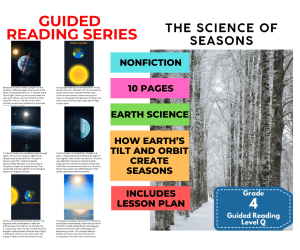
Guided Reading Level Q - Science of Seasons (with Lesson Plan)
ELA, Resources for Teachers, Reading Comprehension, Reading, Life Sciences, Science, Earth and Environmental Sciences, Geography, Social Studies, Space, Grade 3, 4, 5, Worksheets & Printables, Worksheets, Teacher Tools, Centers, Activities, Literacy Readers, Quizzes, Quizzes and Tests, Assessments
This Guided Reading Book - Science of Seasons (Level Q) with lesson plan includes: Guided Reading Color Label (front cover x1) This is a quick way to match the book’s demands to what students can generally handle.. The overall goal is to use the level/color to pick books for several smaller groups. To qualify for a certain level, a student is expected to read a book from that level with about 90–94% accuracy. If a student is consistently accurate and understands, move up a level. If the student is struggling at that level, drop down and add more support. Each student will improve at completely different rates, but it is generally one of the best ways to check progress across the class. DOWNLOAD THE CATALOG TO VIEW ALL GUIDED READING BOOKS AVAILABLE (SORTED LEVELS A-Z) Pre-Reading Question (x1) Teacher asks the prompt aloud, can be while showing the cover or first page. Students share what they already know, or make educated guesses from the cover. Prompt them to use the target vocabulary. Write some of their responses on the board to look back at during the reading. Vocabulary Words (x5) Introduce the five words, best doing it one at a time. Start by saying it, while students repeat and then see if anyone knows what it means before reading further. Read through the meaning and try to briefly connect each word to a picture or gesture so it’s meaningful. Ask students to flip through the book pages and point to where they see each of the vocabulary words. While reading the book pause upon coming across one of the vocab words or read the sentence twice to make sure students understand the word has appeared. Optional: Ask students to raise hands whenever they see/hear one of the new words. Guided Reading Pages (x10) Check the book snapshot (below) for: primary topic - do you need to prep extra reading or intro materials on this? what is taught best - decide on 1-2 bullets to focus on, use the prompt or words provided here for best results. learning goals - what you are checking for students to be able to do after the session, elicit answers using prompts or words provided. key vocabulary (see section above). questions overview - so you know what is coming up and if you need to prep extra materials to assist understanding. Run the lesson You may have already looked at a few of the pages together, but you can show them some of the pictures again first to set meaning. Depending on how much time you have and how familiar your students are with guided reading class, you may want to read the book aloud first with the group first. Students whisper or partner read, while you listen in. If time, do it as a group, one student reading a page each. Use the guided page’s prompts to coach: “Check the picture / does it make sense?” “Point under the words / try the first sound” “Reread the sentence smoothly”. Try to focus more on one student per session (rotating every time), so you can work out if they are ready to move up or need to move down a level. Comprehension Questions (back cover x3) This is your way to check that students didn’t just say the words, but actually understood the text. First, let students answer by pointing to the page/picture and saying a short sentence. After any answer, follow with: “Show me where you found that in the text.” In bigger groups, have partners answer first (10–20 seconds), then call on 2–3 students to share. Differentiation tips: Emerging speakers/struggling readers: oral + pointing On-level: oral in a full sentence Higher: one written sentence or draw + label Book Snapshot Title: The Science of Seasons Genre: Nonfiction (informational text) Subject: Earth & Space Science / Reading (Informational Text) Primary Topic: How Earth’s tilt and orbit create seasons Estimated Guided Reading Level (A–Z): Q What This Book Teaches Best Cause-and-effect in Earth science: The text explains how Earth’s orbit and its 23.5° axial tilt lead to changing seasons. Sunlight angle and temperature: Readers learn how direct, concentrated sunlight warms more than slanted rays that spread out and provide less heat. Key seasonal markers: The vernal equinox, summer solstice, autumnal equinox, and winter solstice are described with what happens to daylight and seasons. Hemispheres and opposite seasons: The book states seasons are opposite in the Northern and Southern Hemispheres because of Earth’s tilt. How living things respond to seasons: It describes animals migrating or hibernating when weather turns cold and food becomes scarce. Learning Goals Students will describe Earth’s orbit and explain that one trip takes approximately 365 days. Students will explain how Earth’s axial tilt affects the angles of sunlight hitting Earth. Students will compare direct rays and slanted rays using the text’s heat descriptions. Students will identify what happens during an equinox and during a solstice, based on the text. Students will explain why seasons are opposite in the Northern and Southern Hemispheres. Students will describe two ways animals survive seasonal change: migrating and hibernating. Key Vocabulary From the Text orbit — the path Earth travels around the Sun. axial — related to the line an object spins around. hemisphere — half of Earth. equinox — when day and night are nearly equal. migrate — move to a new place for better conditions. Discussion Prompts Pre-reading question: What do you think makes Earth have different seasons during the year? Comprehension questions: According to the text, how do Earth’s orbit and axial tilt help create the seasons? Comprehension questions: What happens to daylight and darkness during the vernal or autumnal equinox? Comprehension questions: What are two ways animals survive when the weather turns cold and food becomes scarce? Printing Tips 1. Best Printing Method (Recommended) “Booklet” Printing (Best if Available) If your printer or PDF viewer supports Booklet Printing , use this. Settings to use: Print mode: Booklet Paper size: Letter or A4 (either works) Orientation: Landscape Print on both sides: Yes Flip on: Short edge Scaling: Fit to printable area Booklet subset: First test: Front sides only Then: Back sides only This will automatically: Pair pages correctly Put the cover on the outside Align everything for folding After printing, fold in half and staple along the spine . 2. If “Booklet” Printing Is NOT Available You can still print this correctly with manual duplex printing . Step-by-step: Open the PDF. Choose Print . Set: Orientation: Landscape Pages per sheet: 1 Print on both sides: Yes Flip on: Short edge Print all pages . Because each PDF page already contains two facing book pages, the result will still fold cleanly into a book. Thousands of Cored Education products are included with your TeachSimple membership. Download links and encyclopedia index available here.
Author Cored Education
Rating
Tags Reading Comprehension, Reading Passages, Reading, Guided Reading, Guided Reading Lesson Plan, Guided Reading Activity, Pre-reading, Science Lesson Plans, Geography, Space

DNA: Guided Reading Level N with Lesson Plan
ELA, Resources for Teachers, Reading Comprehension, Reading, Science, Life Sciences, Language Development, Technology, Pre-Reading, Vocabulary, Grade 2, 3, 4, Worksheets & Printables, Worksheets, Teacher Tools, Centers, Activities, Literacy Readers, Quizzes, Quizzes and Tests, Assessments, Lesson Plans
This DNA (level n) guided reading book with lesson plan includes: Guided Reading Color Label (front cover x1) This is a quick way to match the book’s demands to what students can generally handle.. The overall goal is to use the level/color to pick books for several smaller groups. To qualify for a certain level, a student is expected to read a book from that level with about 90–94% accuracy. If a student is consistently accurate and understands, move up a level. If the student is struggling at that level, drop down and add more support. Each student will improve at completely different rates, but it is generally one of the best ways to check progress across the class. DOWNLOAD THE CATALOG TO VIEW ALL GUIDED READING BOOKS AVAILABLE (SORTED LEVELS A-Z) Pre-Reading Question (x1) Teacher asks the prompt aloud, can be while showing the cover or first page. Students share what they already know, or make educated guesses from the cover. Prompt them to use the target vocabulary. Write some of their responses on the board to look back at during the reading. Vocabulary Words (x5) Introduce the five words, best doing it one at a time. Start by saying it, while students repeat and then see if anyone knows what it means before reading further. Read through the meaning and try to briefly connect each word to a picture or gesture so it’s meaningful. Ask students to flip through the book pages and point to where they see each of the vocabulary words. While reading the book pause upon coming across one of the vocab words or read the sentence twice to make sure students understand the word has appeared. Optional: Ask students to raise hands whenever they see/hear one of the new words. Guided Reading Pages (x10) Check the book snapshot (below) for: primary topic - do you need to prep extra reading or intro materials on this? what is taught best - decide on 1-2 bullets to focus on, use the prompt or words provided here for best results. learning goals - what you are checking for students to be able to do after the session, elicit answers using prompts or words provided. key vocabulary (see section above). questions overview - so you know what is coming up and if you need to prep extra materials to assist understanding. Run the lesson You may have already looked at a few of the pages together, but you can show them some of the pictures again first to set meaning. Depending on how much time you have and how familiar your students are with guided reading class, you may want to read the book aloud first with the group first. Students whisper or partner read, while you listen in. If time, do it as a group, one student reading a page each. Use the guided page’s prompts to coach: “Check the picture / does it make sense?” “Point under the words / try the first sound” “Reread the sentence smoothly”. Try to focus more on one student per session (rotating every time), so you can work out if they are ready to move up or need to move down a level. Comprehension Questions (back cover x3) This is your way to check that students didn’t just say the words, but actually understood the text. First, let students answer by pointing to the page/picture and saying a short sentence. After any answer, follow with: “Show me where you found that in the text.” In bigger groups, have partners answer first (10–20 seconds), then call on 2–3 students to share. Differentiation tips: Emerging speakers/struggling readers: oral + pointing On-level: oral in a full sentence Higher: one written sentence or draw + label Book Snapshot Title: DNA Genre: Nonfiction (informational science text) Subject: Life Science Primary Topic: DNA as genetic instructions in living things Estimated Guided Reading Level (A–Z): N What This Book Teaches Best Explains DNA as a “secret code” that gives living things instructions to grow and function. Teaches where DNA is kept : DNA is in cells, and a nucleus holds DNA safely inside almost every cell. Describes DNA’s shape as a long, twisted ladder called a double helix , and connects the shape to holding genetic information. Introduces the idea of a genetic code made of four special chemicals whose order works like letters forming sentences the body can “read.” Builds understanding of similarities and differences in living things , including shared DNA across animals and small DNA differences that make individuals unique. Learning Goals Students can explain what the book says DNA does for living things (instructions to grow and function). Students can describe where DNA is found in the body (in cells, held in the nucleus). Students can describe the shape of DNA using details from the text (a long, twisted ladder/double helix). Students can explain how the book describes the genetic code (four chemicals acting like letters in an alphabet). Students can describe ways DNA relates to traits and differences (physical traits, unique codes, identical twins). Students can explain why DNA makes a copy before a cell divides (so new cells have the same instructions). Key Vocabulary From the Text molecule — a tiny thing that carries important information. microscope — a tool to see things too small to see. nucleus — a cell’s control center that holds DNA safely. helix — a twisted shape like a ladder. genetic — related to the body’s DNA code and information. Discussion Prompts Pre-reading question: What do you think a “secret code” inside living things might help them do? Comprehension questions: Where does the book say DNA is kept inside almost every cell? Comprehension questions: What does the book compare the shape of DNA to, and what do scientists call that shape? Comprehension questions: Why does the book say DNA makes an exact copy of itself before a cell divides? Printing Tips 1. Best Printing Method (Recommended) “Booklet” Printing (Best if Available) If your printer or PDF viewer supports Booklet Printing , use this. Settings to use: Print mode: Booklet Paper size: Letter or A4 (either works) Orientation: Landscape Print on both sides: Yes Flip on: Short edge Scaling: Fit to printable area Booklet subset: First test: Front sides only Then: Back sides only This will automatically: Pair pages correctly Put the cover on the outside Align everything for folding After printing, fold in half and staple along the spine . 2. If “Booklet” Printing Is NOT Available You can still print this correctly with manual duplex printing . Step-by-step: Open the PDF. Choose Print . Set: Orientation: Landscape Pages per sheet: 1 Print on both sides: Yes Flip on: Short edge Print all pages . Because each PDF page already contains two facing book pages, the result will still fold cleanly into a book. Thousands of Cored Education products are included with your TeachSimple membership. Download links and encyclopedia index available here.
Author Cored Education
Rating
Tags Reading Comprehension, Reading Passages, Reading, Guided Reading, Guided Reading Lesson Plan, Guided Reading Activity, Pre-reading, Science Lesson Plans, Life Science, Technology
Discovering United Kingdom: Guided Reading Level Q with Lesson Plan
ELA, Resources for Teachers, Reading Comprehension, Reading, Science, Geography, Social Studies, History, Life Sciences, Earth and Environmental Sciences, Grade 3, 4, 5, Worksheets & Printables, Worksheets, Teacher Tools, Centers, Activities, Literacy Readers, Quizzes, Quizzes and Tests, Assessments, Lesson Plans
This Discovering the United Kingdom (level q) guided reading book with lesson plan includes: Guided Reading Color Label (front cover x1) This is a quick way to match the book’s demands to what students can generally handle.. The overall goal is to use the level/color to pick books for several smaller groups. To qualify for a certain level, a student is expected to read a book from that level with about 90–94% accuracy. If a student is consistently accurate and understands, move up a level. If the student is struggling at that level, drop down and add more support. Each student will improve at completely different rates, but it is generally one of the best ways to check progress across the class. DOWNLOAD THE CATALOG TO VIEW ALL GUIDED READING BOOKS AVAILABLE (SORTED LEVELS A-Z) Pre-Reading Question (x1) Teacher asks the prompt aloud, can be while showing the cover or first page. Students share what they already know, or make educated guesses from the cover. Prompt them to use the target vocabulary. Write some of their responses on the board to look back at during the reading. Vocabulary Words (x5) Introduce the five words, best doing it one at a time. Start by saying it, while students repeat and then see if anyone knows what it means before reading further. Read through the meaning and try to briefly connect each word to a picture or gesture so it’s meaningful. Ask students to flip through the book pages and point to where they see each of the vocabulary words. While reading the book pause upon coming across one of the vocab words or read the sentence twice to make sure students understand the word has appeared. Optional: Ask students to raise hands whenever they see/hear one of the new words. Guided Reading Pages (x10) Check the book snapshot (below) for: primary topic - do you need to prep extra reading or intro materials on this? what is taught best - decide on 1-2 bullets to focus on, use the prompt or words provided here for best results. learning goals - what you are checking for students to be able to do after the session, elicit answers using prompts or words provided. key vocabulary (see section above). questions overview - so you know what is coming up and if you need to prep extra materials to assist understanding. Run the lesson You may have already looked at a few of the pages together, but you can show them some of the pictures again first to set meaning. Depending on how much time you have and how familiar your students are with guided reading class, you may want to read the book aloud first with the group first. Students whisper or partner read, while you listen in. If time, do it as a group, one student reading a page each. Use the guided page’s prompts to coach: “Check the picture / does it make sense?” “Point under the words / try the first sound” “Reread the sentence smoothly”. Try to focus more on one student per session (rotating every time), so you can work out if they are ready to move up or need to move down a level. Comprehension Questions (back cover x3) This is your way to check that students didn’t just say the words, but actually understood the text. First, let students answer by pointing to the page/picture and saying a short sentence. After any answer, follow with: “Show me where you found that in the text.” In bigger groups, have partners answer first (10–20 seconds), then call on 2–3 students to share. Differentiation tips: Emerging speakers/struggling readers: oral + pointing On-level: oral in a full sentence Higher: one written sentence or draw + label Book Snapshot Title: Discovering the United Kingdom Genre: Nonfiction Subject: Social Studies (Geography, Government, Culture) Primary Topic: The UK’s nations, landmarks, climate, and culture Estimated Guided Reading Level (A–Z): Q What This Book Teaches Best Introduces the United Kingdom as a union of four countries and explains that each has its own traditions and landscapes. Builds geography knowledge by describing where the UK is located and by highlighting regional features in Scotland, Wales, and Northern Ireland. Teaches civics basics by explaining the UK’s constitutional monarchy and that the elected Parliament makes laws. Connects history and landmarks through examples like Stonehenge and major places in London along the River Thames. Explains how climate supports wildlife and gives an example of conservation connected to the red squirrel. Learning Goals Students will identify the four countries that make up the United Kingdom using details from the text. Students will describe why London is important in the United Kingdom and name one detail about the River Thames from the text. Students will describe key physical features of Scotland and explain what “lochs” are using the text’s description. Students will describe two details the text gives about Wales, such as its landscape, castles, or language. Students will explain how the text describes the UK’s government and who makes laws. Students will explain how the UK’s temperate climate is described and name one effect it has on wildlife. Key Vocabulary From the Text sovereign — able to govern itself. distinct — clearly different. interspersed — spread in between other things. constitutional — based on rules for how a country is run. prehistoric — from before written records. Discussion Prompts Pre-reading question: When you hear “United Kingdom,” what places or facts do you expect to learn about? Comprehension questions: What four countries does the text say make up the United Kingdom? Comprehension questions: What does the text say about who makes laws in the United Kingdom? Comprehension questions: What are two details the text gives about Scotland or Wales? Printing Tips 1. Best Printing Method (Recommended) “Booklet” Printing (Best if Available) If your printer or PDF viewer supports Booklet Printing , use this. Settings to use: Print mode: Booklet Paper size: Letter or A4 (either works) Orientation: Landscape Print on both sides: Yes Flip on: Short edge Scaling: Fit to printable area Booklet subset: First test: Front sides only Then: Back sides only This will automatically: Pair pages correctly Put the cover on the outside Align everything for folding After printing, fold in half and staple along the spine . 2. If “Booklet” Printing Is NOT Available You can still print this correctly with manual duplex printing . Step-by-step: Open the PDF. Choose Print . Set: Orientation: Landscape Pages per sheet: 1 Print on both sides: Yes Flip on: Short edge Print all pages . Because each PDF page already contains two facing book pages, the result will still fold cleanly into a book. Thousands of Cored Education products are included with your TeachSimple membership. Download links and encyclopedia index available here.
Author Cored Education
Rating
Tags Reading Comprehension, Reading Passages, Reading, Guided Reading, Guided Reading Lesson Plan, Guided Reading Activity, Pre-reading, Social Studies, Geography, History

Guided Reading Activities with Lesson Plans: Fiction Set 2 - Animals
ELA, Reading, Reading Comprehension, Common Core, ESL, Language Development, Pre-Reading, Vocabulary, Resources for Teachers, Grade 2, 3, Worksheets & Printables, Worksheets, Teacher Tools, Lesson Plans, Activities
Guided Reading Activities with Lesson Plans Fiction Set 2 Note: This download DOES NOT include the passages themselves. If you have not already done so, download in a format of your choice in the "reading links" section below. Overview The perfect companion materials for Cored Education reading comprehension downloads. This collection of guided reading lessons includes a wide array of engaging themes that aim to foster comprehension, vocabulary development, and creative thinking. Each lesson is crafted to be interactive and immersive, making learning enjoyable while promoting essential literacy skills. The lessons are designed for students to actively engage with both the material and the world around them, creating connections to their personal experiences while developing key skills. Includes Guided Reading Materials For: 1.Unexpected Visitors 2.Feeding Time 3.New Pup Next Door 4.Stargazing 5.On the Search 6.Tadpoles 7.Lucky Caterpillar 8.Karl the Photographer 9.Chasing Pheasants 10.Part of the Family Reading Links: This is the guided reading materials version and DOES NOT include the passages themselves. The passages related to this download are available here in GOOGLE Docs, GOOGLE Forms, GOOGLE Slides. PDF, PPT, WORD. Google Docs Google Forms Google Slides PDF PPT Word Details Pre-reading Discussions Each lesson begins with pre-reading questions that help activate prior knowledge and engage students in the theme of the lesson. This allows students to make personal connections with the content before diving into the reading material. Vocabulary Development Every lesson includes vocabulary exploration that introduces key terms students will encounter in the reading. These words are essential for understanding the passage, and activities encourage students to apply the new vocabulary in context. Comprehension Check After the reading, the lessons provide comprehension questions (typically multiple-choice) that assess students’ understanding of the story. These questions help students reflect on key events, characters, and concepts within the text, reinforcing their comprehension. Creative Writing Prompts To foster creativity, the lessons include writing activities that challenge students to apply what they've learned in imaginative ways. These prompts allow students to practice creative expression while reinforcing the lesson’s theme. Discussion Topics Each lesson ends with wrap-up discussion questions that encourage students to think critically and engage in group conversations. These discussions can enhance social learning and deepen understanding by connecting the lesson's content to broader real-world applications. Theme-Based Learning The themes (e.g., winter, nature walks, photography, flowers) are universally appealing and offer opportunities for cross-curricular connections with science, art, and environmental studies. This makes the lessons versatile for a wide range of teaching contexts. Student-Centered Approach The activities are designed to be interactive and student-driven, allowing them to explore the content through discussions, hands-on vocabulary practice, and personal reflections. This promotes active learning and keeps students engaged. FULL CATALOG OF DOWNLOAD LINKS HERE Grade 2/3 Links Fiction Set 1 - Nature Google Docs Google Forms Google Slides PDF PPT Word Guided Reading Materials Fiction Set 2 - Animals Google Docs Google Forms Google Slides PDF PPT Word Guided Reading Materials Fiction Set 3 - Food Google Docs Google Forms Google Slides PDF PPT Word Guided Reading Materials Fiction Set 4 - School Google Docs Google Forms Google Slides PDF PPT Word Guided Reading Materials Fiction Set 5 - Friends Google Docs Google Forms Google Slides PDF PPT Word Guided Reading Materials Fiction Set 6 - Family Google Docs Google Forms Google Slides PDF PPT Word Guided Reading Materials Fiction Set 7 - Sports Google Docs Google Forms Google Slides PDF PPT Word Guided Reading Materials Nonfiction Set 1 - Technology Google Docs Google Forms Google Slides PDF PPT Word Guided Reading Materials Nonfiction Set 2 - Nutrition Google Docs Google Forms Google Slides PDF PPT Word Guided Reading Materials Nonfiction Set 3 - Animals Google Docs Google Forms Google Slides PDF PPT Word Guided Reading Materials Reading Passages Overview Each passage is especially written for Grade 2-3 students, including key vocabulary required for this age group. Topics are varied and are accompanied by colorful graphics. Topics are meant to educate, yet entertain the modern student. These passages are perfect for the modern classroom. Whereas textbooks can become outdated in no time, any changes to technology or the world will result in updates to this product. Mixed Questions The mixed questions section of each lesson includes a variation of fivecomprehension, vocabulary and math questions. In addition, key reading strategies are frequently covered including cause & effect, summarizing, compare & contrast and making conclusions. Three of the questions will be MCQs and two will require a written response of some kind. Full answers and example responses appear at the end of the lesson. Spelling & Vocab Each reading passage contains a variety of words and phrases designed for Grade 2-3 students. Spelling and vocab activities provide the opportunity to build fluency with these words. As it can become quite mundane doing the same activities over and over, each lesson in a set will contain a different spelling and vocab activity . Writing Prompts Writing prompts are designed to continue the theme or lessons learned in the story. Students are persuaded to write in a variety of ways and each prompt includes several cues to help. As with the spelling/vocab section, writing prompts will vary. This includes research pieces, reading responses, poetry and creative writing prompts. Full Answer Keys Full answer keys and sample responses are provided so no matter how busy you are, you know you're covered! Mixed question answers provide evidence from the text, math questions contain the relevant workings. Answers are designed for use by the teacher, but also suitable as a handout to the student. Additional File One lesson will have an additional file. This is something fun to extend the lesson with. For similar downloads and other frees, do check out Cored Group on TeachSimple.
Author Cored Education
Tags Elementary, Reading, Comprehension, Vocabulary, Answers, Common Core, Guided Reading, Guided Reading Activity, Guided Reading Lesson Plans, Guided Reading Lesson Plan

Guided Reading Level H - Snow, Sleet, and Hail
ELA, Resources for Teachers, Reading Comprehension, Reading, Science, Pre-Reading, Language Development, Earth and Environmental Sciences, Earth Sciences, Physics, Kindergarten, Grade 1, 2, Worksheets & Printables, Worksheets, Teacher Tools, Centers, Activities, Literacy Readers, Quizzes, Quizzes and Tests, Assessments
This Guided Reading Book - Snow, Sleet, and Hail (Level H) includes: Guided Reading Color Label (front cover x1) This is a quick way to match the book’s demands to what students can generally handle.. The overall goal is to use the level/color to pick books for several smaller groups. To qualify for a certain level, a student is expected to read a book from that level with about 90–94% accuracy. If a student is consistently accurate and understands, move up a level. If the student is struggling at that level, drop down and add more support. Each student will improve at completely different rates, but it is generally one of the best ways to check progress across the class. DOWNLOAD THE CATALOG TO VIEW ALL GUIDED READING BOOKS AVAILABLE (SORTED LEVELS A-Z) Pre-Reading Question (x1) Teacher asks the prompt aloud, can be while showing the cover or first page. Students share what they already know, or make educated guesses from the cover. Prompt them to use the target vocabulary. Write some of their responses on the board to look back at during the reading. Vocabulary Words (x5) Introduce the five words, best doing it one at a time. Start by saying it, while students repeat and then see if anyone knows what it means before reading further. Read through the meaning and try to briefly connect each word to a picture or gesture so it’s meaningful. Ask students to flip through the book pages and point to where they see each of the vocabulary words. While reading the book pause upon coming across one of the vocab words or read the sentence twice to make sure students understand the word has appeared. Optional: Ask students to raise hands whenever they see/hear one of the new words. Guided Reading Pages (x10) Check the book snapshot (below) for: primary topic - do you need to prep extra reading or intro materials on this? what is taught best - decide on 1-2 bullets to focus on, use the prompt or words provided here for best results. learning goals - what you are checking for students to be able to do after the session, elicit answers using prompts or words provided. key vocabulary (see section above). questions overview - so you know what is coming up and if you need to prep extra materials to assist understanding. Run the lesson You may have already looked at a few of the pages together, but you can show them some of the pictures again first to set meaning. Depending on how much time you have and how familiar your students are with guided reading class, you may want to read the book aloud first with the group first. Students whisper or partner read, while you listen in. If time, do it as a group, one student reading a page each. Use the guided page’s prompts to coach: “Check the picture / does it make sense?” “Point under the words / try the first sound” “Reread the sentence smoothly”. Try to focus more on one student per session (rotating every time), so you can work out if they are ready to move up or need to move down a level. Comprehension Questions (back cover x3) This is your way to check that students didn’t just say the words, but actually understood the text. First, let students answer by pointing to the page/picture and saying a short sentence. After any answer, follow with: “Show me where you found that in the text.” In bigger groups, have partners answer first (10–20 seconds), then call on 2–3 students to share. Differentiation tips: Emerging speakers/struggling readers: oral + pointing On-level: oral in a full sentence Higher: one written sentence or draw + label Book Snapshot Title: Snow, Sleet, and Hail Genre: Nonfiction (informational) Subject: Life Science / Earth Science Primary Topic: Types of frozen water from the sky Estimated Guided Reading Level (A–Z): H What This Book Teaches Best Introduces three kinds of frozen water that fall from the sky: snow, sleet, and hail. Explains simple conditions and traits: snow falls when air is cold and feels “soft and light.” Builds science vocabulary using clear examples (snowflakes as “tiny crystal,” sleet as rain that “freezes as it falls”). Describes how hail forms and changes size (“grows inside a tall cloud” and “gets bigger and bigger”). Learning Goals Identify snow, sleet, and hail as kinds of frozen water. Describe what the text says snow is like and when it falls. Explain what a snowflake is, using the book’s words. Explain how the book says sleet forms as it falls. Describe how the book says hail forms and grows before it falls. Tell how frozen water affects Earth in the book (it “covers the earth,” and cold weather “changes the land”). Key Vocabulary From the Text crystal — a hard, shiny shape. sleet — rain that freezes as it falls. freezes — turns from water into ice when very cold. bounces — jumps back up after it hits something. hail — hard ice that falls during a big storm. Discussion Prompts Pre-reading question: What kinds of frozen water have you seen fall from the sky? Comprehension questions: What does the book say snow is like when it falls? Comprehension questions: What does the book say sleet is made from as it falls? Comprehension questions: Where does the book say hail grows before it falls? Printing Tips 1. Best Printing Method (Recommended) “Booklet” Printing (Best if Available) If your printer or PDF viewer supports Booklet Printing , use this. Settings to use: Print mode: Booklet Paper size: Letter or A4 (either works) Orientation: Landscape Print on both sides: Yes Flip on: Short edge Scaling: Fit to printable area Booklet subset: First test: Front sides only Then: Back sides only This will automatically: Pair pages correctly Put the cover on the outside Align everything for folding After printing, fold in half and staple along the spine . 2. If “Booklet” Printing Is NOT Available You can still print this correctly with manual duplex printing . Step-by-step: Open the PDF. Choose Print . Set: Orientation: Landscape Pages per sheet: 1 Print on both sides: Yes Flip on: Short edge Print all pages . Because each PDF page already contains two facing book pages, the result will still fold cleanly into a book. Thousands of Cored Education products are included with your TeachSimple membership. Download links and encyclopedia index available here.
Author Cored Education
Rating
Tags Vocabulary, Reading Comprehension, Reading Passages, Leveled Reading, Nonfiction, Reading, Guided Reading, Earth Science, Weather, Physics
Guided Reading Lesson Plan & Activities for Grade 1
Reading, ELA, Grade 1, Activities, Lesson Plans, Teacher Tools
A few words on guided reading Guided reading involves small-group instruction where a teacher aids each reader in developing strategies for effectively processing new texts that progressively increase in difficulty. In guided reading, students in a small group read a text chosen by you that matches their instructional reading level. You deliver instruction throughout the lesson to help students develop their mental frameworks of strategies for handling progressively difficult texts. Through guided reading, learners discover how to participate in each aspect of the reading process and utilize that literacy skill across all teaching situations. This ebook offers a complete guided reading lesson plan for first-grade students. It is inspired by the book Brown Bear, Brown Bear, What Do You See? by Bill Martin Jr., though any other picture book may also be utilized. The length of the lesson is around 30 minutes, though it may change based on class size.
Author Bright Classroom Ideas Marketplace
Tags Guided, Reading, Grade 1, Lesson, Plan, Activities, Language

Guided Reading Lesson Plan & Activities for Grade 3
Reading, ELA, Grade 3, Activities, Lesson Plans, Teacher Tools
Once they have mastered literacy skills in earlier grades, 3rd graders develop into more proficient and self-reliant readers. Third grade reading emphasizes helping children learn to think and discuss their reading in more profound and detailed manners. Students engage with lengthier texts, and the majority read fictional chapter books. Numerous reading lessons for 3rd graders focus on discussing and writing about the meanings, lessons, and key concepts found in texts. Third graders are prompted to form their own opinions regarding the books they read and to talk about their thoughts on a text or the characters. Series books play a vital role in 3rd grade, as they enable students to link various books and discuss the development of specific characters. As third graders delve into a wider variety of books and extended texts, they enhance their reading fluency and acquire skills to read, define, and pronounce intricate words. This lesson plan will help you teach guided reading to your grade 3 students.
Author Bright Classroom Ideas Marketplace
Tags Guided, Reading, Lesson, Plan, Activities, Grade 3, Language

Guided Reading Lesson Plan & Activities for Kindergarten
Reading, ELA, Kindergarten, Activities, Lesson Plans, Teacher Tools
Guided reading in Kindergarten involves tailored small group reading teaching. It certainly isn't the entire group. The small groups are formed according to the reading abilities of the students. It is very distinct and adaptable. Students are able to enter and exit groups as necessary. Every group utilizes leveled books chosen to cater to their specific requirements. Developing a guided reading lesson plan may appear overwhelming. Nevertheless, if you divide it into components concentrating on your students’ requirements, the methods you will demonstrate, and the text you will utilize, it becomes significantly easier to handle. Your lesson plans will encompass an objective outlining the strategies you'll teach, vocabulary work, an introduction to the book, the reading of the book, comprehension questions, and activities to follow the reading. If you prefer not to design your own, there are numerous lesson plan templates available for selection. This comprehensive guided reading ebook includes a complete lesson plan along with activities and recommended answers for your kindergarten students.
Author Bright Classroom Ideas Marketplace
Tags Guided, Reading, Lesson, Plan, Activities, Kindergarten, Language

Guided Reading Level D: Dens, Nests and Burrows
ELA, Resources for Teachers, Reading Comprehension, Reading, Language Development, Pre-Reading, Vocabulary, Animals, Life Sciences, Science, Kindergarten, Grade 1, 2, Worksheets & Printables, Worksheets, Teacher Tools, Centers, Activities, Literacy Readers, Quizzes, Quizzes and Tests, Assessments
This Guided Reading Book - Dens, Nests and Burrows (Level D) includes: Guided Reading Color Label (front cover x1) This is a quick way to match the book’s demands to what students can generally handle.. The overall goal is to use the level/color to pick books for several smaller groups. To qualify for a certain level, a student is expected to read a book from that level with about 90–94% accuracy. If a student is consistently accurate and understands, move up a level. If the student is struggling at that level, drop down and add more support. Each student will improve at completely different rates, but it is generally one of the best ways to check progress across the class. DOWNLOAD THE CATALOG TO VIEW ALL GUIDED READING BOOKS AVAILABLE (SORTED LEVELS A-Z) Pre-Reading Question (x1) Teacher asks the prompt aloud, can be while showing the cover or first page. Students share what they already know, or make educated guesses from the cover. Prompt them to use the target vocabulary. Write some of their responses on the board to look back at during the reading. Vocabulary Words (x5) Introduce the five words, best doing it one at a time. Start by saying it, while students repeat and then see if anyone knows what it means before reading further. Read through the meaning and try to briefly connect each word to a picture or gesture so it’s meaningful. Ask students to flip through the book pages and point to where they see each of the vocabulary words. While reading the book pause upon coming across one of the vocab words or read the sentence twice to make sure students understand the word has appeared. Optional: Ask students to raise hands whenever they see/hear one of the new words. Guided Reading Pages (x10) Check the book snapshot (below) for: primary topic - do you need to prep extra reading or intro materials on this? what is taught best - decide on 1-2 bullets to focus on, use the prompt or words provided here for best results. learning goals - what you are checking for students to be able to do after the session, elicit answers using prompts or words provided. key vocabulary (see section above). questions overview - so you know what is coming up and if you need to prep extra materials to assist understanding. Run the lesson You may have already looked at a few of the pages together, but you can show them some of the pictures again first to set meaning. Depending on how much time you have and how familiar your students are with guided reading class, you may want to read the book aloud first with the group first. Students whisper or partner read, while you listen in. If time, do it as a group, one student reading a page each. Use the guided page’s prompts to coach: “Check the picture / does it make sense?” “Point under the words / try the first sound” “Reread the sentence smoothly”. Try to focus more on one student per session (rotating every time), so you can work out if they are ready to move up or need to move down a level. Comprehension Questions (back cover x3) This is your way to check that students didn’t just say the words, but actually understood the text. First, let students answer by pointing to the page/picture and saying a short sentence. After any answer, follow with: “Show me where you found that in the text.” In bigger groups, have partners answer first (10–20 seconds), then call on 2–3 students to share. Differentiation tips: Emerging speakers/struggling readers: oral + pointing On-level: oral in a full sentence Higher: one written sentence or draw + label Book Snapshot Title: Dens, Nests and Burrows Genre: Nonfiction Subject: Science Primary Topic: Animal homes: nests, burrows, dens, lodges Estimated Guided Reading Level (A–Z): D What This Book Teaches Best Animals live in different kinds of homes to stay safe, rest, and stay hidden from weather or danger. Bird nests: what they’re made of and why many are built high in trees (to keep eggs safe from animals on the ground). Burrows and tunnels: animals dig in the ground for cool, dark places to sleep, and some burrows can be large with special rooms. Dens: a den is described as a hidden shelter, including where some animals find dens and why they use them. How animal homes can also be built in water (beaver lodges) and how an underwater entrance helps keep a family safe. Learning Goals Students will explain how an animal home helps an animal (safe from weather, resting, staying hidden) using details from the text. Students will identify and describe three kinds of animal homes named in the book (nests, burrows, dens, lodges). Students will describe why some nests are built high in trees based on the text. Students will describe what a burrow is and why animals dig burrows, using the book’s wording. Students will tell what a den is according to the book and give one place an animal might find a den. Students will describe one feature of a beaver lodge that helps keep the family safe. Key Vocabulary From the Text burrow — a hole or tunnel in the ground. tunnel — a long passage under something. den — a hidden shelter for an animal. lodges — homes beavers build from sticks and mud. dreys — squirrel nests made with leaves and twigs. Discussion Prompts Pre-reading question: Where do you think animals might live to stay safe and hidden? Comprehension questions: What does a home help an animal do? What is a burrow? Where is the entrance to a beaver lodge? Printing Tips 1. Best Printing Method (Recommended) “Booklet” Printing (Best if Available) If your printer or PDF viewer supports Booklet Printing , use this. Settings to use: Print mode: Booklet Paper size: Letter or A4 (either works) Orientation: Landscape Print on both sides: Yes Flip on: Short edge Scaling: Fit to printable area Booklet subset: First test: Front sides only Then: Back sides only This will automatically: Pair pages correctly Put the cover on the outside Align everything for folding After printing, fold in half and staple along the spine . 2. If “Booklet” Printing Is NOT Available You can still print this correctly with manual duplex printing . Step-by-step: Open the PDF. Choose Print . Set: Orientation: Landscape Pages per sheet: 1 Print on both sides: Yes Flip on: Short edge Print all pages . Because each PDF page already contains two facing book pages, the result will still fold cleanly into a book. Thousands of Cored Education products are included with your TeachSimple membership. Download links and encyclopedia index available here.
Author Cored Education
Rating
Tags Vocabulary, Reading Comprehension, Reading Passages, Leveled Reading, Nonfiction, Reading, Guided Reading, Life Science, Animals, Nests

Guided Reading Lesson Plan & Activities for Grade 7
Reading, ELA, Grade 7, Activities, Lesson Plans, Teacher Tools
Seventh graders can concentrate better on enhancing the skills they started to cultivate in 6th grade without the extra pressure of adapting to the new middle school setting. By 7th grade, it is anticipated that students have adjusted to middle school life and are thus expected to operate more autonomously while managing their time and schedules with diminished (but still some) support. Typically, in 7th grade, students expand upon the abilities they acquired in 6th grade by engaging with more intricate and lengthy texts and essays in both writing and reading. This effort will equip them for 8th grade, where they will solidify and enhance their skills, ultimately positioning them for success in high school. In 7th grade, learners enhance their skills in analyzing the texts they read and supporting their analysis with evidence from the text. In particular, 7th grade students focus on scrutinizing texts more thoroughly and utilizing details from the text to formulate ideas, conduct analysis, and draw inferences. This ebook contains a comprehensive 90-minute lesson plan, featuring activities and suggested answers.
Author Bright Classroom Ideas Marketplace
Tags Guided, Reading, Lesson, Plan, Activities, Grade 7, Language

Guided Reading Level F - Planets in Our Solar System
ELA, Resources for Teachers, Reading Comprehension, Reading, Language Development, Pre-Reading, Vocabulary, Science, Earth and Environmental Sciences, Space, Kindergarten, Grade 1, 2, Worksheets & Printables, Worksheets, Teacher Tools, Centers, Activities, Literacy Readers, Quizzes, Quizzes and Tests, Assessments
This Guided Reading Book - Planets in Our Solar System (Level F) includes: Guided Reading Color Label (front cover x1) This is a quick way to match the book’s demands to what students can generally handle.. The overall goal is to use the level/color to pick books for several smaller groups. To qualify for a certain level, a student is expected to read a book from that level with about 90–94% accuracy. If a student is consistently accurate and understands, move up a level. If the student is struggling at that level, drop down and add more support. Each student will improve at completely different rates, but it is generally one of the best ways to check progress across the class. DOWNLOAD THE CATALOG TO VIEW ALL GUIDED READING BOOKS AVAILABLE (SORTED LEVELS A-Z) COMPANION VIDEO NOW AVAILABLE (EMBEDDED AFTER PREVIEW PICTURES IN PRODUCT DESCRIPTION) Pre-Reading Question (x1) The teacher says the question aloud, either while showing the cover or the first page. Students share what they already know or make sensible guesses based on the cover. Encourage them to use the target vocabulary where possible. Write a few of their ideas on the board so you can return to them during or after the reading. Vocabulary Words (x5) Introduce the five words one at a time. Say each word aloud, have students repeat it, and then ask if anyone already knows what it means. Read the meaning together and briefly connect each word to a picture, action, or gesture so it feels more memorable. Ask students to flip through the book and point to any pages where they spot the vocabulary words. While reading, pause when one of the words appears, or reread the sentence so students clearly notice and understand it in context. Optional: Ask students to raise their hands whenever they see or hear one of the new words. Guided Reading Pages (x10) Check the book snapshot below for: Primary topic — decide whether students need a quick introduction or extra background first. What this lesson teaches best — choose 1–2 key points to focus on during the session. Learning goals — keep in mind what students should be able to understand or say by the end. Key vocabulary — review and reinforce these throughout the lesson. Questions overview — look ahead so you know what students will be asked and whether any extra support is needed. Run the lesson You may already have looked at a few pages together, but it can help to revisit some of the pictures first to build meaning. Depending on your time and how confident the group is with guided reading, you may want to read the whole book aloud to them first. Students can then whisper-read or partner-read while you listen in. If time allows, you can also read as a group, with each student taking a page. Use the guided reading prompts to support them, such as: “Check the picture—does it make sense?” “Point under the words.” “Try the first sound.” “Reread the sentence smoothly.” It can be helpful to focus more closely on one student each session, rotating over time, so you can better judge whether they are ready to move up or may need more support at their current level. Comprehension Questions (back cover x3) This is where you check that students understood the text, not just the words on the page. Start by letting students answer by pointing to a page or picture and saying a short sentence. After they respond, follow up with: “Show me where you found that in the text.” In larger groups, let partners discuss their answer first for 10–20 seconds, then invite 2–3 students to share. Differentiation tips Emerging speakers / struggling readers: oral response + pointing On-level: oral response in a full sentence Higher: one written sentence or a drawing with labels Book Snapshot Title: Planets in Our Solar System Genre: Nonfiction (informational) Subject: Science Primary Topic: Basic facts about the Sun, the planets, and the Moon Estimated Guided Reading Level (A–Z): F What This Book Teaches Best Introduces the Sun as a star at the center of the solar system that gives light and heat to the planets. Teaches the order of the planets, from Mercury to Neptune, with one main fact about each one. Builds science vocabulary naturally through the text, including words like craters , surface , giant , unique , and reflects . Helps students compare planets using simple details such as color, temperature, rings, winds, and clouds. Learning Goals Students will identify the Sun’s job in the solar system using details from the text. Students will name the planets in order from Mercury to Neptune as shown in the book. Students will describe at least three planets using facts from the text. Students will explain what makes one planet “unique” in the book. Students will tell what the Moon does at night, according to the text. Key Vocabulary From the Text craters — deep holes in the ground surface — the outside layer of something giant — very, very big unique — special and different from others reflects — bounces light back Discussion Prompts Pre-reading question: What do you already know about the Sun, the Moon, and the planets? Comprehension question: Which planet does the book say is the smallest? Comprehension question: What is Saturn famous for? Comprehension question: What does the Moon reflect at night? 1. Best Printing Method (Recommended) Booklet printing is the best option if your printer or PDF viewer supports it. This method usually places the pages in the correct order automatically and makes folding much easier. Settings to use: Print mode: Booklet Paper size: Letter or A4 Orientation: Landscape Print on both sides: Yes Flip on: Short edge Scaling: Fit to printable area Booklet subset: First, print front sides only Then, print back sides only This will automatically: Pair the pages correctly Place the cover on the outside Help everything line up properly for folding After printing, fold the pages in half and staple along the spine. 2. If “Booklet” Printing Is Not Available You can still print the book correctly by using manual duplex printing . Step-by-step: Open the PDF. Click Print . Use these settings: Orientation: Landscape Pages per sheet: 1 Print on both sides: Yes Flip on: Short edge Print all pages. Since each PDF page already contains two facing book pages, the pages should still fold neatly into a book. Thousands of Cored Education products are included with your TeachSimple membership. Download links and encyclopedia index available here.
Author Cored Education
Rating
Tags Vocabulary, Reading Comprehension, Reading Passages, Leveled Reading, Nonfiction, Reading, Guided Reading, Earth Science, Space, Planets