



3,911 products added recently
Page 13 - Science Assessments
Provide comprehensive science assessments covering biology, chemistry, physics, and Earth science. This collection includes lab reports, concept checks, and experimental evaluations. Foster a deeper understanding of scientific principles by using targeted assessments.

 Show filters

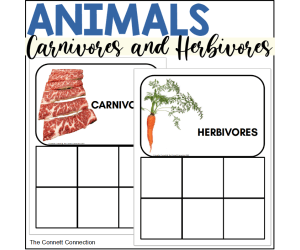
Animal Sort: Carnivore Herbivore Omnivore
Science, Life Sciences, Biology, Grade 1, 2, 3, Activities, Centers, Assessments, Teacher Tools
Allow students to sort animals by what they eat. Students can sort by animal by whether they are carnivores, herbivores, or omnivores. What is Included: There are three sorting card headers for carnivores, herbivores, or omnivores. There are eight sorting mats for carnivores, herbivores, or omnivores. There are six picture cards for each of the three sets of sorting activities. Each sorting mat includes a real life example of an animal that belongs in that animal group. All of the picture cards also include real photographs of each animal. What Questions are Asked: To use these, students will lay out either the header cards or the sorting mats. They will then sort the animal images beneath or on top of the correct sorting mat. When to Use: Science Center - The sorting mats can be placed in a science center for students to learn about living things and what they eat. Morning Work - These animal sorts can allow teachers to create quick and easy morning activities for students while they wait on their classmates to arrive to class. Independent Practice - These animal sorts are great for students to independently work on living things. Emergency Sub Plans - The low prep nature and easy to set up activity , makes these worksheets a great activity to leave with subs to assign to students. Small Group Activity - These animal sorts can be used in small groups so teachers can target the students who need extra practice with living things. Writing Review Activity - These animal sorts work well as a review to reinforce student's learning of living things. These sorting activities are easy to create. The mats just need to be printed out. The picture cards need to be printed and cut apart. Once made, the sort can be used over and over.
Author The Connett Connection
Rating
Tags Science Sort, Hands On Assessment, Carnivore, Herbivore, Omnivore
Science Revision for Grade 3
Science, Grade 3, Activities, Worksheets & Printables, Assessments, Teacher Tools
This Grade 3 Science worksheet is perfect for reviewing key science topics in a fun and easy way. It includes 30 activities that students can complete directly on the page. There is no need for extra materials or prep. The activities cover plants, animals, the sun, water, solids, and more. Students answer multiple choice questions, write true or false, fill in blanks, match words, label a plant, and write short answers. Each activity helps students think, read carefully, and remember science facts. The worksheet uses simple language and clear instructions. It is great for classroom use, homework, or revision before a test. You can also use it for group work or as a science center task. An answer key is included to save you time. Teachers love this worksheet because it keeps students focused and learning. It works well in all kinds of classrooms. Print and use it today to help your students enjoy science and succeed!
Author Bright Classroom Ideas Marketplace
Rating
Tags Science, Grade 3, Revision
Farms Reading Comprehension Passage - Cored Ed Encyclopedia
ELA, Language Development, Resources for Teachers, Reading Comprehension, Reading, Pre-Reading, Writing, Nature & Plants, Life Sciences, Science, Grade 2, 3, 4, 5, Worksheets & Printables, Worksheets, Teacher Tools, Centers, Activities, Writing Prompts, Assessments, Tests, Quizzes and Tests, Quizzes
This farms reading comprehension contains the following: Pre-Reading Trivia Students will write down one thing they already know about the subject and then read five more facts and discuss. These facts are fun, and the students will enjoy learning about the subject before reading more. Reading Passage The text is a high-interest reading passage with set paragraphs, roughly three to four paragraphs long. It contains a variety of themes about the topic, anywhere from history to technology. The passage is between 250 and 350 words in length. Mixed Questions The first question page contains four multiple-choice questions, each with a choice of four answers, and three written response questions that require a sentence or two from the student. Creative Writing In this question, the student will be required to write a five to eight sentence paragraph on a question related to the topic. Extension Activities This page is optional for fast finishers. If there are five to ten minutes left at the end of the lesson, the student can choose one of three activities, each one requiring a different skill. Answer Key There are answers for the multiple-choice questions and three written response questions have sample answers. FULL CATALOG OF DOWNLOAD LINKS AND ENCYCLOPEDIA INDEX HERE Cored Ed Encyclopedia Overview The Cored Ed Encyclopedia is a weekly series of lessons that you can pick up and use right away. These short readings fit into whatever time you have available. Each one includes a warm-up, a reading, and a set of questions, but it’s flexible — you can do just the reading, the full lesson, or skip the writing section if you need to. Each lesson focuses on a single topic so students don’t get lost. The writing is clear but never childish, making it perfect for grades two through five. Topics range from animals and science to history, inventions, and everyday things. No matter the level of the student, everyone should take away at least one new idea or fact from each lesson. The materials are easy to print, easy to explain, and require no setup. They work well for whole-class teaching, partner work, or independent study.
Author Cored Education
Rating
Tags Vocabulary, Spelling, Reading Comprehension, Reading Passages, Reading, Creative Writing, Reading Strategies, Writing Prompts, Farms, Life Science

Owls Reading Comprehension Passage - Cored Ed Encyclopedia
ELA, Language Development, Resources for Teachers, Reading Comprehension, Reading, Pre-Reading, Writing, Science, Animals, Life Sciences, Grade 2, 3, 4, 5, Worksheets & Printables, Worksheets, Teacher Tools, Centers, Activities, Writing Prompts, Assessments, Tests, Quizzes and Tests, Quizzes
This owls reading comprehension contains the following: Visualize on the Cover (Teacher Read Aloud Script) Start your lesson by taking a few moments to visualize the topic and share thoughts or feelings about it. COMPANION VIDEO NOW AVAILABLE (EMBEDDED AFTER PREVIEW PICTURES IN PRODUCT DESCRIPTION) Pre-Reading Trivia Students will write down one thing they already know about the subject and then read five more facts and discuss. These facts are fun, and the students will enjoy learning about the subject before reading more. Reading Passage The text is a high-interest reading passage with set paragraphs, roughly three to four paragraphs long. It contains a variety of themes about the topic, anywhere from history to technology. The passage is between 250 and 350 words in length. Mixed Questions The first question page contains four multiple-choice questions, each with a choice of four answers, and three written response questions that require a sentence or two from the student. Vocabulary Questions Practice seven key words from the text in this section across two activities. First section is scrambled words where students will unscramble three words given a clue for each. The second section is a word to meaning matching activity. Creative Writing In this question, the student will be required to write a five to eight sentence paragraph on a question related to the topic. Extension Activities This page is optional for fast finishers or to take home. There are several activities, each one requiring a different skill. Do some, do none, do all, completely optional - but you will feel reassured knowing every possibility is planned for. Includes summary writting question. Answer Key There are answers for the multiple-choice questions, written response questions have sample answers, vocabulary answers and if there is a summary question then a sample summary will be provided as well. FULL CATALOG OF DOWNLOAD LINKS AND ENCYCLOPEDIA INDEX HERE Lesson Snapshot Title: Owls Genre: Nonfiction (informational text) Subject: Life Science (animals) / Reading Informational Text Primary Topic: How owls hunt, live, and help ecosystems Estimated Guided Reading Level (A–Z): S What This Lesson Teaches Best How owls are birds of prey in a group called Strigiformes , with more than 200 kinds , and most hunt alone and mostly at night. How an owl’s facial disc works “like a satellite dish” to gather tiny sounds and guide them toward its ears. How owl bodies help hunting: wing feathers let air pass quietly, and owls turn their heads (nearly 270 degrees ) because their eyes stay fixed. How scientists sort owls into two main families— Tytonidae and Strigidae —and how owls live in many habitats worldwide (with a few exceptions). How pellets and nest boxes connect owls to people today (learning what was eaten, helping keep mouse numbers down, and supporting safe nesting). Learning Goals Students will describe what the text says about how many kinds of owls there are and when most owls hunt. Students will explain how a facial disc helps an owl find prey using details from the passage. Students will describe two body features that help owls hunt quietly and accurately. Students will identify the two main owl families named in the text and one detail about each. Students will explain what an owl pellet is and how it helps students and scientists learn. Students will name habitats where owls can live and describe one way people can help owls near fields and barns. Key Vocabulary From the Text Strigiformes — a group name for owls. facial — related to the face. parliament — a name for a group of owls. Tytonidae — the barn owl family. pellets — dry bundles of fur and bones owls cough up. Cored Ed Encyclopedia Overview The Cored Ed Encyclopedia is a weekly series of lessons that you can pick up and use right away. These short readings fit into whatever time you have available. Each one includes a warm-up, a reading, and a set of questions, but it’s flexible — you can do just the reading, the full lesson, or skip the writing section if you need to. Each lesson focuses on a single topic so students don’t get lost. The writing is clear but never childish, making it perfect for grades two through five. Topics range from animals and science to history, inventions, and everyday things. No matter the level of the student, everyone should take away at least one new idea or fact from each lesson. The materials are easy to print, easy to explain, and require no setup. They work well for whole-class teaching, partner work, or independent study.
Author Cored Education
Rating
Tags Vocabulary, Spelling, Reading Comprehension, Reading Passages, Reading, Creative Writing, Reading Strategies, Writing Prompts, Owls, Life Science

History of the Domestic Dog: Guided Reading Level R with Lesson Plan
ELA, Resources for Teachers, Reading Comprehension, Reading, Science, Language Development, Life Sciences, Vocabulary, History, Social Studies, Grade 3, 4, 5, Worksheets & Printables, Worksheets, Teacher Tools, Centers, Activities, Literacy Readers, Quizzes, Quizzes and Tests, Assessments, Lesson Plans
This History of the Domestic Dog (level r) guided reading book with lesson plan includes: Guided Reading Color Label (front cover x1) This is a quick way to match the book’s demands to what students can generally handle.. The overall goal is to use the level/color to pick books for several smaller groups. To qualify for a certain level, a student is expected to read a book from that level with about 90–94% accuracy. If a student is consistently accurate and understands, move up a level. If the student is struggling at that level, drop down and add more support. Each student will improve at completely different rates, but it is generally one of the best ways to check progress across the class. DOWNLOAD THE CATALOG TO VIEW ALL GUIDED READING BOOKS AVAILABLE (SORTED LEVELS A-Z) Pre-Reading Question (x1) Teacher asks the prompt aloud, can be while showing the cover or first page. Students share what they already know, or make educated guesses from the cover. Prompt them to use the target vocabulary. Write some of their responses on the board to look back at during the reading. Vocabulary Words (x5) Introduce the five words, best doing it one at a time. Start by saying it, while students repeat and then see if anyone knows what it means before reading further. Read through the meaning and try to briefly connect each word to a picture or gesture so it’s meaningful. Ask students to flip through the book pages and point to where they see each of the vocabulary words. While reading the book pause upon coming across one of the vocab words or read the sentence twice to make sure students understand the word has appeared. Optional: Ask students to raise hands whenever they see/hear one of the new words. Guided Reading Pages (x10) Check the book snapshot (below) for: primary topic - do you need to prep extra reading or intro materials on this? what is taught best - decide on 1-2 bullets to focus on, use the prompt or words provided here for best results. learning goals - what you are checking for students to be able to do after the session, elicit answers using prompts or words provided. key vocabulary (see section above). questions overview - so you know what is coming up and if you need to prep extra materials to assist understanding. Run the lesson You may have already looked at a few of the pages together, but you can show them some of the pictures again first to set meaning. Depending on how much time you have and how familiar your students are with guided reading class, you may want to read the book aloud first with the group first. Students whisper or partner read, while you listen in. If time, do it as a group, one student reading a page each. Use the guided page’s prompts to coach: “Check the picture / does it make sense?” “Point under the words / try the first sound” “Reread the sentence smoothly”. Try to focus more on one student per session (rotating every time), so you can work out if they are ready to move up or need to move down a level. Comprehension Questions (back cover x3) This is your way to check that students didn’t just say the words, but actually understood the text. First, let students answer by pointing to the page/picture and saying a short sentence. After any answer, follow with: “Show me where you found that in the text.” In bigger groups, have partners answer first (10–20 seconds), then call on 2–3 students to share. Differentiation tips: Emerging speakers/struggling readers: oral + pointing On-level: oral in a full sentence Higher: one written sentence or draw + label Book Snapshot Title: The Science and History of the Domestic Dog Genre: Nonfiction (informational) Subject: Life Science Primary Topic: Domestication, traits, and roles of dogs Estimated Guided Reading Level (A–Z): R What This Book Teaches Best Explains dogs’ biological connection to gray wolves , including shared DNA and instincts tied to social behavior and communication. Describes the history of domestication and how human artificial selection led to many distinct dog breeds. Uses specific evidence to show why dogs have exceptional smell and hearing (brain structures, scent receptors, and hearing frequencies). Shows how selective breeding creates specialists for different jobs (speed, herding, cold-weather survival, and service work). Teaches how to read dog communication signals (tail wag speed/height, ear position, facial muscles, back posture). Learning Goals Explain how the text connects domestic dogs to gray wolves using specific evidence (classification and DNA). Describe how domestication began and how humans’ breeding choices created many breeds over time. Identify details that show why dogs can smell better than humans (olfactory bulb and scent receptors). Identify details that show why dogs can hear better than humans (frequencies and ear muscles). Compare at least two breeds in the text by explaining how traits match their work or environment (speed, herding, cold climate, service). Describe what the text says people can look for to understand a dog’s emotional state. Key Vocabulary From the Text subspecies — a smaller group within a kind of animal. domestication — animals becoming used to living with people. olfactory — having to do with smell. frequencies — how high or low a sound is. resilient — able to handle hard conditions and keep going. Discussion Prompts Pre-reading question: What jobs or tasks have you seen dogs do for people? Comprehension questions: According to the text, how are domestic dogs connected to gray wolves? Comprehension questions: What evidence does the text give to show how powerful a dog’s sense of smell is? Comprehension questions: What signs does the text say people can look for to understand a dog’s emotional state? Printing Tips 1. Best Printing Method (Recommended) “Booklet” Printing (Best if Available) If your printer or PDF viewer supports Booklet Printing , use this. Settings to use: Print mode: Booklet Paper size: Letter or A4 (either works) Orientation: Landscape Print on both sides: Yes Flip on: Short edge Scaling: Fit to printable area Booklet subset: First test: Front sides only Then: Back sides only This will automatically: Pair pages correctly Put the cover on the outside Align everything for folding After printing, fold in half and staple along the spine . 2. If “Booklet” Printing Is NOT Available You can still print this correctly with manual duplex printing . Step-by-step: Open the PDF. Choose Print . Set: Orientation: Landscape Pages per sheet: 1 Print on both sides: Yes Flip on: Short edge Print all pages . Because each PDF page already contains two facing book pages, the result will still fold cleanly into a book. Thousands of Cored Education products are included with your TeachSimple membership. Download links and encyclopedia index available here.
Author Cored Education
Rating
Tags Reading Comprehension, Reading Passages, Reading, Guided Reading, Guided Reading Lesson Plan, Guided Reading Activity, Pre-reading, Science Lesson Plans, Life Science, History

Epigenetics: Middle School Life Science Reading Comprehension (Docs)
Science, ELA, Reading, Reading Comprehension, Strategies, Resources for Teachers, Common Core, Language Development, Life Sciences, Biology, Grade 6, 7, 8, 9, 10, Writing Prompts, Worksheets & Printables, Centers, Activities, Teacher Tools, Assessments, Quizzes and Tests, Quizzes, Tests, Literacy Readers
Life Science Reading Comprehension Passage and Questions for Middle School: Epigenetics (Google Document) The engaging passage is about how gene activity can change without changing the DNA sequence itself . It explains how chemical tags, including methyl groups, can affect whether genes are more or less active, and how factors such as diet, stress, exercise, sleep, pollution, and life experiences may influence epigenetic patterns. It also covers identical twins and differences in gene activity over time, possible epigenetic effects across generations, links between epigenetics and disease, and possible uses in personalized medicine. This passage is designed to bridge the gap between science and literacy by strengthening reading comprehension while sparking scientific curiosity in middle school students. It blends English Language Arts skills with accurate science content, helping students build background knowledge, understand key concepts, use evidence from the text, and explain scientific ideas clearly. This resource supports science classroom practice while also reinforcing important literacy skills such as main idea, vocabulary, comprehension, and summarizing. Ideal for interdisciplinary learning in ELA and Science. Suitable for Grade 9 review, too! Student Tasks for The Passage: 10 multiple-choice questions targeting main idea, key details, science concepts, comparison, and real-world applications 10 True/False statements to check understanding and address common misconceptions 5 text-based short-answer questions that require students to explain important ideas from the passage 5 vocabulary matching items with clear, student-friendly definitions 1 summary prompt that asks students to condense the central ideas accurately Full answer key for every section Available Formats for this Resource PDF Fillable PDF Word Docs Product Details Length: 7 pages total Grades: 6–8, also suitable for Grade 9 review Use cases: close reading, stations, homework, intervention, test prep, and sub plans Standards support: Reinforces informational-text skills and supports NGSS-style sense-making by helping students read scientific explanations, connect evidence to key concepts, interpret real-world examples, and explain cause-and-effect relationships in science. FULL CATALOG OF DOWNLOADING LINKS HERE Other Science Reading Collections and Topics You May Find in the Store: 1. Astronomy & Space Science 2. Volcanoes, Rocks, & Mountains 3. Rock Cycle, Soil, & Sinkholes 4. Mars, Glaciers, & Antarctica 5. Water Cycle, Acid Rain, & Wastewater 6. Insects, Animals, & Ecosystems 7. Bioluminescence & Insects 8. Animal Skin, Cats, & T. Rex 9. Human Body and Senses 10. Health & Applied Bioscience 11. Waves, Light, & Imaging 12. Electricity & Energy 13. Motion & Materials 14. Chemistry and Materials Science 15. Electromagnetism 16. Acids and Bases 17. Gas Laws 18. Biotechnology 19. Periodic Trends 20. Protists and Fungi 21. Microevolution 22. Blood 23. Chemical Bonding 24. Magnets 25. Muscles 26. Nuclear Chemistry 27. Electromagnetic Devices 28. Epigenetics 29. The Law of Conservation of Mass 30. Atomic Models 31. Isotopes and Ions 32. Light 33. Human-Environment Interaction 34. Theory of Evolution 35. Photosynthesis 36. Origins of Life and Early Earth 37. Gene Expression and Regulation 38. Thermochemistry 39. Allergies 40. Coevolution 41. Birth to Adulthood 42. Cells 43. Entropy and Free Energy 44. The Human Brain 45. Mixtures and Solutions 46. Invertebrates 47. Zoo Animals 48. Biochemistry 49. Animal Behavior 50. Population Ecology ...and many more engaging science reading passages that cover intriguing and important topics designed to spark curiosity and support student learning. Use this passage to reinforce ELA skills in science, to add literacy to your lessons, and to support independent work. The passages strengthen main idea, evidence use, vocabulary in context, inference, cause and effect, and summary writing. With ready-to-use assessments and complete answer keys, you can provide focused practice that is simple to run and fast to review.
Author Middle & High School - CORED Education
Rating
Tags Middle School, Reading Comprehension, Reading Strategies, ELA, Centers, Reading Passage, Assessments, Vocabulary, Life Science, Biology

Earth Science Reading Passage: Cleaning Wasterwater. SAMPLE
Science, ELA, Reading, Reading Comprehension, Strategies, Resources for Teachers, Earth and Environmental Sciences, Earth Sciences, Environmental Science, Grade 6, 7, 8, 9, Writing Prompts, Worksheets & Printables, Centers, Activities, Teacher Tools, Assessments, Quizzes and Tests, Quizzes, Tests
This is a free passage sample from the complete resource. The full version includes everything needed for a complete reading comprehension activity: the passage, multiple-choice questions, short-answer questions, vocabulary matching, a summary-writing task, and a detailed answer key. Download the complete passage resource by clicking on the following links: PDF Fillable PDF Word Docs Google Docs Science Reading Comprehension Passages and Questions: Cleaning Wastewater (PDF) This very engaging earth science reading passage about Cleaning Wastewater . It is designed to bridge the gap between science and literacy through strengthening reading comprehension and sparking scientific curiosity in middle school students. The passage blends English Language Arts skills with accurate science content that supports NGSS classroom practice. Ideal for interdisciplinary learning in ELA and Science. Suitable for Grade 9 review, too! Student Tasks for The Passage: 5 multiple-choice questions targeting main idea, key details, inference, vocabulary in context, and use of evidence 5 vocabulary matching items with clear, student-friendly definitions 5 text-based questions that require citing specific lines or facts 1 summary prompt that asks students to condense central ideas accurately Full answer key for every section FULL CATALOG OF DOWNLOADING LINKS HERE Product Details Length: 4 pages total Grades: 6–8, also suitable for Grade 9 review Use cases: close reading, stations, homework, intervention, test prep, and sub plans Standards support: reinforces informational-text skills and supports NGSS-style sense making through observation, modeling, and clear use of claim, evidence, and reasoning Why Teachers Choose This Set Authentic science content paired with rigorous literacy practice Consistent task structure across all passages for easier planning and smoother student routines Clear, age-appropriate writing that builds confidence without oversimplifying Other Science Reading Collections you May find in the store: 1. Astronomy & Space Science 2. Volcanoes, Rocks, & Mountains 3. Rock Cycle, Soil, & Sinkholes 4. Mars, Glaciers, & Antarctica 5. Water Cycle, Acid Rain, & Wastewater 6. Insects, Animals, & Ecosystems 7. Bioluminescence & Insects 8. Animal Skin, Cats, & T. Rex 9. Human Body and Senses 10. Health & Applied Bioscience 11. Waves, Light, & Imaging 12. Electricity & Energy 13. Motion & Materials 14. Chemistry and Materials Science Use this set to reinforce ELA skills in science, to add literacy to your lessons, and to support independent work. The passages strengthen main idea, evidence use, vocabulary in context, inference, cause and effect, and summary writing. With ready-to-use assessments and complete answer keys, you can provide focused practice that is simple to run and fast to review.
Author Middle & High School - CORED Education
Rating
Tags Middle School, Reading Comprehension, Reading Strategies, ELA, Centers, Reading Passage, Assessments, Vocabulary, Environmental Science
Pennsylvania PSSA Pack of 3 Science Tests for Grade 8
Science, Grade 8, Assessments, Teacher Tools, Tests, Quizzes and Tests, Worksheets & Printables
Pennsylvania PSSA Pack of 3 Science Tests for Grade 8 Need rigorous 8th grade science test prep that actually reflects the PSSA? These PSSA Science Practice Tests give students real exam-style practice while building confidence and mastery across all tested standards. What’s Included ✅ 3 full-length PSSA-style science practice tests (45 questions each) ✅ 135 total multiple-choice questions ✅ Detailed answer key with step-by-step explanations ✅ Quick answer grids for efficient grading ✅ Comprehensive Teacher’s Guide with pacing and differentiation strategies ✅ Standards alignment (PA Science Anchors S8.A–S8.D) ✅ Diagnostic tools to track student progress and gaps How It Works in the Classroom This 8th grade science test prep resource is designed for flexible classroom use: Use as beginning-of-year benchmarks to assess readiness Implement as mid-year progress monitoring tools Assign for targeted PSSA test prep before exam season Break into stations, homework, or tutoring sessions Ideal for independent practice or sub plans Each test mirrors the format and rigor of the actual exam, helping students feel prepared and confident. Standards & Learning Goals Students review essential middle school science concepts: 🔬 Scientific inquiry, variables, and data analysis (S8.A) 🧬 Life science: cells, genetics, ecosystems (S8.B) ⚡ Physical science: matter, energy, forces, waves (S8.C) 🌎 Earth & space science: plate tectonics, weather, solar system (S8.D) Why Teachers Love It ⭐ Saves hours of planning with ready-to-use assessments ⭐ Prepares students with realistic, standards-aligned questions ⭐ Makes data-driven instruction simple and effective ⭐ Supports differentiation with built-in diagnostic tools ⭐ Works for whole class, small groups, or independent learning Make test prep easier and more effective with this 8th grade science test prep resource. Download today and help your students feel confident and ready for the PSSA!
Author Bright Classroom Ideas Marketplace
Rating
Tags Pennsylvania, Pssa, State Test, Science

Science Reading Passage 38: Geological Time (Google Slides)
ELA, Reading, Reading Comprehension, Common Core, Language Development, Vocabulary, Earth and Environmental Sciences, Science, Earth Sciences, ESL, Grade 5, 6, 7, Presentations, Teacher Tools, Activities, Assessments, Tests, Quizzes and Tests
Free Reading Passage on Geological Time for Earth Science What's inside this free product? Science Reading Comprehension Passage: Geological Time Independent Google Slides Version: This is the independent Google Slides version containingone lesson. Product Info: 38 slides (US English with Answers) Google Slides Version Teaching Duration: 90 Minutes Science Reading Comprehension Outline: Introducing a comprehensive resource tailored for 5th and 6th graders, this product offers enriching reading passages supplemented with illustrative pictures and graphs to clarify key concepts. Aligned with the Common Core State Standards (CCSS), it offers a hassle-free approach to teaching, given that the bulk of the preparation is already done for you. The passages present a diverse set of questions – from multiple choice to data analysis and fill-in-the-blanks. This ensures a rich blend of high-interest content and fundamental curriculum-based science themes. With its versatility, you can seamlessly integrate these lessons into various classroom settings, whether it's whole class discussions, morning exercises, independent desk tasks, small group engagements, contingency plans for substitute teachers, regular homework assignments, or even themed activities for holidays. FULL CATALOG OF DOWNLOAD LINKS HERE Grade 5/6 Links: Physical Science Part 1 - Physical and Chemical Properties Google Docs/Slides/Forms PDF PPT Word Free Supplementary Pack Accompanying Videos Physical Science Part 2 - Motion and Energy Google Docs/Slides/Forms PDF PPT Word Free Supplementary Pack Accompanying Videos Physical Science Part 3 - Electricity and Magnets Google Docs/Slides/Forms PDF PPT Word Free Supplementary Pack Accompanying Videos Life Science Part 1 - Cells, Reproduction and Genetics Google Docs/Slides/Forms PDF PPT Word Free Supplementary Pack Accompanying Videos Life Science Part 2 - Human Body Systems Google Docs/Slides/Forms PDF PPT Word Free Supplementary Pack Accompanying Videos Life Science Part 3 - Plant Parts and Ecosystems Google Docs/Slides/Forms PDF PPT Word Free Supplementary Pack Accompanying Videos Earth Science Part 1 - Plate Tectonics and Rock Cycle Google Docs/Slides/Forms PDF PPT Word Free Supplementary Pack Accompanying Videos Earth Science Part 2 - Ocean Exploration and Natural Resources Google Docs/Slides/Forms PDF PPT Word Free Supplementary Pack Accompanying Videos Earth Science Part 3 - Weather and Solar System Google Docs/Slides/Forms PDF PPT Word Free Supplementary Pack Accompanying Videos For similar products and other frees, do check out Cored Group on TeachSimple .
Author Cored Education
Tags Science, Elementary, Reading, Comprehension, Vocabulary, Answers, Physics, Physical Science, Ccss, Common Core
California CAASPP Pack of 3 Science Tests for Grade 8
Science, Grade 8, Assessments, Teacher Tools, Tests, Quizzes and Tests, Worksheets & Printables
California CAASPP Pack of 3 Science Tests for Grade 8 Help your students master key science concepts and succeed on the CAASPP Grade 8 Science Practice Tests (CAST) ! This rigorous, NGSS-aligned resource includes three full-length tests designed to build confidence, strengthen content knowledge, and prepare students for the California Science Test. What’s Included ✅ 3 full-length CAASPP Grade 8 Science practice tests (50 questions each, 150 total) ✅ Coverage of all domains: Physical Science, Life Science, Earth & Space Science, and Engineering ✅ Printable student test booklets with CAST-style multiple-choice questions ✅ Complete answer key with detailed explanations and domain codes ✅ Comprehensive Teacher’s Guide with pacing, scoring, NGSS alignment, and teaching strategies ✅ Quick-score grids and class data tracking sheets for easy grading How It Works in the Classroom These Grade 8 CAASPP Science practice tests are designed for flexible, real-world classroom use: Use as full-length test simulations (60–75 minutes each) to mirror CAST conditions Assign by domain for targeted review and intervention (Physical, Life, Earth, Engineering) Use answer explanations to reteach concepts and correct misconceptions Track student performance using domain-based scoring and data sheets Administer in one session or split into multiple sessions for deeper instruction Standards & Learning Goals Aligned to California Next Generation Science Standards (CA NGSS) and modeled after the CAST. Students will build mastery in: Physical Science: forces, motion, energy, waves, electricity, and matter Life Science: genetics, natural selection, cells, and body systems Earth & Space Science: plate tectonics, climate change, Earth systems, and space science Engineering & Technology: design process, trade-offs, prototypes, and problem-solving Why Teachers Love It ⭐ Mirrors real CAASPP/CAST format and rigor ⭐ Covers all NGSS domains in one resource ⭐ Includes detailed explanations for meaningful reteaching ⭐ Supports data-driven instruction with domain-level insights ⭐ No-prep, print-and-go for easy classroom use Teachers love using this resource for benchmark assessments, intervention, and end-of-year test prep ! Download these CAASPP Grade 8 Science Practice Tests (CAST) today and give your students the structured, standards-based practice they need to succeed on test day!
Author Bright Classroom Ideas Marketplace
Rating
Tags California, Caaspp, State Test, Science
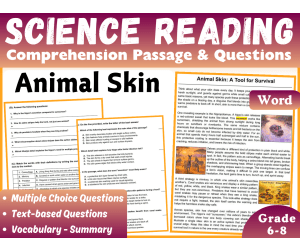
Life Science Reading Comprehension Passage: Animal Skin (Word)
Science, ELA, Reading, Reading Comprehension, Strategies, Resources for Teachers, Life Sciences, Animals, Biology, Grade 6, 7, 8, 9, Writing Prompts, Worksheets & Printables, Centers, Activities, Teacher Tools, Assessments, Quizzes and Tests, Quizzes, Tests
Life Science Reading Comprehension Passage and Questions: Animal Skin (Word) This very engaging life science reading passage about how animal skin helps animals survive. It explains that skin is not just a body covering. It can protect animals from sunlight, germs, insects, and predators. The passage gives three main examples : Hippos: Their red-colored secretion works like sunscreen, discourages insects, and helps kill bacteria. Zebras: Their stripes act as camouflage and can confuse predators when the herd moves together. King snakes: Their colors imitate venomous coral snakes, which makes predators hesitate or back off. This passage is designed to bridge the gap between science and literacy through strengthening reading comprehension and sparking scientific curiosity in middle school students. The passage blends English Language Arts skills with accurate science content that supports NGSS classroom practice. Ideal for interdisciplinary learning in ELA and Science. Suitable for Grade 9 review, too! Student Tasks for The Passage: 5 multiple-choice questions targeting main idea, key details, inference, vocabulary in context, and use of evidence 5 vocabulary matching items with clear, student-friendly definitions 5 text-based questions that require citing specific lines or facts 1 summary prompt that asks students to condense central ideas accurately Full answer key for every section Available Formats for this Resource PDF Fillable PDF Google Docs FULL CATALOG OF DOWNLOADING LINKS HERE Product Details Length: 4 pages total Grades: 6–8, also suitable for Grade 9 review Use cases: close reading, stations, homework, intervention, test prep, and sub plans Standards support: reinforces informational-text skills and supports NGSS-style sense making through observation, modeling, and clear use of claim, evidence, and reasoning Why Teachers Choose This Set Authentic science content paired with rigorous literacy practice Consistent task structure across all passages for easier planning and smoother student routines Clear, age-appropriate writing that builds confidence without oversimplifying Other Science Reading Collections you May find in the store: 1. Astronomy & Space Science 2. Volcanoes, Rocks, & Mountains 3. Rock Cycle, Soil, & Sinkholes 4. Mars, Glaciers, & Antarctica 5. Water Cycle, Acid Rain, & Wastewater 6. Insects, Animals, & Ecosystems 7. Bioluminescence & Insects 8. Animal Skin, Cats, & T. Rex 9. Human Body and Senses 10. Health & Applied Bioscience 11. Waves, Light, & Imaging 12. Electricity & Energy 13. Motion & Materials 14. Chemistry and Materials Science Use this set to reinforce ELA skills in science, to add literacy to your lessons, and to support independent work. The passages strengthen main idea, evidence use, vocabulary in context, inference, cause and effect, and summary writing. With ready-to-use assessments and complete answer keys, you can provide focused practice that is simple to run and fast to review.
Author Middle & High School - CORED Education
Rating
Tags Middle School, Reading Comprehension, Reading Strategies, ELA, Centers, Reading Passage, Assessments, Vocabulary, Life Science

Phonics & Early Literacy with Themed Story Builders
STEM, Classroom Management, Resources for Teachers, Community Building, Science, Basic Science, Inventors, Theories, Special Resources, Social Emotional Learning (SEL), Kindergarten, Preschool, Homeschool Curriculum, Homeschool Templates, Grade 1, 2, 3, Teacher Tools, Assessments, Lesson Plans, Literacy Readers, Quizzes and Tests, Quizzes, Tests, Worksheets & Printables, Workbooks, Worksheets
Do your students get bored by phonics drills? Do you have beginning readers who sound out words well, but do not understand what they read? Phonics & Early Literacy With Themed Story Builders will connect the dots between mechanical decoding and creating a love for books and reading! 39 pages of the most complete literacy program curriculum for Kindergarten through 1st and 2nd grade. The program is rooted in the Science of Reading offers a unique method for teaching phonics skills through a new way of creating stories. This program also provides the student opportunities to develop vocabulary, syntax and comprehension while expressing his/her own creativity and imagination. Constrained Narrative Architecture (CNA) Method not only moves students beyond rote memorization when learning how to decode word lists, but also teaches students how to build themed stories using the newly-acquired phonics skills. Once students have created a complete themed story, they will have an understanding of the phonics rules used in the story, plus vocabulary, syntax and comprehension. What You're Getting with This Resource Without Preparation That Has An Immediate Impact on Teaching!? PHASE ONE: Theoretical Foundations & Core Content for the Teacher- This guide provides an educator with an understanding of the neuroscience behind our methodology. The educator will learn the "why" of Orthographic Mapping, Cognitive Load Theory, Narrative Scaffolding, and other elements to become a more experienced and knowledgeable teacher. PHASE TWO: Student Workbook- The student workbook consists of 10 fun thematic worksheets and each worksheet will provide the student with a story background that aligns to the specific sequential skill provided on the worksheet, and offers the student an adventure in phonics. PHASE THREE: Teacher Resource Package- The teacher resource package consists of pedagogical diagrams, full comprehensive answer key, and a teacher implementation guide with pacing suggestions. The 10 Themed Adventure Worksheets Cover the Following Skills in a Sequence: 1. The Alpine Forest (Short Vowels & CVC Words) 2. Deep Sea Discovery (Consonant Digraphs; sh, ch, th, wh) 3. The Clockwork City (Initial Consonant Blends: L, R, S) 4. Dino-Valley Dig (CVCe Words- “Magic e”) 5. Starlight Space Station (Long Vowel Teams- ai, ee, ea, oa, ue) 6. The Whispering Willow Farm (R-Controlled Vowels- ar, er, ir, or, ur) 7. The Weather Wizards (Diphthongs; ou, ow, oi, oy) 8. The Great Mountain Train (Hard/Soft 'c'/ 'g') 9. The Midnight Toy Shop (Syllable Segmentation) 10. The Enchanted Castle (Cumulative Review/Creative Story Building) This is ideal for large group instruction, small group intervention, structured literacy centers, or an effective homeschool phonics program. It will stop the continual slaughter of expected reading enjoyment and create skilled independent readers now! Search for: phonics programs, science of reading, early literacy, kindergarten reading programs, first grade phonics programs, second grade literacy programs, decodable activities, reading intervention programs, story building worksheets, fill-in-the-blank worksheets, structured literacy center materials, homeschool phonics programs, constant vowel, constant e, constant combination sounds, and constant blends of vowel sounds. The reason why parents and schools are happy is because the curriculum is based on scientific principles, known as the "Science of Reading." This means that the curriculum teaches children to read the right way and progresses from the recognition of the individual sounds to being able to read smoothly and understand what they are reading. Phonics becomes fun instead of boring since this curriculum substitutes the traditional rote phonics drills with engaging themed activities. Children become so involved in creating an imaginative story with dinosaurs or by creating a real-life story about a space station that they do not even realize they are really learning important phonics skills. True comprehension of what to read is developed because this resource requires students to select the word that completes a sentence so that it will make sense. This develops the child’s ability to read for meaning as opposed to simply reading out loud. This resource is designed to be easily differentiated as the teacher’s guide contains suggestions for helping struggling readers (such as those with dyslexia) and those working at an advanced level, making it suitable for all students in a diverse classroom or homeschool environment. This resource is comprehensive and ready to be implemented right away, as it includes not only the worksheets that are used in the program, but also has a complete teacher’s guide, student activities to use with the worksheets, and an answer key. Everything you need! Target Audience Review: According to the explicit scope and sequencing outlined on pages 7 & 8 that outline students working through CVC words all the way to multisyllabic words, the following summarizes how this PDF has been developed for: - Primary Target Students: Kindergarten (approx. age 5) - 1st Grade (approx. age 6) and 2nd grade (approx. age 7). - Primary Buyers: K-2 Classroom Teachers, Home School Parents, Literacy Specialists, Reading Interventionists and Tutors. Phase 1 of the theoretical component of the PDF is especially beneficial to these users as it will allow them to show the product's educational merit by demonstrating that the research supports the Science of Reading. Copyright & Terms of Use: This Author's work is licensed to Syed Hammad Rizvi. This product has been created for personal use/by you and one other teacher in the same place. You cannot alter, redistribute or make this product available for sale. You may not upload this product onto any website unless you would like to lose your copyright ownership of the work. Again, please respect the above license agreement and do not share this product with your colleagues, if they would like access, please help them out by purchasing a license from Teachsimple. Thank you very much for your understanding, I appreciate it! As usual this product is provided as a free service, thanks for being apart of my business!
Author Creative Book Store
Rating
Tags Phonics, Scienceofreading, Earlyliteracy, Structuredliteracy, Reading, Literacy, Teachertiptuesday, Kindergarten, Firstgrade, Secondgrade
Guided Reading Level K - Tallest Giant Giraffes (with Lesson Plan)
ELA, Resources for Teachers, Reading Comprehension, Reading, Science, Language Development, Life Sciences, Animals, Pre-Reading, Vocabulary, Grade 2, 3, 4, Worksheets & Printables, Worksheets, Teacher Tools, Centers, Activities, Literacy Readers, Quizzes, Quizzes and Tests, Assessments, Lesson Plans
This Guided Reading Book - Tallest Giant Giraffes (Level K) with lesson plan includes: Guided Reading Color Label (front cover x1) This is a quick way to match the book’s demands to what students can generally handle.. The overall goal is to use the level/color to pick books for several smaller groups. To qualify for a certain level, a student is expected to read a book from that level with about 90–94% accuracy. If a student is consistently accurate and understands, move up a level. If the student is struggling at that level, drop down and add more support. Each student will improve at completely different rates, but it is generally one of the best ways to check progress across the class. DOWNLOAD THE CATALOG TO VIEW ALL GUIDED READING BOOKS AVAILABLE (SORTED LEVELS A-Z) Pre-Reading Question (x1) Teacher asks the prompt aloud, can be while showing the cover or first page. Students share what they already know, or make educated guesses from the cover. Prompt them to use the target vocabulary. Write some of their responses on the board to look back at during the reading. Vocabulary Words (x5) Introduce the five words, best doing it one at a time. Start by saying it, while students repeat and then see if anyone knows what it means before reading further. Read through the meaning and try to briefly connect each word to a picture or gesture so it’s meaningful. Ask students to flip through the book pages and point to where they see each of the vocabulary words. While reading the book pause upon coming across one of the vocab words or read the sentence twice to make sure students understand the word has appeared. Optional: Ask students to raise hands whenever they see/hear one of the new words. Guided Reading Pages (x10) Check the book snapshot (below) for: primary topic - do you need to prep extra reading or intro materials on this? what is taught best - decide on 1-2 bullets to focus on, use the prompt or words provided here for best results. learning goals - what you are checking for students to be able to do after the session, elicit answers using prompts or words provided. key vocabulary (see section above). questions overview - so you know what is coming up and if you need to prep extra materials to assist understanding. Run the lesson You may have already looked at a few of the pages together, but you can show them some of the pictures again first to set meaning. Depending on how much time you have and how familiar your students are with guided reading class, you may want to read the book aloud first with the group first. Students whisper or partner read, while you listen in. If time, do it as a group, one student reading a page each. Use the guided page’s prompts to coach: “Check the picture / does it make sense?” “Point under the words / try the first sound” “Reread the sentence smoothly”. Try to focus more on one student per session (rotating every time), so you can work out if they are ready to move up or need to move down a level. Comprehension Questions (back cover x3) This is your way to check that students didn’t just say the words, but actually understood the text. First, let students answer by pointing to the page/picture and saying a short sentence. After any answer, follow with: “Show me where you found that in the text.” In bigger groups, have partners answer first (10–20 seconds), then call on 2–3 students to share. Differentiation tips: Emerging speakers/struggling readers: oral + pointing On-level: oral in a full sentence Higher: one written sentence or draw + label Book Snapshot Title: The Tallest Giant: Giraffes Genre: Nonfiction (informational) Subject: Life Science + Reading (Informational Text) Primary Topic: Giraffe body parts and survival traits Estimated Guided Reading Level (A–Z): K What This Book Teaches Best Giraffes are the tallest land animals and live in the warm, sunny savanna in Africa. A giraffe’s long neck helps it reach “juicy green leaves” on tall trees that other animals cannot touch. Giraffes use a long, strong, dark tongue to wrap around branches and pull off leaves, even with sharp thorns. Each giraffe has a unique pattern of spots; no two have the exact same shapes or colors on their fur. The text highlights survival behaviors and features (drinking stance, short standing naps for safety, fast running, and newborn calf size). Learning Goals Students will describe where giraffes live using details from the text. Students will explain how a giraffe’s long neck helps it get food. Students will describe how a giraffe uses its tongue to pull off leaves, even when there are thorns. Students will explain what is unique about each giraffe’s spots. Students will describe what a giraffe must do to drink water and why it is hard to reach the ground. Students will identify two facts about how giraffes stay safe or move (short naps standing up; running up to thirty-five miles per hour; traveling long distances). Key Vocabulary From the Text savanna — a warm, sunny place with grass and tall trees. juicy — full of liquid; wet and tasty. thorns — sharp points on a plant that can poke you. unique — one of a kind; not the same as others. ossicones — small, fuzzy horns on top of a giraffe’s head. Discussion Prompts Pre-reading question: What body parts might help a giraffe get food and stay safe? Comprehension questions: How does a giraffe’s long neck help it reach food that other animals cannot touch? Comprehension questions: What does the book say a giraffe must do to drink water? Comprehension questions: What is special about each giraffe’s pattern of spots? Printing Tips 1. Best Printing Method (Recommended) “Booklet” Printing (Best if Available) If your printer or PDF viewer supports Booklet Printing , use this. Settings to use: Print mode: Booklet Paper size: Letter or A4 (either works) Orientation: Landscape Print on both sides: Yes Flip on: Short edge Scaling: Fit to printable area Booklet subset: First test: Front sides only Then: Back sides only This will automatically: Pair pages correctly Put the cover on the outside Align everything for folding After printing, fold in half and staple along the spine . 2. If “Booklet” Printing Is NOT Available You can still print this correctly with manual duplex printing . Step-by-step: Open the PDF. Choose Print . Set: Orientation: Landscape Pages per sheet: 1 Print on both sides: Yes Flip on: Short edge Print all pages . Because each PDF page already contains two facing book pages, the result will still fold cleanly into a book. Thousands of Cored Education products are included with your TeachSimple membership. Download links and encyclopedia index available here.
Author Cored Education
Rating
Tags Reading Comprehension, Reading Passages, Reading, Guided Reading, Guided Reading Lesson Plan, Guided Reading Activity, Pre-reading, Science Lesson Plans, Life Science, Animals
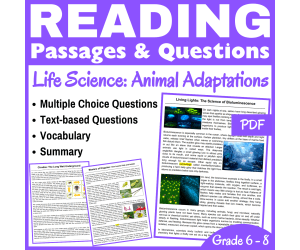
Bioluminescence & Insects : Reading Comprehension passages (PDF)
Science, ELA, Reading, Reading Comprehension, Strategies, Resources for Teachers, Life Sciences, Animals, Insects, Nature & Plants, Grade 6, 7, 8, 9, Writing Prompts, Worksheets & Printables, Centers, Activities, Teacher Tools, Assessments, Quizzes and Tests, Quizzes, Tests
Bioluminescence & Insects: Reading Comprehension Passages (PDF) This very engaging collection of life science reading passages about Bioluminescence & Insects is designed to bridge the gap between science and literacy through strengthening reading comprehension and sparking scientific curiosity in middle school students. Each passage blends English Language Arts skills with accurate science content that supports NGSS classroom practice. Ideal for interdisciplinary learning in ELA and Science. Suitable for Grade 9 review, too! What Is Included? There are (3) informational passages: Living Lights: The Science of Bioluminescence Explains how organisms produce “cold light” with luciferin and luciferase, and shows why they glow for signaling, hunting, and protection. Cicadas: The Long Wait Underground Covers the long underground nymph stage, synchronized emergence, molting, loud calls, and how this life cycle supports survival and reproduction. Masters of Disguise: How Insects Hide and Imitate Distinguishes camouflage from mimicry with clear examples, highlighting how color, shape, and behavior help insects avoid predators and capture prey. Student Tasks for Each Passage: 5 multiple-choice questions targeting main idea, key details, inference, vocabulary in context, and use of evidence 5 vocabulary matching items with clear, student-friendly definitions 5 text-based questions that require citing specific lines or facts 1 summary prompt that asks students to condense central ideas accurately Full answer key for every section Available Formats for this Resource Word Docs Google Docs FULL CATALOG OF DOWNLOADING LINKS HERE Other Science Reading Collections and Topics You May Find in the Store: 1. Astronomy & Space Science 2. Volcanoes, Rocks, & Mountains 3. Rock Cycle, Soil, & Sinkholes 4. Mars, Glaciers, & Antarctica 5. Water Cycle, Acid Rain, & Wastewater 6. Insects, Animals, & Ecosystems 7. Bioluminescence & Insects 8. Animal Skin, Cats, & T. Rex 9. Human Body and Senses 10. Health & Applied Bioscience 11. Waves, Light, & Imaging 12. Electricity & Energy 13. Motion & Materials 14. Chemistry and Materials Science 15. Electromagnetism 16. Acids and Bases 17. Gas Laws 18. Biotechnology 19. Periodic Trends 20. Protists and Fungi 21. Microevolution 22. Blood 23. Chemical Bonding 24. Magnets 25. Muscles 26. Nuclear Chemistry 27. Electromagnetic Devices 28. Epigenetics 29. The Law of Conservation of Mass 30. Atomic Models 31. Isotopes and Ions 32. Light 33. Human-Environment Interaction 34. Theory of Evolution 35. Photosynthesis 36. Origins of Life and Early Earth 37. Gene Expression and Regulation 38. Thermochemistry 39. Allergies 40. Coevolution 41. Birth to Adulthood 42. Cells 43. Entropy and Free Energy 44. The Human Brain 45. Mixtures and Solutions 46. Invertebrates 47. Zoo Animals 48. Biochemistry 49. Animal Behavior 50. Population Ecology ...and many more engaging science reading passages that cover intriguing and important topics designed to spark curiosity and support student learning. Product Details Length: 14 pages total Grades: 6–8, also suitable for Grade 9 review Use cases: close reading, stations, homework, intervention, test prep, and sub plans Standards support: reinforces informational-text skills and supports NGSS-style sense making through observation, modeling, and clear use of claim, evidence, and reasoning Why Teachers Choose This Set Authentic science content paired with rigorous literacy practice Consistent task structure across all passages for easier planning and smoother student routines Clear, age-appropriate writing that builds confidence without oversimplifying Use this set to reinforce ELA skills in science, to add literacy to your lessons, or to support independent work. The passages strengthen main idea, evidence use, vocabulary in context, inference, cause and effect, and summary writing. With ready-to-use assessments and complete answer keys, you can provide focused practice that is simple to run and fast to review.
Author Middle & High School - CORED Education
Rating
Tags Middle School, Reading Comprehension, Reading Strategies, ELA, Centers, Reading Passage, Assessments, Vocabulary, Life Science, Insects
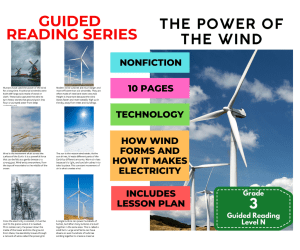
Guided Reading Level N - The Power of the Wind (with Lesson Plan)
ELA, Resources for Teachers, Reading Comprehension, Reading, Social Studies, Geography, Earth and Environmental Sciences, Science, Physics, Technology, Grade 2, 3, 4, Worksheets & Printables, Worksheets, Teacher Tools, Centers, Activities, Literacy Readers, Quizzes, Quizzes and Tests, Assessments, Lesson Plans
This Guided Reading Book - The Power of the Wind (Level N) with lesson plan includes: Guided Reading Color Label (front cover x1) This is a quick way to match the book’s demands to what students can generally handle.. The overall goal is to use the level/color to pick books for several smaller groups. To qualify for a certain level, a student is expected to read a book from that level with about 90–94% accuracy. If a student is consistently accurate and understands, move up a level. If the student is struggling at that level, drop down and add more support. Each student will improve at completely different rates, but it is generally one of the best ways to check progress across the class. DOWNLOAD THE CATALOG TO VIEW ALL GUIDED READING BOOKS AVAILABLE (SORTED LEVELS A-Z) Pre-Reading Question (x1) Teacher asks the prompt aloud, can be while showing the cover or first page. Students share what they already know, or make educated guesses from the cover. Prompt them to use the target vocabulary. Write some of their responses on the board to look back at during the reading. Vocabulary Words (x5) Introduce the five words, best doing it one at a time. Start by saying it, while students repeat and then see if anyone knows what it means before reading further. Read through the meaning and try to briefly connect each word to a picture or gesture so it’s meaningful. Ask students to flip through the book pages and point to where they see each of the vocabulary words. While reading the book pause upon coming across one of the vocab words or read the sentence twice to make sure students understand the word has appeared. Optional: Ask students to raise hands whenever they see/hear one of the new words. Guided Reading Pages (x10) Check the book snapshot (below) for: primary topic - do you need to prep extra reading or intro materials on this? what is taught best - decide on 1-2 bullets to focus on, use the prompt or words provided here for best results. learning goals - what you are checking for students to be able to do after the session, elicit answers using prompts or words provided. key vocabulary (see section above). questions overview - so you know what is coming up and if you need to prep extra materials to assist understanding. Run the lesson You may have already looked at a few of the pages together, but you can show them some of the pictures again first to set meaning. Depending on how much time you have and how familiar your students are with guided reading class, you may want to read the book aloud first with the group first. Students whisper or partner read, while you listen in. If time, do it as a group, one student reading a page each. Use the guided page’s prompts to coach: “Check the picture / does it make sense?” “Point under the words / try the first sound” “Reread the sentence smoothly”. Try to focus more on one student per session (rotating every time), so you can work out if they are ready to move up or need to move down a level. Comprehension Questions (back cover x3) This is your way to check that students didn’t just say the words, but actually understood the text. First, let students answer by pointing to the page/picture and saying a short sentence. After any answer, follow with: “Show me where you found that in the text.” In bigger groups, have partners answer first (10–20 seconds), then call on 2–3 students to share. Differentiation tips: Emerging speakers/struggling readers: oral + pointing On-level: oral in a full sentence Higher: one written sentence or draw + label Book Snapshot Title: The Power of the Wind Genre: Nonfiction (informational science text) Subject: Science (Energy/Earth Science) Primary Topic: How wind forms and how it makes electricity Estimated Guided Reading Level (A–Z): N What This Book Teaches Best Defines wind as the movement of air across Earth’s surface and describes wind as a breeze or a strong gust. Explains the cause of wind : the sun heats Earth unevenly, warm air rises, and cool air moves in to replace it. Shows how people have used wind over time, comparing traditional windmills (grinding grain, pumping water) to modern wind turbines. Describes how a wind turbine works, including blades spinning a shaft connected to a generator that makes electricity. Connects wind energy to sustainability by explaining wind farms , offshore wind farms , and wind energy as a clean, renewable resource. Learning Goals Students will explain what wind is using details from the text. Students will describe how the sun’s heating of Earth helps create wind. Students will describe how traditional windmills used wind to help people. Students will explain how wind turbines change wind’s motion into electricity. Students will describe what a wind farm is and why offshore wind farms can capture strong winds. Students will explain why wind energy is described as renewable and clean in the text. Key Vocabulary From the Text movement — going from one place to another. gust — a short, strong burst of wind. turbines — big machines with blades that spin in wind. generator — a machine that makes electricity. renewable — can be used again and won’t run out. Discussion Prompts Pre-reading question: Where have you seen wind do work, like moving something or making power? Comprehension questions: What does the text say creates wind? Comprehension questions: How did traditional windmills use wind to help people? Comprehension questions: How does a wind turbine turn wind into electricity, according to the text? Printing Tips 1. Best Printing Method (Recommended) “Booklet” Printing (Best if Available) If your printer or PDF viewer supports Booklet Printing , use this. Settings to use: Print mode: Booklet Paper size: Letter or A4 (either works) Orientation: Landscape Print on both sides: Yes Flip on: Short edge Scaling: Fit to printable area Booklet subset: First test: Front sides only Then: Back sides only This will automatically: Pair pages correctly Put the cover on the outside Align everything for folding After printing, fold in half and staple along the spine . 2. If “Booklet” Printing Is NOT Available You can still print this correctly with manual duplex printing . Step-by-step: Open the PDF. Choose Print . Set: Orientation: Landscape Pages per sheet: 1 Print on both sides: Yes Flip on: Short edge Print all pages . Because each PDF page already contains two facing book pages, the result will still fold cleanly into a book. Thousands of Cored Education products are included with your TeachSimple membership. Download links and encyclopedia index available here.
Author Cored Education
Rating
Tags Reading Comprehension, Reading Passages, Reading, Guided Reading, Guided Reading Lesson Plan, Guided Reading Activity, Pre-reading, Geography, Science Lesson Plans, Technology
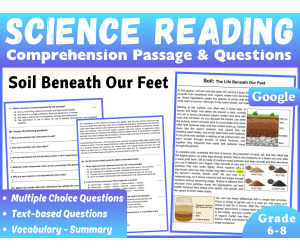
Earth Science Reading Comprehension Passage: Soil Types (Docs)
Science, ELA, Reading, Reading Comprehension, Strategies, Resources for Teachers, Earth and Environmental Sciences, Earth Sciences, Geology, Grade 6, 7, 8, 9, Writing Prompts, Worksheets & Printables, Centers, Activities, Teacher Tools, Assessments, Quizzes and Tests, Quizzes, Tests
Science Reading Comprehension Passages and Questions: Soil Types (Docs) This very engaging earth science reading passage about Soil Types is designed to bridge the gap between science and literacy through strengthening reading comprehension and sparking scientific curiosity in middle school students. The passage blends English Language Arts skills with accurate science content that supports NGSS classroom practice. Ideal for interdisciplinary learning in ELA and Science. Suitable for Grade 9 review, too! Student Tasks for The Passage: 5 multiple-choice questions targeting main idea, key details, inference, vocabulary in context, and use of evidence 5 vocabulary matching items with clear, student-friendly definitions 5 text-based questions that require citing specific lines or facts 1 summary prompt that asks students to condense central ideas accurately Full answer key for every section Available Formats for this Resource PDF Fillable PDF Word Docs FULL CATALOG OF DOWNLOADING LINKS HERE Product Details Length: 5 pages total Grades: 6–8, also suitable for Grade 9 review Use cases: close reading, stations, homework, intervention, test prep, and sub plans Standards support: reinforces informational-text skills and supports NGSS-style sense making through observation, modeling, and clear use of claim, evidence, and reasoning Why Teachers Choose This Set Authentic science content paired with rigorous literacy practice Consistent task structure across all passages for easier planning and smoother student routines Clear, age-appropriate writing that builds confidence without oversimplifying Other Science Reading Collections you May find in the store: 1. Astronomy & Space Science 2. Volcanoes, Rocks, & Mountains 3. Rock Cycle, Soil, & Sinkholes 4. Mars, Glaciers, & Antarctica 5. Water Cycle, Acid Rain, & Wastewater 6. Insects, Animals, & Ecosystems 7. Bioluminescence & Insects 8. Animal Skin, Cats, & T. Rex 9. Human Body and Senses 10. Health & Applied Bioscience 11. Waves, Light, & Imaging 12. Electricity & Energy 13. Motion & Materials 14. Chemistry and Materials Science Use this set to reinforce ELA skills in science, to add literacy to your lessons, and to support independent work. The passages strengthen main idea, evidence use, vocabulary in context, inference, cause and effect, and summary writing. With ready-to-use assessments and complete answer keys, you can provide focused practice that is simple to run and fast to review.
Author Middle & High School - CORED Education
Rating
Tags Middle School, Reading Comprehension, Reading Strategies, ELA, Centers, Reading Passage, Assessments, Vocabulary, Environmental Science, Earth Science

Earth Science Reading Comprehension Passage: From Earth to Mars (PDF)
Science, ELA, Reading, Reading Comprehension, Strategies, Resources for Teachers, Earth and Environmental Sciences, Space, Grade 6, 7, 8, 9, Writing Prompts, Worksheets & Printables, Centers, Activities, Teacher Tools, Assessments, Quizzes and Tests, Quizzes, Tests
Science Reading Comprehension Passages and Questions: From Earth to Mars (PDF) This very engaging earth science reading passage about Mars is designed to bridge the gap between science and literacy through strengthening reading comprehension and sparking scientific curiosity in middle school students. The passage blends English Language Arts skills with accurate science content that supports NGSS classroom practice. Ideal for interdisciplinary learning in ELA and Science. Suitable for Grade 9 review, too! Student Tasks for The Passage: 5 multiple-choice questions targeting main idea, key details, inference, vocabulary in context, and use of evidence 5 vocabulary matching items with clear, student-friendly definitions 5 text-based questions that require citing specific lines or facts 1 summary prompt that asks students to condense central ideas accurately Full answer key for every section Available Formats for this Resource Fillable PDF Word Docs Google Docs FULL CATALOG OF DOWNLOADING LINKS HERE Product Details Length: 5 pages total Grades: 6–8, also suitable for Grade 9 review Use cases: close reading, stations, homework, intervention, test prep, and sub plans Standards support: reinforces informational-text skills and supports NGSS-style sense making through observation, modeling, and clear use of claim, evidence, and reasoning Why Teachers Choose This Set Authentic science content paired with rigorous literacy practice Consistent task structure across all passages for easier planning and smoother student routines Clear, age-appropriate writing that builds confidence without oversimplifying Other Science Reading Collections you May find in the store: 1. Astronomy & Space Science 2. Volcanoes, Rocks, & Mountains 3. Rock Cycle, Soil, & Sinkholes 4. Mars, Glaciers, & Antarctica 5. Water Cycle, Acid Rain, & Wastewater 6. Insects, Animals, & Ecosystems 7. Bioluminescence & Insects 8. Animal Skin, Cats, & T. Rex 9. Human Body and Senses 10. Health & Applied Bioscience 11. Waves, Light, & Imaging 12. Electricity & Energy 13. Motion & Materials 14. Chemistry and Materials Science Use this set to reinforce ELA skills in science, to add literacy to your lessons, and to support independent work. The passages strengthen main idea, evidence use, vocabulary in context, inference, cause and effect, and summary writing. With ready-to-use assessments and complete answer keys, you can provide focused practice that is simple to run and fast to review.
Author Middle & High School - CORED Education
Rating
Tags Middle School, Reading Comprehension, Reading Strategies, ELA, Centers, Reading Passage, Assessments, Vocabulary, Environmental Science, Space
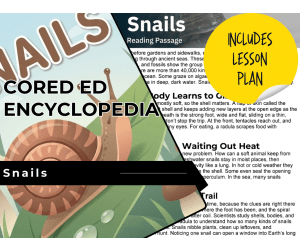
Snails Reading Comprehension Passage - Cored Ed Encyclopedia
ELA, Language Development, Reading Comprehension, Reading, Pre-Reading, Writing, Science, Animals, Life Sciences, Strategies, Grade 2, 3, 4, 5, Worksheets & Printables, Worksheets, Teacher Tools, Centers, Activities, Writing Prompts, Assessments, Quizzes and Tests, Quizzes, Lesson Plans
This snails reading comprehension includes: Visualization (on the front cover) Start your lesson by taking a minute to think and share something about the topic. Read the script aloud (slowly), perhaps prepare some music or sound effects. Student close their eyes and let their imaginations wander. Students open their eyes, read the question aloud and give them a few minutes to complete. Ask a few students to share or keep answers until the end to compare with what they learn in the passage. Quick pause—thousands of Cored Education products are included with your TeachSimple membership. Download links and encyclopedia index available here. Pre-Reading Trivia Students will write down one thing they already know about the subject and then read five more facts and discuss. These facts are fun, and the students will enjoy learning about the subject before reading more. Give 1 minute for students to write what they already know (no pressure—best guess is fine). Read the five facts together. After each fact, do ask a student for their opinion, was it surprising? Set a purpose by asking students to highlight/underline one fact they want to learn more about during the reading. Reading Passage The text is a high-interest reading passage with set paragraphs, roughly three to four paragraphs long. It contains a variety of themes about the topic, anywhere from history to technology. The passage is between 250 and 350 words in length. First, ask students to look at the headings and see what they’ll learn about today. What do they know about the topic/heading? First read options: Teacher read-aloud (best for support). Partner reading (paragraph by paragraph). While reading, students underline important details, and vocabulary words they think may come up in the questions section. Mixed Questions The first question page contains four multiple-choice questions, each with a choice of four answers, and three written response questions that require a sentence or two from the student. Students complete the mcqs first independently, then review quickly as a class. For the 3 written responses, try to get students giving the answer with some form of evidence: “I think ___ because the text says ___.” If students get stuck, send them back to check the passage. Vocabulary Questions Practice seven key words from the text in this section across two activities. First section is scrambled words where students will unscramble three words given a clue for each. The second section is a word to meaning matching activity. Before starting, have some students read out words they underlined in the passage. Ask students to say the word and read aloud the sentence(s) around each word. Ask students to do scrambled words and the matching exercise in pairs then go through answers as a class. For the scrambled spelling task, get four pairs to come up to the board and write the words for extra practice with the other student reading out the clue. For the matching task, prompt students to give full sentences: “I matched ___ with ___ because ___.” Creative Writing In this question, the student will be required to write a five to eight sentence paragraph on a question related to the topic. Before starting, ask students write down 3 key ideas they are going to include in their piece. Ask students for ideas to share around the class to help those struggling. Pro writing expectations: 5–8 sentences At least 2 facts or details from the passage At least 2 vocabulary words from the previous page Students read their paragraphs while classmates listen for facts and vocabulary words. Extension Activities This page is optional for fast finishers or to take home. There are several activities, each one requiring a different skill. Do some, do none, do all, completely optional - but you will feel reassured knowing every possibility is planned for. Includes summary writting question. Answer Key There are answers for the multiple-choice questions, written response questions have sample answers, vocabulary answers and if there is a summary question then a sample summary will be provided as well. Lesson Plan Included Customized lesson plan for this lesson is included. Lesson Snapshot Title: Snails Genre: Nonfiction (informational text with support pages) Subject: Science (Life Science) Primary Topic: Snail traits, habitats, and how they survive Estimated Guided Reading Level (A–Z): S What This Lesson Teaches Best What snails are (gastropods, “belly-footed” mollusks) and how they move using a strong foot on the bottom of their bodies. How snail body parts work, including the mantle making the shell, tentacles with tiny eyes, and a radula that scrapes food with many tiny teeth. How snails live in many habitats (mostly ocean; also land and freshwater), including near shore, on reefs, and in deep, dark water. How snails stay safe and survive tough conditions by pulling into their shell, becoming dormant, and sometimes sealing the opening with mucus or an operculum. How scientists use evidence (shell growth spirals and silvery trails) to study snails and understand how they live in so many places. Learning Goals Explain what “gastropods” means and how snails move using a strong foot. Describe how a snail’s mantle helps make and grow its shell. Identify what a radula is and how it helps a snail eat. Describe how land and freshwater snails avoid drying out and handle hot or cold weather. Use details from the passage to describe where snails live (near shore, reefs, deep water, and moist land places). Key Vocabulary From the Text gastropods — “belly-footed” animals that move using a strong foot. mantle — a flap of skin that makes the shell. radula — a scraper with many tiny teeth for eating. dormant — resting and not active for a while. operculum — a little door that can seal a shell opening. FULL CATALOG OF DOWNLOAD LINKS AND ENCYCLOPEDIA INDEX HERE
Author Cored Education
Rating
Tags Vocabulary, Reading Comprehension, Reading Passages, Reading, Creative Writing, Reading Strategies, Writing Prompts, Lesson Plans, Snails, Life Science

Lawn Mowers Reading Comprehension Passage - Cored Ed Encyclopedia
ELA, Language Development, Resources for Teachers, Reading Comprehension, Reading, Pre-Reading, Writing, Strategies, Science, Technology, Grade 2, 3, 4, 5, Worksheets & Printables, Worksheets, Teacher Tools, Centers, Activities, Writing Prompts, Assessments, Tests, Quizzes and Tests, Quizzes
This lawn mowers reading comprehension contains the following: Visualize on the Cover (Teacher Read Aloud Script) Start your lesson by taking a few moments to visualize the topic and share thoughts or feelings about it. Pre-Reading Trivia Students will write down one thing they already know about the subject and then read five more facts and discuss. These facts are fun, and the students will enjoy learning about the subject before reading more. Reading Passage The text is a high-interest reading passage with set paragraphs, roughly three to four paragraphs long. It contains a variety of themes about the topic, anywhere from history to technology. The passage is between 250 and 350 words in length. Mixed Questions The first question page contains four multiple-choice questions, each with a choice of four answers, and three written response questions that require a sentence or two from the student. Vocabulary Questions Practice seven key words from the text in this section across two activities. First section is scrambled words where students will unscramble three words given a clue for each. The second section is a word to meaning matching activity. Creative Writing In this question, the student will be required to write a five to eight sentence paragraph on a question related to the topic. Extension Activities This page is optional for fast finishers or to take home. There are several activities, each one requiring a different skill. Do some, do none, do all, completely optional - but you will feel reassured knowing every possibility is planned for. Includes summary writting question. Answer Key There are answers for the multiple-choice questions, written response questions have sample answers, vocabulary answers and if there is a summary question then a sample summary will be provided as well. FULL CATALOG OF DOWNLOAD LINKS AND ENCYCLOPEDIA INDEX HERE Lesson Snapshot Title: Lawn Mowers Genre: Nonfiction (informational text) Subject: Science & Technology / Reading (Informational Text) Primary Topic: How lawn mowers cut grass and affect noise/air Estimated Guided Reading Level (A–Z): O What This Lesson Teaches Best Defines what a lawn mower does (trims grass so lawns stay short and even) and where it might be used (backyard, park, sports field). Compares two cutting methods: reel-style “scissors” cutting vs. fast-spinning blade cutting “by impact.” Explains key machine parts and results, including what the mower “deck” does and how dull blades can shred tips and turn them brown. Builds historical understanding with the 1830 invention and patent by Edwin Beard Budding, including materials and design details. Introduces environmental and sound impacts by comparing electric vs. gas mowers (decibels, exhaust, and emissions). Learning Goals Students will explain the main job of a lawn mower using details from the text. Students will describe how a reel mower cuts grass and how a fast-spinning flat blade cuts grass. Students will identify what the mower “deck” does and what can happen when blades are dull. Students will recount what happened in 1830 with Edwin Beard Budding and why his mower mattered. Students will compare gas and electric mowers using the text’s information about loudness and air pollution. Key Vocabulary From the Text reel — a spinning set of curved blades. deck — cover around blade area that guides clippings. patent — legal protection for an invention. decibels — units used to measure how loud sound is. emissions — pollution released into the air. Cored Ed Encyclopedia Overview The Cored Ed Encyclopedia is a weekly series of lessons that you can pick up and use right away. These short readings fit into whatever time you have available. Each one includes a warm-up, a reading, and a set of questions, but it’s flexible — you can do just the reading, the full lesson, or skip the writing section if you need to. Each lesson focuses on a single topic so students don’t get lost. The writing is clear but never childish, making it perfect for grades two through five. Topics range from animals and science to history, inventions, and everyday things. No matter the level of the student, everyone should take away at least one new idea or fact from each lesson. The materials are easy to print, easy to explain, and require no setup. They work well for whole-class teaching, partner work, or independent study.
Author Cored Education
Rating
Tags Vocabulary, Spelling, Reading Comprehension, Reading Passages, Reading, Creative Writing, Reading Strategies, Writing Prompts, Technology, Lawn Mowers

READING-COMPREHENSION PACK | PLANTS | 20 FREE PAGES
Reading, ELA, Writing, Nature & Plants, Life Sciences, Science, Adult Education, Elementary, High School, Homeschool Resources, Middle School, Not Grade Specific, Anchor Charts, Teacher Tools, Assessments, Literacy Readers, Quizzes and Tests
READING-COMPREHENSION PACK | PLANTS | 20 FREE PAGES SUMMARY OF THIS PRODUCT: · Document Title:READING-COMPREHENSION PACK | PLANTS · Number of Pages: 20 · File Format (PDF, Word, PPT): PDF · Color or Black & White: COLOR ABOUT THE AUTHOR;: At EDITORIAL ARENAS EDUCATIVAS, we specialize in designing high-quality educational materials. We want every child to discover that learning can be both entertaining and creative. I invite you to explore my educational store and discover the wide collection of resources available for your classroom or home. MAIN DESCRIPTION OF THIS RESOURCE: What is the full title of the product? This fabulous educational resource is titled: READING-COMPREHENSION PACK | PLANTS How many pages or items does it include in total? This educational compilation contains the following number of pages: 20 What format is it in (digital, printable, PDF, A4, letter)? This fun and engaging resource is designed in A4 format and has been converted to PDF, making it easy to use and carry anywhere. PDF Is the design in full color, black and white, or mixed? This document includes both black and white and color versions, making it more creative and appealing. You also have the freedom to print it in whichever style you prefer. COLOR SECONDARY AND COMPLEMENTARY INFORMATION: Who will benefit the most from this resource (teachers, families, students, therapists)? I strongly believe education involves many people—teachers, parents, and even therapists. That’s why this resource is open to anyone involved in the learning process. Is any additional material needed to work with it? Sometimes yes, such as pencils, crayons, markers, and scissors. It all depends on how deeply you want your students to engage with the activities. What is the main value or advantage of this resource compared to others? The main advantage is that it captures children’s attention. It also makes students believe learning is fun. With this worksheet, your students will strengthen their knowledge and skills.
Author EDITORIAL LAURA EDUCA
Rating
Tags FREE, FREE RESOURCES, ANCHOR CHART, READING, READING AND COMPREHENSION, COMPREHENSION, PLANTS

Renewable Energy Experiments & Design Challenge Pack
Science, Life Sciences, Earth and Environmental Sciences, Earth Sciences, Environmental Science, Geology, Space, Biology, Nature & Plants, Technology, Grade 6, 7, 8, 9, 10, 11, 12, Worksheets & Printables, Workbooks, Worksheets, Word Searches, Teacher Tools, Assessments, Lesson Plans, Quizzes and Tests, Quizzes, Tests
Using the Renewable Energy Experiments and Design Challenge Kit – A rigorous classroom-tested STEM Curriculum that combines Physics, Environmental Science and Engineering Design – will allow you to help your students think like engineers in their development of renewable energy solutions. This kit provides all of the resources necessary for a 4–6 week exploration of renewable technologies related to our decarbonized future, from the quantum principles behind photovoltaic cell technology to the fluid dynamics governing how hydroelectric turbine work. Each of following modules combines a conceptual theory with supplemental worksheets to enhance learning through hands-on experience. The culmination of each module will be students participating in a high-stakes design challenge (Zero-Emission Island) to develop a resilient microgrid that integrates the use of solar, wind, pumped hydroelectric, biogas and battery storage energy. In addition to individual student worksheet documents, this kit includes a comprehensive teacher implementation guide, timeline for pacing to meet state or national standards (NGSS & AP), student use rubrics, lab setup instructions that outline acceptable ranges for outcome data variation, and a complete answer key for ALL (10) worksheets included in this kit. Additionally, this kit includes multiple real-life case studies of renewable energy technologies (i.e., Hornsdale Power Reserve, Hywind Tampen Floating Wind Farm, Agrivoltaics at Jack’s Solar Garden) that provide students with practical applications of the theoretical concepts they have studied. As such, regardless of the type of renewable energy unit you teach (i.e. AP Environmental Science Course, Physics Elective or Engineering Pathway) through the depth of the 10 different renewable energy modules offered within this kit along with the flexibility within the teacher implementation guide and provided assessment tools, making this pack is perfect to help you deliver an unforgettable renewable energy experience for your students. Highlights: 10 complete modules (solar, wind, water/ocean, geothermal, biomass, storing energy, combined energy and grid, life cycle analysis, and LCOE economics) culminating with an island design challenge, Worksheets for students with practice, data analysis, and critical thinking skills, Answer key fully worked out with all qualitative explanations, Teacher's guide (nightly admin book, where applicable) with pacing, aligned to standards (NGSS HS-PS2-1, HS-PS3-3 and HS-ETS1-2) by common failure points, with tolerances in lab wiring, Visuals of energy flow paths, how turbines work, and the engineering process Target audience: Advanced Placement / International Baccalaureate (IB), Grades 9-12 and Entry Level College Environmental or Engineering Class. Reasons Schools & Parents Like It : Ready-made curriculum based on set of standards saves the teacher lots of time (many hours), so everything needed for a complete lesson (worksheets, labs, rubric) are able to be printed out, or assigned electronically. Real live examples of real live engineering solutions to energy issues for 2021 (Hornsdale battery, floating offshore wind turbines, agrivoltaics) will be shown through very useful case studies. Higher order thinking will develop as the students no longer use simply memorization, but will be able to calculate efficiencies, design systems, troubleshoot failure, and validate their choice with data. All instructor is given with teaching easiness through complete instructor support: flags common mistakes with students, lab data tolerance ranges, and answer keys for each piece of lab to help less knowledgeable (or skilled) instructors teach well. Materials can be flexible and modular - they are usable to complete a full 4 or 6 week unit or to supplement or complement an existing unit. Also will work in each of the 3 delivery formats - in-person, hybrid, or remote. Classes to Target By Grade Level: Using mathematics (cubic wind power law, LCOE, Betz efficiency, potential energy equations) as well as laboratory analyses and synthesis tasks this PDF would serve as a perfect fit for: 10–12 Grade (Primarily); 9th Grade Advanced STEM or Honors (with some exceptions); AP Environmental Science; AP Physics I or II (or both); IB Physics or Environmental Systems & Society; High School Engineering OR PLTW (Project Lead the Way); Introduction To Renewable Energy OR Sustainability Engineering In College; Homeschool High School Science Curriculum; STEM Areas In General. Copyright/Terms of Use: This book by Syed Hammad Rizvi is copyrighted. This product can be used for personal use and in one classroom. It cannot be altered, shared or sold. Simply, do not place it online to be publically available and/or downloaded. If you would like to share this with your colleagues, you should purchase additional licenses through Teachsimple and we appreciate your cooperation. This product was created by Syed Hammad Rizvi.
Author Creative Book Store
Rating
Tags SolarEnergy , WindEnergy , Hydroelectric , Geothermal , Biomass , EnergyStorage , GridIntegration , BatteryTechnology , LCOE , LifecycleAnalysis

"Farm to Table" Supply Chain Mazes
Science, Earth and Environmental Sciences, Earth Sciences, Environmental Science, Life Sciences, Nature & Plants, Human Body, Resources for Teachers, Classroom Management, Community Building, Kindergarten, Homeschool Curriculum, Homeschool Templates, Grade 1, 2, 3, 4, Worksheets & Printables, Workbooks, Worksheets, Word Searches, Teacher Tools, Lesson Plans, Quizzes and Tests, Quizzes, Tests, Assessments
Transform how your students see their world with this engaging, no-prep "Farm to Table" activity pack! Ever struggle to explain where food really comes from? This comprehensive resource demystifies the food supply chain in a way that early elementary students can understand and enjoy. Through a series of 10 captivating mazes and corresponding activities, students will follow the incredible journey of a single tomato—from a tiny seed in the soil to the grocery store shelf. This isn't just a set of mazes; it's a foundational lesson in systems thinking, economics, and community roles, perfectly tailored for 1st-grade learners (and adaptable for K-2). Students will develop critical thinking, sequencing, and fine motor skills as they navigate each step of the tomato's path. What's Included in this 42-Page Resource: Comprehensive Educator's Guide: A deep dive into the pedagogy, explaining the "why" behind using mazes to teach complex logistics to young learners. 10 Themed Maze Worksheets: Each maze is beautifully illustrated and represents a specific stage of the supply chain: Planting the Seed Cultivating the Crop (Growing) Harvesting (Picking) Washing & Sorting Packing the Crates Navigating the Delivery Route Receiving at the Market Designing the Produce Display The Shopper's Selection Master Review Maze (Seed to Salad!) 10 Comprehension & Vocabulary Worksheets: Each maze is paired with 10 fill-in-the-blank and true/false questions to reinforce key vocabulary and concepts. Complete Teacher Resources (Part 3): Pedagogical diagrams to visualize the learning framework. A full Answer Key for all worksheets and maze solutions. An Implementation Guide with strategies for differentiation (for developing fine motor skills and advanced thinkers) and cross-curricular extensions. Perfect for Integrating Multiple Subjects: Social Studies: Community helpers, local economics, goods and services, jobs. Science: Plant life cycles, agriculture, basic botany. ELA: Vocabulary building, reading comprehension. Fine Motor Skills: Pencil control, pathfinding, and spatial reasoning. Problem-Solving: Navigating obstacles and making choices within the mazes. Make abstract concepts tangible and fun. Download today and empower your students to become informed, systems-thinking citizens, one tomato at a time! Keywords for Tags: Farm to Table, Supply Chain, Community Helpers, Economics for Kids, Mazes, Worksheets, 1st Grade, 2nd Grade, Kindergarten, Social Studies, Science, No Prep, Printable, Digital Activity, Food and Farming, Agriculture, Sequencing, Life Cycle of a Plant. Why Parents/Schools Love It: Makes Big Ideas Simple: Brilliantly breaks down complex topics like supply chains and economics into a fun, visual, and easy-to-digest story that kids can follow and understand. Truly Cross-Curricular: Seamlessly blends Social Studies (community helpers), Science (plant life cycles), ELA (vocabulary), and fine motor skills into one engaging activity, saving valuable planning time. Builds Essential 21st-Century Skills: Goes beyond simple memorization to develop critical thinking, problem-solving, sequencing, and spatial reasoning as students navigate the mazes and answer contextual questions. Comprehensive & Teacher-Friendly: This is a "print-and-go" resource. With a full educator's guide, differentiation strategies, and a complete answer key, teachers have everything they need to teach the lesson with confidence. Target Audience : Based on the language, concepts, and skill level of the activities, primarily target: 1st Grade Students: The document explicitly mentions "first-grade student" and "six- and seven-year-olds" multiple times. The complexity of the mazes and the sentence structure of the questions are perfectly aligned with this age group. You can also market this to adjacent grades: Advanced Kindergarten Students: For enrichment or gifted programs. 2nd Grade Students: As a review activity or for students needing support in reading comprehension and sequencing. Homeschool Parents: This is an ideal, self-contained unit study for parents teaching early elementary grades. Copyright/Terms of Use: This Book was copyrighted by Syed Hammad Rizvi. This resource is for personal and single classroom use only. You may not alter, redistribute, or sell any part of this resource. In other words, you may not put it on the Internet where it could be publicly found and downloaded. If you want to share this resource with colleagues, please purchase additional licenses from Teachsimple. Thank you for respecting these terms of use. This product is happily brought to you by Syed Hammad Rizvi
Author Creative Book Store
Rating
Tags SocialStudies, ElementarySocialStudies, EconomicsForKids, ElementaryScience, PlantLifeCycle, LifeCycles, Worksheets, TeacherResources, EducationalResources, FarmToTable
All About Insects: Guided Reading Level G with Lesson Plan
ELA, Resources for Teachers, Reading Comprehension, Reading, Science, Language Development, Vocabulary, Pre-Reading, Insects, Life Sciences, Kindergarten, Grade 1, 2, Worksheets & Printables, Worksheets, Teacher Tools, Centers, Activities, Literacy Readers, Quizzes, Quizzes and Tests, Assessments, Lesson Plans
This All About Insects (level g) guided reading book with lesson plan includes: Guided Reading Color Label (front cover x1) This is a quick way to match the book’s demands to what students can generally handle.. The overall goal is to use the level/color to pick books for several smaller groups. To qualify for a certain level, a student is expected to read a book from that level with about 90–94% accuracy. If a student is consistently accurate and understands, move up a level. If the student is struggling at that level, drop down and add more support. Each student will improve at completely different rates, but it is generally one of the best ways to check progress across the class. DOWNLOAD THE CATALOG TO VIEW ALL GUIDED READING BOOKS AVAILABLE (SORTED LEVELS A-Z) Pre-Reading Question (x1) Teacher asks the prompt aloud, can be while showing the cover or first page. Students share what they already know, or make educated guesses from the cover. Prompt them to use the target vocabulary. Write some of their responses on the board to look back at during the reading. Vocabulary Words (x5) Introduce the five words, best doing it one at a time. Start by saying it, while students repeat and then see if anyone knows what it means before reading further. Read through the meaning and try to briefly connect each word to a picture or gesture so it’s meaningful. Ask students to flip through the book pages and point to where they see each of the vocabulary words. While reading the book pause upon coming across one of the vocab words or read the sentence twice to make sure students understand the word has appeared. Optional: Ask students to raise hands whenever they see/hear one of the new words. Guided Reading Pages (x10) Check the book snapshot (below) for: primary topic - do you need to prep extra reading or intro materials on this? what is taught best - decide on 1-2 bullets to focus on, use the prompt or words provided here for best results. learning goals - what you are checking for students to be able to do after the session, elicit answers using prompts or words provided. key vocabulary (see section above). questions overview - so you know what is coming up and if you need to prep extra materials to assist understanding. Run the lesson You may have already looked at a few of the pages together, but you can show them some of the pictures again first to set meaning. Depending on how much time you have and how familiar your students are with guided reading class, you may want to read the book aloud first with the group first. Students whisper or partner read, while you listen in. If time, do it as a group, one student reading a page each. Use the guided page’s prompts to coach: “Check the picture / does it make sense?” “Point under the words / try the first sound” “Reread the sentence smoothly”. Try to focus more on one student per session (rotating every time), so you can work out if they are ready to move up or need to move down a level. Comprehension Questions (back cover x3) This is your way to check that students didn’t just say the words, but actually understood the text. First, let students answer by pointing to the page/picture and saying a short sentence. After any answer, follow with: “Show me where you found that in the text.” In bigger groups, have partners answer first (10–20 seconds), then call on 2–3 students to share. Differentiation tips: Emerging speakers/struggling readers: oral + pointing On-level: oral in a full sentence Higher: one written sentence or draw + label Book Snapshot Title: All About Insects Genre: Nonfiction (informational) Subject: Science (Life Science) Primary Topic: Insect body parts, features, and where they live Estimated Guided Reading Level (A–Z): G What This Book Teaches Best Explains what insects are by stating they are tiny animals that live in many places . Teaches basic insect anatomy: insects have six legs and three body parts (head, thorax, abdomen). Connects structures to functions: legs help the insect move and antennae are used to smell things . Describes common insect features: some have a hard shell that protects the body , and some have wings (dragonflies can fly fast ). Introduces early life stages: many insects come from eggs , and a larva hatches from an egg. Learning Goals Students will describe insects as tiny animals that live in many places. Students will identify that an insect has six legs that help it move. Students will name the three body parts of an insect: head, thorax, and abdomen. Students will explain that most insects have two antennae used to smell things. Students will describe details from the text about insect features (shells, wings) and how insects begin life (eggs, larva). Key Vocabulary From the Text thorax — the middle part of an insect’s body. abdomen — the back part of an insect’s body. antennae — body parts insects use to smell things. larva — a young insect that hatches from an egg. dragonflies — insects that can fly fast. Discussion Prompts Pre-reading question: Where have you seen insects living before? Comprehension questions: What does the book say insects are? Comprehension questions: How many legs does an insect have? Comprehension questions: Where does the book tell you to look to find an insect? Printing Tips 1. Best Printing Method (Recommended) “Booklet” Printing (Best if Available) If your printer or PDF viewer supports Booklet Printing , use this. Settings to use: Print mode: Booklet Paper size: Letter or A4 (either works) Orientation: Landscape Print on both sides: Yes Flip on: Short edge Scaling: Fit to printable area Booklet subset: First test: Front sides only Then: Back sides only This will automatically: Pair pages correctly Put the cover on the outside Align everything for folding After printing, fold in half and staple along the spine . 2. If “Booklet” Printing Is NOT Available You can still print this correctly with manual duplex printing . Step-by-step: Open the PDF. Choose Print . Set: Orientation: Landscape Pages per sheet: 1 Print on both sides: Yes Flip on: Short edge Print all pages . Because each PDF page already contains two facing book pages, the result will still fold cleanly into a book. Thousands of Cored Education products are included with your TeachSimple membership. Download links and encyclopedia index available here.
Author Cored Education
Rating
Tags Reading Comprehension, Reading Passages, Reading, Guided Reading, Guided Reading Lesson Plan, Guided Reading Activity, Pre-reading, Science Lesson Plans, Life Science, Insects
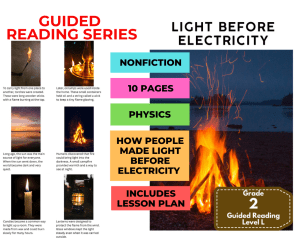
Guided Reading Level L - Light Before Electricity (with Lesson Plan)
ELA, Resources for Teachers, Reading Comprehension, Reading, Science, Engineering, Technology, Physics, History, Social Studies, Grade 1, 2, 3, Worksheets & Printables, Worksheets, Teacher Tools, Centers, Activities, Literacy Readers, Quizzes, Quizzes and Tests, Assessments
This Guided Reading Book - Light Before Electricity (Level L) with lesson plan includes: Guided Reading Color Label (front cover x1) This is a quick way to match the book’s demands to what students can generally handle.. The overall goal is to use the level/color to pick books for several smaller groups. To qualify for a certain level, a student is expected to read a book from that level with about 90–94% accuracy. If a student is consistently accurate and understands, move up a level. If the student is struggling at that level, drop down and add more support. Each student will improve at completely different rates, but it is generally one of the best ways to check progress across the class. DOWNLOAD THE CATALOG TO VIEW ALL GUIDED READING BOOKS AVAILABLE (SORTED LEVELS A-Z) Pre-Reading Question (x1) Teacher asks the prompt aloud, can be while showing the cover or first page. Students share what they already know, or make educated guesses from the cover. Prompt them to use the target vocabulary. Write some of their responses on the board to look back at during the reading. Vocabulary Words (x5) Introduce the five words, best doing it one at a time. Start by saying it, while students repeat and then see if anyone knows what it means before reading further. Read through the meaning and try to briefly connect each word to a picture or gesture so it’s meaningful. Ask students to flip through the book pages and point to where they see each of the vocabulary words. While reading the book pause upon coming across one of the vocab words or read the sentence twice to make sure students understand the word has appeared. Optional: Ask students to raise hands whenever they see/hear one of the new words. Guided Reading Pages (x10) Check the book snapshot (below) for: primary topic - do you need to prep extra reading or intro materials on this? what is taught best - decide on 1-2 bullets to focus on, use the prompt or words provided here for best results. learning goals - what you are checking for students to be able to do after the session, elicit answers using prompts or words provided. key vocabulary (see section above). questions overview - so you know what is coming up and if you need to prep extra materials to assist understanding. Run the lesson You may have already looked at a few of the pages together, but you can show them some of the pictures again first to set meaning. Depending on how much time you have and how familiar your students are with guided reading class, you may want to read the book aloud first with the group first. Students whisper or partner read, while you listen in. If time, do it as a group, one student reading a page each. Use the guided page’s prompts to coach: “Check the picture / does it make sense?” “Point under the words / try the first sound” “Reread the sentence smoothly”. Try to focus more on one student per session (rotating every time), so you can work out if they are ready to move up or need to move down a level. Comprehension Questions (back cover x3) This is your way to check that students didn’t just say the words, but actually understood the text. First, let students answer by pointing to the page/picture and saying a short sentence. After any answer, follow with: “Show me where you found that in the text.” In bigger groups, have partners answer first (10–20 seconds), then call on 2–3 students to share. Differentiation tips: Emerging speakers/struggling readers: oral + pointing On-level: oral in a full sentence Higher: one written sentence or draw + label Book Snapshot Title: Light Before Electricity Genre: Nonfiction (informational) Subject: Science (Technology) / Social Studies (Past and Present) Primary Topic: How people made light before electricity Estimated Guided Reading Level (A–Z): L What This Book Teaches Best The sun was the main source of light long ago, and it got dark when the sun went down. People discovered fire could bring light into darkness and help them see at night. A clear sequence of lighting tools is explained: torches, oil lamps (with a wick), candles, lanterns, gas lamps, electric lightbulbs, and LED bulbs. How inventions solved problems: lanterns protected flames from wind, gas traveled through pipes to power lamps, and electric lightbulbs were safer because they used no real flame. Past-to-present comparison: lighting changed from “flickering fires” to steady electric light you can turn on with a switch. Learning Goals Students will describe why the sun was the main source of light long ago. Students will explain how fire helped people see at night. Students will identify several light sources from the book and describe how each one made light. Students will explain how lanterns kept light steady when carried outside. Students will explain why the electric lightbulb was safer and brighter than candles in the book. Students will describe how LED bulbs are different from older light sources (cool to the touch, little energy). Key Vocabulary From the Text source — where something comes from. torches — long sticks with a flame used for light. wick — a string that helps a lamp or candle burn. invention — something new that someone creates. flickering — shining in a shaky way, like moving firelight. Discussion Prompts Pre-reading question: What kinds of lights do you use when it is dark? Comprehension questions: What was the main source of light for everyone long ago? How did lanterns protect the flame when people carried them outside? Why did the book say the electric lightbulb was safer than candles? Printing Tips 1. Best Printing Method (Recommended) “Booklet” Printing (Best if Available) If your printer or PDF viewer supports Booklet Printing , use this. Settings to use: Print mode: Booklet Paper size: Letter or A4 (either works) Orientation: Landscape Print on both sides: Yes Flip on: Short edge Scaling: Fit to printable area Booklet subset: First test: Front sides only Then: Back sides only This will automatically: Pair pages correctly Put the cover on the outside Align everything for folding After printing, fold in half and staple along the spine . 2. If “Booklet” Printing Is NOT Available You can still print this correctly with manual duplex printing . Step-by-step: Open the PDF. Choose Print . Set: Orientation: Landscape Pages per sheet: 1 Print on both sides: Yes Flip on: Short edge Print all pages . Because each PDF page already contains two facing book pages, the result will still fold cleanly into a book. Thousands of Cored Education products are included with your TeachSimple membership. Download links and encyclopedia index available here.
Author Cored Education
Rating
Tags Reading Comprehension, Reading Passages, Reading, Guided Reading, Guided Reading Lesson Plan, Guided Reading Activity, Pre-reading, Vocabulary, Physics, History