Meteors Reading Comprehension Passage - Cored Ed Encyclopedia




ELA, Language Development, Resources for Teachers, Reading Comprehension, Reading, Pre-Reading, Science, Earth Sciences, Earth and Environmental Sciences, Space
Worksheets & Printables, Worksheets, Teacher Tools, Centers, Activities, Writing Prompts, Assessments, Tests, Quizzes and Tests, Quizzes


About This Product
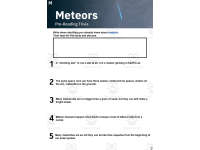
This meteors reading comprehension contains the following:
Visualize on the Cover (Teacher Read Aloud Script)
Start your lesson by taking a few moments to visualize the topic and share thoughts or feelings about it.
Pre-Reading Trivia
Students will write down one thing they already know about the subject and then read five more facts and discuss. These facts are fun, and the students will enjoy learning about the subject before reading more.
Reading Passage
The text is a high-interest reading passage with set paragraphs, roughly three to four paragraphs long. It contains a variety of themes about the topic, anywhere from history to technology. The passage is between 250 and 350 words in length.
Mixed Questions
The first question page contains four multiple-choice questions, each with a choice of four answers, and three written response questions that require a sentence or two from the student.
Vocabulary Questions
Practice seven key words from the text in this section across two activities. First section is scrambled words where students will unscramble three words given a clue for each. The second section is a word to meaning matching activity.
Creative Writing
In this question, the student will be required to write a five to eight sentence paragraph on a question related to the topic.
Extension Activities
This page is optional for fast finishers or to take home. There are several activities, each one requiring a different skill. Do some, do none, do all, completely optional - but you will feel reassured knowing every possibility is planned for. Includes summary writting question.
Answer Key
There are answers for the multiple-choice questions, written response questions have sample answers, vocabulary answers and if there is a summary question then a sample summary will be provided as well.
FULL CATALOG OF DOWNLOAD LINKS AND ENCYCLOPEDIA INDEX HERE
Lesson Snapshot
Title: Meteors
Genre: Nonfiction
Subject: Science (Earth & Space Science)
Primary Topic: Meteoroids, meteors, meteorites, and meteor showers
Estimated Guided Reading Level (A–Z): N
What This Lesson Teaches Best
Clarifies what a “shooting star” is by explaining how a space rock glows in Earth’s air.
Teaches the three related terms—meteoroid, meteor, and meteorite—based on where the space rock is found.
Explains why most meteors don’t reach the ground and describes what a meteorite can look like after a “fiery trip.”
Describes meteor showers and explains why many streaks can seem to point back to one spot in the sky.
Builds science curiosity by explaining that some meteorites are extremely old and can act like “time capsules.”
Learning Goals
Explain why a meteor is sometimes called a “shooting star,” using details from the text.
Identify and describe the difference between a meteoroid, a meteor, and a meteorite.
Describe what makes the bright streak of a meteor in Earth’s air.
Explain what a meteor shower is and what causes it, based on the passage.
Describe why meteorite finds are rare and why museums and scientists collect them.
Key Vocabulary From the Text
Meteoroid — a space rock while it is still in space.
Meteor — a bright streak made as a space rock burns in air.
Meteorite — a space rock that lands on the ground.
Atmosphere — the air around Earth.
Constellation — a named pattern of stars.
Cored Ed Encyclopedia Overview
The Cored Ed Encyclopedia is a weekly series of lessons that you can pick up and use right away. These short readings fit into whatever time you have available. Each one includes a warm-up, a reading, and a set of questions, but it’s flexible — you can do just the reading, the full lesson, or skip the writing section if you need to. Each lesson focuses on a single topic so students don’t get lost. The writing is clear but never childish, making it perfect for grades two through five. Topics range from animals and science to history, inventions, and everyday things. No matter the level of the student, everyone should take away at least one new idea or fact from each lesson. The materials are easy to print, easy to explain, and require no setup. They work well for whole-class teaching, partner work, or independent study.
Resource Tags
0 Reviews
Check out these other great products