



2,686 products added recently
Page 17 - Science Assessments
Provide comprehensive science assessments covering biology, chemistry, physics, and Earth science. This collection includes lab reports, concept checks, and experimental evaluations. Foster a deeper understanding of scientific principles by using targeted assessments.

 Show filters


Farms and Food: Guided Reading Level N with Lesson Plan
ELA, Resources for Teachers, Reading Comprehension, Reading, Science, Language Development, Geography, Social Studies, Life Sciences, Technology, Grade 2, 3, 4, Worksheets & Printables, Worksheets, Teacher Tools, Centers, Activities, Literacy Readers, Quizzes, Quizzes and Tests, Assessments, Lesson Plans
This Farms and Food (level n) guided reading book with lesson plan includes: Guided Reading Color Label (front cover x1) This is a quick way to match the book’s demands to what students can generally handle.. The overall goal is to use the level/color to pick books for several smaller groups. To qualify for a certain level, a student is expected to read a book from that level with about 90–94% accuracy. If a student is consistently accurate and understands, move up a level. If the student is struggling at that level, drop down and add more support. Each student will improve at completely different rates, but it is generally one of the best ways to check progress across the class. DOWNLOAD THE CATALOG TO VIEW ALL GUIDED READING BOOKS AVAILABLE (SORTED LEVELS A-Z) Pre-Reading Question (x1) Teacher asks the prompt aloud, can be while showing the cover or first page. Students share what they already know, or make educated guesses from the cover. Prompt them to use the target vocabulary. Write some of their responses on the board to look back at during the reading. Vocabulary Words (x5) Introduce the five words, best doing it one at a time. Start by saying it, while students repeat and then see if anyone knows what it means before reading further. Read through the meaning and try to briefly connect each word to a picture or gesture so it’s meaningful. Ask students to flip through the book pages and point to where they see each of the vocabulary words. While reading the book pause upon coming across one of the vocab words or read the sentence twice to make sure students understand the word has appeared. Optional: Ask students to raise hands whenever they see/hear one of the new words. Guided Reading Pages (x10) Check the book snapshot (below) for: primary topic - do you need to prep extra reading or intro materials on this? what is taught best - decide on 1-2 bullets to focus on, use the prompt or words provided here for best results. learning goals - what you are checking for students to be able to do after the session, elicit answers using prompts or words provided. key vocabulary (see section above). questions overview - so you know what is coming up and if you need to prep extra materials to assist understanding. Run the lesson You may have already looked at a few of the pages together, but you can show them some of the pictures again first to set meaning. Depending on how much time you have and how familiar your students are with guided reading class, you may want to read the book aloud first with the group first. Students whisper or partner read, while you listen in. If time, do it as a group, one student reading a page each. Use the guided page’s prompts to coach: “Check the picture / does it make sense?” “Point under the words / try the first sound” “Reread the sentence smoothly”. Try to focus more on one student per session (rotating every time), so you can work out if they are ready to move up or need to move down a level. Comprehension Questions (back cover x3) This is your way to check that students didn’t just say the words, but actually understood the text. First, let students answer by pointing to the page/picture and saying a short sentence. After any answer, follow with: “Show me where you found that in the text.” In bigger groups, have partners answer first (10–20 seconds), then call on 2–3 students to share. Differentiation tips: Emerging speakers/struggling readers: oral + pointing On-level: oral in a full sentence Higher: one written sentence or draw + label Book Snapshot Title: Farms and Food Genre: Nonfiction (informational) Subject: Life Science / Agriculture Primary Topic: How food is grown and gets to consumers Estimated Guided Reading Level (A–Z): N What This Book Teaches Best Explains how healthy soil supports plant growth and why the earth is tested before planting begins. Describes how farms use sunlight, water, and irrigation systems to give crops the moisture they need. Shows how machinery (like tractors and plows) helps farmers prepare land and work large areas efficiently. Introduces major farm products (grains, root vegetables, fruit from orchards, milk, eggs, chicken) and how they are produced or collected. Traces the farm-to-table pathway through harvest (including a combine harvester for grains) and transport , including keeping food at the correct temperature to stay fresh and safe. Learning Goals Students can describe how the book says soil helps plants grow and why soil is tested before planting. Students can explain how irrigation helps crops get the correct amount of moisture. Students can identify ways farm machinery is used during the growing season, including pulling a plow to prepare ground for seeds. Students can describe at least three kinds of foods the book names and how each comes from farms. Students can explain what a combine harvester does during harvest, based on the text. Students can describe why the text says food is kept at the correct temperature during travel. Key Vocabulary From the Text consumed — eaten by people. irrigation — bringing water to crops using systems. machinery — large machines used to do farm work. orchards — places where fruit trees are grown. distribution — delivering goods to different places. Discussion Prompts Pre-reading question: What steps do you think food goes through before it reaches your dinner table? Comprehension questions: Why does the book say the earth is tested before planting begins? Comprehension questions: What does the text say a combine harvester does during harvest? Comprehension questions: According to the text, why is food kept at the correct temperature during travel? Printing Tips 1. Best Printing Method (Recommended) “Booklet” Printing (Best if Available) If your printer or PDF viewer supports Booklet Printing , use this. Settings to use: Print mode: Booklet Paper size: Letter or A4 (either works) Orientation: Landscape Print on both sides: Yes Flip on: Short edge Scaling: Fit to printable area Booklet subset: First test: Front sides only Then: Back sides only This will automatically: Pair pages correctly Put the cover on the outside Align everything for folding After printing, fold in half and staple along the spine . 2. If “Booklet” Printing Is NOT Available You can still print this correctly with manual duplex printing . Step-by-step: Open the PDF. Choose Print . Set: Orientation: Landscape Pages per sheet: 1 Print on both sides: Yes Flip on: Short edge Print all pages . Because each PDF page already contains two facing book pages, the result will still fold cleanly into a book. Thousands of Cored Education products are included with your TeachSimple membership. Download links and encyclopedia index available here.
Author Cored Education
Rating
Tags Reading Comprehension, Reading Passages, Reading, Guided Reading, Guided Reading Lesson Plan, Guided Reading Activity, Pre-reading, Science Lesson Plans, Geography, Life Science
Illinois (ISA) Science Practice Test for Grade 5
Science, Grade 5, Assessments, Teacher Tools, Tests, Quizzes and Tests, Worksheets & Printables
Make ISA science test prep simple and effective with this Grade 5 Practice Test Bundle. This resource helps students build confidence and master key science concepts before test day. It includes one full-length practice test with 45 questions. All questions are standards-aligned and follow the format of the real ISA assessment. The materials are printable and easy to use. A detailed answer key with clear explanations and a teacher guide are included. You can use this test in many ways. Use it as a full test simulation or as a diagnostic assessment. Assign sections by domain for targeted review. Track student progress and identify misconceptions. Students investigate Earth, biological, and physical science subjects. They research Earth systems, materials, ecosystems, and energy. Additionally, they examine facts, analyze scenarios, and support concepts with proof. Because it doesn't require any preparation and saves time, teachers adore this resource. Clear grading and targeted reteaching are also supported by it. Make use of it to give your pupils self-assurance and preparation for the ISA science test.
Author Bright Classroom Ideas Marketplace
Rating
Tags ILLINOIS, STATE TEST, ISA, SCIENCE

Science Reading Passages on Light Heat Electricity Magnetism: Fillable
Science, Physics, Common Core, ESL, Language Development, ELA, Vocabulary, Reading Comprehension, Reading, Grade 2, 3, 4, Worksheets & Printables, Worksheets, Assessments, Teacher Tools, Tests, Quizzes and Tests
Reading Passages on Light Heat Electricity Magnetism for Physical Science Snapshot Genre: Nonfiction Subject: Physical Science Primary Topic: Light, heat, electricity, circuits, and magnetism Estimated Guided Reading Level (A–Z): N What This Teaches Best It explains reflection and refraction with concrete examples such as mirrors, windows, pencils in water, and lenses. It teaches that heat is energy transfer that moves from warmer objects to cooler objects, including conduction between touching objects. It introduces electricity as moving electrons, explains electric current and conductors, and shows how a flashlight circuit works. It teaches why symbols simplify circuit diagrams and how magnets, poles, magnetic fields, and electromagnets behave. Learning Goals Students will explain the difference between reflection and refraction using examples from the text. Students will describe how heat moves and define conduction. Students will explain how electrons, current, conductors, filaments, and circuits work together in a flashlight. Students will identify why symbols are used in electrical diagrams. Students will describe magnetic fields, poles, and how electromagnets become stronger. Part 3 - Light, Heat, Electricity & Magnetism. Reading Passage 1: Characteristics of Light: Reflection and Refraction Reading Passage 2: Heat, Sources of Heat, and Heat Conduction Reading Passage 3: Electricity, Electrical Circuits, and Energy Reading Passage 4: Symbols and Electric Circuits Reading Passage 5: Magnets Magnetism and Electromagnetism FILLABLE PDF VERSION Worksheet-style pages, but with type-in answer boxes so students can complete and save their work digitally. Other versions are available in the links list below or in the full catalog. FULL CATALOG OF DOWNLOAD LINKS HERE Grade 3/4 Links: Physical Science Part 1 - Properties of Objects and Materials Google Docs/Slides/Forms PDF PPT Word Free Supplementary Pack Accompanying Videos Physical Science Part 2 - Position and Motion of Objects Google Docs/Slides/Forms PDF PPT Word Free Supplementary Pack Accompanying Videos Physical Science Part 3 - Light, Heat, Electricity, Magnetism Google Docs/Slides/Forms PDF PPT Word Free Supplementary Pack Accompanying Videos Life Science Part 1 - Characteristics of Organisms Google Docs/Slides/Forms PDF PPT Word Free Supplementary Pack Accompanying Videos Life Science Part 2 - Life Cycles of Organisms Google Docs/Slides/Forms PDF PPT Word Free Supplementary Pack Accompanying Videos Life Science Part 3 - Organisms and Environments Google Docs/Slides/Forms PDF PPT Word Free Supplementary Pack Accompanying Videos Earth Science Part 1 - Properties of Earth Materials Google Docs/Slides/Forms PDF PPT Word Free Supplementary Pack Accompanying Videos Earth Science Part 2 - Changes in the Earth and Sky Google Docs/Slides/Forms PDF PPT Word Free Supplementary Pack Accompanying Videos Earth Science Part 3 - Objects in the Sky Google Docs/Slides/Forms PDF PPT Word Free Supplementary Pack Accompanying Videos For similar products and other frees, do check out Cored Group on TeachSimple .
Author Cored Education
Rating
Tags Science, Elementary, Reading, Comprehension, Vocabulary, Physics, Physical Science, Reading Comprehension Assessments, Science Assessments, Vocabulary Assessments

Deserts Reading Comprehension Passage - Cored Ed Encyclopedia
ELA, Language Development, Reading Comprehension, Reading, Life Sciences, Science, Earth and Environmental Sciences, Technology, Geography, Social Studies, Grade 2, 3, 4, 5, Worksheets & Printables, Worksheets, Teacher Tools, Centers, Activities, Writing Prompts, Assessments, Quizzes and Tests, Quizzes, Lesson Plans
This deserts reading comprehension with lesson plan includes: Visualization (on the front cover) Start your lesson by taking a minute to think and share something about the topic. Read the script aloud (slowly), perhaps prepare some music or sound effects. Student close their eyes and let their imaginations wander. Students open their eyes, read the question aloud and give them a few minutes to complete. Ask a few students to share or keep answers until the end to compare with what they learn in the passage. COMPANION VIDEO NOW AVAILABLE (EMBEDDED AFTER PREVIEW PICTURES IN PRODUCT DESCRIPTION) Quick pause—thousands of Cored Education products are included with your TeachSimple membership. Download links and encyclopedia index available here. Pre-Reading Trivia Students will write down one thing they already know about the subject and then read five more facts and discuss. These facts are fun, and the students will enjoy learning about the subject before reading more. Give 1 minute for students to write what they already know (no pressure—best guess is fine). Read the five facts together. After each fact, do ask a student for their opinion, was it surprising? Set a purpose by asking students to highlight/underline one fact they want to learn more about during the reading. Reading Passage The text is a high-interest reading passage with set paragraphs, roughly three to four paragraphs long. It contains a variety of themes about the topic, anywhere from history to technology. The passage is between 250 and 350 words in length. First, ask students to look at the headings and see what they’ll learn about today. What do they know about the topic/heading? First read options: Teacher read-aloud (best for support). Partner reading (paragraph by paragraph). While reading, students underline important details, and vocabulary words they think may come up in the questions section. Mixed Questions The first question page contains four multiple-choice questions, each with a choice of four answers, and three written response questions that require a sentence or two from the student. Students complete the mcqs first independently, then review quickly as a class. For the 3 written responses, try to get students giving the answer with some form of evidence: “I think ___ because the text says ___.” If students get stuck, send them back to check the passage. Vocabulary Questions Practice seven key words from the text in this section across two activities. First section is scrambled words where students will unscramble three words given a clue for each. The second section is a word to meaning matching activity. Before starting, have some students read out words they underlined in the passage. Ask students to say the word and read aloud the sentence(s) around each word. Ask students to do scrambled words and the matching exercise in pairs then go through answers as a class. For the scrambled spelling task, get four pairs to come up to the board and write the words for extra practice with the other student reading out the clue. For the matching task, prompt students to give full sentences: “I matched ___ with ___ because ___.” Creative Writing In this question, the student will be required to write a five to eight sentence paragraph on a question related to the topic. Before starting, ask students write down 3 key ideas they are going to include in their piece. Ask students for ideas to share around the class to help those struggling. Pro writing expectations: 5–8 sentences At least 2 facts or details from the passage At least 2 vocabulary words from the previous page Students read their paragraphs while classmates listen for facts and vocabulary words. Extension Activities This page is optional for fast finishers or to take home. There are several activities, each one requiring a different skill. Do some, do none, do all, completely optional - but you will feel reassured knowing every possibility is planned for. Includes summary writting question and additional facts. Answer Key There are answers for the multiple-choice questions, written response questions have sample answers, vocabulary answers and if there is a summary question then a sample summary will be provided as well. Lesson Plan Included Customized lesson plan for this lesson is included. Lesson Snapshot Title: Deserts Genre: Nonfiction (informational text with headings) Subject: Earth Science / Life Science / Reading (Informational Text) Primary Topic: Deserts are defined by dryness and survival tricks Estimated Guided Reading Level (A–Z): P What This Lesson Teaches Best Clarifies the key definition: a desert is defined by dryness , not by sand. Explains desert rainfall patterns (often under about 10 inches/25 centimeters per year, sometimes arriving in a quick burst). Builds understanding that deserts can be hot or cold, including Antarctica as the biggest desert on Earth in the passage. Highlights plant and animal adaptations (cacti storing water; plants keeping/curling leaves; rodents getting moisture from seeds; animals hiding in burrows by day and moving at night). Introduces how scientists study deserts today (weather stations, soil samples, satellite pictures) and explains “rain shadow.” Learning Goals Students will explain how the passage defines a desert. Students will describe what the passage says about how much rain many deserts get in a year. Students will identify at least two survival tricks of desert plants from the text. Students will identify at least two survival tricks of desert animals from the text. Students will explain what a “rain shadow” is, using the passage’s description. Students will describe ways deserts are studied today, based on the text. Key Vocabulary From the Text dryness — having very little water or rain. sparse — not many; spread out. burrows — holes in the ground where animals hide. satellite — something in space that takes pictures from above. dunes — hills of sand shaped by wind. FULL CATALOG OF DOWNLOAD LINKS AND ENCYCLOPEDIA INDEX HERE
Author Cored Education
Rating
Tags Vocabulary, Reading Comprehension, Reading Passages, Lesson Plans, Ela Lesson Plans, Reading Comprehension Lesson Plans, Pre-reading, Science Lesson Plans, Earth Science, Geography
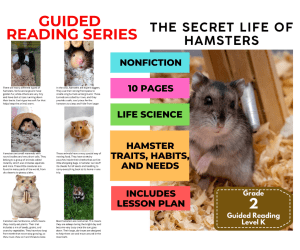
Guided Reading Level K - Secret Life of Hamsters (with Lesson Plan)
ELA, Resources for Teachers, Reading Comprehension, Reading, Pre-Reading, Language Development, Life Sciences, Science, Vocabulary, Animals, Grade 1, 2, 3, Worksheets & Printables, Worksheets, Teacher Tools, Centers, Activities, Literacy Readers, Quizzes, Quizzes and Tests, Assessments
This Guided Reading Book - The Secret Life of Hamsters (Level K) with lesson plan includes: Guided Reading Color Label (front cover x1) This is a quick way to match the book’s demands to what students can generally handle.. The overall goal is to use the level/color to pick books for several smaller groups. To qualify for a certain level, a student is expected to read a book from that level with about 90–94% accuracy. If a student is consistently accurate and understands, move up a level. If the student is struggling at that level, drop down and add more support. Each student will improve at completely different rates, but it is generally one of the best ways to check progress across the class. DOWNLOAD THE CATALOG TO VIEW ALL GUIDED READING BOOKS AVAILABLE (SORTED LEVELS A-Z) Pre-Reading Question (x1) Teacher asks the prompt aloud, can be while showing the cover or first page. Students share what they already know, or make educated guesses from the cover. Prompt them to use the target vocabulary. Write some of their responses on the board to look back at during the reading. Vocabulary Words (x5) Introduce the five words, best doing it one at a time. Start by saying it, while students repeat and then see if anyone knows what it means before reading further. Read through the meaning and try to briefly connect each word to a picture or gesture so it’s meaningful. Ask students to flip through the book pages and point to where they see each of the vocabulary words. While reading the book pause upon coming across one of the vocab words or read the sentence twice to make sure students understand the word has appeared. Optional: Ask students to raise hands whenever they see/hear one of the new words. Guided Reading Pages (x10) Check the book snapshot (below) for: primary topic - do you need to prep extra reading or intro materials on this? what is taught best - decide on 1-2 bullets to focus on, use the prompt or words provided here for best results. learning goals - what you are checking for students to be able to do after the session, elicit answers using prompts or words provided. key vocabulary (see section above). questions overview - so you know what is coming up and if you need to prep extra materials to assist understanding. Run the lesson You may have already looked at a few of the pages together, but you can show them some of the pictures again first to set meaning. Depending on how much time you have and how familiar your students are with guided reading class, you may want to read the book aloud first with the group first. Students whisper or partner read, while you listen in. If time, do it as a group, one student reading a page each. Use the guided page’s prompts to coach: “Check the picture / does it make sense?” “Point under the words / try the first sound” “Reread the sentence smoothly”. Try to focus more on one student per session (rotating every time), so you can work out if they are ready to move up or need to move down a level. Comprehension Questions (back cover x3) This is your way to check that students didn’t just say the words, but actually understood the text. First, let students answer by pointing to the page/picture and saying a short sentence. After any answer, follow with: “Show me where you found that in the text.” In bigger groups, have partners answer first (10–20 seconds), then call on 2–3 students to share. Differentiation tips: Emerging speakers/struggling readers: oral + pointing On-level: oral in a full sentence Higher: one written sentence or draw + label Book Snapshot Title: The Secret Life of Hamsters Genre: Nonfiction (informational) Subject: Life Science Primary Topic: Hamster traits, habits, and needs Estimated Guided Reading Level (A–Z): K What This Book Teaches Best Explains what hamsters are and what animal group they belong to (small mammals; rodents). Describes how hamsters move and store food using cheek pouches. Teaches how hamsters stay safe in the wild by digging underground burrows to sleep and hide. Explains eating habits and body needs (herbivores; teeth that keep growing and must be worn down). Describes nighttime behavior and care routines (nocturnal; exercise, grooming, sand-bathing, resting after activity). Learning Goals Identify what group of animals hamsters belong to using details from the text. Describe how cheek pouches help hamsters carry items back to their home. Explain how burrows help hamsters stay safe and what they are used for. Describe what hamsters eat and what “herbivores” means in the book. Explain why hamsters need to chew on hard things, according to the text. Describe one way hamsters stay clean and one way they rest after a busy night. Key Vocabulary From the Text rodents — animals in the same group as mice and squirrels. pouches — stretchy pockets that can hold things. burrows — underground tunnels where an animal can sleep and hide. herbivores — animals that mostly eat plants. nocturnal — awake at night and asleep during the day. Discussion Prompts Pre-reading question: How do you think a hamster stays safe and gets what it needs when it is awake at night? Comprehension questions: According to the text, what group of animals do hamsters belong to? How do cheek pouches help a hamster carry things back home? Why does the text say hamsters need to chew on hard things? Printing Tips 1. Best Printing Method (Recommended) “Booklet” Printing (Best if Available) If your printer or PDF viewer supports Booklet Printing , use this. Settings to use: Print mode: Booklet Paper size: Letter or A4 (either works) Orientation: Landscape Print on both sides: Yes Flip on: Short edge Scaling: Fit to printable area Booklet subset: First test: Front sides only Then: Back sides only This will automatically: Pair pages correctly Put the cover on the outside Align everything for folding After printing, fold in half and staple along the spine . 2. If “Booklet” Printing Is NOT Available You can still print this correctly with manual duplex printing . Step-by-step: Open the PDF. Choose Print . Set: Orientation: Landscape Pages per sheet: 1 Print on both sides: Yes Flip on: Short edge Print all pages . Because each PDF page already contains two facing book pages, the result will still fold cleanly into a book. Thousands of Cored Education products are included with your TeachSimple membership. Download links and encyclopedia index available here.
Author Cored Education
Rating
Tags Reading Comprehension, Reading Passages, Reading, Guided Reading, Guided Reading Lesson Plan, Guided Reading Activity, Pre-reading, Vocabulary, Science Lesson Plans, Animals

Science Passages on Physical and Chemical Properties (Google Drive)
ELA, Reading, Reading Comprehension, Common Core, Physics, Science, ESL, Language Development, Spelling, Grade 5, 6, 7, Worksheets, Worksheets & Printables, Assessments, Teacher Tools, Presentations, Tests, Quizzes and Tests
Reading Passages on Physical and Chemical Properties for Physical Science Physical and Chemical Properties: Reading Passages Physical Science - Stimulate renewed enthusiasm and curiosity in the realm of science with these vibrant science reading comprehension lessons. Bursting with vivid colors and engaging topics, these resources are designed to captivate and motivate your students, urging them to delve deeper into their scientific explorations. And the best part? As an educator, you can be at ease and confident in the effectiveness of these lessons, knowing that a significant portion of the groundwork and preparation has been meticulously taken care of for you, making the teaching process smoother and more enjoyable. What's inside? Physical & Chemical Properties Reading Passage1: Measuring Matter: Mass, Volume, and Density Reading Passage2: Physical and Chemical Properties of Matter Reading Passage 3: Physical and Chemical Changes in Matter Reading Passage4: Atoms, Elements, and Compounds Reading Passage5: Chemicals: Helpful and Harmful Product Info: 40 pages, 186 slides, 5 forms Teaching Duration: 2 Weeks Science Reading Comprehension Outline: Introducing a comprehensive resource tailored for 5th and 6th graders, this product offers enriching reading passages supplemented with illustrative pictures and graphs to clarify key concepts. Aligned with the Common Core State Standards (CCSS), it offers a hassle-free approach to teaching, given that the bulk of the preparation is already done for you. The passages present a diverse set of questions – from multiple choice to data analysis and fill-in-the-blanks. This ensures a rich blend of high-interest content and fundamental curriculum -based science themes. With its versatility, you can seamlessly integrate these lessons into various classroom settings, whether it's whole class discussions, morning exercises, independent desk tasks, small group engagements, contingency plans for substitute teachers, regular homework assignments, or even themed activities for holidays. FULL CATALOG OF DOWNLOAD LINKS HERE Grade 5/6 Links: Physical Science Part 1 - Physical and Chemical Properties Google Docs/Slides/Forms PDF PPT Word Free Supplementary Pack Accompanying Videos Physical Science Part 2 - Motion and Energy Google Docs/Slides/Forms PDF PPT Word Free Supplementary Pack Accompanying Videos Physical Science Part 3 - Electricity and Magnets Google Docs/Slides/Forms PDF PPT Word Free Supplementary Pack Accompanying Videos Life Science Part 1 - Cells, Reproduction and Genetics Google Docs/Slides/Forms PDF PPT Word Free Supplementary Pack Accompanying Videos Life Science Part 2 - Human Body Systems Google Docs/Slides/Forms PDF PPT Word Free Supplementary Pack Accompanying Videos Life Science Part 3 - Plant Parts and Ecosystems Google Docs/Slides/Forms PDF PPT Word Free Supplementary Pack Accompanying Videos Earth Science Part 1 - Plate Tectonics and Rock Cycle Google Docs/Slides/Forms PDF PPT Word Free Supplementary Pack Accompanying Videos Earth Science Part 2 - Ocean Exploration and Natural Resources Google Docs/Slides/Forms PDF PPT Word Free Supplementary Pack Accompanying Videos Earth Science Part 3 - Weather and Solar System Google Docs/Slides/Forms PDF PPT Word Free Supplementary Pack Accompanying Videos For similar products and other frees, do check out Cored Group on TeachSimple .
Author Cored Education
Tags Science, Elementary, Reading, Comprehension, Vocabulary, Answers, Physics, Physical Science, Ccss, Common Core
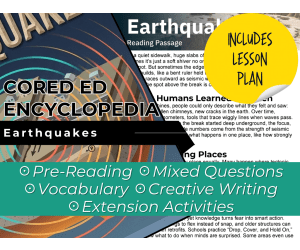
Earthquakes Reading Comprehension Passage - Cored Ed Encyclopedia
ELA, Reading Comprehension, Reading, Science, Technology, Social Studies, Earth and Environmental Sciences, Geography, Pre-Reading, Language Development, Grade 2, 3, 4, 5, Worksheets & Printables, Worksheets, Teacher Tools, Centers, Activities, Writing Prompts, Assessments, Quizzes and Tests, Quizzes, Lesson Plans
This earthquakes reading comprehension with lesson plan includes: Visualization (on the front cover) Start your lesson by taking a minute to think and share something about the topic. Read the script aloud (slowly), perhaps prepare some music or sound effects. Student close their eyes and let their imaginations wander. Students open their eyes, read the question aloud and give them a few minutes to complete. Ask a few students to share or keep answers until the end to compare with what they learn in the passage. Quick pause—thousands of Cored Education products are included with your TeachSimple membership. Download links and encyclopedia index available here. Pre-Reading Trivia Students will write down one thing they already know about the subject and then read five more facts and discuss. These facts are fun, and the students will enjoy learning about the subject before reading more. Give 1 minute for students to write what they already know (no pressure—best guess is fine). Read the five facts together. After each fact, do ask a student for their opinion, was it surprising? Set a purpose by asking students to highlight/underline one fact they want to learn more about during the reading. Reading Passage The text is a high-interest reading passage with set paragraphs, roughly three to four paragraphs long. It contains a variety of themes about the topic, anywhere from history to technology. The passage is between 250 and 350 words in length. First, ask students to look at the headings and see what they’ll learn about today. What do they know about the topic/heading? First read options: Teacher read-aloud (best for support). Partner reading (paragraph by paragraph). While reading, students underline important details, and vocabulary words they think may come up in the questions section. Mixed Questions The first question page contains four multiple-choice questions, each with a choice of four answers, and three written response questions that require a sentence or two from the student. Students complete the mcqs first independently, then review quickly as a class. For the 3 written responses, try to get students giving the answer with some form of evidence: “I think ___ because the text says ___.” If students get stuck, send them back to check the passage. Vocabulary Questions Practice seven key words from the text in this section across two activities. First section is scrambled words where students will unscramble three words given a clue for each. The second section is a word to meaning matching activity. Before starting, have some students read out words they underlined in the passage. Ask students to say the word and read aloud the sentence(s) around each word. Ask students to do scrambled words and the matching exercise in pairs then go through answers as a class. For the scrambled spelling task, get four pairs to come up to the board and write the words for extra practice with the other student reading out the clue. For the matching task, prompt students to give full sentences: “I matched ___ with ___ because ___.” Creative Writing In this question, the student will be required to write a five to eight sentence paragraph on a question related to the topic. Before starting, ask students write down 3 key ideas they are going to include in their piece. Ask students for ideas to share around the class to help those struggling. Pro writing expectations: 5–8 sentences At least 2 facts or details from the passage At least 2 vocabulary words from the previous page Students read their paragraphs while classmates listen for facts and vocabulary words. Extension Activities This page is optional for fast finishers or to take home. There are several activities, each one requiring a different skill. Do some, do none, do all, completely optional - but you will feel reassured knowing every possibility is planned for. Includes summary writting question and additional facts. Answer Key There are answers for the multiple-choice questions, written response questions have sample answers, vocabulary answers and if there is a summary question then a sample summary will be provided as well. Lesson Plan Included Customized lesson plan for this lesson is included. Lesson Snapshot Title: Earthquakes Genre: Nonfiction (Informational Text) Subject: Science (Earth Science) / Reading (Informational Text) Primary Topic: How earthquakes happen and how people prepare Estimated Guided Reading Level (A–Z): N What This Lesson Teaches Best Explains what causes earthquakes : rocks can get stuck along a fault , pressure builds, and rocks suddenly slip. Builds understanding of earthquake vocabulary and concepts (fault, seismic waves, epicenter, focus, magnitude, intensity). Shows how scientists measure and describe earthquakes using seismometers and “magnitude” vs. “intensity.” Describes where quakes happen more often (where tectonic plates meet , including the Pacific Ocean’s Ring of Fire ) and what can follow ( aftershocks , possible tsunami ). Connects science to safety and preparedness , including “ Drop, Cover, and Hold On ,” retrofits, and warning systems. Learning Goals Students will be able to describe how pressure can build along a fault and lead to an earthquake. Students will be able to identify and explain the meanings of key earthquake terms used in the text. Students will be able to explain how seismic waves relate to ground shaking and the epicenter . Students will be able to compare “magnitude” and “intensity” as described in the passage. Students will be able to describe why some places experience more earthquakes than others (plate boundaries, Ring of Fire). Students will be able to list actions people and communities take to be ready for earthquakes. Key Vocabulary From the Text fault — a crack where rocks can slip. seismic — related to shaking waves moving through Earth. epicenter — the spot above where the break happened. seismometers — tools that trace wiggly lines when waves pass. aftershocks — smaller earthquakes that can follow a big quake. FULL CATALOG OF DOWNLOAD LINKS AND ENCYCLOPEDIA INDEX HERE
Author Cored Education
Rating
Tags Vocabulary, Reading Comprehension, Reading Passages, Lesson Plans, Ela Lesson Plans, Reading Comprehension Lesson Plans, Pre-reading, Science Lesson Plans, Geography, Earth Science

Parrots Reading Comprehension Passage - Cored Ed Encyclopedia
ELA, Language Development, Resources for Teachers, Reading Comprehension, Reading, Pre-Reading, Writing, Science, Life Sciences, Animals, Grade 2, 3, 4, 5, Worksheets & Printables, Worksheets, Teacher Tools, Centers, Activities, Writing Prompts, Assessments, Tests, Quizzes and Tests, Quizzes
This parrots reading comprehension contains the following: Visualize on the Cover (Teacher Read Aloud Script) Start your lesson by taking a few moments to visualize the topic and share thoughts or feelings about it. Pre-Reading Trivia Students will write down one thing they already know about the subject and then read five more facts and discuss. These facts are fun, and the students will enjoy learning about the subject before reading more. Reading Passage The text is a high-interest reading passage with set paragraphs, roughly three to four paragraphs long. It contains a variety of themes about the topic, anywhere from history to technology. The passage is between 250 and 350 words in length. Mixed Questions The first question page contains four multiple-choice questions, each with a choice of four answers, and three written response questions that require a sentence or two from the student. Vocabulary Questions Practice seven key words from the text in this section across two activities. First section is scrambled words where students will unscramble three words given a clue for each. The second section is a word to meaning matching activity. Creative Writing In this question, the student will be required to write a five to eight sentence paragraph on a question related to the topic. Extension Activities This page is optional for fast finishers or to take home. There are several activities, each one requiring a different skill. Do some, do none, do all, completely optional - but you will feel reassured knowing every possibility is planned for. Includes summary writting question. Answer Key There are answers for the multiple-choice questions, written response questions have sample answers, vocabulary answers and if there is a summary question then a sample summary will be provided as well. FULL CATALOG OF DOWNLOAD LINKS AND ENCYCLOPEDIA INDEX HERE Lesson Snapshot Title: Parrots Genre: Nonfiction (informational text) Subject: Life Science (Animals) / Conservation / Reading Informational Text Primary Topic: Parrot traits, intelligence, and protection Estimated Guided Reading Level (A–Z): S Support pages present: trivia, mixed questions, vocabulary, creative writing, extension activities, answers, QR page. Support-page QA check: The vocabulary section includes “Zygodactyl,” but that word does not appear in the reading passage (the passage says “two toes forward, two back”). What This Lesson Teaches Best How parrots are grouped as an order called Psittaciformes , with many kinds (from parrotlets to macaws). How parrots’ body parts help them survive: a strong beak for cracking nuts, touch sensors for careful nibbling, and feet designed for climbing and holding food. How scientists tested parrots’ understanding through experiments, including what an African gray parrot named Alex could do in lab games. How human actions can harm wild parrots (forests cleared, parrots taken illegally) and why some species are threatened with extinction. How an international agreement called CITES helps protect parrots by limiting selling them across borders. Learning Goals Students will describe where many parrots live and where they raise chicks, using details from the text. Students will explain how a parrot’s beak works “like a toolbox,” using specific examples from the passage. Students will describe how a parrot’s feet are built and what the feet help parrots do. Students will explain what the text says Alex could do that changed how people viewed mimicry. Students will identify two problems the passage says can hurt wild parrots and explain one way parrots are protected. Key Vocabulary From the Text Psittaciformes — the scientific order name for parrots. fused — joined together so it cannot move. ultraviolet — light that eyes can notice in bright sunlight. mimicry — copying sounds (and seeming like more than that). extinction — when a species is gone forever. Cored Ed Encyclopedia Overview The Cored Ed Encyclopedia is a weekly series of lessons that you can pick up and use right away. These short readings fit into whatever time you have available. Each one includes a warm-up, a reading, and a set of questions, but it’s flexible — you can do just the reading, the full lesson, or skip the writing section if you need to. Each lesson focuses on a single topic so students don’t get lost. The writing is clear but never childish, making it perfect for grades two through five. Topics range from animals and science to history, inventions, and everyday things. No matter the level of the student, everyone should take away at least one new idea or fact from each lesson. The materials are easy to print, easy to explain, and require no setup. They work well for whole-class teaching, partner work, or independent study.
Author Cored Education
Rating
Tags Vocabulary, Spelling, Reading Comprehension, Reading Passages, Reading, Creative Writing, Reading Strategies, Writing Prompts, Parrots, Life Science

Guided Reading Level H - All About Hiking (with Lesson Plan)
ELA, Resources for Teachers, Reading Comprehension, Reading, Science, Earth and Environmental Sciences, Geography, Social Studies, Health, P.E. & Health, Kindergarten, Grade 1, 2, Worksheets & Printables, Worksheets, Teacher Tools, Centers, Activities, Literacy Readers, Quizzes, Quizzes and Tests, Assessments
This Guided Reading Book - All About Hiking (Level H) with lesson plan includes: Guided Reading Color Label (front cover x1) This is a quick way to match the book’s demands to what students can generally handle.. The overall goal is to use the level/color to pick books for several smaller groups. To qualify for a certain level, a student is expected to read a book from that level with about 90–94% accuracy. If a student is consistently accurate and understands, move up a level. If the student is struggling at that level, drop down and add more support. Each student will improve at completely different rates, but it is generally one of the best ways to check progress across the class. DOWNLOAD THE CATALOG TO VIEW ALL GUIDED READING BOOKS AVAILABLE (SORTED LEVELS A-Z) Pre-Reading Question (x1) Teacher asks the prompt aloud, can be while showing the cover or first page. Students share what they already know, or make educated guesses from the cover. Prompt them to use the target vocabulary. Write some of their responses on the board to look back at during the reading. Vocabulary Words (x5) Introduce the five words, best doing it one at a time. Start by saying it, while students repeat and then see if anyone knows what it means before reading further. Read through the meaning and try to briefly connect each word to a picture or gesture so it’s meaningful. Ask students to flip through the book pages and point to where they see each of the vocabulary words. While reading the book pause upon coming across one of the vocab words or read the sentence twice to make sure students understand the word has appeared. Optional: Ask students to raise hands whenever they see/hear one of the new words. Guided Reading Pages (x10) Check the book snapshot (below) for: primary topic - do you need to prep extra reading or intro materials on this? what is taught best - decide on 1-2 bullets to focus on, use the prompt or words provided here for best results. learning goals - what you are checking for students to be able to do after the session, elicit answers using prompts or words provided. key vocabulary (see section above). questions overview - so you know what is coming up and if you need to prep extra materials to assist understanding. Run the lesson You may have already looked at a few of the pages together, but you can show them some of the pictures again first to set meaning. Depending on how much time you have and how familiar your students are with guided reading class, you may want to read the book aloud first with the group first. Students whisper or partner read, while you listen in. If time, do it as a group, one student reading a page each. Use the guided page’s prompts to coach: “Check the picture / does it make sense?” “Point under the words / try the first sound” “Reread the sentence smoothly”. Try to focus more on one student per session (rotating every time), so you can work out if they are ready to move up or need to move down a level. Comprehension Questions (back cover x3) This is your way to check that students didn’t just say the words, but actually understood the text. First, let students answer by pointing to the page/picture and saying a short sentence. After any answer, follow with: “Show me where you found that in the text.” In bigger groups, have partners answer first (10–20 seconds), then call on 2–3 students to share. Differentiation tips: Emerging speakers/struggling readers: oral + pointing On-level: oral in a full sentence Higher: one written sentence or draw + label Book Snapshot Title: All About Hiking Genre: Nonfiction (informational) Subject: Health / Outdoor Safety Primary Topic: Hiking basics: trails, gear, nature, and care Estimated Guided Reading Level (A–Z): H What This Book Teaches Best Defines hiking as “a long walk in nature” and a sport done on trails. Describes that trails exist in different environments (forests and rocky ground). Explains essential hiking items and why they help (footwear with treads, backpack, water, snacks). Introduces navigation support on trails by explaining what trail markers and signs do. Emphasizes caring for nature by not leaving litter so the trail stays clean. Learning Goals Students can describe what hiking is using details from the text. Students can identify different trail environments mentioned in the book. Students can explain how specific hiking items help hikers (boots, backpack, water, snacks). Students can explain how trail markers and signs help hikers follow the correct path. Students can describe how hikers can protect the environment by leaving no litter behind. Key Vocabulary From the Text footwear — shoes or boots you wear on your feet. treads — bumpy lines on shoes that help you not slip. essential — very important; you really need it. reusable — can be used again instead of thrown away. landscape — the land you can see in an area. Discussion Prompts Pre-reading question: What supplies do you think people might bring when they go hiking? Comprehension questions: What does the book say hiking is? What do trail markers and signs help hikers do? What happens to the trail when no litter is left behind? Printing Tips 1. Best Printing Method (Recommended) “Booklet” Printing (Best if Available) If your printer or PDF viewer supports Booklet Printing , use this. Settings to use: Print mode: Booklet Paper size: Letter or A4 (either works) Orientation: Landscape Print on both sides: Yes Flip on: Short edge Scaling: Fit to printable area Booklet subset: First test: Front sides only Then: Back sides only This will automatically: Pair pages correctly Put the cover on the outside Align everything for folding After printing, fold in half and staple along the spine . 2. If “Booklet” Printing Is NOT Available You can still print this correctly with manual duplex printing . Step-by-step: Open the PDF. Choose Print . Set: Orientation: Landscape Pages per sheet: 1 Print on both sides: Yes Flip on: Short edge Print all pages . Because each PDF page already contains two facing book pages, the result will still fold cleanly into a book. Thousands of Cored Education products are included with your TeachSimple membership. Download links and encyclopedia index available here.
Author Cored Education
Rating
Tags Reading Comprehension, Reading Passages, Reading, Guided Reading, Guided Reading Lesson Plan, Guided Reading Activity, Pre-reading, Vocabulary, Science Lesson Plans, Geography Lesson Plans
Ohio (OST) Science Practice Test for Grade 8
Science, Grade 8, Assessments, Teacher Tools, Tests, Quizzes and Tests, Worksheets & Printables
Help your students prepare for the Ohio OST Science test with confidence. This Grade 8 practice test gives clear and focused practice. It follows Ohio Learning Standards and matches the real test format. The resource includes a full 55-question test that covers three science domains. Students study Earth and space, life science, and physical science. They explore topics like plate tectonics, cells, and chemical reactions. This builds strong science knowledge. Question types include multiple choice, multi-select, and constructed response. The answer key provides clear explanations, standards alignment, and sample answers. It also includes quick grading tools and rubrics. This makes grading simple and fast. Strong support is provided by the instructor guide. It contains suggestions for differentiation, test methodologies, and a data tracker for tracking advancement. Use this material in a variety of ways. Assign one domain at a time or administer the entire mock exam in two sessions. Use it for small groups, review, and evaluation. Strong science skills are developed and time is saved with this no-prep resource. On test day, your pupils will feel prepared and self-assured.
Author Bright Classroom Ideas Marketplace
Rating
Tags Ohio, Ost, State Test, Science
Reading Passage 42 Earth, Moon and Sun (Google Docs)
ELA, Reading, Reading Comprehension, Science, Earth and Environmental Sciences, Earth Sciences, Common Core, ESL, Language Development, Vocabulary, Grade 5, 6, 7, Centers, Activities, Assessments, Teacher Tools, Tests, Quizzes and Tests
Free Reading Passage on Earth, Moon and Sun for Earth Science What's inside this free product? Science Reading Comprehension Passage: Earth, Moon and Sun Independent Google Docs Version: This is the independent Google Docs version containingone lesson. Product Info: 8 PAGES (US English with Answers) Google Docs Version Teaching Duration: 90 Minutes Science Reading Comprehension Outline: Introducing a comprehensive resource tailored for 5th and 6th graders, this product offers enriching reading passages supplemented with illustrative pictures and graphs to clarify key concepts. Aligned with the Common Core State Standards (CCSS), it offers a hassle-free approach to teaching, given that the bulk of the preparation is already done for you. The passages present a diverse set of questions – from multiple choice to data analysis and fill-in-the-blanks. This ensures a rich blend of high-interest content and fundamental curriculum-based science themes. With its versatility, you can seamlessly integrate these lessons into various classroom settings, whether it's whole class discussions, morning exercises, independent desk tasks, small group engagements, contingency plans for substitute teachers, regular homework assignments, or even themed activities for holidays. FULL CATALOG OF DOWNLOAD LINKS HERE Grade 5/6 Links: Physical Science Part 1 - Physical and Chemical Properties Google Docs/Slides/Forms PDF PPT Word Free Supplementary Pack Accompanying Videos Physical Science Part 2 - Motion and Energy Google Docs/Slides/Forms PDF PPT Word Free Supplementary Pack Accompanying Videos Physical Science Part 3 - Electricity and Magnets Google Docs/Slides/Forms PDF PPT Word Free Supplementary Pack Accompanying Videos Life Science Part 1 - Cells, Reproduction and Genetics Google Docs/Slides/Forms PDF PPT Word Free Supplementary Pack Accompanying Videos Life Science Part 2 - Human Body Systems Google Docs/Slides/Forms PDF PPT Word Free Supplementary Pack Accompanying Videos Life Science Part 3 - Plant Parts and Ecosystems Google Docs/Slides/Forms PDF PPT Word Free Supplementary Pack Accompanying Videos Earth Science Part 1 - Plate Tectonics and Rock Cycle Google Docs/Slides/Forms PDF PPT Word Free Supplementary Pack Accompanying Videos Earth Science Part 2 - Ocean Exploration and Natural Resources Google Docs/Slides/Forms PDF PPT Word Free Supplementary Pack Accompanying Videos Earth Science Part 3 - Weather and Solar System Google Docs/Slides/Forms PDF PPT Word Free Supplementary Pack Accompanying Videos For similar products and other frees, do check out Cored Group on TeachSimple .
Author Cored Education
Tags Science, Elementary, Reading, Comprehension, Vocabulary, Answers, Physics, Physical Science, Ccss, Digital Centers

New York NYS Practice Tests Bundle for Grade 8
ELA, Math, Science, Grade 8, Assessments, Teacher Tools, Tests, Quizzes and Tests, Worksheets & Printables
Prepare your students for success with this Grade 8 NYS ELA, Math & Science Practice Test Bundle . This comprehensive, standards-aligned resource helps students build confidence while strengthening essential skills across all tested subjects using a realistic test format. It is clear, structured, and easy to use. This bundle includes full-length practice tests for ELA, Math, and Science, with standards-aligned questions that reflect the format and rigor of New York State assessments. Students develop reading comprehension, critical analysis, evidence-based writing, algebraic reasoning, problem-solving, and scientific inquiry skills through engaging, test-style questions. Complete answer keys are included for quick and easy grading. The printable, classroom-ready format makes implementation simple and stress-free for teachers. This material can be used by teachers for independent practice, small group intervention, benchmark assessments, and exam preparation. Additionally, it is effective for subplans, full exam simulations, review days, and homework. Students increase their accuracy, endurance, and confidence in a variety of areas while becoming acquainted with the requirements of the NYS exam. Simply print and utilize. This Grade 8 ELA, Math, and Science package simplifies test preparation and gives your children the confidence they need to do well on test day.
Author Bright Classroom Ideas Marketplace
Rating
Tags Ela, Science, Math, New York, State Test

Chemistry & Materials Science: Reading Comprehension Passages (PDF)
Science, ELA, Reading, Reading Comprehension, Strategies, Resources for Teachers, Chemistry, Grade 6, 7, 8, 9, Writing Prompts, Worksheets & Printables, Centers, Activities, Teacher Tools, Assessments, Quizzes and Tests, Quizzes, Tests
Chemistry and Materials Science: Reading Comprehension Passages (PDF) This very engaging collection of physical science reading passages about chemistry and material science is designed to bridge the gap between science and literacy through strengthening reading comprehension and sparking scientific curiosity in middle school students. Each passage blends English Language Arts skills with accurate science content that supports NGSS classroom practice. Ideal for interdisciplinary learning in ELA and Science. Suitable for Grade 9 review, too! What Is Included? There are - (3) - informational passages: Salt: Tiny Crystals, Big Effects The Hidden Science of Clothing Fingerprints: Patterns That Solve Crimes Student Tasks for Each Passage: 5 multiple-choice questions targeting main idea, key details, inference, vocabulary in context, and use of evidence 5 vocabulary matching items with clear, student-friendly definitions 5 text-based questions that require citing specific lines or facts 1 summary prompt that asks students to condense central ideas accurately Full answer key for every section Available Formats for this Resource Word Docs Google Docs FULL CATALOG OF DOWNLOADING LINKS HERE Reading Passage Links: Astronomy & Space Science PDF Word Docs Google Docs Volcanoes, Rocks, & Mountains PDF Word Docs Google Docs Rock Cycle, Soil, & Sinkholes PDF Word Docs Google Docs Mars, Glaciers, & Antarctica PDF Word Docs Google Docs Water Cycle, Acid Rain, & Wastewater PDF Word Docs Google Docs Insects, Animals, & Ecosystems PDF Word Docs Google Docs Bioluminescence & Insects PDF Word Docs Google Docs Animal Skin, Cats, & T. Rex PDF Word Docs Google Docs Human Body and Senses PDF Word Docs Google Docs Health & Applied Bioscience PDF Word Docs Google Docs Waves, Light, & Imaging PDF Word Docs Google Docs Electricity & Energy PDF Word Docs Google Docs Motion & Materials PDF Word Docs Google Docs Chemistry and Materials Science PDF Word Docs Google Docs Product Details Length: 13 pages total Grades: 6–8, also suitable for Grade 9 review Use cases: close reading, stations, homework, intervention, test prep, and sub plans Standards support: reinforces informational-text skills and supports NGSS-style sense making through observation, modeling, and clear use of claim, evidence, and reasoning Why Teachers Choose This Set Authentic science content paired with rigorous literacy practice Consistent task structure across all passages for easier planning and smoother student routines Clear, age-appropriate writing that builds confidence without oversimplifying Use this set to reinforce ELA skills in science, to add literacy to your lessons, and to support independent work. The passages strengthen main idea, evidence use, vocabulary in context, inference, cause and effect, and summary writing. With ready-to-use assessments and complete answer keys, you can provide focused practice that is simple to run and fast to review.
Author CORED Education - Middle & High School
Rating
Tags Middle School, Reading Comprehension, Reading Strategies, ELA, Centers, Reading Passage, Assessments, Vocabulary, Physical Science, Chemistry
Reading Comprehension: Properties of Earth Materials (Google Drive)
Science, Earth and Environmental Sciences, Earth Sciences, Common Core, ESL, Language Development, ELA, Vocabulary, Reading Comprehension, Reading, Grade 2, 3, 4, Centers, Activities, Assessments, Teacher Tools, Presentations, Tests, Quizzes and Tests, Diagrams, Worksheets, Worksheets & Printables
Reading Comprehension: Properties of Earth Materials for Earth Science Properties of Earth Materials: Reading Passages Earth Science: Enhance your teaching arsenal with these captivating science reading lessons. Aligned with the Common Core State Standards (CCSS) and encompassing high-interest topics paired with diverse question types, these materials make introducing your students to science reading a breeze. With most of the groundwork laid out for you, delve into fascinating subjects such as minerals, the rock cycle, and fossils, ensuring an enriching and streamlined educational experience. What's inside? Part 1 - Properties of Earth Materials Reading Passage 1: Earth Science and Earth Materials Reading Passage 2: Earth Materials and Their Uses Reading Passage 3: Minerals Reading Passage 4: Rocks and the Rock Cycle Reading Passage 5: Soils Reading Passage 6: Fossils Product Info: 35 PAGES (Docs Version: US English with Answers) 6 FORMS (Self-Grading) 170 SLIDES Teaching Duration: 2 Weeks Science Reading Comprehension Outline: Targeted for students in 3rd and 4th grades, these reading passages are enhanced with illustrations and graphs to elucidate critical points. Each lesson aligns with the Common Core State Standards, allowing you to integrate science reading practice effortlessly, knowing that minimal preparation is needed on your part. Each passage comes with a variety of questions in different formats, including multiple-choice formats, data analysis, and fill-in-the-blanks. The topics covered strike a balance between engaging content and core curriculum-based science subjects. Versatile in application, these lessons are suitable for a variety of settings such as whole-class instruction, morning activities, independent desk work, small group discussions, contingency plans for substitute teachers, homework assignments, or even special holiday-themed tasks. FULL CATALOG OF DOWNLOAD LINKS HERE Grade 3/4 Links: Physical Science Part 1 - Properties of Objects and Materials Google Docs/Slides/Forms PDF PPT Word Free Supplementary Pack Accompanying Videos Physical Science Part 2 - Position and Motion of Objects Google Docs/Slides/Forms PDF PPT Word Free Supplementary Pack Accompanying Videos Physical Science Part 3 - Light, Heat, Electricity, Magnetism Google Docs/Slides/Forms PDF PPT Word Free Supplementary Pack Accompanying Videos Life Science Part 1 - Characteristics of Organisms Google Docs/Slides/Forms PDF PPT Word Free Supplementary Pack Accompanying Videos Life Science Part 2 - Life Cycles of Organisms Google Docs/Slides/Forms PDF PPT Word Free Supplementary Pack Accompanying Videos Life Science Part 3 - Organisms and Environments Google Docs/Slides/Forms PDF PPT Word Free Supplementary Pack Accompanying Videos Earth Science Part 1 - Properties of Earth Materials Google Docs/Slides/Forms PDF PPT Word Free Supplementary Pack Accompanying Videos Earth Science Part 2 - Changes in the Earth and Sky Google Docs/Slides/Forms PDF PPT Word Free Supplementary Pack Accompanying Videos Earth Science Part 3 - Objects in the Sky Google Docs/Slides/Forms PDF PPT Word Free Supplementary Pack Accompanying Videos For similar products and other frees, do check out Cored Group on TeachSimple .
Author Cored Education
Rating
Tags Science, Elementary, Reading, Comprehension, Vocabulary, Science Assessments, Reading Comprehension Assessments, Vocabulary Assessments, Earth Science, Self Assessment
Reading Passages on Objects in the Sky (Word)
ELA, Reading, Reading Comprehension, Science, Earth and Environmental Sciences, Earth Sciences, Common Core, Space, Grade 2, 3, 4, Worksheets & Printables, Worksheets, Assessments, Teacher Tools, Tests, Quizzes and Tests
Reading Passages on Objects in the Sky for Earth Science Objects in the Sky: Reading Passages Earth Science: Discovering engaging yet straightforward reading practices can indeed be a daunting task. However, this collection of science reading activities offers an excellent solution. These resources are not only adept for preparing students for exams but are also perfect for homework assignments or seamlessly integrating science into your teaching regimen. Featuring questions aligned with the Common Core State Standards (CCSS) and a range of compelling topics, it's a valuable addition to any educator's toolkit. What's inside? Part 3 - Objects in the Sky Reading Passage 1: Objects in the Sky Reading Passage 2: The Sun Product Info: 10 PAGES (US English with Full Answer Keys) Teaching Duration: Approximately 2 Weeks Science Reading Comprehension Outline: Targeted for students in 3rd and 4th grades, these reading passages are enhanced with illustrations and graphs to elucidate critical points. Each lesson aligns with the Common Core State Standards, allowing you to integrate science reading practice effortlessly, knowing that minimal preparation is needed on your part. Each passage comes with a variety of questions in different formats, including multiple-choice formats, data analysis, and fill-in-the-blanks. The topics covered strike a balance between engaging content and core curriculum-based science subjects. Versatile in application, these lessons are suitable for a variety of settings such as whole-class instruction, morning activities, independent desk work, small group discussions, contingency plans for substitute teachers, homework assignments, or even special holiday-themed tasks. FULL CATALOG OF DOWNLOAD LINKS HERE Grade 3/4 Links: Physical Science Part 1 - Properties of Objects and Materials Google Docs/Slides/Forms PDF PPT Word Free Supplementary Pack Accompanying Videos Physical Science Part 2 - Position and Motion of Objects Google Docs/Slides/Forms PDF PPT Word Free Supplementary Pack Accompanying Videos Physical Science Part 3 - Light, Heat, Electricity, Magnetism Google Docs/Slides/Forms PDF PPT Word Free Supplementary Pack Accompanying Videos Life Science Part 1 - Characteristics of Organisms Google Docs/Slides/Forms PDF PPT Word Free Supplementary Pack Accompanying Videos Life Science Part 2 - Life Cycles of Organisms Google Docs/Slides/Forms PDF PPT Word Free Supplementary Pack Accompanying Videos Life Science Part 3 - Organisms and Environments Google Docs/Slides/Forms PDF PPT Word Free Supplementary Pack Accompanying Videos Earth Science Part 1 - Properties of Earth Materials Google Docs/Slides/Forms PDF PPT Word Free Supplementary Pack Accompanying Videos Earth Science Part 2 - Changes in the Earth and Sky Google Docs/Slides/Forms PDF PPT Word Free Supplementary Pack Accompanying Videos Earth Science Part 3 - Objects in the Sky Google Docs/Slides/Forms PDF PPT Word Free Supplementary Pack Accompanying Videos For similar products and other frees, do check out Cored Group on TeachSimple .
Author Cored Education
Rating
Tags Science, Elementary, Reading, Comprehension, Vocabulary, Science Assessments, Reading Comprehension Assessments, Vocabulary Assessments, Earth Science

Science Revision for Grade 11
Science, Grade 11, Activities, Worksheets & Printables, Assessments, Teacher Tools
This Grade 11 Science worksheet ebook is the perfect tool for busy teachers. It includes 30 ready-to-use activities that cover Biology, Chemistry, Physics, and Environmental Science. All tasks can be completed directly on the worksheet. There is no prep needed! The activities include labeling diagrams, matching, multiple choice, fill-in-the-blanks, short answers, and simple calculations. Everything is designed to help students review key concepts in a fun and clear way. The questions encourage thinking and understanding, not just memorizing. This resource works great in class, for homework, or for revision. Each activity is followed by an answer key, so checking answers is quick and easy. You can print the whole worksheet or choose individual sections. Teachers will love how simple and flexible this ebook is. It saves time, keeps students engaged, and fits easily into any science lesson plan. If you teach Grade 11 Science, this ebook is a must-have in your toolkit! Help your students succeed—with less stress for you.
Author Bright Classroom Ideas Marketplace
Rating
Tags Science, Grade 11, Revision
Illuminating Life: The Chemistry of Photosynthesis Reading Passage
ELA, Reading, Writing, Research, Resources for Teachers, Science, Nature & Plants, Life Sciences, High School, Homeschool Resources, Teacher Tools, Assessments, Quizzes and Tests, Lesson Plans, Worksheets & Printables, Writing Prompts
:Photosynthesis is one of those magical processes that truly brings science to life, and as a homeschool mom of a 9th grader, I know how important it is to have resources that make complex topics accessible and engaging. That is exactly why I created Illuminating Life: The Chemistry of Photosynthesis Reading Passage and Q & A . This Illuminating Life: The Chemistry of Photosynthesis Reading Passage and Q & A resource is designed to help students/homeschoolers grasp the essential role photosynthesis plays in sustaining life on Earth, while also building their reading comprehension and note-taking skills. Whether you are teaching in a classroom or around your kitchen table, this set will make tackling biology’s “big ideas” a whole lot easier. INCLUDED IN THIS RESOURCE: Engaging, student-friendly reading passage on photosynthesis 20 thought-provoking Q & A comprehension and critical thinking questions Complete answer key for all questions 5 versatile note-taking sheets to suit different learning styles TOPICS COVERED: The process and importance of photosynthesis Light-dependent reactions and the Calvin Cycle The role of chlorophyll and energy transformation Photosynthesis’ impact on ecosystems and the carbon cycle Illuminating Life: The Chemistry of Photosynthesis Reading Passage and Q & A is more than just a worksheet—it is a complete mini-unit designed to foster curiosity, critical thinking, and a deeper appreciation for the wonders of biology. As a homeschool mom, I know how precious your time is and how important it is to have resources you can trust. With this set, you will be able to guide your students/homeschoolers through one of science’s most essential topics with confidence and ease. Happy learning! If you and your students/homeschoolers enjoyed this resource, please leave a review. Thank you for your support! Tina - Big Easy Homeschooling Mom
Author Homeschool with Big Easy Homeschooling Mom
Rating
Tags Photosynthesis Reading Passage For High School, Biology Q&A Worksheet, Homeschool Photosynthesis Resource, Energy Transformation In Biology, Understanding The Calvin Cycle, Chlorophyll And Photosynthesis Explained, Cycle Activities For Students, Light-dependent Reactions, Homeschool Science, Energy Transformation

Science Reading Comprehension Passage 25: Nervous System (Word)
ELA, Reading, Reading Comprehension, Common Core, Language Development, Vocabulary, Human Body, Life Sciences, Science, ESL, Grade 5, 6, 7, Worksheets & Printables, Worksheets, Assessments, Teacher Tools, Tests, Quizzes and Tests
Free Reading Passage on Nervous System for Life Science What's inside this free product? Science Reading Comprehension Passage: Nervous System Independent Word Version: This is the independent Word version containingone lesson. Product Info: 8 PAGES (US English with Answers) Word Version Teaching Duration: 90 Minutes Science Reading Comprehension Outline: Introducing a comprehensive resource tailored for 5th and 6th graders, this product offers enriching reading passages supplemented with illustrative pictures and graphs to clarify key concepts. Aligned with the Common Core State Standards (CCSS), it offers a hassle-free approach to teaching, given that the bulk of the preparation is already done for you. The passages present a diverse set of questions – from multiple choice to data analysis and fill-in-the-blanks. This ensures a rich blend of high-interest content and fundamental curriculum-based science themes. With its versatility, you can seamlessly integrate these lessons into various classroom settings, whether it's whole class discussions, morning exercises, independent desk tasks, small group engagements, contingency plans for substitute teachers, regular homework assignments, or even themed activities for holidays. FULL CATALOG OF DOWNLOAD LINKS HERE Grade 5/6 Links: Physical Science Part 1 - Physical and Chemical Properties Google Docs/Slides/Forms PDF PPT Word Free Supplementary Pack Accompanying Videos Physical Science Part 2 - Motion and Energy Google Docs/Slides/Forms PDF PPT Word Free Supplementary Pack Accompanying Videos Physical Science Part 3 - Electricity and Magnets Google Docs/Slides/Forms PDF PPT Word Free Supplementary Pack Accompanying Videos Life Science Part 1 - Cells, Reproduction and Genetics Google Docs/Slides/Forms PDF PPT Word Free Supplementary Pack Accompanying Videos Life Science Part 2 - Human Body Systems Google Docs/Slides/Forms PDF PPT Word Free Supplementary Pack Accompanying Videos Life Science Part 3 - Plant Parts and Ecosystems Google Docs/Slides/Forms PDF PPT Word Free Supplementary Pack Accompanying Videos Earth Science Part 1 - Plate Tectonics and Rock Cycle Google Docs/Slides/Forms PDF PPT Word Free Supplementary Pack Accompanying Videos Earth Science Part 2 - Ocean Exploration and Natural Resources Google Docs/Slides/Forms PDF PPT Word Free Supplementary Pack Accompanying Videos Earth Science Part 3 - Weather and Solar System Google Docs/Slides/Forms PDF PPT Word Free Supplementary Pack Accompanying Videos For similar products and other frees, do check out Cored Group on TeachSimple .
Author Cored Education
Tags Science, Elementary, Reading, Comprehension, Vocabulary, Answers, Physics, Physical Science, Ccss, Common Core

AI Ethics for Young Learners - Artificial Intelligence Book
Strategies, Reading, ELA, Reading Comprehension, Research, Technology, Science, Computer Science, Engineering, STEM, Grade 3, 4, 5, 9, 10, 11, 12, Activities, Projects, Teacher Tools, Assessments, Lesson Plans, Literacy Readers, Outlines, Rubrics, Writing Prompts, Worksheets & Printables
Unravel the fascinating realm of artificial intelligence through "AI Ethics for Young Learners - Artificial Intelligence," an all-inclusive textbook crafted to inculcate AI concepts and ethical values in young minds in an interesting and young-friendly manner. Offering in-depth information starting from AI in daily life examples such as assistants and video games to more complex topics such as biased computer algorithms, issues of data privacy, fundamental concepts of cybersecurity, and AI use, this SEO-friendly kids’ book is most suited to class 4 to class 12 settings, providing young minds with empowerment to learn AI basics, identify ethical issues, and become responsible digital participants. With 90 chapters spread throughout AI learning patterns in young minds, ethical issues in decision-making algorithms, robot AI while maintaining system security, program accountability in AI, and AI in the coming age of medicine, creativity, and environmental protection, this AI book by subject experts is ideal to disrupt young minds with AI-related critical thinking skills through practical AI examples and ethical tales of AI adventures in society. Tags: AI ethics education in kids, AI textbook in classroom education, AI education in teen brains, ethical AI learning book, classroom learning books in grade 4 to grade12 levels. Why Parents/Schools Love It: Engaging and Age-Appropriate Content: Reduces complex AI and ethics topics to simple and relatable stories and examples that hold the attention of young learners without causing an overload. Encourages Critical Thinking and Responsibility: Students learn to second-guess AI decisions, to perceive bias, and to claim responsibility for their actions as advocates for the appropriate use of technology in daily life. Comprehensive Curriculum Support: With 90 chapters, it leads the students from the basics of AI through advanced ethical dilemmas; perfect for STEM lessons, homeschooling, or classroom discussions. Values and Safety: Stressing the importance of privacy, fairness, and human judgment in AI-all important to giving parents peace of mind that aligns with family values. Inspires Innovation: This lets the kids come up with their own ethical AI ideas and concepts, which can trigger their innovative thinking to make them future-ready in the tech arena. Targeted Classes for Students : It can be seen from the thorough evaluation of the contents and suitability of the material in the book that it is ideally suited for students from grades 4 through 12 as mentioned in the title page. The contents begin with explanatory pieces that are simple and accessible in terms of the examples they use such as “What is Artificial Intelligence?" and examples such as smart assistants in basic forms for earlier grades (4-6), then move into advanced examples such as bias in algorithms, the issue of privacy laws and cybersecurity threats and ethical problem-solving for advanced students from grades 7-12. The text is written in simple sentences and analogies (as in the explanation given in “How A.I. Learns Like Playing a Game"), and sophisticated technical terms are avoided in this manner and can be suited for the entire spectrum mentioned. Copyright/Terms of Use : This Book was copyrighted by Syed Hammad Rizvi. Please do not give out or sell copies of this resource or any part of it. Furthermore, do not post this resource on the Internet in such a way that people can download this resource. By the way, you can modify this resource, but only for your personal or school-class usage. Please note that if you would like to share this resource with your peers, licensing options for additional copies are available via Teachsimple. Thank you for your compliance with this usage agreement. This product is delightedly presented to you by Syed Hammad Rizvi
Author Creative Book Store
Rating
Tags AIEthicsForKids, ArtificialIntelligenceBook, AIEducationForTeens, EthicalAIForYoungLearners, STEMBooksForStudents, AIBasicsForGrades4to12, DataPrivacyForKids, BiasInAIExplained, ResponsibleTechForYouth, AIAndEthicsCurriculum
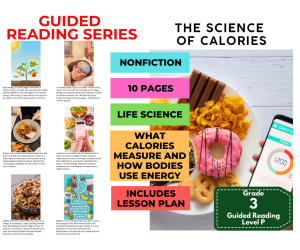
The Science of Calories: Guided Reading Level P with Lesson Plan
ELA, Resources for Teachers, Reading Comprehension, Reading, Science, Life Sciences, Health, P.E. & Health, Physics, Language Development, Grade 2, 3, 4, Worksheets & Printables, Worksheets, Teacher Tools, Centers, Activities, Literacy Readers, Quizzes, Quizzes and Tests, Assessments, Lesson Plans
This The Science of Calories (level p) guided reading book with lesson plan includes: Guided Reading Color Label (front cover x1) This is a quick way to match the book’s demands to what students can generally handle.. The overall goal is to use the level/color to pick books for several smaller groups. To qualify for a certain level, a student is expected to read a book from that level with about 90–94% accuracy. If a student is consistently accurate and understands, move up a level. If the student is struggling at that level, drop down and add more support. Each student will improve at completely different rates, but it is generally one of the best ways to check progress across the class. DOWNLOAD THE CATALOG TO VIEW ALL GUIDED READING BOOKS AVAILABLE (SORTED LEVELS A-Z) Pre-Reading Question (x1) Teacher asks the prompt aloud, can be while showing the cover or first page. Students share what they already know, or make educated guesses from the cover. Prompt them to use the target vocabulary. Write some of their responses on the board to look back at during the reading. Vocabulary Words (x5) Introduce the five words, best doing it one at a time. Start by saying it, while students repeat and then see if anyone knows what it means before reading further. Read through the meaning and try to briefly connect each word to a picture or gesture so it’s meaningful. Ask students to flip through the book pages and point to where they see each of the vocabulary words. While reading the book pause upon coming across one of the vocab words or read the sentence twice to make sure students understand the word has appeared. Optional: Ask students to raise hands whenever they see/hear one of the new words. Guided Reading Pages (x10) Check the book snapshot (below) for: primary topic - do you need to prep extra reading or intro materials on this? what is taught best - decide on 1-2 bullets to focus on, use the prompt or words provided here for best results. learning goals - what you are checking for students to be able to do after the session, elicit answers using prompts or words provided. key vocabulary (see section above). questions overview - so you know what is coming up and if you need to prep extra materials to assist understanding. Run the lesson You may have already looked at a few of the pages together, but you can show them some of the pictures again first to set meaning. Depending on how much time you have and how familiar your students are with guided reading class, you may want to read the book aloud first with the group first. Students whisper or partner read, while you listen in. If time, do it as a group, one student reading a page each. Use the guided page’s prompts to coach: “Check the picture / does it make sense?” “Point under the words / try the first sound” “Reread the sentence smoothly”. Try to focus more on one student per session (rotating every time), so you can work out if they are ready to move up or need to move down a level. Comprehension Questions (back cover x3) This is your way to check that students didn’t just say the words, but actually understood the text. First, let students answer by pointing to the page/picture and saying a short sentence. After any answer, follow with: “Show me where you found that in the text.” In bigger groups, have partners answer first (10–20 seconds), then call on 2–3 students to share. Differentiation tips: Emerging speakers/struggling readers: oral + pointing On-level: oral in a full sentence Higher: one written sentence or draw + label Book Snapshot Title: The Science of Calories Genre: Nonfiction (informational science text) Subject: Science (Nutrition/Human Body) Primary Topic: What calories measure and how bodies use energy Estimated Guided Reading Level (A–Z): P What This Book Teaches Best Defines energy as what living things need to survive and function, and connects energy to everyday examples like cars and lamps. Explains that a calorie measures energy in food (not weight or size) and describes it as a scientific unit of measurement. Shows how most energy starts with the sun , and how plants use photosynthesis to turn light into chemical energy stored in plant parts. Describes how the human body uses energy all the time (even during rest or sleep) to power the heart, lungs, and brain. Explains how food energy is released through digestion , how activity increases energy demand, and how extra calories may be stored as body fat. Learning Goals Explain what energy is and why living things need it. Describe what a calorie measures according to the text. Explain how plants get energy from the sun and where that energy is stored in a plant. Describe how digestion helps the body unlock energy from food. Describe how physical activity changes the body’s need for calories. Explain what happens when more calories are consumed than the body needs for daily activities. Key Vocabulary From the Text measurement — finding out how much of something there is. photosynthesis — plants use sunlight to make chemical energy. digestion — the process that unlocks energy in food. intestines — long tubes that help finish breaking down food. converted — changed from one form into another. Discussion Prompts Pre-reading question: What do you think calories tell us about the food we eat? Comprehension questions: What does the book say a calorie measures? Comprehension questions: How does the book explain that plants capture and store energy from the sun? Comprehension questions: What does the book say happens when a person consumes more calories than needed for daily activities? Printing Tips 1. Best Printing Method (Recommended) “Booklet” Printing (Best if Available) If your printer or PDF viewer supports Booklet Printing , use this. Settings to use: Print mode: Booklet Paper size: Letter or A4 (either works) Orientation: Landscape Print on both sides: Yes Flip on: Short edge Scaling: Fit to printable area Booklet subset: First test: Front sides only Then: Back sides only This will automatically: Pair pages correctly Put the cover on the outside Align everything for folding After printing, fold in half and staple along the spine . 2. If “Booklet” Printing Is NOT Available You can still print this correctly with manual duplex printing . Step-by-step: Open the PDF. Choose Print . Set: Orientation: Landscape Pages per sheet: 1 Print on both sides: Yes Flip on: Short edge Print all pages . Because each PDF page already contains two facing book pages, the result will still fold cleanly into a book. Thousands of Cored Education products are included with your TeachSimple membership. Download links and encyclopedia index available here.
Author Cored Education
Rating
Tags Reading Comprehension, Reading Passages, Reading, Guided Reading, Guided Reading Lesson Plan, Guided Reading Activity, Pre-reading, Science Lesson Plans, Life Science, Health
Bees Reading Comprehension Passage - Cored Ed Encyclopedia
ELA, Language Development, Reading Comprehension, Reading, Writing, Pre-Reading, Science, Insects, Life Sciences, Vocabulary, Grade 2, 3, 4, 5, Worksheets & Printables, Worksheets, Teacher Tools, Centers, Activities, Writing Prompts, Assessments, Quizzes and Tests, Quizzes, Lesson Plans
This bees reading comprehension with lesson plan includes: Visualization (on the front cover) Start your lesson by taking a minute to think and share something about the topic. Read the script aloud (slowly), perhaps prepare some music or sound effects. Student close their eyes and let their imaginations wander. Students open their eyes, read the question aloud and give them a few minutes to complete. Ask a few students to share or keep answers until the end to compare with what they learn in the passage. Quick pause—thousands of Cored Education products are included with your TeachSimple membership. Download links and encyclopedia index available here. Pre-Reading Trivia Students will write down one thing they already know about the subject and then read five more facts and discuss. These facts are fun, and the students will enjoy learning about the subject before reading more. Give 1 minute for students to write what they already know (no pressure—best guess is fine). Read the five facts together. After each fact, do ask a student for their opinion, was it surprising? Set a purpose by asking students to highlight/underline one fact they want to learn more about during the reading. Reading Passage The text is a high-interest reading passage with set paragraphs, roughly three to four paragraphs long. It contains a variety of themes about the topic, anywhere from history to technology. The passage is between 250 and 350 words in length. First, ask students to look at the headings and see what they’ll learn about today. What do they know about the topic/heading? First read options: Teacher read-aloud (best for support). Partner reading (paragraph by paragraph). While reading, students underline important details, and vocabulary words they think may come up in the questions section. Mixed Questions The first question page contains four multiple-choice questions, each with a choice of four answers, and three written response questions that require a sentence or two from the student. Students complete the mcqs first independently, then review quickly as a class. For the 3 written responses, try to get students giving the answer with some form of evidence: “I think ___ because the text says ___.” If students get stuck, send them back to check the passage. Vocabulary Questions Practice seven key words from the text in this section across two activities. First section is scrambled words where students will unscramble three words given a clue for each. The second section is a word to meaning matching activity. Before starting, have some students read out words they underlined in the passage. Ask students to say the word and read aloud the sentence(s) around each word. Ask students to do scrambled words and the matching exercise in pairs then go through answers as a class. For the scrambled spelling task, get four pairs to come up to the board and write the words for extra practice with the other student reading out the clue. For the matching task, prompt students to give full sentences: “I matched ___ with ___ because ___.” Creative Writing In this question, the student will be required to write a five to eight sentence paragraph on a question related to the topic. Before starting, ask students write down 3 key ideas they are going to include in their piece. Ask students for ideas to share around the class to help those struggling. Pro writing expectations: 5–8 sentences At least 2 facts or details from the passage At least 2 vocabulary words from the previous page Students read their paragraphs while classmates listen for facts and vocabulary words. Extension Activities This page is optional for fast finishers or to take home. There are several activities, each one requiring a different skill. Do some, do none, do all, completely optional - but you will feel reassured knowing every possibility is planned for. Includes summary writting question and additional facts. Answer Key There are answers for the multiple-choice questions, written response questions have sample answers, vocabulary answers and if there is a summary question then a sample summary will be provided as well. Lesson Plan Included Customized lesson plan for this lesson is included. Lesson Snapshot Title: Bees Genre: Nonfiction (informational passage) Subject: Life Science Primary Topic: Pollination, hive roles, and waggle-dance communication Estimated Guided Reading Level (A–Z): S What This Lesson Teaches Best Bees as insects with many kinds (more than 20,000) living almost everywhere on Earth except **Antarctica. How bees help plants make seeds by moving pollen from flower to flower while gathering nectar and pollen for baby bees. How honey bees live in organized hives with shared jobs (queen, drones, and worker bees doing specific tasks). How honey bees turn nectar into honey and store it for later as extra food. How the waggle dance can share direction and distance to food, supported by the work of Karl von Frisch. Learning Goals Describe where bees live and how many kinds the passage says there are. Explain how pollen gets from one flower to another in the passage. Identify what pollen and nectar do for growing baby bees. Describe how jobs are shared in a honey bee hive, including the queen, drones, and workers. Explain what the waggle dance communicates and how other bees follow it in a dim hive. Describe how honey is made and stored, using details from the passage. Key Vocabulary From the Text pollen — yellow dust that helps plants make seeds. nectar — sweet liquid inside blossoms. colony — a group of bees living together. larvae — baby insects before they become adults. vibration — shaking that can be felt as movement. FULL CATALOG OF DOWNLOAD LINKS AND ENCYCLOPEDIA INDEX HERE
Author Cored Education
Rating
Tags Vocabulary, Reading Comprehension, Reading Passages, Lesson Plans, Ela Lesson Plans, Reading Comprehension Lesson Plans, Pre-reading, Science Lesson Plans, Life Science, Insects
Boats Reading Comprehension Passage - Cored Ed Encyclopedia
ELA, Language Development, Resources for Teachers, Reading Comprehension, Reading, Pre-Reading, Creative Writing, Writing, Physics, Science, Grade 2, 3, 4, 5, Worksheets & Printables, Worksheets, Teacher Tools, Centers, Activities, Writing Prompts, Assessments, Tests, Quizzes and Tests, Quizzes
This boats reading comprehension contains the following: Pre-Reading Trivia Students will write down one thing they already know about the subject and then read five more facts and discuss. These facts are fun, and the students will enjoy learning about the subject before reading more. COMPANION VIDEO NOW AVAILABLE (EMBEDDED AFTER PREVIEW PICTURES IN PRODUCT DESCRIPTION) Reading Passage The text is a high-interest reading passage with set paragraphs, roughly three to four paragraphs long. It contains a variety of themes about the topic, anywhere from history to technology. The passage is between 250 and 350 words in length. Mixed Questions The first question page contains four multiple-choice questions, each with a choice of four answers, and three written response questions that require a sentence or two from the student. Creative Writing In this question, the student will be required to write a five to eight sentence paragraph on a question related to the topic. Extension Activities This page is optional for fast finishers. If there are five to ten minutes left at the end of the lesson, the student can choose one of three activities, each one requiring a different skill. Answer Key There are answers for the multiple-choice questions and three written response questions have sample answers. FULL CATALOG OF DOWNLOAD LINKS AND ENCYCLOPEDIA INDEX HERE Cored Ed Encyclopedia Overview The Cored Ed Encyclopedia is a weekly series of lessons that you can pick up and use right away. These short readings fit into whatever time you have available. Each one includes a warm-up, a reading, and a set of questions, but it’s flexible — you can do just the reading, the full lesson, or skip the writing section if you need to. Each lesson focuses on a single topic so students don’t get lost. The writing is clear but never childish, making it perfect for grades two through five. Topics range from animals and science to history, inventions, and everyday things. No matter the level of the student, everyone should take away at least one new idea or fact from each lesson. The materials are easy to print, easy to explain, and require no setup. They work well for whole-class teaching, partner work, or independent study.
Author Cored Education
Rating
Tags Vocabulary, Spelling, Reading Comprehension, Reading Passages, Cored Encyclopedia, Facts, Reading, Creative Writing, Physics, Boats
Free Reading Passage: Classification of Matter (Docs)
ELA, Reading, Science, Physics, Common Core, Reading Comprehension, ESL, Language Development, Vocabulary, Resources for Teachers, Grade 2, 3, 4, Centers, Activities, Assessments, Teacher Tools, Tests, Quizzes and Tests, Worksheets, Worksheets & Printables
Free Reading Passage on Classification of Matter for Physical Science What's inside this free product? Science Reading Comprehension Passage3: Classification of Matter Independent Docs Version: This is the independent Docs version containingone lesson. Product Info: 5 PAGES (US English with Answers) Docs Version Teaching Duration: 90 Minutes Science Reading Comprehension Outline: Targeted for students in 3rd and 4th grades, these reading passages are enhanced with illustrations and graphs to elucidate critical points. Each lesson aligns with the Common Core State Standards, allowing you to integrate science reading practice effortlessly, knowing that minimal preparation is needed on your part. Each passage comes with a variety of questions in different formats, including multiple-choice formats, data analysis, and fill-in-the-blanks. The topics covered strike a balance between engaging content and core curriculum-based science subjects. Versatile in application, these lessons are suitable for a variety of settings such as whole-class instruction, morning activities, independent desk work, small group discussions, contingency plans for substitute teachers, homework assignments, or even special holiday-themed tasks. FULL CATALOG OF DOWNLOAD LINKS HERE Grade 3/4 Links: Physical Science Part 1 - Properties of Objects and Materials Google Docs/Slides/Forms PDF PPT Word Free Supplementary Pack Accompanying Videos Physical Science Part 2 - Position and Motion of Objects Google Docs/Slides/Forms PDF PPT Word Free Supplementary Pack Accompanying Videos Physical Science Part 3 - Light, Heat, Electricity, Magnetism Google Docs/Slides/Forms PDF PPT Word Free Supplementary Pack Accompanying Videos Life Science Part 1 - Characteristics of Organisms Google Docs/Slides/Forms PDF PPT Word Free Supplementary Pack Accompanying Videos Life Science Part 2 - Life Cycles of Organisms Google Docs/Slides/Forms PDF PPT Word Free Supplementary Pack Accompanying Videos Life Science Part 3 - Organisms and Environments Google Docs/Slides/Forms PDF PPT Word Free Supplementary Pack Accompanying Videos Earth Science Part 1 - Properties of Earth Materials Google Docs/Slides/Forms PDF PPT Word Free Supplementary Pack Accompanying Videos Earth Science Part 2 - Changes in the Earth and Sky Google Docs/Slides/Forms PDF PPT Word Free Supplementary Pack Accompanying Videos Earth Science Part 3 - Objects in the Sky Google Docs/Slides/Forms PDF PPT Word Free Supplementary Pack Accompanying Videos For similar products and other frees, do check out Cored Group on TeachSimple .
Author Cored Education
Tags Science, Elementary, Reading, Comprehension, Vocabulary, Answers, Physics, Physical Science, Ccss, Common Core
Science Reading Comprehension: Organisms and Environments Fillable PDF
Science, Life Sciences, Biology, Common Core, ELA, Reading Comprehension, Reading, Human Body, Animals, Grade 2, 3, 4, Worksheets & Printables, Worksheets, Assessments, Teacher Tools, Tests, Quizzes and Tests
Reading Comprehension: Organisms and Environments for Life Science (Biology) Snapshot Genre: Nonfiction Subject: Science (Life Science) Primary Topic: Food webs and environmental change Estimated Guided Reading Level (A–Z): P What This Teaches Best It teaches energy flow in ecosystems through producers, consumers, food chains, and food webs. It shows how one change in an ecosystem can lead to other changes in plants, animals, soil, and water. It explains that organisms can affect environments in harmful and helpful ways. It teaches how people can change environments quickly through dams, roads, farming, mining, and pollution. It introduces environmental problem-solving through endangered species and habitat harm. These are the strongest instructional takeaways from the collection. Learning Goals Students will explain the difference between producers and consumers. Students will describe how a food chain differs from a food web. Students will explain how one change in an ecosystem can affect many living things. Students will identify ways organisms can help or harm their surroundings. Students will describe several ways people can change environments. Students will explain how pollution and habitat changes can put living things at risk. Part 3 - Organisms & Environments Reading Passage 1: Food Chains and Food Webs Reading Passage 2: Organisms Change Environments Reading Passage 3: People Change Environments FILLABLE PDF VERSION Worksheet-style pages, but with type-in answer boxes so students can complete and save their work digitally. Other versions are available in the links list below or in the full catalog. FULL CATALOG OF DOWNLOAD LINKS HERE Grade 3/4 Links: Physical Science Part 1 - Properties of Objects and Materials Google Docs/Slides/Forms PDF PPT Word Free Supplementary Pack Accompanying Videos Physical Science Part 2 - Position and Motion of Objects Google Docs/Slides/Forms PDF PPT Word Free Supplementary Pack Accompanying Videos Physical Science Part 3 - Light, Heat, Electricity, Magnetism Google Docs/Slides/Forms PDF PPT Word Free Supplementary Pack Accompanying Videos Life Science Part 1 - Characteristics of Organisms Google Docs/Slides/Forms PDF PPT Word Free Supplementary Pack Accompanying Videos Life Science Part 2 - Life Cycles of Organisms Google Docs/Slides/Forms PDF PPT Word Free Supplementary Pack Accompanying Videos Life Science Part 3 - Organisms and Environments Google Docs/Slides/Forms PDF PPT Word Free Supplementary Pack Accompanying Videos Earth Science Part 1 - Properties of Earth Materials Google Docs/Slides/Forms PDF PPT Word Free Supplementary Pack Accompanying Videos Earth Science Part 2 - Changes in the Earth and Sky Google Docs/Slides/Forms PDF PPT Word Free Supplementary Pack Accompanying Videos Earth Science Part 3 - Objects in the Sky Google Docs/Slides/Forms PDF PPT Word Free Supplementary Pack Accompanying Videos For similar products and other frees, do check out Cored Group on TeachSimple .
Author Cored Education
Rating
Tags Science, Elementary, Reading, Comprehension, Reading Centers, Life Science, Biology, Science Assessments, Reading Comprehension Assessments, Vocabulary Assessments