



2,372 products added recently
Page 21 - 5th Grade Lesson Plans
Prepare your fifth graders for future challenges with lesson plans that promote higher-order thinking and mastery of key concepts. These resources encourage collaboration and in-depth exploration across subjects. Use them to guide your students toward readiness for middle school.

 Show filters

I WONDER - What Jobs Do Clouds Do | Animated Video Lesson
Earth Sciences, Earth and Environmental Sciences, Science, Grade 4, 5, 6, 7, 8, 9, 10, Lesson Plans, Teacher Tools
video Introduction An amazing video designed for the students to learn more about famous phenomena in different countries. I WONDER - What Jobs Do Clouds Do | Animated Video Lesson What do you know about this phenomenon? Where it happens? When it happens? What are the safety measures that we should take to be safe during this phenomenon? Are there any other places in the world that experienced this phenomenon? If yes, tell us more about them. Why do you think it happens? Do you like reading about Geography? What is your favorite country in the whole world? I WONDER - What Jobs Do Clouds Do | Animated Video Lesson The video is perfect for encouraging the researching skills for the students, while learning more about this fantastic phenomenon. I WONDER - What Jobs Do Clouds Do | Animated Video Lesson The video is perfect for encouraging the researching skills for the students, while learning more about this fantastic phenomenon. Format Available in a PDF format.
Author Educational Voice
Rating
Tags What Jobs Do Clouds Do, What Jobs Do Clouds Do Video, Clouds, Clouds Facts, Clouds Video, Clouds Video For Kids, Clouds Facts For Kids, Cloud, Cloud Facts, Cloud Video

X-Rays Reading Comprehension Passage - Cored Ed Encyclopedia
ELA, Language Development, Reading Comprehension, Reading, Science, Technology, Physics, History, Social Studies, Pre-Reading, Grade 2, 3, 4, 5, Worksheets & Printables, Worksheets, Teacher Tools, Centers, Activities, Writing Prompts, Assessments, Quizzes and Tests, Quizzes, Lesson Plans
This x-rays reading comprehension with lesson plan includes: Visualization (on the front cover) Start your lesson by taking a minute to think and share something about the topic. Read the script aloud (slowly), perhaps prepare some music or sound effects. Student close their eyes and let their imaginations wander. Students open their eyes, read the question aloud and give them a few minutes to complete. Ask a few students to share or keep answers until the end to compare with what they learn in the passage. Quick pause—thousands of Cored Education products are included with your TeachSimple membership. Download links and encyclopedia index available here. Pre-Reading Trivia Students will write down one thing they already know about the subject and then read five more facts and discuss. These facts are fun, and the students will enjoy learning about the subject before reading more. Give 1 minute for students to write what they already know (no pressure—best guess is fine). Read the five facts together. After each fact, do ask a student for their opinion, was it surprising? Set a purpose by asking students to highlight/underline one fact they want to learn more about during the reading. Reading Passage The text is a high-interest reading passage with set paragraphs, roughly three to four paragraphs long. It contains a variety of themes about the topic, anywhere from history to technology. The passage is between 250 and 350 words in length. First, ask students to look at the headings and see what they’ll learn about today. What do they know about the topic/heading? First read options: Teacher read-aloud (best for support). Partner reading (paragraph by paragraph). While reading, students underline important details, and vocabulary words they think may come up in the questions section. Mixed Questions The first question page contains four multiple-choice questions, each with a choice of four answers, and three written response questions that require a sentence or two from the student. Students complete the mcqs first independently, then review quickly as a class. For the 3 written responses, try to get students giving the answer with some form of evidence: “I think ___ because the text says ___.” If students get stuck, send them back to check the passage. Vocabulary Questions Practice seven key words from the text in this section across two activities. First section is scrambled words where students will unscramble three words given a clue for each. The second section is a word to meaning matching activity. Before starting, have some students read out words they underlined in the passage. Ask students to say the word and read aloud the sentence(s) around each word. Ask students to do scrambled words and the matching exercise in pairs then go through answers as a class. For the scrambled spelling task, get four pairs to come up to the board and write the words for extra practice with the other student reading out the clue. For the matching task, prompt students to give full sentences: “I matched ___ with ___ because ___.” Creative Writing In this question, the student will be required to write a five to eight sentence paragraph on a question related to the topic. Before starting, ask students write down 3 key ideas they are going to include in their piece. Ask students for ideas to share around the class to help those struggling. Pro writing expectations: 5–8 sentences At least 2 facts or details from the passage At least 2 vocabulary words from the previous page Students read their paragraphs while classmates listen for facts and vocabulary words. Extension Activities This page is optional for fast finishers or to take home. There are several activities, each one requiring a different skill. Do some, do none, do all, completely optional - but you will feel reassured knowing every possibility is planned for. Includes summary writting question. Answer Key There are answers for the multiple-choice questions, written response questions have sample answers, vocabulary answers and if there is a summary question then a sample summary will be provided as well. Lesson Plan Included Customized lesson plan for this lesson is included. Lesson Snapshot Title: X-Rays Genre: Nonfiction (informational text) Subject: Science (energy, technology, space science) / Informational Reading Primary Topic: Discovering X-rays and how they’re used Estimated Guided Reading Level (A–Z): R Support pages present: Pre-reading trivia; mixed questions; vocabulary page; creative writing; extension activities; answer key What This Lesson Teaches Best How Wilhelm Conrad Röntgen noticed a surprising glow in a dark lab and named the mystery ray “X.” Why X-ray pictures look like “shadow pictures,” with bone and metal stopping rays more than skin and soft tissue. How X-rays help doctors and dentists see inside the body without surgery, and how CT scans use many X-rays from different angles. That X-ray doses are kept as low as possible because X-rays can damage cells. How X-rays are used beyond hospitals, including security scanners and space telescopes on satellites that collect X-rays from hot places near black holes. Learning Goals Students will describe what happened in the lab that made the discovery of X-rays possible. Students will explain why bone and soft tissues show up differently on an X-ray picture. Students will identify how X-rays help doctors or dentists look inside the body without cutting. Students will describe what the text says about safety and why doses are kept low. Students will give an example of an X-ray use outside a doctor’s office found in the passage. Key Vocabulary From the Text invisible — not able to be seen. mystery — something not understood yet. detector — a tool that records the X-rays. tissues — soft parts inside the body. wavelength — the size/length of a wave. FULL CATALOG OF DOWNLOAD LINKS AND ENCYCLOPEDIA INDEX HERE
Author Cored Education
Rating
Tags Vocabulary, Reading Comprehension, Reading Passages, Lesson Plans, Ela Lesson Plans, Reading Comprehension Lesson Plans, Pre-reading, Science Lesson Plans, History Lesson Plans, Physics

I WONDER - How Many Teeth Should I Have | Animated Video Lesson
Human Body, Life Sciences, Science, Biology, STEM, Grade 1, 2, 3, 4, 5, 6, 7, 8, Lesson Plans, Teacher Tools
Video Overview The human body is full of fascinating wonders to learn. This video is created to help the students recognize the anatomy and the job of the human body. I WONDER - How Many Teeth Should I Have | Animated Video Lesson Every part and organ in our human body is vital so let's see how important they are. Have you ever imagined how we look like if we didn't have a skeleton? Did you know that because we have our amazing muscles we can stand! Do you know how many teeth do we have? Have you ever wondered about the food journey inside our body? Can you name all the glands in our body? Why do we have skin? Our nervous system is really good at sending signals. Can you tell us more about it? Are you really good at Mathematics, painting, or any other thing? You should really thank your brain about it! The famous five senses are really doing a great work? Can you explain how every sense works? I WONDER - How Many Teeth Should I Have | Animated Video Lesson The video is perfect for encouraging the researching skills for the students, while learning more about our fantastic human body. I WONDER - How Many Teeth Should I Have | Animated Video Lesson This friendly designed video is suitable for students at school, homeschooling, and as a group activity. Format Available in MP4 format.
Author Educational Voice
Tags How Many Teeth Should I Have, How Many Teeth Should I Have Video, Teeth, Teeth Facts, Teeth Facts For Kids, Teeth Video, Teeth Video For Kids, Tooth, Tooth Facts, Tooth Facts For Kids

Senses,Nervous & Respiratory Systems: The Sense of Hearing - FLASH-PC
Science, Life Sciences, Human Body, Common Core, Grade 5, 6, 7, 8, Teacher Tools, Lesson Plans
The Sense of Hearing - FLASH-PC FLASH-PC is an instructional tool to help students understand the complex interactions between the senses, nervous, and respiratory systems. The primary focus is on the sense of hearing. Suitable for Grades 5-8 This software is ideal for educators in public schools as well as homeschoolers. It can be implemented in a variety of ways such as whole-group instruction, small study groups or even assigned as homework. The science-based content revolves around human body structure and functions. User-friendly Interface On opening the zipped folder, there are multiple reading passages on sensory processing with emphasis on our auditory system's detailed workings facilitating hearing. These passages are packaged with 'Before You Read' and 'After You Read' questions that foster learner curiosity and measure comprehension respectively. Interactive Features: There are printables supplementing interactive features rendering tangible learning experiences especially beneficial to tactile learners. Vocabulary Flashcards : These serve both instructive purposes (introducing new terms) and evaluative ones (testing mastery). They also allow for self-paced learning. Videos: Videos along other activities promote an active learning approach fostering student participation rather than simply absorbing content passively. Alignment with Educational Standards The Sense Of Hearing - FLASH-PC aligns with Common Core State Standards established for Grades 5-8 Science curricula boosting its relevancy in achieving wider science literacy objectives. Its design also incorporates Bloom's Taxonomy principles advocating critical thinking skills development alongside knowledge acquisition regarding auditory system structure-function relationships. In Conclusion: An amalgamation of diverse teaching strategies packaged within an intuitive medium — The Sense Of Hearing - FLASH-PC positions itself as an irreplaceable addition to any science educator's toolkit.
Author Classroom Complete Press
Tags Interactive Activities, Human Body, Respiratory Systems, Senses, Science Quiz
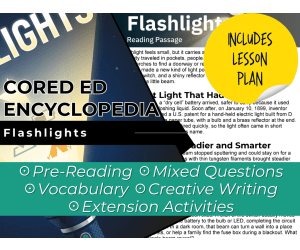
Flashlights Reading Comprehension Passage - Cored Ed Encyclopedia
ELA, Reading Comprehension, Reading, Science, Technology, Language Development, Social Studies, History, Pre-Reading, Physics, Grade 2, 3, 4, 5, Worksheets & Printables, Worksheets, Teacher Tools, Centers, Activities, Writing Prompts, Assessments, Quizzes and Tests, Quizzes, Lesson Plans
This Flashlights reading comprehension with lesson plan includes: Visualization (on the front cover) Start your lesson by taking a minute to think and share something about the topic. Read the script aloud (slowly), perhaps prepare some music or sound effects. Student close their eyes and let their imaginations wander. Students open their eyes, read the question aloud and give them a few minutes to complete. Ask a few students to share or keep answers until the end to compare with what they learn in the passage. Quick pause—thousands of Cored Education products are included with your TeachSimple membership. Download links and encyclopedia index available here. Pre-Reading Trivia Students will write down one thing they already know about the subject and then read five more facts and discuss. These facts are fun, and the students will enjoy learning about the subject before reading more. Give 1 minute for students to write what they already know (no pressure—best guess is fine). Read the five facts together. After each fact, do ask a student for their opinion, was it surprising? Set a purpose by asking students to highlight/underline one fact they want to learn more about during the reading. Reading Passage The text is a high-interest reading passage with set paragraphs, roughly three to four paragraphs long. It contains a variety of themes about the topic, anywhere from history to technology. The passage is between 250 and 350 words in length. First, ask students to look at the headings and see what they’ll learn about today. What do they know about the topic/heading? First read options: Teacher read-aloud (best for support). Partner reading (paragraph by paragraph). While reading, students underline important details, and vocabulary words they think may come up in the questions section. Mixed Questions The first question page contains four multiple-choice questions, each with a choice of four answers, and three written response questions that require a sentence or two from the student. Students complete the mcqs first independently, then review quickly as a class. For the 3 written responses, try to get students giving the answer with some form of evidence: “I think ___ because the text says ___.” If students get stuck, send them back to check the passage. Vocabulary Questions Practice seven key words from the text in this section across two activities. First section is scrambled words where students will unscramble three words given a clue for each. The second section is a word to meaning matching activity. Before starting, have some students read out words they underlined in the passage. Ask students to say the word and read aloud the sentence(s) around each word. Ask students to do scrambled words and the matching exercise in pairs then go through answers as a class. For the scrambled spelling task, get four pairs to come up to the board and write the words for extra practice with the other student reading out the clue. For the matching task, prompt students to give full sentences: “I matched ___ with ___ because ___.” Creative Writing In this question, the student will be required to write a five to eight sentence paragraph on a question related to the topic. Before starting, ask students write down 3 key ideas they are going to include in their piece. Ask students for ideas to share around the class to help those struggling. Pro writing expectations: 5–8 sentences At least 2 facts or details from the passage At least 2 vocabulary words from the previous page Students read their paragraphs while classmates listen for facts and vocabulary words. Extension Activities This page is optional for fast finishers or to take home. There are several activities, each one requiring a different skill. Do some, do none, do all, completely optional - but you will feel reassured knowing every possibility is planned for. Includes summary writting question and additional facts. Answer Key There are answers for the multiple-choice questions, written response questions have sample answers, vocabulary answers and if there is a summary question then a sample summary will be provided as well. Lesson Plan Included Customized lesson plan for this lesson is included. Lesson Snapshot Title: Flashlights Genre: Nonfiction (Informational Text) Subject: Science (Technology/Physical Science) / Reading (Informational Text) Primary Topic: Flashlight parts, history, and how it works Estimated Guided Reading Level (A–Z): P What This Lesson Teaches Best Explains the main parts inside a flashlight (a power source, a switch, and a reflector) and what they do. Teaches a short history of flashlights , including the “dry cell” battery and an 1899 U.S. patent for a hand-held electric light. Shows cause and effect : early zinc-carbon batteries tired quickly, so the light came in short flashes—leading to the name “flashlight.” Compares how flashlight beams improved over time, from sputtering light to steadier beams, including incandescent bulbs and later LEDs. Connects electricity to a real object by describing how a click of the switch completes a circuit so electricity can flow. Learning Goals Students will describe what a flashlight carries “in one hand” and what it helps people do in the dark. Students will identify three parts inside a flashlight case and explain each part’s job using the passage. Students will explain why the flashlight got its name, using evidence about early batteries and short flashes. Students will describe how flashlight lighting changed over time (dry cell batteries, incandescent bulbs, LEDs). Students will explain what happens when a flashlight switch is clicked, based on how the circuit is completed. Key Vocabulary From the Text reflector — shiny part that gathers glow and pushes it forward. patent — legal protection for an invention. incandescent — a kind of bulb that makes light using heat. LEDs — bright lights that can shine longer on same power. circuit — complete path that lets electricity flow. FULL CATALOG OF DOWNLOAD LINKS AND ENCYCLOPEDIA INDEX HERE
Author Cored Education
Rating
Tags Vocabulary, Reading Comprehension, Reading Passages, Lesson Plans, Ela Lesson Plans, Reading Comprehension Lesson Plans, Pre-reading, Science Lesson Plans, History, Technology

Iraq War (2003-2010): The Fall of Baghdad Gr. 5-8
Social Studies, History, History: USA, Grade 5, 6, 7, 8, Teacher Tools, Lesson Plans
The Iraq War (2003-2010): The Fall of Baghdad Gr. 5-8 This engaging, informative teaching tool is designed specifically for Grade 5 to 8 students. It dives into the nuanced history of Iraq's turmoil and instability from the years of 2003 to 2010, concentrating on the military operation that led to the collapse of dictator Saddam Hussein's regime. Usage Educators can use this resource in various ways such as whole-class discussions or individual assignments. Students can be involved in interactive activities like creating a poster promoting tourism in Iraq, blending creativity with learning about Iraqi culture and geography. Geographical Understanding and Key Themes This teaching tool includes map activities highlighting events leading up to both the Persian Gulf War and subsequently, the war in Iraq. Pertinent themes like world terrorism are also addressed within this plan - emphasizing how fear surrounding weapons of mass destruction escalated these conflicts. Bloom’s Taxonomy Inspired Activities This resource was originally written following Bloom’s Taxonomy - an educational framework that categorizes learning skills. Each activity presents its own unique challenges aimed at stimulating critical-thinking among students while enriching their knowledge base simultaneously. Traditional Tasks & Convenience for Teachers In addition, there are more traditional tasks such as hands-on activities, quizzes and word searches; aiming not just at testing existing knowledge but also making learning irresistible by incorporating elements typically associated with play into it. An included answer key provides convenience by reducing extra prep-work necessary on teacher’s part when grading completed assignments. All told within one downloadable PDF that includes 27 ready-to-print pages full of enriching education resources carefully crafted around reliable historical information about the Iraq War and its profound effects. Fitted not only for public school teachers but also homeschoolers, this resource aims to foster a deep, intellectual understanding in students in an approachable manner.
Author Classroom Complete Press
Tags Iraq War, Baghdad, Reading Passage, Social Studies, History Assessment
I WONDER - What Is An Ogre | Animated Video Lesson
History, Social Studies, Common Core, Grade 4, 5, 6, 7, 8, 9, 10, Lesson Plans, Teacher Tools
Video Introduction An amazing video designed for the students to learn more about mythological creatures in different cultures. I WONDER - What Is An Ogre | Animated Video Lesson Mythology is full of wonders and spectacular stories. Ancient civilizations were trying to explore every aspect of life, while they search for new technologies, they wanted to believe in something big and can change the world, so they created mythical creatures and mythical stories. Let's hear about them! What do you know about these creatures? Cyclops, Centaurs, Selkies, Phoenix, Gnomes, Dragons, Gorgons, Orcs, Cerberus, Trolls, Minotaur, Griffins, Mermaids, Elves, Polyphemus, Pegasus, and Ogres. I WONDER - What Is An Ogre | Animated Video Lesson The video is perfect for encouraging the creativity skills for the students, while learning more about this fantastic mythical creature. I WONDER - What Is An Ogre | Animated Video Lesson This friendly designed video is suitable for students at school, homeschooling, and as a group activity. Format Available in MP4 format.
Author Educational Voice
Rating
Tags What Is An Ogre, What Is An Ogre Facts, Ogre, Ogre Video, Ogre Facts, Ogre Video For Kids, Ogre Facts For Kids, Mythology, Mythology Facts, Mythology Video

World Political Leaders: The Dalai Lama (Tibet) Gr. 5-8
Social Studies, Government, Grade 5, 6, 7, 8, Teacher Tools, Lesson Plans
"World Political Leaders: The Dalai Lama (Tibet) Gr. 5-8" Teaching Resource This resource provides a remarkable opportunity to educators in teaching their students about significant global political leaders and their impacts. Specifically designed for Grades 5-8, it is best suited for a social studies curriculum with an emphasis on government education. Focus on Leaders The material encompasses twelve notable political leaders from the past century, each holding substantial influence on the world stage. It features in-depth chapters dedicated to various leaders such as: George W. Bush Ronald Reagan Vicente Fox Margaret Thatcher and others... Included within this comprehensive list is a special chapter on His Holiness - The Dalai Lama of Tibet, focusing his role both as an influential political leader and spiritual guide. Tailor-made Materials for Efficient Teaching The resource offers several detailed lesson plans specially customized for these grade levels distributed along with printable PDF files ensuring convenient classroom integration. Features include: Analogies prompting critical thinking within students via writing tasks A range of activities such as crosswords or word searches carrying key lessons along the journey through global politics Multifaceted Implementation & Rigorous Assessment Strategies Targeted Learning Needs This tool adapts itself beautifully to diverse educational settings, enabling group discussions or independent learning or smaller group conversations based upon individual student needs. assessment strategies enable teachers to track student progress effectively through quizzes and answer keys. Alignment with Recognized Standards The approach used in this material aligns well with state standards as well as Bloom's Taxonomy, aiming at a superior level of knowledge absorption and understanding amongst middle-grade learners and fulfilling holistic education requirements. Final Thoughts This teaching tool delivers an enriching exploration of the global political canvas through a journey into the lives of influential leaders. It directs students toward an appreciation for diverse government systems, fostering intellectual growth that is integral to becoming world-aware citizens.
Author Classroom Complete Press
Tags World Leaders, Government, Dalai Lama, Government Worksheet, Comprehension

I WONDER - How Do Nocturnal Animals Use Their Sense Of Smell
STEM, Animals, Life Sciences, Science, Biology, Grade 1, 2, 3, 4, 5, 6, 7, 8, Lesson Plans, Teacher Tools
Video Introduction Animal kingdoms are full of fascinating wonders to learn. This video is designed for the students to learn more about animals in different countries. I WONDER - How Do Nocturnal Animals Use Their Sense Of Smell | Animated Video Lesson Do you like animals? what is your favorite one? Do you own a pet? If yes, tell us more about it, like what its name? And what do you like most about it? What are the animal kingdoms? Can you write down the characteristics of each animal class like mammals, birds, reptiles, amphibian, fish and mollusks. Do you know that some animals can sing, can you name any of them? What is the largest and the smallest mammal in the world? What is the largest and the smallest bird in the world? What is the largest and the smallest fish in the world? I WONDER - How Do Nocturnal Animals Use Their Sense Of Smell | Animated Video Lesson The video is perfect for encouraging the researching skills for the students, while learning more about these fantastic animals. I WONDER - How Do Nocturnal Animals Use Their Sense Of Smell | Animated Video Lesson This friendly designed video is suitable for students at school, homeschooling, and as a group activity. Format Available in MP4 format.
Author Educational Voice
Tags How Do Nocturnal Animals Use Their Sense Of Smell, How Do Nocturnal Animals Use Their Sense Of Smell Video, Nocturnal Animals Sense Of Smell, Nocturnal Animals Sense Of Smell Facts, Nocturnal Animals Sense Of Smell Video
I WONDER - Are There Different Types Of Microorganisms
Biology, Life Sciences, Science, Grade 4, 5, 6, 7, 8, 9, 10, Lesson Plans, Teacher Tools
Video Introduction An amazing activity designed for the students to learn more about STEM. I WONDER - Are There Different Types Of Microorganisms | Animated Video Lesson Do you like STEM subjects? what is your favorite one? Have you ever tried to plant a seed? If yes, tell us more about it. Or have you ever tried to invent something? If yes, tell us more about it. And how do you think it will help us? Have you ever seen a microorganism under a microscope? What was it? And how it looked like? Mathematics is a marvelous subject. Let' sharpen our brains and solve some equations. Do you like timetable tricks? What is your favorite one? Do you know how to code? Have you ever created an app or a game before? If yes, how was it like? I WONDER - Are There Different Types Of Microorganisms | Animated Video Lesson The video is perfect for encouraging the researching skills for the students, while learning more about this fantastic topic. I WONDER - Are There Different Types Of Microorganisms | Animated Video Lesson This friendly designed video is suitable for students at school, homeschooling, and as a group activity. Format Available in MP4 format.
Author Educational Voice
Tags Are There Different Types Of Microorganisms, Are There Different Types Of Microorganisms Video, Types Of Microorganisms, Types Of Microorganisms Facts, Types Of Microorganisms Video, Types Of Microorganisms Video For Kids

Curriculum Math Tools - Stopwatch Tool - FLASH-MAC
Math, Algebra, Grade 1, 2, 3, 4, 5, 6, 7, 8, Lesson Plans, Teacher Tools
Curriculum Math Tools - Stopwatch Tool - FLASH-MAC The Curriculum Math Tools - Stopwatch Tool for Mac (FLASH-MAC) is a teaching resource designed to help educators enhance the understanding of complex mathematical concepts amongst learners. This tool aligns with recognized educational standards like the National Council of Teachers of Mathematics (NCTM), Common Core, and STEM. This versatile software caters primarily to Grade 1 through Grade 8 and perfectly supplements subjects like Algebra. Whether you're a public school teacher or a homeschooling parent, this is an ideal solution for you. Easy Installation The software comes as a compact ZIP file compatible with Mac operating systems. It ensures convenience whether you're conducting classes in schools on institution computers or facilitating learning from home on your device. Focusing on Five Strands of Mathematics Number & Operations Algebra Geometry Measurement Data Analysis & Probability You can conveniently incorporate this stopwatch tool into exercises related to any or all these five strands making learning comprehensive yet engaging. Versatility that offers variety The stopwatch caters not only to whole group instruction but also facilitates small group activities and individual tasks such as homework assignments. It effectively eliminates potential barriers during exploration and comprehension while simultaneously improving proficiency among students. In essence, if high-quality math-based teaching resources are what you need – ready, accessible whether traditionally taught or remotely facilitated – then Curriculum Math Tools' Stopwatch Tool- FLASH MAC just might be your best bet! Your journey towards fun, engaging and effective teaching is just a ZIP file away!
Author Classroom Complete Press
Tags Math Tools, Math Assessment, Algebra, Stopwatch, Math Curriculum

I WONDER - Why Did The Mayan Build Chichén Itzá | Animated Video
History, Social Studies, History: Ancient, Geography, History: World, Grade 4, 5, 6, 7, 8, 9, 10, Lesson Plans, Teacher Tools
Video Introduction An amazing video designed for the students to learn more about famous places in different countries. I WONDER - Why Did The Mayan Build Chichén Itzá | Animated Video Lesson What do you know about this place? Do you know in which part of the world it is? Have you ever visited this place? If yes, can you tell us more about your adventure, and what do you like the most about this place? Do you like reading about Geography? What is your favorite country in the whole world? If you are going on a trip where it will be? Which country? What you are going to see there? Does this country has a famous place to visit? I WONDER - Why Did The Mayan Build Chichén Itzá | Animated Video Lesson The activity is perfect for encouraging the researching skills for the students, while learning more about this fantastic place. I WONDER - Why Did The Mayan Build Chichén Itzá | Animated Video Lesson This friendly designed video is suitable for students at school, homeschooling, and as a group activity. Format Available in MP4 format.
Author Educational Voice
Rating
Tags Why Did The Mayan Build Chichén Itzá, Why Did The Mayan Build Chichén Itzá Video, Chichén Itzá, Chichén Itzá Video, Chichén Itzá Facts, Chichén Itzá Facts For Kids, Chichén Itzá Video For Kids

I WONDER - When Was The Taj Mahal Built | Animated Video Lesson
History, Social Studies, Geography, History: Asian, Grade 4, 5, 6, 7, 8, 9, 10, Lesson Plans, Teacher Tools
Video Introduction An amazing video designed for the students to learn more about famous places in different countries. I WONDER - When Was The Taj Mahal Built | Animated Video Lesson What do you know about this place? Do you know in which part of the world it is? Have you ever visited this place? If yes, can you tell us more about your adventure, and what do you like the most about this place? Do you like reading about Geography? What is your favorite country in the whole world? If you are going on a trip where it will be? Which country? What you are going to see there? Does this country has a famous place to visit? I WONDER - When Was The Taj Mahal Built | Animated Video Lesson The activity is perfect for encouraging the researching skills for the students, while learning more about this fantastic place. I WONDER - When Was The Taj Mahal Built | Animated Video Lesson This friendly designed video is suitable for students at school, homeschooling, and as a group activity. Format Available in MP4 format.
Author Educational Voice
Rating
Tags When Was The Taj Mahal Built, When Was The Taj Mahal Built Video, Taj Mahal, Taj Mahal Facts, Taj Mahal Video, Taj Mahal Video For Kids, Taj Mahal Facts For Kids, India, Geography

I WONDER - How Much Of Earth Is Covered In Water | Animated Video
Geography, Social Studies, Grade 2, 3, 4, 5, 6, 7, 8, Lesson Plans, Teacher Tools
Video Introduction An amazing video designed for the students to learn more about famous places in different countries. I WONDER - How Much Of Earth Is Covered In Water | Animated Video Lesson What do you know about this place? Do you know in which part of the world it is? Have you ever visited this place? If yes, can you tell us more about your adventure, and what do you like the most about this place? Do you like reading about Geography? What is your favorite country in the whole world? If you are going on a trip where it will be? Which country? What you are going to see there? Does this country has a famous place to visit? I WONDER - How Much Of Earth Is Covered In Water | Animated Video Lesson The activity is perfect for encouraging the researching skills for the students, while learning more about this fantastic place. I WONDER - How Much Of Earth Is Covered In Water | Animated Video Lesson This friendly designed video is suitable for students at school, homeschooling, and as a group activity. Format Available in MP4 format.
Author Educational Voice
Tags How Much Of Earth Is Covered In Water, How Much Of Earth Is Covered In Water Video, Earth, Earth Facts, Earthfacts For Kids, Earth Video, Earth Video For Kids, Water On Earth, Water On Earth Video

I Wonder - Why Is It Important To Balance Sugar In take
Biology, Life Sciences, Science, Human Body, STEM, Grade 2, 3, 4, 5, 6, 7, 8, Lesson Plans, Teacher Tools
Video Overview The human body is full of fascinating wonders to learn. This video is created to help the students recognize the anatomy and the job of the human body. I WONDER - Why Is It Important To Balance Sugar In take | Animated Video Lesson Every part and organ in our human body is vital so let's see how important they are. Have you ever imagined how we look like if we didn't have a skeleton? Did you know that because we have our amazing muscles we can stand! Do you know how many teeth do we have? Have you ever wondered about the food journey inside our body? Can you name all the glands in our body? Why do we have skin? Our nervous system is really good at sending signals. Can you tell us more about it? Are you really good at Mathematics, painting, or any other thing? You should really thank your brain about it! The famous five senses are really doing a great work? Can you explain how every sense works? I WONDER - Why Is It Important To Balance Sugar In take | Animated Video Lesson The video is perfect for encouraging the researching skills for the students, while learning more about our fantastic human body. I WONDER - Why Is It Important To Balance Sugar In take | Animated Video Lesson This friendly designed video is suitable for students at school, homeschooling, and as a group activity. Format Available in MP4 format.
Author Educational Voice
Tags Why Is It Important To Balance Sugar In Take, Why Is It Important To Balance Sugar In Take Video, Sugar In Take, Sugar In Take Facts, Sugar In Take Facts For Kids, Sugar In Take Video, Sugar In Take Video For Kids
Reducing Your Own Carbon Footprint: How To Make Your Footprint Smaller And Why You Should Gr. 5-8
Science, Earth and Environmental Sciences, Environmental Science, Grade 5, 6, 7, 8, Teacher Tools, Lesson Plans
Reducing Your Own Carbon Footprint: How To Make Your Own Footprint Smaller and Why You Should Gr. 5-8 A comprehensive educational digital resource aimed at teaching students of grades 5 to 8 about climate change, its causes and their own environmental impact. The Greenhouse Effect This tool assists in teaching students about the greenhouse effect, exposing them to its causes and outcomes. It encourages critical thinking by identifying energy consumption in a common household space – such as the kitchen. Farm to Table Carbon Output An overview of all steps involved in farm-to-table food production—building connections between everyday actions and global carbon output. Travel-Evoked Carbon Footprint Understand how modes of travel contribute heavily to one's carbon footprint. A provision for tools that calculate learners' travel footprints with suggestions on reducing the impact.. Waste Management vs Recycling > "Recycling isn't always enough", hence, this resource provides practical ways learners can manage their waste footprints. Moulding Environmentally-Conscious Communities > Influencial materials equipping educators to help students understand their place within an environmentally oriented society encouraging them towards contributing actively. Bonus Resource: This digital guide challenges students problem-solving skills via examples showing how 'green' rules can be part of social contracts effectively reducing a shared carbon footprint. Pdf based format convenient for use on any device. Bloom's Taxonomy framed graphic organizers along with STEAM focused materials – Underlining environmental science. An interactive carbon footprint calculator Puzzles and games like a word search game and crossword puzzle. A comprehension quiz with an answer key to assess understanding. Note: This resource is curated specifically for science teachers, homeschooling educators. It can be used flexibly in full-classroom sessions or assigned as smaller group activities such as homework projects. You need the right tool for teaching students their relationship with the environment? Look no further because "Reducing Your Own Carbon Footprint: How To Make Your Own Footprint Smaller" is available just for you!
Author Classroom Complete Press
Tags Science Workbook, Reading Passage, Environmental, Carbon Footprint, Science Assessment
Mexican Government: Three Branches of the Mexican Government Gr. 5-8
Social Studies, Government, Grade 5, 6, 7, 8, Teacher Tools, Lesson Plans
Mexican Government: Three Branches of the Mexican Government Gr. 5-8 This is an excellent teaching resource developed specifically for educators guiding Grade 5 to 8 students through their Social Studies journey. Seamlessly delivered in PDF format, it serves as a valuable tool for teachers and homeschoolers alike to gain insights into Mexico's governmental structure. Within this lesson plan, learners explore: The Constitution of Mexico- highlighting its balance of power among different branches. Article 3, which guarantees everyone's right to education. The significance of abolishing slavery in the Constitution of 1917. The Presidential oath,bearing the promises a President needs to uphold. Furthermore, it sheds light on various departments under Mexico’s Executive Branch including Health, Environment, Tourism and Agriculture. It also familiarizes learners with different political parties and their ideologies providing valuable insights into Mexican politics. Ideal Adaptability This resource can be ideally adapted for group discussions or small workgroups. It can also be given as homework illustrating versatility depending on teaching style. Educational Standards Compliance & Cognitive Development Approach: Made in accordance with state educational standards offering quality assurance; Built on Bloom’s Taxonomy promoting cognitive development on multiple levels; Included Extras: Diverse writing tasks tapping into learners’ creativity; Crossword puzzles and word search games instilling learning while having fun; A comprehension quiz testing students’ understanding along with provided answer key reassuring effective learning methodology is employed. Let’s make teaching engaging and learning fascinating with Mexican Government: Three Branches of the Mexican Government Gr. 5-8.
Author Classroom Complete Press
Tags PDF

Ecosystems: Populations
Science, Earth and Environmental Sciences, Environmental Science, Common Core, Grade 5, 6, 7, 8, Teacher Tools, Lesson Plans
Ecosystems: Populations - A Valuable Teaching Resource The teaching resource, Ecosystems: Populations, is an invaluable asset for educators aiming to add depth and clarity to their students’ understanding of the intricate relationships within ecosystems. This chapter slice from the comprehensive lesson plan "Ecosystems," delves into the fundamental aspects of biotic and abiotic ecosystems in a manner that is truly enriching yet easy-to-follow. Improve Students' Understanding Teachers can enhance student comprehension by dissecting essential contrasts: Producers vs Consumers, Decomposers vs Evolving populations. This resource elucidates changes in ecosystems and provides a keen perspective on Food Chains and Webs—concepts that often baffle students attempting to grasp ecosystem dynamics. The integral role of water cycles interacting with entities ranging from man down to microorganisms. About The Resource This science educational resource offers 27 pages in a ready-to-print PDF format aimed at grade 5-8 curriculum's environmental science subset. The package encompasses reading passages crafted with simplified language and vocabulary which would suit remedial students perfectly without compromising content integrity. Color Mini Posters: The set also includes well-designed color mini posters making visual learning more engaging while complementing each student's unique learning style. Interactive Activities: Adding versatility to its application are interactive activities that promote participation and better retention amongst learners. All content aligns with Common Core State Standards—an indicative of its relevancy—while also adhering meticulously to Bloom's Taxonomy—an effective methodology encouraging higher forms of thinking among learners—and STEM initiatives that reflect real-world situations thereby fostering critical thinking skills beyond classroom boundaries. Make it a part of your teaching arsenal Embrace this tool as part of your teaching arsenal; impart pivotal scientific knowledge proficiently, equipped by 'Ecosystems: Populations' today. Let us simplify the route to understanding the intricate harmony within Earth's diverse ecosystems while instilling values of environmental stewardship in our young learners.
Author Classroom Complete Press
Tags Science Lesson Plan, Ecosystems Lesson, Ecosystems Text, Populations, Environment
World Political Leaders: Margaret Thatcher (United Kingdom) Gr. 5-8
Social Studies, Government, Grade 5, 6, 7, 8, Teacher Tools, Lesson Plans
World Political Leaders: Margaret Thatcher (United Kingdom) Gr. 5-8 This educational resource is designed for grade 5 to grade 8 students who are newcomers to the world of politics and international impacts. It's part of a broader lesson plan that includes twelve influential political leaders from the past century. Leadership Styles and Historical Impact The material uncovers insights into George W. Bush's 'war on terrorism', Ronald Reagan's Cold War involvement, as well as Vicente Fox's mediating role between Fidel Castro and George W.Bush. Prominent Female Leader: Margaret Thatcher Besides touching upon these global figures, it also spends considerable focus on Margaret Thatcher from United Kingdom, whose role was pivotal in ending apartheid in South Africa. This makes it highly applicable for gender studies or during Women’s History Month discussions. Mikhail Gorbachev's journey from leading the Soviet Union to becoming Nobel Peace Prize laureate Nelson Mandela’s fight towards equal rights in South Africa Dalai Lama – A spiritual leader & Tibet Lama known for his contribution towards Buddhism and Asian cultural heritage This downloadable package is an all-in-one PDF file having 25 ready-to-print pages,Bloom's Taxonomy-aligned and State Standards-based, filled with various engaging activities including: writing assignments riddles (crosswords puzzles & word search games) quizzes for comprehension assessment - suitable for whole group teachings session, small groups or individual homework assignments! This comprehensive teaching tool with included answer keys ensures that you're prepared to give your students a multifaceted approach to political study, making the material more interesting and interactive. It's a perfect fit for social studies lessons or government related topics sparking classrooms conversations and debates.
Author Classroom Complete Press
Tags World Leaders, Political Leaders, United Kingdom, Reagan, Terrorism
I WONDER - How Does Gravitational Pull Work | Animated Video Lesson
Physics, Science, Grade 4, 5, 6, 7, 8, 9, 10, Lesson Plans, Teacher Tools
Video Introduction An amazing activity designed for the students to learn more about STEM. I WONDER - How Does Gravitational Pull Work | Animated Video Lesson Do you like STEM subjects? what is your favorite one? Have you ever tried to plant a seed? If yes, tell us more about it. Or have you ever tried to invent something? If yes, tell us more about it. And how do you think it will help us? Have you ever seen a microorganism under a microscope? What was it? And how it looked like? Mathematics is a marvelous subject. Let' sharpen our brains and solve some equations. Do you like timetable tricks? What is your favorite one? Do you know how to code? Have you ever created an app or a game before? If yes, how was it like? I WONDER - How Does Gravitational Pull Work | Animated Video Lesson The video is perfect for encouraging the researching skills for the students, while learning more about this fantastic topic. I WONDER - How Does Gravitational Pull Work | Animated Video Lesson This friendly designed video is suitable for students at school, homeschooling, and as a group activity. Format Available in MP4 format.
Author Educational Voice
Tags How Does Gravitational Pull Work, How Does Gravitational Pull Work Video, Gravitational Pull, Gravitational Pull Facts, Gravitational Pull Facts For Kids, Gravitational Pull Facts Video, Physics, Physics Video For Kids

Prevention, Recycling & Conservation: Reduce and Reuse Gr. 5-8
Science, Earth and Environmental Sciences, Environmental Science, Grade 5, 6, 7, 8, Teacher Tools, Lesson Plans
Prevention, Recycling & Conservation: Reduce and Reuse Gr. 5-8 A comprehensive teaching resource that expands students' awareness of eco-friendly practices. This educational tool specifically targets the principles of conservation, recycling, and reduction in the context of grades 5 to 8 classrooms. Main Highlights: Covers areas such as conservation and natural, renewable and non-renewable resources with simple yet comprehensive language. Focuses on waste reduction methods like composting - explaining how organic material breakdown reduces landfill wastage. Touches upon significant present-day issues like water pollution from waste disposal or air pollution from burning fossil fuels – also presents potential solutions such as alternative fuels. Further Insights Beyond conventional topics, Prevention, Recycling & Conservation: Reduce and Reuse Gr. 5-8 provides teachers with practical lessons on sustainable living methods geared towards achieving a zero-waste future – preparing students for their role in shaping an environmentally friendly future. It comes packaged with reading passages tailored grade-wise along with engaging student activities designed according to Bloom's Taxonomy framework for skill development at different cognitive levels which aligns well with State Standards: An excellent tool for public school teachers or homeschoolers looking for seamless integration into regular curriculum planning efforts. Included tests prep materials make comprehension assessment easy while the color mini posters aid better retention among remedial learners through visualization - useful both as whole group instruction material or small group discussions etc. Making Science classrooms more responsive to today's environmental science realities/needs is crucial. With an emphasis on understanding better ways to prevent wastage along with recycling & conservation endeavors 'Prevention Recycling Conservation Reduce Reuse Gr 5-8' is definitely an essential addition to all teaching resources, irrespective of the teaching format.
Author Classroom Complete Press
Tags PDF

World Electoral Processes: History of the Voting System Gr. 5-8
Social Studies, Government, Grade 5, 6, 7, 8, Teacher Tools, Lesson Plans
World Electoral Processes: History of the Voting System Gr. 5-8 World Electoral Processes: History of the Voting System Gr. 5-8 is an instructional resource designed to enlighten students on global voting systems. It navigates through various government types such as presidential, parliamentary and dictatorships. The Learning Journey This guide provides a sequential walkthrough from ancient governments to today's electoral procedures. It harbors multiple activities promoting understanding for democratic concepts and critical thoughts regarding citizen representation. Presidential power dynamics versus Parliamentary setups Fostering comprehension via interactive learning scenarios - like role-playing exercises. Facing Dictatorships Squarely No important topic is left unaddressed including illuminating insights into dictatorship roles evolution over time and its propensity for military leaders, thanks to historical contextual lessons. A blend of Theory and Practice Citizenship requirements relating to voting rights in different countries An actual classroom election exercise on board Bloom’s Taxonomy-based learning approach – complying with existing state standards for encouraging sophisticated thinking skills within the student body along with additional engagement boosters (writing tasks, crosswords, word searches ). Emphasis is given on ready adaptability within diverse teaching setups – whole group classes or small team learning sessions while being also useful as homework or review assignment material.
Author Classroom Complete Press
Tags PDF
I WONDER - How Big Was The Allosaurus | Animated Video Lesson
History: Ancient, History, Social Studies, History: World, Animals, Life Sciences, Science, Grade 4, 5, 6, 7, 8, 9, 10, Lesson Plans, Teacher Tools
Video Introduction An amazing video designed for the students to learn more about dinosaurs in different countries. I WONDER - How Big Was The Allosaurus | Animated Video Lesson Do you like dinosaurs? what is your favorite one? Do you own a pet? If yes, tell us more about it, like what its name? And what do you like most about it? Do you think that your pet has been evolved from a dinosaur? Can you write down the characteristics of your favourite dinosaur like it's shape, their rivals, where did it use to live and what was their favourite food? What is the largest and the smallest dinosaur that ever found? Why is the T-rex is so famous? Have you ever read any interesting facts about it? Can you name any of the carnivores or herbivores dinosaurs? I WONDER - How Big Was The Allosaurus | Animated Video Lesson The video is perfect for encouraging the researching skills for the students, while learning more about dinosaurs. I WONDER - How Big Was The Allosaurus | Animated Video Lesson This friendly designed video is suitable for students at school, homeschooling, and as a group activity. Format Available in MP4 format.
Author Educational Voice
Rating
Tags How Big Was The Allosaurus, How Big Was The Allosaurus Video, Allosaurus, Allosaurus Facts, Allosaurus Facts For Kids, Allosaurus Video, Allosaurus Video For Kids, Dinosaur, Dinosaurs

I WONDER - Who Was The God Zeus | Animated Video Lesson
History, Social Studies, History: Ancient, History: Europe, Grade 4, 5, 6, 7, 8, 9, 10, Lesson Plans, Teacher Tools
Video Introduction An amazing video designed for the students to learn more about history. I WONDER - Who Was The God Zeus | Animated Video Lesson Do you like history? Which topic do you really enjoy about history? Have you ever read an interesting fact about the Vikings? If yes, can you mention them? What do you like most about the Victorian era? Can you name all the Tudors? Have you ever wondered how people used to live in ancient Japan and ancient China? Do you know any interesting facts about ancient Egyptians and the Pharaohs? Have you ever visited South America? What do you know about Incas and Aztecs? Celtic culture was really one of a kind, can you name any of the places that Celts used to live in? Imagine yourself living during the ancient Roman empire, how your life will look like? Ancient Greece was an amazing place to live in. What do you know about ancient Greek life? I WONDER - Who Was The God Zeus | Animated Video Lesson The video is perfect for encouraging the researching skills for the students, while learning more about history. I WONDER - Who Was The God Zeus | Animated Video Lesson This friendly designed video is suitable for students at school, homeschooling, and as a group activity. Format Available in MP4 format.
Author Educational Voice
Tags Who Was The God Zeus, Who Was The God Zeus Video, God Zeus, God Zeus Facts, God Zeus Facts For Kids, God Zeus Video, God Zeus Video For Kids, God, Gods, Zeus