



3,923 products added recently
Page 106 - Worksheets
Enhance your classroom with a wide array of worksheets covering various subjects and grade levels. These resources offer engaging activities to reinforce lessons, assess understanding, and provide extra practice. Utilize them to supplement your curriculum and support student learning effectively.

 Show filters

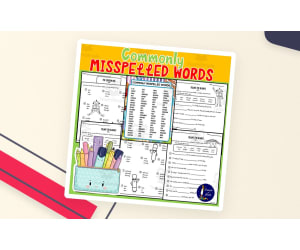
Most Commonly Misspelled Words
ELA, Language Development, Vocabulary, Spelling, Grade 3, 4, 5, Worksheets & Printables, Worksheets
Most Commonly Misspelled Words is a teaching resource that helps students in grades 3-5 improve their spelling. This packet focuses on 84 of the most commonly misspelled words that elementary students frequently use but struggle to spell correctly. The activities allow students to identify proper spelling, choose the correctly spelled word using context clues, practice using the words in sentences, and alphabetize commonly misspelled words. With consistent exposure and writing practice for each word, students will remember the proper spelling both phonetically and visually. This resource can be implemented in small groups, whole class instruction, or as individual practice to reinforce spelling skills. Using these targeted activities and repeated practice, students will become better writers and readers.
Author Soumara Siddiqui
Rating
Tags Grammar, Spelling, Writing, Vocabulary, English Language Arts
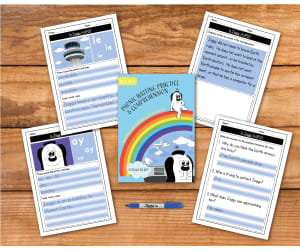
Writing And Comprehension Practice: Is Zoggy A UFO (4-8 years)
ELA, Language Development, Phonics, Preschool, Grade 1, 2, Worksheets & Printables, Worksheets
Is Zoggy a UFO: A Unique teaching resource Writing and Comprehension Practice: Is Zoggy A UFO (4-8 years) is a one-of-a-kind teaching tool purposely crafted for educators assisting children in the primary stages of language arts. It adds remarkably to the early development of reading, writing, and comprehension skills. User-Friendly Product The product fits perfectly for children aged between 4 and 8 years, suitable for Grades 1, Grade 2, and Kindergarten. Its core aim is to establish essential spelling blocks while fostering comprehension abilities. Inclusive Learning Material This splendid educational resource includes illustrative worksheets that accompany the unique phonics book - "Is Zoggy a UFO?". Each worksheet combines learning with fun-filled activities. The character "Zoggy" directs kids on exciting journeys where they unknowingly master complex double consonant blends and vowel digraphs. Create sound knowledge of letter sounds? Aid tracing and word/letter-writing skills? Presentation of day-to-day life spellings? Inculcate simple comprehensions centred around stories? Mission Spelling Zero - Yellow Level Essential The product forms an integral part of the yellow level in the Mission Spelling Zero scheme. Moreover, this PDF file offers high-quality practice time with no extra preparation needed from your end! Use it as classwork or share it across for group revisions or even assign intriguing homework tasks – Is Zoggy A UFO establishes an engaging learning experience throughout! Note: Owning a copy of "Is Zoggy a UFO" is important to make the most of this highly advantageous resource kit! A Joy-Filled Learning Journey Anxiously wait for these young learners, under your valuable guidance, to embark upon an exciting journey in mastering reading and writing skills with their new friend, Zoggy!
Author Guinea Pig Education
Tags Teaching Resource, Language Arts, Reading Skills, Spelling Skills, Comprehension

Explore India
Social Studies, Geography, Grade 2, 3, 4, 5, Worksheets & Printables, Worksheets
Explore India is a 26-page teaching resource that allows students to discover this fascinating country. Educators can use these materials in various ways - introduce new vocabulary words and images as a whole class, have students work on the multiple activities in small groups, or assign the worksheets, reading passages, comics, and more as independent practice. The packet begins with activating prior knowledge about India. Then, through matching words and pictures, coloring maps, answering reading comprehension questions, writing stories, and filling out graphic organizers, learners will gain exposure to aspects of Indian culture like clothing, landmarks, food, animals, holidays, and more. This versatile resource works well for individualized learning or collaborative projects. With modifiable difficulty levels, it is appropriate for grades 2 through 5.
Author Learn it ANY way
Tags India, India Food, India Culture, Vocabulary, Reading

Literacy worksheets: Natural disasters and weather
ELA, Language Development, Vocabulary, Science, Earth and Environmental Sciences, Environmental Science, Grade 3, 4, 5, Worksheets & Printables, Worksheets
This book contains a variety of literacy activities that can be completed independently at home or at school. You can use this resource for remote learning, in the classroom or as an enrichment activity . Table of contents: p.4 vocabulary sheet p.5 Activity sheet p.6 List of the vocabulary words p.7 Bingo sheet p.8 Create a word search p.9 Write sentences p.10-11 Write a story p.12 Making connections between the topic and your life p.13 Guessing game p.14 Anagrams p.15 Create riddles p.16 Research on Internet p.17 Favorite word p.18 Transforming: New knowledge p.19-20 Create a comics strip, level 1 p.21-23 Create a comics strip, level 2 p.24 Vocabulary study p.25 Venn diagram to compare p.26 Draw a scene p.27 Game: The pichenette race p.28 Cliparts credits
Author Learn it ANY way
Tags Natural Disasters, Tsunamis, Earthquakes, Storm, Hurricane, Weather, Extreme Weather, Vocabulary
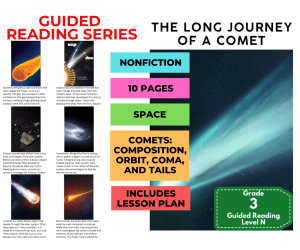
Guided Reading Level N - The Long Journey of Comets (with Lesson Plan)
ELA, Resources for Teachers, Reading Comprehension, Reading, Language Development, Science, Pre-Reading, Space, Earth and Environmental Sciences, Physics, Grade 2, 3, 4, Worksheets & Printables, Worksheets, Teacher Tools, Centers, Activities, Literacy Readers, Quizzes, Quizzes and Tests, Assessments
This Guided Reading Book - The Long Journey of a Comet (Level N) with lesson plan includes: Guided Reading Color Label (front cover x1) This is a quick way to match the book’s demands to what students can generally handle.. The overall goal is to use the level/color to pick books for several smaller groups. To qualify for a certain level, a student is expected to read a book from that level with about 90–94% accuracy. If a student is consistently accurate and understands, move up a level. If the student is struggling at that level, drop down and add more support. Each student will improve at completely different rates, but it is generally one of the best ways to check progress across the class. DOWNLOAD THE CATALOG TO VIEW ALL GUIDED READING BOOKS AVAILABLE (SORTED LEVELS A-Z) Pre-Reading Question (x1) Teacher asks the prompt aloud, can be while showing the cover or first page. Students share what they already know, or make educated guesses from the cover. Prompt them to use the target vocabulary. Write some of their responses on the board to look back at during the reading. Vocabulary Words (x5) Introduce the five words, best doing it one at a time. Start by saying it, while students repeat and then see if anyone knows what it means before reading further. Read through the meaning and try to briefly connect each word to a picture or gesture so it’s meaningful. Ask students to flip through the book pages and point to where they see each of the vocabulary words. While reading the book pause upon coming across one of the vocab words or read the sentence twice to make sure students understand the word has appeared. Optional: Ask students to raise hands whenever they see/hear one of the new words. Guided Reading Pages (x10) Check the book snapshot (below) for: primary topic - do you need to prep extra reading or intro materials on this? what is taught best - decide on 1-2 bullets to focus on, use the prompt or words provided here for best results. learning goals - what you are checking for students to be able to do after the session, elicit answers using prompts or words provided. key vocabulary (see section above). questions overview - so you know what is coming up and if you need to prep extra materials to assist understanding. Run the lesson You may have already looked at a few of the pages together, but you can show them some of the pictures again first to set meaning. Depending on how much time you have and how familiar your students are with guided reading class, you may want to read the book aloud first with the group first. Students whisper or partner read, while you listen in. If time, do it as a group, one student reading a page each. Use the guided page’s prompts to coach: “Check the picture / does it make sense?” “Point under the words / try the first sound” “Reread the sentence smoothly”. Try to focus more on one student per session (rotating every time), so you can work out if they are ready to move up or need to move down a level. Comprehension Questions (back cover x3) This is your way to check that students didn’t just say the words, but actually understood the text. First, let students answer by pointing to the page/picture and saying a short sentence. After any answer, follow with: “Show me where you found that in the text.” In bigger groups, have partners answer first (10–20 seconds), then call on 2–3 students to share. Differentiation tips: Emerging speakers/struggling readers: oral + pointing On-level: oral in a full sentence Higher: one written sentence or draw + label Book Snapshot Title: The Long Journey of a Comet Genre: Nonfiction (informational) Subject: Earth & Space Science Primary Topic: Comets: composition, orbit, coma, and tails Estimated Guided Reading Level (A–Z): N What This Book Teaches Best What comets are and what they’re made of (a “dirty snowball” mixture of ice, dust, and rock). How comets travel through the solar system, including long, oval-shaped orbits and time spent in the Kuiper Belt. What changes when a comet nears the Sun, including sublimation and the formation of a glowing coma. How solar wind and radiation create two tails that point away from the Sun, and how dust and ion tails differ. Why comets matter to scientists, described as “time capsules” that help scientists learn about the universe’s history. Learning Goals Students can describe what a comet is and identify materials the text says it contains. Students can explain what the nucleus is using details from the book. Students can describe what happens as a comet moves closer to the Sun, including sublimation and coma formation. Students can explain why a comet’s tails form and why they point away from the Sun. Students can compare the dust tail and the ion tail using text details. Students can explain what scientists can learn by studying comets, according to the text. Key Vocabulary From the Text mixture — different things combined together. nucleus — the solid center part of a comet. sublimation — when ice turns directly into gas. radiation — energy that travels out from the Sun. distinct — clearly different from something else. Discussion Prompts Pre-reading question: What do you think happens to a comet as it travels closer to the Sun? Comprehension questions: What does the text say a comet is made of? According to the text, what causes a comet to form a coma? What does the text say scientists can learn by studying comets? Printing Tips 1. Best Printing Method (Recommended) “Booklet” Printing (Best if Available) If your printer or PDF viewer supports Booklet Printing , use this. Settings to use: Print mode: Booklet Paper size: Letter or A4 (either works) Orientation: Landscape Print on both sides: Yes Flip on: Short edge Scaling: Fit to printable area Booklet subset: First test: Front sides only Then: Back sides only This will automatically: Pair pages correctly Put the cover on the outside Align everything for folding After printing, fold in half and staple along the spine . 2. If “Booklet” Printing Is NOT Available You can still print this correctly with manual duplex printing . Step-by-step: Open the PDF. Choose Print . Set: Orientation: Landscape Pages per sheet: 1 Print on both sides: Yes Flip on: Short edge Print all pages . Because each PDF page already contains two facing book pages, the result will still fold cleanly into a book. Thousands of Cored Education products are included with your TeachSimple membership. Download links and encyclopedia index available here.
Author Cored Education
Rating
Tags Reading Comprehension, Reading Passages, Reading, Guided Reading, Guided Reading Lesson Plan, Guided Reading Activity, Pre-reading, Vocabulary, Science Lesson Plans, Space
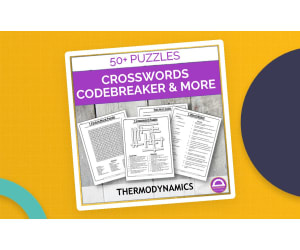
Thermodynamics Crossword Puzzles
Science, Physics, Grade 9, 10, 11, 12, Crosswords Puzzles, Worksheets, Worksheets & Printables
50 Puzzles, Endless Learning: 50 crossword puzzles crafted to teach and reinforce essential thermodynamics vocabulary. From “entropy” to “adiabatic process,” every term finds its place in these brain-teasing grids. A resource for 9th 12th students: 50 crossword puzzles designed to teach and review essential thermodynamics vocabulary. These puzzles are perfect for: sub plans, distance learning, homework, early finisher work. Each puzzle covers a wide range of topics, ensuring a strong foundation in key terms and concepts. 7 Crosswords 2 Circle Find a Word Puzzles 2 Cartoon Jumble 4 Clue Jumble 2 Clueless Crosswords 10 Code Words 2 Communicative Crosswords Puzzles 1 Anagram 1 Mystery 3 Find a Word Puzzles 1 Find a Word Anagram 1 Find a Word Mystery 3 No Peeky Puzzles 2 Word Definition 4 Word Match 5 Word Jumble List of terms: Thermodynamics Heat Temperature Energy Work System Entropy Internal Energy Heat Transfer Thermal Equilibrium Adiabatic Isobaric Isothermal Heat Capacity First Law of Thermodynamics Heat Engine Carnot Cycle Entropy Increase Enthalpy Boiling Point Critical Point Phase Diagram Heat Exchanger Thermal Expansion Pressure-Temperature Diagram Second Law of Thermodynamics Entropy Production Thermal Conduction Thermal Insulation Heat Pump Answer Keys for Easy Assessment: No more guessing games! The included answer keys ensure smooth evaluation and feedback. Boost Critical Thinking: These puzzles aren’t just about filling in blanks; they encourage critical thinking, problem-solving, and mental agility. As you connect the dots (or rather, the letters), you’re building a mental bridge to thermodynamic mastery. What's included: Print and go resource a zip file with puzzles and solutions.
Author Matemaths
Tags Matemaths, Physics, Thermodynamics, Puzzle, Crossword
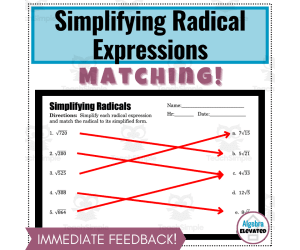
Simplifying Radicals Matching Worksheet
Math, Algebra, Grade 8, 9, Worksheets & Printables, Worksheets
Introduction Simplifying Radicals Matching Worksheet is an educational resource specifically developed for Grade 8 and Grade 9 students. This worksheet challenges pupils to simplify 13 square root expressions and match their calculations with the provided answers. Benefits This unique setting presents immediate feedback on their calculations. When students can't spot their answer among the options or find themselves repeating an answer twice, it signals a need to retry solving the problem. The matching concept expedites both teaching and grading processes. Teachers can guide pupils through each problem's solution during class discussions, and swiftly mark these worksheets while still obtaining clear insight into student work. An answer bank that outnumbers questions eliminates guessing without proper working, making learning more effective. Potential usage scenarios This versatile tool enhances algebra lessons effectively across different settings including: Larger classroom activities Smaller study groups Homework practice exercises. Versatility and Convinience – Simplifying Radicals Matching Worksheet In addition to being highly educational,the design of this worksheet is also practical.It comes as a printable handout in PDF format along with a comprehensive answer keyed ready for swift grading or review purposes.
Author Algebra Elevated
Tags Simplifying Radicals, Matching Worksheet, Algebra, Square Root Expressions, Practice Exercises, Roots And Radicals Worksheets
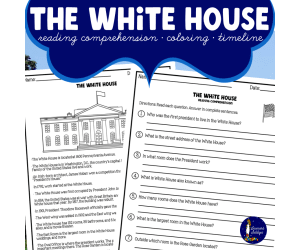
The White House Worksheets
Social Studies, History, History: USA, History: British, Grade 3, 4, 5, Worksheets, Worksheets & Printables
Where can you find the White House? What makes the Oval Office unique? Who was responsible for the White House fire in 1814? Your students will uncover answers to these inquiries and more as they delve into essential facts and details about the White House, commonly known as the People's House. This package includes: White House Reading Comprehension set White House Timeline activity Coloring activity featuring the White House Crafting a Letter to the White House Answer key Students will respond to questions using complete sentences, drawing on key details about the White House. They will utilize the provided reading material to construct a timeline showcasing significant historical events. Additionally, they'll have the chance to color an illustration of the White House and share three newfound insights. Finally, they'll draft a letter or create a drawing for potential submission to the White House. Instructions on how to send officially are included. Thank you! The White House Worksheets | The White House Worksheets | The White House Worksheets | The White House Worksheets | The White House Worksheets | The White House Worksheets | The White House Worksheets | The White House Worksheets | The White House Worksheets | The White House Worksheets | The White House Worksheets | The White House Worksheets |
Author Soumara Siddiqui
Tags The White House, White House Worksheets, White House Coloring Page, White House Facts

Twelfth Night Act 4, Scenes 1-3 | Double Entry Journals
ELA, Literature, Grade 9, 10, 11, 12, Worksheets & Printables, Worksheets
Double Entry Journals for Twelfth Night Act 4, Scenes 1-3 This 2-page printable and digital resource helps high school students analyze Act 4, Scenes 1-3 of Shakespeare's Twelfth Night using the double entry journal strategy. With four thought-provoking journal prompts, students will summarize the key events of each scene, reflect on the decisions and actions of the main characters, make inferences about underlying themes and symbolism, and make text-to-self connections. This versatile resource works well for whole-class analysis, small group discussion, or independent study, enabling educators to facilitate engaging conversations about this classic romantic comedy.
Author ELA Resources
Tags Literature, Shakespeare, Twelfth Night, Double Entry Journals, Reading, Comprehension, Journal Writing, Writer's Workshop, Reading Response

Intro to Percents Guided Notes + Homework Set
Math, Percentages, Grade 7, 8, 9, 10, Worksheets & Printables, Worksheets
This is an Intro to Percents Guided Notes + Homework Set. Students will learn more about this math skill as they walk through guided notes allowing them to learn and apply as they go along. A homework assignment is included to further student understanding of this math skill. Answer key included.
Author Eddie McCarthy
Tags Math Homework, Guided Notes, Percents, Word Problems, Introduction To Percents

Reading Comprehension Passages Fiction Set 2 Sample: Graduation (Word)
ELA, Reading, Reading Comprehension, Common Core, ESL, Language Development, Vocabulary, Creative Writing, Writing, Resources for Teachers, Grade 6, 7, Worksheets & Printables, Worksheets, Assessments, Teacher Tools, Tests, Quizzes and Tests, Writing Prompts
Reading Comprehension Passages Fiction Set 2 Overview Reading comprehension lessons, especially written for Grade 6-7, providing the chance to read interesting and engaging passages. Each lesson has a mix of questions to check understanding, a vocabulary or spelling activity to help remember key language introduced, and a writing exercise. Full answer keys are provided. Passage Included 2.Graduation: Matt helps prepare for his brother's graduation party. FULL CATALOG OF DOWNLOAD LINKS HERE Word Version This is the Word editable version. This download is available in GOOGLE Docs, GOOGLE Forms, GOOGLE Slides. PDF, PPT, WORD. Grade 6/7 Links Fiction Set 1 Google Docs Google Forms Google Slides PDF PPT Word Guided Reading Materials Fiction Set 2 Google Docs Google Forms Google Slides PDF PPT Word Guided Reading Materials Nonfiction Set 1 Google Docs Google Forms Google Slides PDF PPT Word Guided Reading Materials Nonfiction Set 2 Google Docs Google Forms Google Slides PDF PPT Word Guided Reading Materials Reading Passages Overview Each passage is especially written for Grade 6/7 students, including key vocabulary required for this age group. Topics are varied and are accompanied by colorful graphics. Topics are meant to educate, yet entertain the modern student. The majority of these short stories contain an important message - a way of developing these young learners further. Mixed Questions The mixed questions section of each lesson includes a variation of five to six comprehension, vocabulary and Math questions. In addition, key reading strategies are frequently covered including cause & effect, summarizing, compare & contrast and making conclusions. Mixed questions require a written response (no MCQ's), full answers and example responses appear at the end of the lesson. Spelling & Vocab Each reading passage contains a variety of words and phrases designed for Grade 6/7 students. Spelling and vocab activities provide the opportunity to build fluency with these words. Activities provide clues to help assist students. Vocabulary activities include extra questions where students must write a synonym, an antonym or a sentence using a certain word. Writing Prompts Writing prompts are designed to continue the theme or lessons learned in the story. Students are persuaded to write in a variety of ways and each prompt includes several cues to help. The main focus in this product, is the student. Prompts will require the student to relate to past experiences and encourage them to discuss feelings and ways to improve. Full Answer Keys Full answer keys and sample responses are provided so no matter how busy you are, you know you're covered! Mixed question answers provide evidence from the text, Math questions contain the relevant workings. Answers are designed for use by the teacher, but also suitable as a handout to the student. For More Like This For similar downloads and other frees, do check out Cored Group on TeachSimple.
Author Cored Education
Tags Elementary, Reading, Comprehension, Vocabulary, Answers, Ccss, Common Core, Spelling, Writing, Passages

Operant and Classical Conditioning (Slides, Class Activity, Worksheets, Videos)
Social Studies, History, Psychology, Grade 7, 8, 9, 10, 11, 12, Worksheets, Worksheets & Printables
Understanding Psychological Conditioning Made Easy\nThis comprehensive 24-page teaching resource on operant and classical conditioning facilitates student learning through visually engaging slides , an introductory activity, embedded videos, and takeaway worksheets. Students will gain essential knowledge of key conditioning concepts like positive reinforcement, negative reinforcement, positive punishment, negative punishment, antecedents, behaviors, consequences, and real-world examples. The informative slides use graphics and examples to clearly explain each concept in a student-friendly way. The introductory activity lets students apply their understanding, while the embedded videos further solidify learning. Finally, the student notes worksheets allow learners to document key takeaways for future studying. Together, these materials create an impactful learning experience that caters to different learning styles. Any educator aiming to effectively teach conditioning principles will find this resource invaluable.
Author Ed Dynamic
Tags Conditioning, Operant, Classical, Psychology, Learning

Nature Diary Printable for Students
Science, Life Sciences, Animals, Biology, Earth and Environmental Sciences, Environmental Science, Preschool, Grade 1, 2, Worksheets & Printables, Worksheets
This Nature Diary is perfect for your students to take along with them as they enjoy nature walks at school and at home. This Nature Diary has been designed with the young/special needs child in mind, especially those who are not particularly arty, to encourage them to begin to record their observations in a simple way. Nature study, once a much-promoted means for teaching science was once the domain of the public school where it was taught diligently. Home educators are rediscovering its benefits, as promoted by Charlotte Mason. Format of the nature diary The diary has room for 28 entries. On each page, the child will label the entry with the day's date. Students will make accurate observations about the weather, what they saw and where they saw it. Each page has a small box for students to draw a picture. There is more room at the end of the book for extra notes/sketches. The diary can be used just as much in a town as in the country as there is always something to see, even in the crack of a pavement. The benefits of nature study. To encourage observational skills To encourage pupils to ask and find answers to questions To encourage pupils to learn about the fascinating natural world around them, and from there to want to care for the amazing world in which they live. What is included? 1 PDF with room for 28 entries.
Author Lilibette's Resources
Tags Nature Printable, Nature Worksheet, Weather, Weather Worksheet, Student Diary, Home Education., Nature Study, Charlotte Mason
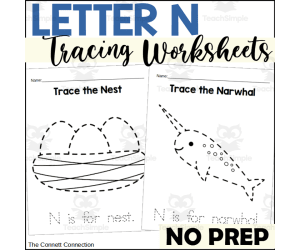
Letter N Tracing Worksheets
ELA, Writing, Handwriting, Language Development, Phonics, Kindergarten, Preschool, Worksheets & Printables, Worksheets
Letter N Tracing Worksheets Students will develop fine motor skills and letter formation abilities with these 3 letter N tracing pages. Large, simple images like a narwhal, nest, and nose along with corresponding sentences provide opportunities for preschoolers and kindergarteners to practice proper letter formation, beginning sounds recognition, and pen control. These no prep printables can be used during literacy centers , writing stations, morning work, small groups, independent practice, homework, and sub plans. For variation, students are encouraged to trace using pencils, crayons, paint, chalk, and more. Teachers may also laminate pages for reusable write and wipe practice. Similar beginning letter sound tracing resources are available in my store.
Author The Connett Connection
Tags Tracing Worksheets, Handwriting Practice, Handwriting Worksheets, Alphabet Worksheets, Letter Of The Week, Fine Motor Skills, Writing Center, Letter N, Letter N Activities, Letter N Worksheets

World History II Important Figures + Events Worksheet
Social Studies, History, History: World, Grade 9, 10, 11, 12, Worksheets, Worksheets & Printables
This is a New European Imperialism Questions Worksheet . Students will research and write on topics such as Scientific Revolution, World War I, Latin America and so much more. Answer key included.
Author History with DeLong
Tags World History, Important Figures, Historical Events, Graphic Organizers, Global Trade, Scientific Revolution Worksheet Answer Key, The Scientific Revolution Worksheet Answer Key
Pacific Ocean Adapted Book, Printable, Color and BW, Special Ed
Science, Earth and Environmental Sciences, Earth Sciences, Preschool, Kindergarten, Grade 1, Worksheets & Printables, Worksheets
Pacific Ocean Adapted Book, Printable , Color and BW, Special Ed A highly interactive educational resource indeed. Useful for livening up your science lessons on the Pacific Ocean. Suitable for teachers in diverse settings; public schools or homeschool environments. Particularly enriches learning for grades Pre-K through First Grade and Special Ed students. Features: Cut-and-paste approach making it highly engaging. In-depth exploration of the Pacific Ocean including vocabulary acquisition. Reading comprehension questions to evaluate knowledge retention. Versatility in Use This resource has flexibility built into it- use it for whole group instruction or small group activities during class discussions or simply as a part of homework tasks! No-prep Design + Double Printing Options We understand preferences can vary from full color options to conserving ink with classic black & white options - we provide both! Teacher-friendliness is increased with easy-to-use design without requiring any prior preparation. In Short: An eight-page interactive book that ensures efficient learning experience. Multifaceted utility - be it classroom instructions or homework assignments. One-click download yields one PDF with all necessary materials: No-frills, no-stress! Focused Areas of Learning - All Things Oceans! This worksheet provides comprehensive education pertaining to Earth’s largest ocean providing details about its features, inhabitants, characteristics etc., thus promising an exciting journey delivering global ecological awareness within your reach. In essence when looking at tools that enhance explorative learning within Earth Sciences related to oceans – consider Pacific Ocean Adapted Book; the perfect, engagingly designed worksheet.
Author My Kind of Crazy
Tags Pacific Ocean, Adapted Book, Printable, Color, Black/White
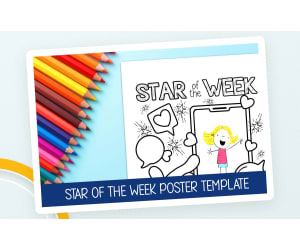
Star of the Week Template – Bulletin Board Poster
ELA, Special Resources, Social Emotional Learning (SEL), Writing, Handwriting, Preschool, Grade 1, 2, 3, 4, 5, Coloring Pages, Worksheets, Worksheets & Printables
Forever June Digital Design START THE YEAR OFF PROPERLY WITH MY STAR OF THE WEEK POSTER! If you looking for something unique for your classroom, you have come to the right place! MyStar of the Week Template is a fun resource for your teacher toolbox! This Instant Download Listing contains 4 high resolution jpeg files, sized at A4, 8X10, 11X14 & 16X20 inches. This Star of the week coloring page is a fun activity for students of various ages- Appropriate for Homeschool Students and Students in Grades K-4 Regular Classrooms. This Student of the Week Template is an excellent resource for teachers wanting to implement Social Emotional Learning in their classrooms! Kids will enjoy creating self portraits and expressing themselves to their classmates and teacher! This is a wonderful opportunity to celebrate each student in your class on a weekly basis. Start this system at Back to School time until the End of the School Year. This set of DIY Poster Templates require students to open up and share things about themselves with their classmates and to enjoy being celebrated for exactly who they are! This fun activity is appropriate for many different grades, homeschool students, ESL classrooms etc.! I SUPPLY THE DESIGN AND YOU SUPPLY THE LITTLE LEARNERS! Take this fun opportunity to order your Star of the Week Classroom Poster today!It's as easy as 1-2-3, just Order-Download-Print!And then let the weekly student celebrations begin! Thanks for visitingFOREVER JUNE DESIGN!I hope your students have as much fun being the star of the week as I did creating these DIY posters! Here Are More Resources for You to Enjoy: Take Home Mother’s Day Gift Father’s Day Handprint Craft Teacher Appreciation Gift for Students Earth Day Handprint Art Pledge Earth Day Papercraft Personalized Father’s Day Gift You Can Find More Resources At My Store Front Here:Forever June Digital Design
Author Forever June Digital Design
Rating
Tags STAR OF THE WEEK, STUDENT POSTER, ALL ABOUT ME TEMPLATE, WEEKLY ACTIVITY, COLORING PAGE, SELF PORTRAIT, BACK TO SCHOOL, BULLETIN BOARD, SOCIAL EMOTIONAL LEARNING (SEL) CLASSROOM
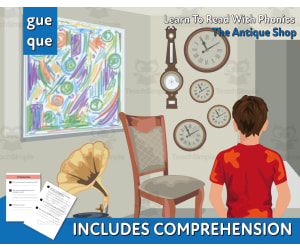
Close Reading Comprehension 'The Antique Shop’
ELA, Reading, Preschool, Grade 1, 2, 3, Worksheets & Printables, Worksheets
Close Reading Comprehension 'The Antique Shop' An insightful educational resource that aims to enhance the reading and comprehension abilities in children, while also assisting in revision of 'que' and 'gue'. Ideal for Kindergarten to Grade 3 students. Benefits A thought-provoking tale that provides young learners an opportunity to strengthen their phonics skills. The simple yet engaging narrative ensures it's fit even for those just starting their literary journey. After completing the 16-page story, children are encouraged to answer comprehension questions aimed at evaluating their understanding. Multiple Usage Scenarios The Close Reading Comprehension ‘The Antique Shop’ worksheet is perfect both for classroom group sessions, small learning groups or home-based assignments provided with adult assistance. Its adaptability makes it ideal for not just traditional classrooms but homeschooling setups as well! Educational yet Exciting This resource successfully combines education and entertainment, so you can be assured of complete attentiveness from young learners. The worksheets are readily available in PDF format whenever required. Conclusion In conclusion, Close Reading Comprehension ‘The Antique Shop' cultivates a love of reading among children. It acts as"Not just another educational resource but a unique tool instrumental in shaping young minds." .
Author Guinea Pig Education
Tags Educational Resource, Reading Comprehension, Phonics Skills, Critical Thinking, Interactive Learning
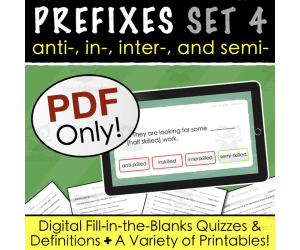
Prefixes | anti- in- inter- & semi- | Digital + Printable Quizzes & Lists
ELA, Grammar, Grade 2, 3, 4, Worksheets, Worksheets & Printables
Are you looking for a high quality resource that practices prefixes? With this resource you have everything to introduce, practice and test the most common prefixes. In this set, the prefixes anti- in- inter- & semi- are featured. First of all, you can use the PDF based digital presentation to introduce these prefixes to your student. Just open the file, put it on full screen mode and use the arrow keys to navigate through the slides. You will first see the definition and then the word with its prefix. Ideal! You can also use the printable handouts to let your students practice at home. Then test them either on the computer or on paper. The paper version has an answer key, so it is very easy to check each and every answer. The digital version is again a PDF based digital file. Just put it up on the screen and use the arrows. Each second slide reveals the answer.
Author Tom's Talk
Tags Prefixes, Language Learning, Teaching Resource, Digital Quizzes, Printable Quizzes, Printable Quizzes For Fun
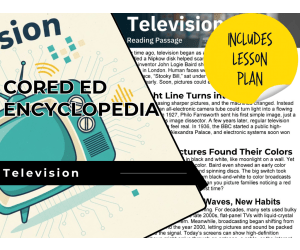
Television Reading Comprehension Passage - Cored Ed Encyclopedia
ELA, Language Development, Reading Comprehension, Reading, Pre-Reading, Science, Technology, Engineering, History, Social Studies, Grade 2, 3, 4, 5, Worksheets & Printables, Worksheets, Teacher Tools, Centers, Activities, Writing Prompts, Assessments, Quizzes and Tests, Quizzes, Lesson Plans
This television reading comprehension includes: Visualization (on the front cover) Start your lesson by taking a minute to think and share something about the topic. Read the script aloud (slowly), perhaps prepare some music or sound effects. Student close their eyes and let their imaginations wander. Students open their eyes, read the question aloud and give them a few minutes to complete. Ask a few students to share or keep answers until the end to compare with what they learn in the passage. Quick pause—thousands of Cored Education products are included with your TeachSimple membership. Download links and encyclopedia index available here. Pre-Reading Trivia Students will write down one thing they already know about the subject and then read five more facts and discuss. These facts are fun, and the students will enjoy learning about the subject before reading more. Give 1 minute for students to write what they already know (no pressure—best guess is fine). Read the five facts together. After each fact, do ask a student for their opinion, was it surprising? Set a purpose by asking students to highlight/underline one fact they want to learn more about during the reading. Reading Passage The text is a high-interest reading passage with set paragraphs, roughly three to four paragraphs long. It contains a variety of themes about the topic, anywhere from history to technology. The passage is between 250 and 350 words in length. First, ask students to look at the headings and see what they’ll learn about today. What do they know about the topic/heading? First read options: Teacher read-aloud (best for support). Partner reading (paragraph by paragraph). While reading, students underline important details, and vocabulary words they think may come up in the questions section. Mixed Questions The first question page contains four multiple-choice questions, each with a choice of four answers, and three written response questions that require a sentence or two from the student. Students complete the mcqs first independently, then review quickly as a class. For the 3 written responses, try to get students giving the answer with some form of evidence: “I think ___ because the text says ___.” If students get stuck, send them back to check the passage. Vocabulary Questions Practice seven key words from the text in this section across two activities. First section is scrambled words where students will unscramble three words given a clue for each. The second section is a word to meaning matching activity. Before starting, have some students read out words they underlined in the passage. Ask students to say the word and read aloud the sentence(s) around each word. Ask students to do scrambled words and the matching exercise in pairs then go through answers as a class. For the scrambled spelling task, get four pairs to come up to the board and write the words for extra practice with the other student reading out the clue. For the matching task, prompt students to give full sentences: “I matched ___ with ___ because ___.” Creative Writing In this question, the student will be required to write a five to eight sentence paragraph on a question related to the topic. Before starting, ask students write down 3 key ideas they are going to include in their piece. Ask students for ideas to share around the class to help those struggling. Pro writing expectations: 5–8 sentences At least 2 facts or details from the passage At least 2 vocabulary words from the previous page Students read their paragraphs while classmates listen for facts and vocabulary words. Extension Activities This page is optional for fast finishers or to take home. There are several activities, each one requiring a different skill. Do some, do none, do all, completely optional - but you will feel reassured knowing every possibility is planned for. Includes summary writting question. Answer Key There are answers for the multiple-choice questions, written response questions have sample answers, vocabulary answers and if there is a summary question then a sample summary will be provided as well. Lesson Plan Included Customized lesson plan for this lesson is included. Lesson Snapshot Title: Television Genre: Nonfiction (informational text) Subject: Science (Technology) Primary Topic: How television changed from mechanical to digital Estimated Guided Reading Level (A–Z): S What This Lesson Teaches Best How an invention changed over time, from a “spinning disk” experiment to modern screens and signals. Key milestones in television’s development (1925 Selfridges demo, 1927 Farnsworth, 1936 BBC service, late 2000s flat-panels). How pictures can be broken into lines/signals and sent by wire, radio, antenna, cable, or internet. The shift from black-and-white to color broadcasts and how viewers experienced that change over decades. Comparing analog and digital signals as two different ways information travels. Learning Goals Students will describe how early television used a spinning Nipkow disk to scan pictures into lines. Students will identify key people, places, and dates from the passage (Baird, Farnsworth, Selfridges, Alexandra Palace). Students will explain how television changed from mechanical parts to all-electronic systems that made clearer pictures. Students will summarize how TV viewing changed from bulky cathode-ray tubes to flat-panel screens and high-definition images. Students will compare analog and digital signals using details from the text. Key Vocabulary From the Text scan — break a picture into lines to send it. signals — messages that carry picture or sound information. broadcasting — sending TV so many people can receive it. analog — a smooth, continuous wave way of sending. digital — coded bits that travel more cleanly. FULL CATALOG OF DOWNLOAD LINKS AND ENCYCLOPEDIA INDEX HERE
Author Cored Education
Rating
Tags Vocabulary, Reading Comprehension, Reading Passages, Lesson Plans, Ela Lesson Plans, Reading Comprehension Lesson Plans, Pre-reading, History, Social Studies, Social Studies Lesson Plans

Word Work Family Packet
ELA, Language Development, Phonics, Kindergarten, Preschool, Worksheets & Printables, Worksheets
You will get a variety of engaging printables with this Word Work Family Packet. If you are looking to increase phonemic awareness, there will be many skills included to help you do that. Including: Picture Name: A list of 35 words with their recognizable picture next to them. Letter Sound Recognition: Students will match the beginning sound of the word to the letter they hear. Initial, Medial, and Final Sounds: Students will use the letters presented and write the beginning, middle, or final sound of the pictures on each line provided. Some letters will be used more than once. Build Word Families: Students will find the pictures that rhyme when saying what they are Substitute Letters: Students will change the first letter of each word to create a new word that matches the picture on the right. Use the letter box below if needed. This resource can be used with a classroom projector to teach and practice whole group participation. Students can take turns writing the answers on the white board or use their copy of the resource at their desks. Print out and use a dry erase pocket for centers and early finishers, BONUS! 2 Graphic Organizers: Students will be asked to cut out the caterpillar and use it as a graphic organizer to create word families or phonemic substitutions using medial and final letters to make new words. They can do the same with the second graphic organizer, which is an ice cream cone. Students will practice with letter sound recognition, substituting letters, and so much more. Pages in this resource are presented in color, but also in black and white. All you have to do is print and go. This resource may be used to assess phonemic skills at the beginning and at the end of a semester or at the end of the school year. This is a 17-page PDF
Author The Kinder Lady
Tags Word Work, Word Families, Short Vowels, Phonics, Literacy, Reading Center, Initial Sounds, Medial Sounds, Substitute Letters, Graphic Organizers
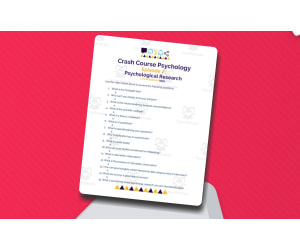
Crash Course Psychology Episode Worksheet | 2 - Psychological Research
Social Studies, History, Psychology, Grade 10, 11, 12, Worksheets & Printables, Worksheets
Crash Course Psychology Research Worksheet Engage high schoolers in psychology using real-world connections with this 2-page episode worksheet for Crash Course Psychology’s “Psychological Research” video. Students will answer 15 analysis questions while watching the insightful 10-minute video that examines psychology research methods. Implement as an entire class or in small groups, allowing students to rewatch the popular Crash Course video for improved comprehension. Check student understanding yourself or have them self-assess using the included answer key. Pair with other psychology resources like ethnocentrism slides and Crash Course government to build student interest. Discover more social studies and psychology materials for high school classrooms at Active Social Studies.
Author Ed Dynamic
Tags Psychology, Crash Course Video, Crash Course Episode, Crash Course Worksheet, Comprehension Worksheet, Scientific Method, Vocabulary, Crash Course Psychology 2

Basic Positions Worksheets
Math, Early Math, Preschool, Grade 1, Worksheets, Worksheets & Printables
Young children need to develop their understanding of basic positions in order to be able to successfully navigate the world around them. Positions like “in front”, “behind”, “next to”, and “under” are all necessary for basic communication and for understanding the physical environment. Positional language is a way of describing an object, action, or location in relation to some other object, action, or location. It can be used to help children identify and name objects, give them information about the location of an object or action, and to provide them with information about how to use an object. Positional language is also important for helping children develop an understanding of time, size, and distance. In these worksheets children are shown a variety of pictures and they have to pick out and circle the ones that show the relevant given position. The pictures are all in black and white to save on printing costs and provide children with the added activity of coloring in, should you wish. There are also pictures where a choice is given underneath of which position it shows. 9 PDF printable worksheets for children to understand and practice positional language. Language included: * In front * Behind * Next to * Beside * In between * Above * Below Clipart images courtesy of Kari Bolt Clip Art
Author SEN Resource Source
Tags Early Math, Postitions, Positional Language
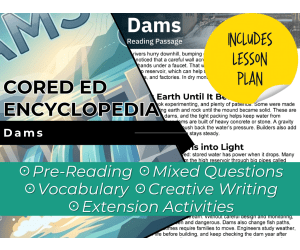
Dams Reading Comprehension Passage - Cored Ed Encyclopedia
ELA, Language Development, Reading Comprehension, Reading, Pre-Reading, Science, Technology, Physics, Earth and Environmental Sciences, Life Sciences, Grade 2, 3, 4, 5, Worksheets & Printables, Worksheets, Teacher Tools, Centers, Activities, Writing Prompts, Assessments, Quizzes and Tests, Quizzes, Lesson Plans
This dams reading comprehension with lesson plan includes: Visualization (on the front cover) Start your lesson by taking a minute to think and share something about the topic. Read the script aloud (slowly), perhaps prepare some music or sound effects. Student close their eyes and let their imaginations wander. Students open their eyes, read the question aloud and give them a few minutes to complete. Ask a few students to share or keep answers until the end to compare with what they learn in the passage. Quick pause—thousands of Cored Education products are included with your TeachSimple membership. Download links and encyclopedia index available here. Pre-Reading Trivia Students will write down one thing they already know about the subject and then read five more facts and discuss. These facts are fun, and the students will enjoy learning about the subject before reading more. Give 1 minute for students to write what they already know (no pressure—best guess is fine). Read the five facts together. After each fact, do ask a student for their opinion, was it surprising? Set a purpose by asking students to highlight/underline one fact they want to learn more about during the reading. Reading Passage The text is a high-interest reading passage with set paragraphs, roughly three to four paragraphs long. It contains a variety of themes about the topic, anywhere from history to technology. The passage is between 250 and 350 words in length. First, ask students to look at the headings and see what they’ll learn about today. What do they know about the topic/heading? First read options: Teacher read-aloud (best for support). Partner reading (paragraph by paragraph). While reading, students underline important details, and vocabulary words they think may come up in the questions section. Mixed Questions The first question page contains four multiple-choice questions, each with a choice of four answers, and three written response questions that require a sentence or two from the student. Students complete the mcqs first independently, then review quickly as a class. For the 3 written responses, try to get students giving the answer with some form of evidence: “I think ___ because the text says ___.” If students get stuck, send them back to check the passage. Vocabulary Questions Practice seven key words from the text in this section across two activities. First section is scrambled words where students will unscramble three words given a clue for each. The second section is a word to meaning matching activity. Before starting, have some students read out words they underlined in the passage. Ask students to say the word and read aloud the sentence(s) around each word. Ask students to do scrambled words and the matching exercise in pairs then go through answers as a class. For the scrambled spelling task, get four pairs to come up to the board and write the words for extra practice with the other student reading out the clue. For the matching task, prompt students to give full sentences: “I matched ___ with ___ because ___.” Creative Writing In this question, the student will be required to write a five to eight sentence paragraph on a question related to the topic. Before starting, ask students write down 3 key ideas they are going to include in their piece. Ask students for ideas to share around the class to help those struggling. Pro writing expectations: 5–8 sentences At least 2 facts or details from the passage At least 2 vocabulary words from the previous page Students read their paragraphs while classmates listen for facts and vocabulary words. Extension Activities This page is optional for fast finishers or to take home. There are several activities, each one requiring a different skill. Do some, do none, do all, completely optional - but you will feel reassured knowing every possibility is planned for. Includes summary writting question and additional facts. Answer Key There are answers for the multiple-choice questions, written response questions have sample answers, vocabulary answers and if there is a summary question then a sample summary will be provided as well. Lesson Plan Included Customized lesson plan for this lesson is included. Lesson Snapshot Title: Dams Genre: Nonfiction (informational text with headings) Subject: Science (Engineering) / Reading (Informational Text) Primary Topic: How dams store water, make electricity, and release water safely Estimated Guided Reading Level (A–Z): P What This Lesson Teaches Best Explains what a dam does by describing how a wall can hold back river water into a deep reservoir. Teaches types of dams and how they stay strong (embankment dams packed tight; gravity dams using weight; layers and drains for stability). Shows how stored water can generate electricity using penstocks, turbines, and generators. Highlights safety and trade-offs, including controlled release through a spillway, the danger of failure, and impacts on fish paths and river mud. Uses headings to organize information into clear sections (building, electricity, and safe water release). Learning Goals Students will explain how a dam changes a river’s flow and creates a reservoir. Students will describe how embankment dams are built and why tight packing matters. Students will identify the role of penstocks, turbines, and generators in making electricity. Students will explain why spillways are needed and how they help release extra water safely. Students will describe at least one cost or concern the passage connects to dams. Key Vocabulary From the Text reservoir — deep stored water behind a dam. embankment — packed earth-and-rock mound used to build a dam. penstocks — big pipes that send water down from a reservoir. turbines — spinning machines turned by rushing water. spillway — safe path for extra water to leave a reservoir. FULL CATALOG OF DOWNLOAD LINKS AND ENCYCLOPEDIA INDEX HERE
Author Cored Education
Rating
Tags Vocabulary, Reading Comprehension, Reading Passages, Lesson Plans, Ela Lesson Plans, Reading Comprehension Lesson Plans, Pre-reading, Science Lesson Plans, Physics, Technology