



2,722 products added recently
Page 22 - Science Fiction Writing Prompts

 Show filters


Candy Reading Comprehension 1 Lesson Sample Formal Assessments
ELA, Language Development, Resources for Teachers, Vocabulary, Spelling, Reading Comprehension, Reading, Common Core, Grade 2, 3, 4, 5, Teacher Tools, Centers, Activities, Assessments, Tests, Quizzes and Tests, Quizzes, Word Problems, Worksheets & Printables, Writing Prompts
THIS IS A ONE LESSON FREE SAMPLE OF THE FOLLOWING PRODUCT: Themed Reading Comprehension Passages Series - Candy This reading comprehension series is built for grades 2 to 5 and keeps things simple, clear, and easy to use. Every title follows a fun, kid-friendly theme and comes with two passage levels, one written for grades 2 to 3 and a more challenging version for grades 4 to 5. Students then work through a mix of follow-up pages that check understanding in different ways: multiple-choice questions, short written responses, scrambled words, a quick summary, and a theme-based word problem. Answer keys are included, so prep stays minimal. Each resource also comes in nine classroom-friendly formats, so you can choose what fits your setup: print or digital, editable or ready to go, and even self-grading options. Because the layout stays consistent, it is easy to plug into whole-class lessons, small groups, literacy centers, morning work, fast finisher tubs, sub plans, or home learning. It is a straightforward way to build comprehension, practice reading skills in context, and strengthen written responses without adding extra steps for you. Candy Lesson List Note: This product has titles different to those in the rest of the themed series. 1. Candy Types 2. Candy Flavors 3. Candy Shapes and Colors 4. Candy Ingredients 5. Candy Fun Facts FORMAL ASSESSMENT VERSION Formal, test-style pages for quick grading, progress checks, and clear results. Other versions are available in the links list below or in the full catalog. How to Use These Lessons Perfect for: Morning work or early-finisher bins Guided reading blocks or comprehension warmups Literacy centers or small-group rotations Holiday/seasonal review lessons Independent stations, sub plans, or take-home enrichment More Candy Themed Products CROSSWORDS WORDSEARCHES MAZES FULL CATALOG OF DOWNLOAD LINKS HERE Themed Reading Links Addition Animals Around the Home Birthday FORMATS: -FORMAL ASSESSMENT VERSION -PRESENTABLE PDF -PPT -SLIDES - PDF -FILLABLE PDF -WORD -FORMS -DOCS SUPPLEMENTARY MATERIALS (COMING SOON): -VISUAL READING PASSAGE VIDEO -GUIDED LEARNING VIDEO -LESSON PLANS Candy FORMATS: -FORMAL ASSESSMENT VERSION -PRESENTABLE PDF -PPT -SLIDES -PDF -FILLABLE PDF -WORD -FORMS -DOCS SUPPLEMENTARY MATERIALS (COMING SOON): -VISUAL READING PASSAGE VIDEO -GUIDED LEARNING VIDEO -LESSON PLANS Christmas Cinco de Mayo Clothes Colors Days and Months Division Earth Day Easter Easy Mazes Fall Father's Day Food Geography (Set 1) Geography (Set 2) Geography (Set 3) Graduation Health History (Set 1) History (Set 2) History (Set 3) Human Body Kindness Life Skills Mother's Day Multiplication Science (Set 1) Science (Set 2) Science (Set 3) Shapes Social Skills Spring Sports St. Patrick's Day Subtraction Summer Thanksgiving Transport Valentine's Day Winter Free One Lesson Themes Chinese New Year Lunar New Year Halloween Pink Shirt Day Independence Day Juneteenth President's Day Groundhog Day Readings in Depth Structure Each resource is built around a focused sub-theme within the broader topic. Students read two leveled passages (Grades 2–3 and Grades 4–5), then move through a short, consistent sequence of activities that checks understanding and keeps momentum: multiple-choice, brief written responses, a scrambled-words review, a compact summary task, and a light theme-linked word problem. The flow is predictable for students, but varied enough to feel fresh across topics. Each completed resource includes: Two differentiated reading passages (lower and upper level) A multiple-choice comprehension page Short written-response questions A scrambled-words or quick vocabulary check A brief summary activity A simple, theme-connected word problem Answer keys for fast marking and easy self-checking Nine classroom-friendly formats, including print, editable, digital, and self-grading options Themes Included These readings span a wide range of age-appropriate, high-interest topics, such as: Seasons and celebrations Real-world science and nature Community, character, and life skills Everyday high-frequency themes students already enjoy Each title connects to familiar experiences while strengthening comprehension, vocabulary in context, and clear written expression. Easy extensions (optional): Read twice: first for gist, second to highlight key details Write two “right there” questions and swap with a partner Create a 3-bullet fact list or mini mind map Turn the summary into a 3-sentence retell using sequence words Add one extra math question connected to the topic Compare the two levels: what details appear in both? Differentiation tips: Pre-teach 2–3 key words with quick examples Offer sentence starters for written responses Use partner reading: one reads aloud, one tracks evidence Allow highlighting or underlining before answering questions Provide a shorter chunking option for students who need breaks Encourage confident readers to justify answers with a quoted detail For similar downloads and other frees, do check out Cored Group on TeachSimple.
Author Cored Education
Rating
Tags Vocabulary, Spelling, Candy, Candy Activities, Writing Prompts, Word Problems, Reading Comprehension, Candy Reading, Candy Passages, Reading Passages

Journal Prompts for Daily Writing
ELA, Writing, Grade 1, 2, Writing Prompts, Worksheets & Printables
So you are trying to set up your Writing Station so it can stand alone for awhile before you have to change the prompts. Does that sound like you? It was definitely me! So...I solved this problem by giving children a choice of a few prompts to write about and then changed them every so often. TheseDaily Journal Writing Activitiesare an easy way to encouragewriting everyday.There are so many choices and posters that can be hung in your station to support young writers.In my opinion, this resource is all you will need for journal writing! I am so excited to haveupdated and completed this Set of Journal Prompts to Encourage Writing. This set is best for first and second grade. These journal writing prompts contain a plethora of writing ideas!Although this set is an update, I have added many more pages and changed the format, butI have also kept the former resource in the packet and Compiled the 2 resources together just incase the older resource’s format was more appealing to you! Ever since I started teaching 30+ years ago and encouraged my first graders as well as my own children to write letters to grandparents, thank you notes to friends and love ones and grocery lists for me, I have believed that every scribble had an intense meaning and when I would encourage my students or children to “read” back what their scribbles, labels, words and sentences said, the kiddos knew the meaning of these symbols, scribbles and letters! I am a firm believer that “Kid Writing” is an important piece of emergent reading and writing and the more you read, the better you read and vice versa! What’s Included: ✎Over 200 writing prompts with starter ideas with room for a picture and writing. ✎Covers and prompts categorized into the following sections: ✎All about School….16 pages ✎All about ME ………37 pages ✎All about Feelings...14 pages ✎Special Days ………23 pages of prompts that span from Halloween to Father’s Day ✎Seasons and Weather…….22 pages ✎Other Fun Writing Ideas …….13 pages ✎Letters, Notes, Lists, Memos and a few more….30 pages National Holidays to Write about…54 pages taking writing through January to December ⭐Pages are NOT numbered so you can differentiate for your student needs. ⭐Covers are included for each of the sections above. ⭐Please note the section about Notes, Letters, Memos etc. may present a higher level of difficulty for younger students. ✎ An anchor Chart On How to Spell a Word. ✎ 5 small posters with words to help young writers. I can… I like…When I Grow Up I want to be…My Favorite thing to do…My Favorite Color… ✎ 64 original writing prompts from the older resource with starter ideas with room for a picture and writing ✎ One complete page with writing lines to run off 2-sided with prompts. This way if students want to write more they can. ✎ Cards with writing ideas, pictures and words to assist young writers. These I put in a basket or “Treasure Chest” to choose ideas. ✎ Ideas to last a LONG Time that are aligned with Common Core!! Ideas for Use: ✐Morning Work ✐Stations/Centers ✐Writing Workshop for special learners ✐To differentiate your writing files and support more reluctant writers in other ways. ✐To easily encourage Journal Writing. ✐For homework ✐Homeschool ✐For parents to support their children with write
Author Sunshine and Lollipops
Tags Journal Writing, Journaling, Creative Writing, Daily Writing, Writing Prompts

Three Little Pigs | Diary Writing Prompts
ELA, Literature, Preschool, Grade 1, 2, 3, Writing Prompts, Worksheets & Printables
The Three Little Pigs Diary Writing Prompts This is an educational teaching resource specifically designed for Kindergarten to Grade 3 students. It is a versatile tool that comes in two formats - PowerPoint and PDF. The content based on the beloved children's story of The Three Little Pigs spans over 4 informative pages. Main Aim: To enhance language arts and literature skills through engaging prompts. Product Features: Two unique sets of writing prompts. Innovative format that promotes critical thinking and comprehension in students. In this tool, children are encouraged to stimulate their creativity by stepping into the shoes of characters from the story. They engage in a plot from different perspectives through diary entry exercises, bolstering creative thinking and offering an effective method for evaluating comprehension levels. Suitable for various learning styles, it can be incorporated into different teaching scenarios such as: Aiding group activities in a classroom. Tutoring smaller groups during breakout sessions. It can also serve as: An engaging homework assignment that encourages independent thinking beyond standard workbooks. Either way, this resource sparks enthusiasm about literature while solidifying written expression skills. It presents text interpretation methods with real-world applications making The Three Little Pigs Diary Writing Prompts an invaluable asset for educators seeking to enrich language art content and improve creative writing abilities among young learners in an entertaining way.
Author Good Human Project
Tags Writing Prompts, Diary Entries, Literature Skills, Creative Thinking, Comprehension Skills

Penguin's Cozy Hat Cored Literacy Readers Level D
ELA, Resources for Teachers, Reading Comprehension, Reading, Common Core, Library, Children’s Literature, Literature, Social Emotional Learning (SEL), Special Resources, Kindergarten, Grade 1, 2, Worksheets & Printables, Worksheets, Teacher Tools, Centers, Activities, Writing Prompts, Literacy Readers
Book Snapshot Title: Penguin’s Cozy Hat Genre: Fiction Primary Topic: Persevering through a windy challenge Estimated Guided Reading Level (A–Z): D What This Book Teaches Best Perseverance / determination: Percy keeps holding on until his hat stayed put , showing real determination. Cause and effect: A small puff of wind turns into a stronger wind that tugged at his hat. Problem-solving with actions: Percy changes his body position— wiggles , squats low , and holds steady —to keep the hat on. Descriptive language: Words like crisp , icy cold , and roared help readers feel the setting. Learning Goals Students will: retell the main events from the story describe why Percy loved his hat using details from the text explain how the wind affected Percy’s hat and what Percy did in response identify words and phrases that describe the cold, windy setting explain how Percy feels at the end and support the idea with text evidence Key Vocabulary From the Text waddled — walked with short, side-to-side steps crisp — cold and fresh feeling tugged — pulled hard on something squatted — bent down very low determination — not giving up when it’s difficult FULL CATALOG OF DOWNLOAD LINKS AND ENCYCLOPEDIA INDEX HERE Printing Tips 1. Best Printing Method (Recommended) “Booklet” Printing (Best if Available) If your printer or PDF viewer supports Booklet Printing , use this. Settings to use: Print mode: Booklet Paper size: Letter or A4 (either works) Orientation: Landscape Print on both sides: Yes Flip on: Short edge Scaling: Fit to printable area Booklet subset: First test: Front sides only Then: Back sides only This will automatically: Pair pages correctly Put the cover on the outside Align everything for folding After printing, fold in half and staple along the spine . 2. If “Booklet” Printing Is NOT Available You can still print this correctly with manual duplex printing . Step-by-step: Open the PDF. Choose Print . Set: Orientation: Landscape Pages per sheet: 1 Print on both sides: Yes Flip on: Short edge Print all pages . Because each PDF page already contains two facing book pages, the result will still fold cleanly into a book. Literacy Readers Overview This product is perfect for small group instruction, such as guided reading, strategy groups, or interventions. It could also be used for independent reading, homework, or holiday work. It could also be used for literacy stations, read-aloud practice, or sub plans. Extension Ideas There are several ways to extend the lesson, including reading twice—first for understanding, and the second time to find the key details. Perhaps you can highlight or underline a detail that answers the comprehension questions. You can also turn it into a writing activity: What did you learn, or retell the story using first, next, then, finally. You could even choose a vocabulary word, draw it, with a caption from the text. For more advanced learners, perhaps you can compare this to another text they have read recently. Differentiation Tips For differentiation, if the words are hard, then perhaps you can preview some of them before you begin. For responses, perhaps you can give the students the first few words, for example, “In the book…”. You can also pair up the students, which normally leads to one of them helping the other. You can read it through again for fluency. Perhaps you can read two or three pages at a time and then come together as a group and analyze. For similar downloads and other frees, do check out Cored Group on TeachSimple.
Author Cored Education
Rating
Tags Vocabulary, Reading Comprehension, Reading Passages, Literacy Readers, Storybooks, Penguins, Fiction, Leveled Reading, Sel, Ela

May Writing Prompts - Learning Passport
ELA, Writing, Creative Writing, Grade 2, 3, 4, Writing Prompts, Worksheets & Printables
May Writing Prompts - Learning Passport The Learning Passport is a one-of-a-kind tool, specifically designed to boost student engagement and competence in creative writing. It's meticulously crafted around the events and themes of May, providing students an engaging catalyst to let their creative energies flow on paper. The learning passport includes 30 writing prompts dealing with a variety of topics such as: Dance Like a Chicken Day National Teacher's Day Lucky Penny Day Making Friends, etc. A distinctive feature of this learning passport is the 'accountability aspect' . Whenever a student completes their writing task/topic, they receive a stamp on their learning passport. This not only acts as an incentive but also assists them in tracking progress. Assembly Instructions: Print the pages double-sided Cut around the edges if required Fold along the defined lines and staple accordingly This resource caters aptly to classes from grades 2-4. It can be utilized flexibly; during morning sessions for warm-up exercises or even assigned as homework tasks; depending upon what aligns well with your class routine. Incorporating Creativity: The design reconciliation allows children freedom shaping up covers or graphics using colors that cherish it—expanding scope beyond just penning down thoughts! A Progressive Tool For Remote Classrooms: With teachers continuously exploring new methodologies to stimulate creativity—both within physical classrooms or virtual ones—the May Writing Prompts -Learning Passport indeed comes across as a timely ally offering instructive sessions in a fun and interactive manner!
Author Knowledge Mobile
Tags Writing Prompts, Creative Writing, Student Engagement, Accountability, Language Arts

Zoo Animal Research Writing Project on ELEPHANTS for K-2nd Grade
Life Studies, ELA, Writing, Creative Writing, Reading, Science, Life Sciences, Animals, Research, Kindergarten, Grade 1, 2, Teacher Tools, Worksheets & Printables, Lesson Plans, Presentations, Worksheets, Coloring Pages, Writing Prompts
Animal Research Writing Project on Elephants for K-2. Engage young students in reading, writing, and science with this 19-page informational writing project on elephants. Students will read fascinating facts, examine real-life photos, color images, draw habitat scenes, organize information with writing organizers, and compose their own informative writing piece on elephants. Three differentiated writing levels are included to accommodate varying abilities. When completed, the project can be bound into a printed book for the classroom or home library. This elephant unit can be implemented in whole groups, small groups, or as an individual student project. Pair it with the 7 other available animal projects for a cross-curricular writing program. Suitable for kindergarten through 2nd grade. Teachers appreciate the ready-to-use animal units covering reading, note-taking, drafting, illustrating, and publishing. Engage your class in meaningful informational writing with this standards-based project on monkeys. Plus, there are many more zoo animals to research as well in my store: K-5 Treasures! For additional Zoo Animal reports, click on the following links below: Animal Research Writing Project on TIGERS for K-2nd Grade Animal Research Writing Project on MONKEYS for K-2nd Grade Animal Research Writing Project on PANDAS for K-2nd Grade Animal Research Writing Project on HIPPOS for K-2nd Grade Animal Research Writing Project on ELEPHANTS for K-2nd Grade Animal Research Writing Project on GIRAFFES for K-2nd Grade Here are even more informational resources on report writing for OCEAN ANIMALS. Click on the links below: Animal Research Writing Project on WHALES for K-2nd Grade Animal Research Writing Project on the OCTOPUS for K-2nd Grade Animal Research Writing Project on SEA TURTLES for K-2nd Grade Animal Research Writing Project on ORCAS for K-2nd Grade Animal Research Writing Project on the SHELLFISH for K-2nd Grade Animal Research Writing Project on DOLPHINS for K-2nd Grade Animal Research Writing Project on SEALS for K-2nd Grade
Author K-5 Treasures
Tags Animal Research, Informational Writing, Writing Report, Zoo Animals, Report On Animals, Report On Zoo Animals, 1st Grade Writing, 2nd Grade Writing, Elephants, Report On Elephants
United Nations Reading Comprehension Passage - Cored Ed Encyclopedia
ELA, Language Development, Reading Comprehension, Reading, Pre-Reading, Vocabulary, History, Social Studies, Government, Writing, Grade 2, 3, 4, 5, Worksheets & Printables, Worksheets, Teacher Tools, Centers, Activities, Writing Prompts, Assessments, Quizzes and Tests, Quizzes, Lesson Plans
This United Nations reading comprehension with lesson plan includes: Visualization (on the front cover) Start your lesson by taking a minute to think and share something about the topic. Read the script aloud (slowly), perhaps prepare some music or sound effects. Student close their eyes and let their imaginations wander. Students open their eyes, read the question aloud and give them a few minutes to complete. Ask a few students to share or keep answers until the end to compare with what they learn in the passage. Quick pause—thousands of Cored Education products are included with your TeachSimple membership. Download links and encyclopedia index available here. Pre-Reading Trivia Students will write down one thing they already know about the subject and then read five more facts and discuss. These facts are fun, and the students will enjoy learning about the subject before reading more. Give 1 minute for students to write what they already know (no pressure—best guess is fine). Read the five facts together. After each fact, do ask a student for their opinion, was it surprising? Set a purpose by asking students to highlight/underline one fact they want to learn more about during the reading. Reading Passage The text is a high-interest reading passage with set paragraphs, roughly three to four paragraphs long. It contains a variety of themes about the topic, anywhere from history to technology. The passage is between 250 and 350 words in length. First, ask students to look at the headings and see what they’ll learn about today. What do they know about the topic/heading? First read options: Teacher read-aloud (best for support). Partner reading (paragraph by paragraph). While reading, students underline important details, and vocabulary words they think may come up in the questions section. Mixed Questions The first question page contains four multiple-choice questions, each with a choice of four answers, and three written response questions that require a sentence or two from the student. Students complete the mcqs first independently, then review quickly as a class. For the 3 written responses, try to get students giving the answer with some form of evidence: “I think ___ because the text says ___.” If students get stuck, send them back to check the passage. Vocabulary Questions Practice seven key words from the text in this section across two activities. First section is scrambled words where students will unscramble three words given a clue for each. The second section is a word to meaning matching activity. Before starting, have some students read out words they underlined in the passage. Ask students to say the word and read aloud the sentence(s) around each word. Ask students to do scrambled words and the matching exercise in pairs then go through answers as a class. For the scrambled spelling task, get four pairs to come up to the board and write the words for extra practice with the other student reading out the clue. For the matching task, prompt students to give full sentences: “I matched ___ with ___ because ___.” Creative Writing In this question, the student will be required to write a five to eight sentence paragraph on a question related to the topic. Before starting, ask students write down 3 key ideas they are going to include in their piece. Ask students for ideas to share around the class to help those struggling. Pro writing expectations: 5–8 sentences At least 2 facts or details from the passage At least 2 vocabulary words from the previous page Students read their paragraphs while classmates listen for facts and vocabulary words. Extension Activities This page is optional for fast finishers or to take home. There are several activities, each one requiring a different skill. Do some, do none, do all, completely optional - but you will feel reassured knowing every possibility is planned for. Includes summary writting question. Answer Key There are answers for the multiple-choice questions, written response questions have sample answers, vocabulary answers and if there is a summary question then a sample summary will be provided as well. Lesson Plan Included Customized lesson plan for this lesson is included. Lesson Snapshot Title: United Nations Genre: Nonfiction (Informational text) Subject: Social Studies (Civics/Global Studies) Primary Topic: How the UN began and works for peace Estimated Guided Reading Level (A–Z): P What This Lesson Teaches Best Origins and purpose of the UN: Explains that delegates from 50 countries met in San Francisco in 1945 and signed the United Nations Charter, leading to the UN officially beginning on October 24, 1945. How countries work together in the UN: Describes the UN headquarters in New York City and how member countries speak and vote in the General Assembly, while a smaller group (the Security Council) votes on steps meant to protect peace. Peacekeeping basics: Introduces UN peacekeeping observers (UNTSO) and explains that peacekeepers watch, report, and help keep ceasefires from breaking (and are not there to conquer). Communication across languages: Shows why interpreters matter by explaining that leaders use interpreters in six official languages so the same message can travel across the room. UN help beyond meetings: Notes that UN groups like UNICEF and the World Health Organization work on children’s needs, health, and bringing supplies after earthquakes, floods, or wars. Learning Goals Students will identify key dates and events that led to the UN officially beginning in 1945. Students will describe how the General Assembly and the Security Council are different, using details from the text. Students will explain what the United Nations Charter is and what it was meant to help countries do. Students will summarize what peacekeepers do and why peacekeeping can be hard when countries won’t cooperate. Students will use context clues to determine the meaning of key words such as interpreters and ceasefires . Key Vocabulary From the Text delegates — people chosen to represent a country at a meeting. Charter — a written promise that explains a group’s goals. headquarters — the main building where an organization works. interpreters — people who change speech into another language. ceasefires — times when fighting stops for a while. FULL CATALOG OF DOWNLOAD LINKS AND ENCYCLOPEDIA INDEX HERE
Author Cored Education
Rating
Tags Vocabulary, Reading Comprehension, Reading Passages, Lesson Plans, Ela Lesson Plans, Reading Comprehension Lesson Plans, Pre-reading, Social Studies Lesson Plans, Social Studies, Government

Reading Passages: Civic Action and Social Change (Fillable PDF)
ELA, Reading, Reading Comprehension, Strategies, Resources for Teachers, Social Studies, Sociology, Grade 6, 7, 8, 9, Writing Prompts, Worksheets & Printables, Centers, Activities, Teacher Tools, Assessments, Quizzes and Tests, Quizzes, Tests
Social Studies Reading Comprehension Passages and Questions: Civic Action and Social Change (Fillable PDF) This resource introduces a collection of Social Studies reading comprehension passages with questions about Civic Action and Social Change. The passages are carefully designed to bridge the gap between social studies and literacy through strengthening reading comprehension and sparking knowledge curiosity in middle school students. Each passage blends English Language Arts skills with accurate social studies content . Ideal for interdisciplinary learning in ELA and Social Studies. Suitable for Grade 9 review, too! These worksheets are designed as fillable PDFs , which means students can type their answers directly into the document on any computer or tablet . Each page includes highlighted text fields that show them exactly where to type! What Is Included in this Collection? There are three informational passages (with full answer keys): The Butterfly Effect: Small Moments, Big Consequences From Piggy Bank to Profit: How Banks Make Money Work Flipping the Switch: A Student Campaign for Change For Each Passage, students will have multiple tasks to complete as follow: 5 multiple-choice questions targeting main idea, key details, inference, vocabulary in context, and use of evidence 5 vocabulary matching items with clear, student-friendly definitions 5 text-based questions that require citing specific lines or facts 1 summary prompt that asks students to condense central ideas accurately Available Formats for this Resource PDF Word Docs Google Docs FULL CATALOG OF DOWNLOADING LINKS HERE For more Social Studies Reading Passages, check the following Links: Ancient Civilizations PDF Fillable PDF Word Docs Google Docs Early Empires and Trade Networks PDF Fillable PDF Word Docs Google Docs The Founding of the United States PDF Fillable PDF Word Docs Google Docs Language, Culture, and Meaning PDF Fillable PDF Word Docs Google Docs Psychology and Society PDF Fillable PDF Word Docs Google Docs Global Festivals and Traditions PDF Fillable PDF Word Docs Google Docs Extreme Environments and People PDF Fillable PDF Word Docs Google Docs Food, Culture, and Preservation PDF Fillable PDF Word Docs Google Docs Global Food Customs PDF Fillable PDF Word Docs Google Docs Media, Communication, and Popular Culture PDF Fillable PDF Word Docs Google Docs Human Impact on the Environment PDF Fillable PDF Word Docs Google Docs Civic Action and Social Change PDF Fillable PDF Word Docs Google Docs Fashion, Society, and Power PDF Fillable PDF Word Docs Google Docs People, Places, and Unusual Histories PDF Fillable PDF Word Docs Google Docs How to Use These PDFs Click on the highlighted area to start typing your answer. Move to the next question by clicking in the next highlighted box. When you are finished, close the document and select SAVE so your answers stay recorded. If you want to keep a blank copy for later, choose Save As and give your completed version a new name. Product Details Length: 15 pages total Grades: 6–8, also suitable for Grade 9 review Use cases: close reading, stations, homework, intervention, test prep, and sub plans Why Teachers Choose This Set Authentic social studies content paired with rigorous literacy practice Consistent task structure across all passages for easier planning and smoother student routines Clear, age-appropriate writing that builds confidence without oversimplifying Use this set to reinforce ELA skills in social studies, to add literacy to your lessons, and to support independent work. The passages strengthen main idea, evidence use, vocabulary in context, inference, cause and effect, and summary writing. With ready-to-use assessments and complete answer keys, you can provide focused practice that is simple to run and fast to review.
Author CORED Education - Middle & High School
Rating
Tags Middle School, Reading Comprehension, Reading Strategies, ELA, Centers, Reading Passage, Assessments, Vocabulary, Social Studies, Civic Action And Social Change
Oxygen Reading Comprehension Passage - Cored Ed Encyclopedia
ELA, Language Development, Resources for Teachers, Reading Comprehension, Reading, Pre-Reading, Writing, Science, Physics, Chemistry, Grade 2, 3, 4, 5, Worksheets & Printables, Worksheets, Teacher Tools, Centers, Activities, Writing Prompts, Assessments, Tests, Quizzes and Tests, Quizzes
This oxygen reading comprehension contains the following: Visualize on the Cover (Teacher Read Aloud Script) Start your lesson by taking a few moments to visualize the topic and share thoughts or feelings about it. Pre-Reading Trivia Students will write down one thing they already know about the subject and then read five more facts and discuss. These facts are fun, and the students will enjoy learning about the subject before reading more. Reading Passage The text is a high-interest reading passage with set paragraphs, roughly three to four paragraphs long. It contains a variety of themes about the topic, anywhere from history to technology. The passage is between 250 and 350 words in length. Mixed Questions The first question page contains four multiple-choice questions, each with a choice of four answers, and three written response questions that require a sentence or two from the student. Vocabulary Questions Practice seven key words from the text in this section across two activities. First section is scrambled words where students will unscramble three words given a clue for each. The second section is a word to meaning matching activity. Creative Writing In this question, the student will be required to write a five to eight sentence paragraph on a question related to the topic. Extension Activities This page is optional for fast finishers or to take home. There are several activities, each one requiring a different skill. Do some, do none, do all, completely optional - but you will feel reassured knowing every possibility is planned for. Includes summary writting question. Answer Key There are answers for the multiple-choice questions, written response questions have sample answers, vocabulary answers and if there is a summary question then a sample summary will be provided as well. FULL CATALOG OF DOWNLOAD LINKS AND ENCYCLOPEDIA INDEX HERE Lesson Snapshot Title: Oxygen Genre: Nonfiction (informational text) Subject: Science (Chemistry / Earth & Life Science) + Reading Informational Text Primary Topic: Discovery, role, and uses of oxygen Estimated Guided Reading Level (A–Z): S What This Lesson Teaches Best How scientists in the 1770s noticed a “new gas” through clues like a candle flaring brighter and a mouse staying active longer than in ordinary air. How Lavoisier’s careful weighing helped show that “air” is made of parts, leading to naming oxygen and explaining burning and rusting as oxidation . How oxygen is invisible yet makes up about 21% of Earth’s atmosphere , and how bodies use it while breathing out carbon dioxide . How photosynthesis helps balance gases: leaves take in carbon dioxide and water, make sugar, and send oxygen back into the air. Where oxygen is found and how people use it (as O and often O₂ , in air and also “locked into” water/sand/rocks, used in hospitals , factories , and rockets ). Learning Goals Students will describe what Joseph Priestley did and what clues suggested the gas was different from ordinary air. Students will explain why Lavoisier weighed jars, metals, and air before and after heating them. Students will explain what the passage says oxidation helps explain. Students will describe the exchange between humans and plants involving oxygen and carbon dioxide. Students will identify at least two places oxygen can be found or used, based on the text. Key Vocabulary From the Text dephlogisticated — Priestley’s name for oxygen under an old fire theory. mercuric — related to mercury; part of “mercuric oxide” in the text. oxidation — a process that explains burning and rusting. atmosphere — the blanket of gases around Earth. photosynthesis — plants make sugar and send oxygen back into the air. Cored Ed Encyclopedia Overview The Cored Ed Encyclopedia is a weekly series of lessons that you can pick up and use right away. These short readings fit into whatever time you have available. Each one includes a warm-up, a reading, and a set of questions, but it’s flexible — you can do just the reading, the full lesson, or skip the writing section if you need to. Each lesson focuses on a single topic so students don’t get lost. The writing is clear but never childish, making it perfect for grades two through five. Topics range from animals and science to history, inventions, and everyday things. No matter the level of the student, everyone should take away at least one new idea or fact from each lesson. The materials are easy to print, easy to explain, and require no setup. They work well for whole-class teaching, partner work, or independent study.
Author Cored Education
Rating
Tags Vocabulary, Spelling, Reading Comprehension, Reading Passages, Reading, Creative Writing, Reading Strategies, Writing Prompts, Oxygen, Physical Science

Social Studies Reading Passages: Psychology and Society (Docs)
ELA, Reading, Reading Comprehension, Strategies, Resources for Teachers, Social Studies, Psychology, Sociology, Grade 6, 7, 8, 9, Writing Prompts, Worksheets & Printables, Centers, Activities, Teacher Tools, Assessments, Quizzes and Tests, Quizzes, Tests
Social Studies Reading Comprehension Passages: Psychology and Society (Docs) This resource introduces a collection of Social Studies reading comprehension passages about Psychology and Society. The passages are carefully designed to bridge the gap between social studies and literacy through strengthening reading comprehension and sparking knowledge curiosity in middle school students. Each passage blends English Language Arts skills with accurate social studies content. Ideal for interdisciplinary learning in ELA and Social Studies. Suitable for Grade 9 review, too! What Is Included in this Collection? There are three informational passages (with full answer keys): Facing Fear: Understanding Phobias Color Therapy: Can Colors Help You Feel Better Inside the Mind of a Criminal: Profiling at Work For Each Passage, students will have multiple tasks to complete as follow: 5 multiple-choice questions targeting main idea, key details, inference, vocabulary in context, and use of evidence 5 vocabulary matching items with clear, student-friendly definitions 5 text-based questions that require citing specific lines or facts 1 summary prompt that asks students to condense central ideas accurately Available Formats for this Resource PDF Fillable PDF Word Docs FULL CATALOG OF DOWNLOADING LINKS HERE For more Social Studies Reading Passages, check the following Links: Ancient Civilizations PDF Fillable PDF Word Docs Google Docs Early Empires and Trade Networks PDF Fillable PDF Word Docs Google Docs The Founding of the United States PDF Fillable PDF Word Docs Google Docs Language, Culture, and Meaning PDF Fillable PDF Word Docs Google Docs Psychology and Society PDF Fillable PDF Word Docs Google Docs Global Festivals and Traditions PDF Fillable PDF Word Docs Google Docs Extreme Environments and People PDF Fillable PDF Word Docs Google Docs Food, Culture, and Preservation PDF Fillable PDF Word Docs Google Docs Global Food Customs PDF Fillable PDF Word Docs Google Docs Media, Communication, and Popular Culture PDF Fillable PDF Word Docs Google Docs Human Impact on the Environment PDF Fillable PDF Word Docs Google Docs Civic Action and Social Change PDF Fillable PDF Word Docs Google Docs Fashion, Society, and Power PDF Fillable PDF Word Docs Google Docs People, Places, and Unusual Histories PDF Fillable PDF Word Docs Google Docs Product Details Length: 15 pages total Grades: 6–8, also suitable for Grade 9 review Use cases: close reading, stations, homework, intervention, test prep, and sub plans Why Teachers Choose This Set Authentic social studies content paired with rigorous literacy practice Consistent task structure across all passages for easier planning and smoother student routines Clear, age-appropriate writing that builds confidence without oversimplifying Use this set to reinforce ELA skills in social studies, to add literacy to your lessons, and to support independent work. The passages strengthen main idea, evidence use, vocabulary in context, inference, cause and effect, and summary writing. With ready-to-use assessments and complete answer keys, you can provide focused practice that is simple to run and fast to review.
Author CORED Education - Middle & High School
Rating
Tags Middle School, Reading Comprehension, Reading Strategies, ELA, Centers, Reading Passage, Assessments, Vocabulary, Social Studies, Psychology
Social Studies Reading Passages: Our Planet and Human Impact (Docs)
ELA, Reading, Reading Comprehension, Strategies, Resources for Teachers, Social Studies, Geography, Grade 6, 7, 8, 9, Writing Prompts, Worksheets & Printables, Centers, Activities, Teacher Tools, Assessments, Quizzes and Tests, Quizzes, Tests
Social Studies Reading Comprehension Passages and Questions: Our Planet: Natural Extremes and Human Impact (Word) This resource introduces a collection of Social Studies reading comprehension passages with questions about Our Planet: Natural Extremes and Human Impact. The passages are carefully designed to bridge the gap between social studies and literacy through strengthening reading comprehension and sparking knowledge curiosity in middle school students. Each passage blends English Language Arts skills with accurate social studies content . Ideal for interdisciplinary learning in ELA and Social Studies. Suitable for Grade 9 review, too! What Is Included in this Collection? There are three informational passages (with full answer keys): Remaking Plastic: Turning Waste into Useful Materials Underwater Noise Pollution South America: A Continent of Natural Extremes For Each Passage, students will have multiple tasks to complete as follow: 5 multiple-choice questions targeting main idea, key details, inference, vocabulary in context, and use of evidence 5 vocabulary matching items with clear, student-friendly definitions 5 text-based questions that require citing specific lines or facts 1 summary prompt that asks students to condense central ideas accurately Available Formats for this Resource PDF Fillable PDF Word Docs FULL CATALOG OF DOWNLOADING LINKS HERE For more Social Studies Reading Passages, check the following Links: Ancient Civilizations PDF Fillable PDF Word Docs Google Docs Early Empires and Trade Networks PDF Fillable PDF Word Docs Google Docs The Founding of the United States PDF Fillable PDF Word Docs Google Docs Language, Culture, and Meaning PDF Fillable PDF Word Docs Google Docs Psychology and Society PDF Fillable PDF Word Docs Google Docs Global Festivals and Traditions PDF Fillable PDF Word Docs Google Docs Extreme Environments and People PDF Fillable PDF Word Docs Google Docs Food, Culture, and Preservation PDF Fillable PDF Word Docs Google Docs Global Food Customs PDF Fillable PDF Word Docs Google Docs Media, Communication, and Popular Culture PDF Fillable PDF Word Docs Google Docs Human Impact on the Environment PDF Fillable PDF Word Docs Google Docs Civic Action and Social Change PDF Fillable PDF Word Docs Google Docs Fashion, Society, and Power PDF Fillable PDF Word Docs Google Docs People, Places, and Unusual Histories PDF Fillable PDF Word Docs Google Docs Product Details Length: 15 pages total Grades: 6–8, also suitable for Grade 9 review Use cases: close reading, stations, homework, intervention, test prep, and sub plans Why Teachers Choose This Set Authentic social studies content paired with rigorous literacy practice Consistent task structure across all passages for easier planning and smoother student routines Clear, age-appropriate writing that builds confidence without oversimplifying Use this set to reinforce ELA skills in social studies, to add literacy to your lessons, and to support independent work. The passages strengthen main idea, evidence use, vocabulary in context, inference, cause and effect, and summary writing. With ready-to-use assessments and complete answer keys, you can provide focused practice that is simple to run and fast to review.
Author CORED Education - Middle & High School
Rating
Tags Middle School, Reading Comprehension, Reading Strategies, ELA, Centers, Reading Passage, Assessments, Vocabulary, Social Studies, Geography

Informative Writing Step-by-Step (200 Spring Flowers-Themed Writing Prompts)
ELA, Reading, Reading Comprehension, Grammar, Language Development, Spelling, Writing, Science, Life Sciences, Nature & Plants, Grade 3, 4, 5, Writing Prompts, Worksheets & Printables
Did you know that Daffodils are named after a Greek myth? If you need an engaging way to teach informative writing, look no further than this step-by-step unit! Perfect for elementary teachers and homeschoolers alike, this LOW PREP resource covers the five steps of informative writing—research and brainstorming; main points and support; introduction and conclusion; draft, edit, and revise; and final draft—using a cross-curricular approach and spring flowers theme. Each day's lesson addresses one step. Differentiated graphic organizers—primary lines, regular lines, and no lines—are included to match the student's handwriting skill level. A GREAT ADDITION TO YOUR: Spring, flowers, or Earth Day unit study Writing lessons or centers Science class ...or just for fun! HOW IT WORKS: Each student picks or is assigned a topic from the cards Select one of the included writing prompts or create your own Students research their assigned topic (individually or in small groups) Starting with research and brainstorming, students complete one informative writing step each day Students present their final draft—orally or using the included graphic organizers—in response to the assigned writing prompt Help your students become expert informative writers! Whether you're looking for an introduction to informative writing or an assessment of prior knowledge, this resource has something for everyone. SPRING FLOWERS INCLUDE: Blue-Bead Lily Bluet Houstonia Caerulea Canada Mayflower Claytonia Virginica Coltsfoot Tussilago Farfara Crocus Daffodil Darwin Hybrid Tulips Double Tulips Eastern Redbud Erigenia Erythronium Americanum Ficaria Verna Forget-Me-Nots Forsythia Fosteriana French Single Late Fringed Fritillaria Ghost Flower Disert Grape Hyacinth Greigii Hyacinths Kaufmanniana Lily-Flowered Tulips Painted Trillium Pansies and Violas Parrot Pink Lady's Slipper Primrose Rhododendron Sanguinaria Single Early Single Late Snowdrops Sweet Alyssum Tulips Viridiflora Wallflowers Weigela CROSS-CURRICULAR SUBJECTS COVERED: Art (drawing and coloring) English language arts Grammar Reading Research Science Spelling Writing
Author Heather Huhman
Tags Informative Writing, Beginner Writing, Early Writing, Elementary Writing, Flowers, Spring Flowers, Earth Day, Nature, How To Teach Informative Writing, Informative Writing Prompts
Furniture Reading Comprehension Passage - Cored Ed Encyclopedia
ELA, Language Development, Resources for Teachers, Reading Comprehension, Reading, Pre-Reading, Writing, Science, Technology, Strategies, Grade 2, 3, 4, 5, Worksheets & Printables, Worksheets, Teacher Tools, Centers, Activities, Writing Prompts, Assessments, Tests, Quizzes and Tests, Quizzes
This furniture reading comprehension contains the following: Pre-Reading Trivia Students will write down one thing they already know about the subject and then read five more facts and discuss. These facts are fun, and the students will enjoy learning about the subject before reading more. Reading Passage The text is a high-interest reading passage with set paragraphs, roughly three to four paragraphs long. It contains a variety of themes about the topic, anywhere from history to technology. The passage is between 250 and 350 words in length. Mixed Questions The first question page contains four multiple-choice questions, each with a choice of four answers, and three written response questions that require a sentence or two from the student. Creative Writing In this question, the student will be required to write a five to eight sentence paragraph on a question related to the topic. Extension Activities This page is optional for fast finishers. If there are five to ten minutes left at the end of the lesson, the student can choose one of three activities, each one requiring a different skill. Answer Key There are answers for the multiple-choice questions and three written response questions have sample answers. FULL CATALOG OF DOWNLOAD LINKS AND ENCYCLOPEDIA INDEX HERE Snapshot Genre: Nonfiction (informational text) Subject: Reading Primary Topic: What furniture is, how it’s made, and history Estimated Guided Reading Level (A–Z): Q What This Lesson Teaches Best Defines furniture by what it helps people do (sit, eat, sleep, work, store things) and gives examples of common items. Explains how furniture is made , including common materials and how makers connect parts using joints . Builds background knowledge about furniture across time , from using natural objects to evidence of built furniture long ago and stone furniture at Skara Brae. Shows how museums use objects as evidence of how people lived, including examples from the Victoria and Albert Museum (V&A) collection. Learning Goals Students will be able to explain what furniture is and list everyday tasks it helps people do. Students will be able to identify examples of furniture named in the passage and describe what each might be used for. Students will be able to describe how furniture can be made, including common materials and how joints connect pieces. Students will be able to describe key points in the history of furniture mentioned in the text (natural objects, carving/building, Skara Brae stone furniture). Students will be able to explain why museums collect furniture and name at least one example of an item mentioned from the V&A collection. Key Vocabulary From the Text joints — special fits that lock furniture parts together. archaeologists — people who study the past using evidence. cupboards — furniture for storing things behind doors. centuries — periods of one hundred years. lacquer — a shiny coating used on some objects. Cored Ed Encyclopedia Overview The Cored Ed Encyclopedia is a weekly series of lessons that you can pick up and use right away. These short readings fit into whatever time you have available. Each one includes a warm-up, a reading, and a set of questions, but it’s flexible — you can do just the reading, the full lesson, or skip the writing section if you need to. Each lesson focuses on a single topic so students don’t get lost. The writing is clear but never childish, making it perfect for grades two through five. Topics range from animals and science to history, inventions, and everyday things. No matter the level of the student, everyone should take away at least one new idea or fact from each lesson. The materials are easy to print, easy to explain, and require no setup. They work well for whole-class teaching, partner work, or independent study.
Author Cored Education
Rating
Tags Vocabulary, Spelling, Reading Comprehension, Reading Passages, Reading, Creative Writing, Reading Strategies, Writing Prompts, Technology, Furniture
Ancient Egypt Reading Comprehension Passage - Cored Ed Encyclopedia
ELA, Language Development, Reading Comprehension, Reading, Social Studies, History, History: Ancient, Writing, Pre-Reading, Vocabulary, Grade 2, 3, 4, 5, Worksheets & Printables, Worksheets, Teacher Tools, Centers, Activities, Writing Prompts, Assessments, Quizzes and Tests, Quizzes, Lesson Plans
This ancient Egypt reading comprehension with lesson plan includes: Visualization (on the front cover) Start your lesson by taking a minute to think and share something about the topic. Read the script aloud (slowly), perhaps prepare some music or sound effects. Student close their eyes and let their imaginations wander. Students open their eyes, read the question aloud and give them a few minutes to complete. Ask a few students to share or keep answers until the end to compare with what they learn in the passage. Quick pause—thousands of Cored Education products are included with your TeachSimple membership. Download links and encyclopedia index available here. Pre-Reading Trivia Students will write down one thing they already know about the subject and then read five more facts and discuss. These facts are fun, and the students will enjoy learning about the subject before reading more. Give 1 minute for students to write what they already know (no pressure—best guess is fine). Read the five facts together. After each fact, do ask a student for their opinion, was it surprising? Set a purpose by asking students to highlight/underline one fact they want to learn more about during the reading. Reading Passage The text is a high-interest reading passage with set paragraphs, roughly three to four paragraphs long. It contains a variety of themes about the topic, anywhere from history to technology. The passage is between 250 and 350 words in length. First, ask students to look at the headings and see what they’ll learn about today. What do they know about the topic/heading? First read options: Teacher read-aloud (best for support). Partner reading (paragraph by paragraph). While reading, students underline important details, and vocabulary words they think may come up in the questions section. Mixed Questions The first question page contains four multiple-choice questions, each with a choice of four answers, and three written response questions that require a sentence or two from the student. Students complete the mcqs first independently, then review quickly as a class. For the 3 written responses, try to get students giving the answer with some form of evidence: “I think ___ because the text says ___.” If students get stuck, send them back to check the passage. Vocabulary Questions Practice seven key words from the text in this section across two activities. First section is scrambled words where students will unscramble three words given a clue for each. The second section is a word to meaning matching activity. Before starting, have some students read out words they underlined in the passage. Ask students to say the word and read aloud the sentence(s) around each word. Ask students to do scrambled words and the matching exercise in pairs then go through answers as a class. For the scrambled spelling task, get four pairs to come up to the board and write the words for extra practice with the other student reading out the clue. For the matching task, prompt students to give full sentences: “I matched ___ with ___ because ___.” Creative Writing In this question, the student will be required to write a five to eight sentence paragraph on a question related to the topic. Before starting, ask students write down 3 key ideas they are going to include in their piece. Ask students for ideas to share around the class to help those struggling. Pro writing expectations: 5–8 sentences At least 2 facts or details from the passage At least 2 vocabulary words from the previous page Students read their paragraphs while classmates listen for facts and vocabulary words. Extension Activities This page is optional for fast finishers or to take home. There are several activities, each one requiring a different skill. Do some, do none, do all, completely optional - but you will feel reassured knowing every possibility is planned for. Includes summary writting question and additional facts. Answer Key There are answers for the multiple-choice questions, written response questions have sample answers, vocabulary answers and if there is a summary question then a sample summary will be provided as well. Lesson Plan Included Customized lesson plan for this lesson is included. Lesson Snapshot Title: Ancient Egypt Genre: Nonfiction (informational passage) Subject: Social Studies Primary Topic: Nile flooding, kingdoms, pyramids, and writing Estimated Guided Reading Level (A–Z): T What This Lesson Teaches Best How the Nile River flooding left dark mud that helped farming and food growth. The meaning of Kemet (“black land”) and why it described the fertile farming strip. How leaders joined Upper Egypt and Lower Egypt into one kingdom, with the pharaoh as a symbol of unity. Key achievements in building and record-keeping (pyramids, scribes, hieroglyphs, papyrus, grain and taxes). How the Rosetta Stone helped scholars decode hieroglyphs by showing the same text in three kinds of writing. Learning Goals Explain how the Nile River’s yearly flooding helped people grow food. Describe why people called the fertile farm area Kemet, or “black land.” Identify ways ancient Egyptians organized and strengthened their kingdom (sharing water, one ruler, a capital). Describe how pyramids changed over time (step pyramid for Djoser and later pyramids at Giza). Explain how scribes used hieroglyphs and papyrus to keep records of grain and taxes. Describe how the Rosetta Stone led to reading hieroglyphs again. Key Vocabulary From the Text fertile — able to grow lots of plants. pharaoh — ruler of ancient Egypt. hieroglyphs — picture symbols used for writing. papyrus — plant paper used for writing. decree — an official order from leaders. FULL CATALOG OF DOWNLOAD LINKS AND ENCYCLOPEDIA INDEX HERE
Author Cored Education
Rating
Tags Vocabulary, Reading Comprehension, Reading Passages, Lesson Plans, Ela Lesson Plans, Reading Comprehension Lesson Plans, Pre-reading, History, Ancient History Lesson Plans, History Lesson Plans

Reading Comprehension Nonfiction Set 4 Sample: Best Season (Word)
ELA, Reading, Reading Comprehension, Common Core, ESL, Language Development, Spelling, Creative Writing, Writing, Resources for Teachers, Grade 4, 5, Worksheets & Printables, Worksheets, Writing Prompts, Assessments, Teacher Tools, Tests, Quizzes and Tests
Reading Comprehension Passages Nonfiction Set 4 Sample Overview No prep reading comprehension lessons, with enjoyable articles and topics. Each lesson has a blend of post-reading activities. Mixed questions to check overall understanding. Vocabulary activities, plus a writing section. Lessons also contain a bonus extension exercise at the end. Some you may like, some you may not, either way they are there if you wish to use them. Full answer keys are provided. Passage Included 1.Best Season: Is winter the best season? What activities do we do? Read more in this article. Word Version This is the Word editable version. This download is available in GOOGLE Docs, GOOGLE Forms, GOOGLE Slides. PDF, PPT, WORD. FULL CATALOG OF DOWNLOAD LINKS HERE Grade 4/5 Links Fiction Set 1 - Animals Google Docs Google Forms Google Slides PDF PPT Word Guided Reading Materials Fiction Set 2 - Family Google Docs Google Forms Google Slides PDF PPT Word Guided Reading Materials Fiction Set 3 - Friends Google Docs Google Forms Google Slides PDF PPT Word Guided Reading Materials Fiction Set 4 - School Google Docs Google Forms Google Slides PDF PPT Word Guided Reading Materials Fiction Set 5 - Sports Google Docs Google Forms Google Slides PDF PPT Word Guided Reading Materials Nonfiction Set 1 - Birds Google Docs Google Forms Google Slides PDF PPT Word Guided Reading Materials Nonfiction Set 2 - Insects Google Docs Google Forms Google Slides PDF PPT Word Guided Reading Materials Nonfiction Set 3 - Mammals Google Docs Google Forms Google Slides PDF PPT Word Guided Reading Materials Nonfiction Set 4 - Nature Google Docs Google Forms Google Slides PDF PPT Word Guided Reading Materials Nonfiction Set 5 - Sea Animals Google Docs Google Forms Google Slides PDF PPT Word Guided Reading Materials Reading Passages Overview Each passage is especially written for Grade 4-5 students, including key vocabulary required for this age group. Topics are varied and are accompanied by colorful graphics. Topics are meant to educate, yet entertain the modern student. These passages are perfect for the modern classroom. Whereas textbooks can become outdated in no time, any changes to technology or the world will result in updates to this product. Mixed Questions The mixed questions section of each lesson includes a variation of five comprehension, vocabulary and math questions. In addition, key reading strategies are frequently covered including cause & effect, summarizing, compare & contrast and making conclusions. Two or three of the questions will be MCQs and other questions will require a written response of some kind. Full answers and example responses appear at the end of the lesson. Spelling & Vocab Each reading passage contains a variety of words and phrases designed for Grade 4-5 students. Spelling and vocab activities provide the opportunity to build fluency with these words. As it can become quite mundane doing the same activities over and over, each lesson in a set will contain a different spelling and vocab activity . Activities include: spelling games, sentence match-ups, mixed-up text and decoding words from the lesson. Writing Prompts Writing prompts are designed to continue the theme or lessons learned in the story. Students are persuaded to write in a variety of ways and each prompt includes several cues to help. As with the spelling/vocab section, writing prompts will vary. This includes research pieces, reading responses, poetry and creative writing prompts. Full Answer Keys Full answer keys and sample responses are provided so no matter how busy you are, you know you're covered! Mixed question answers provide evidence from the text, math questions contain the relevant workings. Answers are designed for use by the teacher, but also suitable as a handout to the student. Just for Fun Each lesson will have a bonus extension exercise. This is something fun to extend the lesson with. You can find these at the end of each lesson, titled Just for Fun. Just for Funs are optional. Some you may like, some you may not. Either way, they are there to do with as you wish. For similar downloads and other frees, do check out Cored Group on TeachSimple.
Author Cored Education
Tags Elementary, Reading, Comprehension, Vocabulary, Answers, Ccss, Common Core, Spelling, Writing, Passages

High School Forest Animals and Their Habitat Reading Passage
Science, Earth and Environmental Sciences, Life Sciences, Animals, Environmental Science, Research, ELA, Writing, Reading, Nature & Plants, Homeschool Resources, High School, Teacher Tools, Assessments, Lesson Plans, Quizzes and Tests, Worksheets & Printables, Writing Prompts
As a homeschool parent, finding resources that are not bone-dry but still offer actual rigor is a massive headache. When my own daughter hit 9th grade, those "fun" nature studies we loved in middle school just stopped cutting it. She inquired about topics in science so I create this Forest Animals and Their Habitats Reading Passage resources. I took the time to upgrade this Forest Animals and Their Habitats Reading Passage resource from the middle school level to the high school level. I wanted to move past the basics and really dig into the "why" of ecology. It is not just a list of critters—it is an exploration of how forest systems actually stay in balance. I have worked hard to make this substantial enough for a high school credit, but engaging enough that your teen will not roll their eyes at the kitchen table. My goal? Less prep stress for you and better "big picture" conversations for them. INCLUDED IN THIS RESOURCE Detailed reading passage focusing on forest ecology and complex habitats. A glossary terms with definitions that actually make sense. 10 Note-Taking Sheets designed to help students/homeschoolers synthesize what they’re reading. 20 critical thinking questions and a full answer key. TOPICS COVERED Breaking down the specific roles of herbivores, carnivores, and omnivores. Looking at morphological and behavioral traits, including the science of hibernation. The vital impact of seed dispersal and nutrient cycling. Real talk about anthropogenic threats and our role in stewardship. I totally get the juggling act. I love to create resources that are interest-based for my daughter in our homeschool. This Forest Animals and Their Habitats Reading Passage resource is designed to flex with your family’s rhythm. I made sure to lean into themes of stewardship and respect here. To me, homeschooling is about more than just hitting high school requirements; it is about protecting that spark of curiosity while they learn to care for the world around them. This Forest Animals and Their Habitats Reading Passage unit was a game-changer for our 9th-grade year; I hope it sparks some genuine "aha!" moments in your home, too. If you and your students/homeschoolers enjoyed this resource, please leave a review. Thank you for your support! Tina - Big Easy Homeschooling Mom
Author Homeschool with Big Easy Homeschooling Mom
Rating
Tags Forest Ecology Curriculum, High School Biology Reading, Forest Animal Habitats, Animal Adaptations Lesson, Biodiversity Reading Passage, Environmental Science High School Homeschool, Homeschool Science Resources, High School Reading Comprehension, Forest Ecosystem Services, Nature-based Homeschooling
Bicycles Reading Comprehension Passage - Cored Ed Encyclopedia
ELA, Language Development, Resources for Teachers, Reading Comprehension, Reading, Pre-Reading, Creative Writing, Writing, Physics, Science, Grade 2, 3, 4, 5, Worksheets & Printables, Worksheets, Teacher Tools, Centers, Activities, Writing Prompts, Assessments, Tests, Quizzes and Tests, Quizzes
This bicycles reading comprehension contains the following: Pre-Reading Trivia Students will write down one thing they already know about the subject and then read five more facts and discuss. These facts are fun, and the students will enjoy learning about the subject before reading more. COMPANION VIDEO NOW AVAILABLE (EMBEDDED AFTER PREVIEW PICTURES IN PRODUCT DESCRIPTION) Reading Passage The text is a high-interest reading passage with set paragraphs, roughly three to four paragraphs long. It contains a variety of themes about the topic, anywhere from history to technology. The passage is between 250 and 350 words in length. Mixed Questions The first question page contains four multiple-choice questions, each with a choice of four answers, and three written response questions that require a sentence or two from the student. Creative Writing In this question, the student will be required to write a five to eight sentence paragraph on a question related to the topic. Extension Activities This page is optional for fast finishers. If there are five to ten minutes left at the end of the lesson, the student can choose one of three activities, each one requiring a different skill. Answer Key There are answers for the multiple-choice questions and three written response questions have sample answers. FULL CATALOG OF DOWNLOAD LINKS AND ENCYCLOPEDIA INDEX HERE Cored Ed Encyclopedia Overview The Cored Ed Encyclopedia is a weekly series of lessons that you can pick up and use right away. These short readings fit into whatever time you have available. Each one includes a warm-up, a reading, and a set of questions, but it’s flexible — you can do just the reading, the full lesson, or skip the writing section if you need to. Each lesson focuses on a single topic so students don’t get lost. The writing is clear but never childish, making it perfect for grades two through five. Topics range from animals and science to history, inventions, and everyday things. No matter the level of the student, everyone should take away at least one new idea or fact from each lesson. The materials are easy to print, easy to explain, and require no setup. They work well for whole-class teaching, partner work, or independent study.
Author Cored Education
Rating
Tags Vocabulary, Spelling, Reading Comprehension, Reading Passages, Cored Encyclopedia, Facts, Reading, Creative Writing, Bicycles, Physics
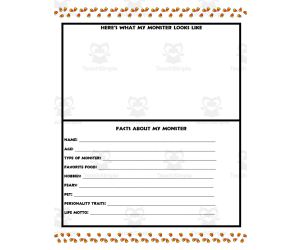
Creative Writing Prompt - Create Your Own Monster
ELA, Writing, Creative Writing, Grade 9, 10, 11, 12, Writing Prompts, Worksheets & Printables
This resource is a Creative Writing Prompt - Create Your Own Monster. Students will decide if they want to work on their own or with a partner on this assignment. There are a set of requirements that students will follow to create their own monster. Then students will write about and illustrate their creative monster.
Author Time Thrifty Teacher
Tags Creative Writing, Monster, Writing Prompts, Dialogue, Characterization, Create Your Own Monster, Monster Writing

Reading Comprehension and Questions Fiction Set 5 - Sports (PDF)
ELA, Reading, Reading Comprehension, Common Core, ESL, Language Development, Vocabulary, Spelling, Literature, Writing, Grade 4, 5, Worksheets & Printables, Worksheets, Writing Prompts, Assessments, Teacher Tools, Tests, Quizzes and Tests, Centers, Activities
Reading Comprehension Passages Fiction Set 5 Overview No prep reading comprehension lessons, with enjoyable stories and topics. Each lesson has a blend of post-reading activities. Mixed questions to check overall understanding. Vocabulary activities, plus a writing section. Lessons also contain a bonus extension exercise at the end. Some you may like, some you may not, either way they are there if you wish to use them. Full answer keys are provided. Passages Include 1.Olympics: Lauren and her class get excited when talking about the Olympics. 2.Tryouts: Max is getting himself ready for the basketball tryouts. 3.Big Brienne: Kitty has the game of her life against Big Brienne. 4.A Skate on the Lake: Aimee has a nice evening at the lake with her dad and friends. 5.Baseball Boy: Mitch goes to watch the Chicago Hitters. Read about his day. 6.Running: An informative, yet light piece about running. PDF Version This is the PDF uneditable version. This download is available in GOOGLE Docs, GOOGLE Forms, GOOGLE Slides. PDF, PPT, WORD. FULL CATALOG OF DOWNLOAD LINKS HERE Grade 4/5 Links Fiction Set 1 - Animals Google Docs Google Forms Google Slides PDF PPT Word Guided Reading Materials Fiction Set 2 - Family Google Docs Google Forms Google Slides PDF PPT Word Guided Reading Materials Fiction Set 3 - Friends Google Docs Google Forms Google Slides PDF PPT Word Guided Reading Materials Fiction Set 4 - School Google Docs Google Forms Google Slides PDF PPT Word Guided Reading Materials Fiction Set 5 - Sports Google Docs Google Forms Google Slides PDF PPT Word Guided Reading Materials Nonfiction Set 1 - Birds Google Docs Google Forms Google Slides PDF PPT Word Guided Reading Materials Nonfiction Set 2 - Insects Google Docs Google Forms Google Slides PDF PPT Word Guided Reading Materials Nonfiction Set 3 - Mammals Google Docs Google Forms Google Slides PDF PPT Word Guided Reading Materials Nonfiction Set 4 - Nature Google Docs Google Forms Google Slides PDF PPT Word Guided Reading Materials Nonfiction Set 5 - Sea Animals Google Docs Google Forms Google Slides PDF PPT Word Guided Reading Materials Reading Passages Overview Each passage is especially written for Grade 4-5 students, including key vocabulary required for this age group. Topics are varied and are accompanied by colorful graphics. Topics are meant to educate, yet entertain the modern student. These passages are perfect for the modern classroom. Whereas textbooks can become outdated in no time, any changes to technology or the world will result in updates to this product. Mixed Questions The mixed questions section of each lesson includes a variation of five comprehension, vocabulary and math questions. In addition, key reading strategies are frequently covered including cause & effect, summarizing, compare & contrast and making conclusions. Two or three of the questions will be MCQs and other questions will require a written response of some kind. Full answers and example responses appear at the end of the lesson. Spelling & Vocab Each reading passage contains a variety of words and phrases designed for Grade 4-5 students. Spelling and vocab activities provide the opportunity to build fluency with these words. As it can become quite mundane doing the same activities over and over, each lesson in a set will contain a different spelling and vocab activity . Activities include: spelling games, sentence match-ups, mixed-up text and decoding words from the lesson. Writing Prompts Writing prompts are designed to continue the theme or lessons learned in the story. Students are persuaded to write in a variety of ways and each prompt includes several cues to help. As with the spelling/vocab section, writing prompts will vary. This includes research pieces, reading responses, poetry and creative writing prompts. Full Answer Keys Full answer keys and sample responses are provided so no matter how busy you are, you know you're covered! Mixed question answers provide evidence from the text, math questions contain the relevant workings. Answers are designed for use by the teacher, but also suitable as a handout to the student. Just for Fun Each lesson will have a bonus extension exercise. This is something fun to extend the lesson with. You can find these at the end of each lesson, titled Just for Fun. Just for Funs are optional. Some you may like, some you may not. Either way, they are there to do with as you wish. For similar downloads and other frees, do check out Cored Group on TeachSimple.
Author Cored Education
Rating
Tags Elementary, Reading, Comprehension, Vocabulary, Answers, Spelling, Writing, Passages, Reading Centers, Reading Comprehension Assessments
Reading Comprehension and Questions Fiction Set 5 - Sports (Fillable)
ELA, Reading, Reading Comprehension, Common Core, ESL, Language Development, Vocabulary, Spelling, Literature, Writing, Grade 4, 5, Worksheets & Printables, Worksheets, Writing Prompts, Assessments, Teacher Tools, Tests, Quizzes and Tests, Centers, Activities
Reading Comprehension Passages Fiction Set 5 Snapshot Title: Reading Comprehension: Fiction Grade 4–5 Sports Genre: Fiction collection (sports-themed stories) with one informational passage Subject: Reading (ELA) Primary Topic: Sports moments, practice, competition, and teamwork Estimated Guided Reading Level (A–Z): Q What This Teaches Best Inferring characters’ feelings and motivations from actions and dialogue (e.g., Lauren’s disappointment/excitement, Max’s nervousness, Kitty’s fear turning into confidence). Problem/solution and perseverance in sports situations (tryouts pressure, facing a “rival,” learning what matters in competition). Sequencing and retelling through clear event chains (planning, practicing, traveling to an event, and reflecting afterward). Figurative and sensory language for setting and mood (the frozen lake, “orange radiance,” sounds/smells of outdoor skating). Vocabulary and word-study practice tied to the passages (note: the Running decode activity includes “opponent,” while the passage uses “opponents”). Learning Goals Identify and retell key events from a sports story in the correct order. Describe how a character feels at different moments using text evidence. Explain how practice or preparation affects what happens in a story. Determine the meaning of unfamiliar words using context clues in the passage. Compare how different texts present sports as fun, competition, or personal goals. Passages Include 1.Olympics: Lauren and her class get excited when talking about the Olympics. 2.Tryouts: Max is getting himself ready for the basketball tryouts. 3.Big Brienne: Kitty has the game of her life against Big Brienne. 4.A Skate on the Lake: Aimee has a nice evening at the lake with her dad and friends. 5.Baseball Boy: Mitch goes to watch the Chicago Hitters. Read about his day. 6.Running: An informative, yet light piece about running. FILLABLE PDF VERSION Worksheet-style pages, but with type-in answer boxes so students can complete and save their work digitally. Other versions are available in the links list below or in the full catalog. FULL CATALOG OF DOWNLOAD LINKS HERE For similar downloads and other frees, do check out Cored Group on TeachSimple.
Author Cored Education
Rating
Tags Elementary, Reading, Comprehension, Vocabulary, Answers, Spelling, Writing, Passages, Reading Centers, Reading Comprehension Assessments
High School British Alternative Music Reading Passage and Q & A
Creative Arts, Music, ELA, Reading, Writing, Research, Resources for Teachers, Social Studies, History, High School, Homeschool Resources, Teacher Tools, Assessments, Lesson Plans, Quizzes and Tests, Worksheets & Printables, Writing Prompts
As a homeschool mom watching my 9th grader navigate the complexities of culture, identity, and artistic expression, I have seen firsthand how music can be a powerful lens for understanding history and society. This British Alternatiave Music Reading Passage, Q & A, and Note-Taking Sheets comprehensive resource explores the profound impact of British alternative music that will challenge your high school student/homeschooler to think critically about art, culture, and social change. INCLUDED IN THIS RESOURCE: Comprehensive reading passage covering iconic British alternative bands 20 detailed analytical questions Complete answer key with thorough explanations for teachers/homeschool parents NO-PREP and ready-to-use TOPICS COVERED: Cultural counter-narratives Artistic evolution and creative risk-taking Regional identity and musical expression Technology's impact on music distribution This British Alternatiave Music Reading Passage, Q & A, and Note-Taking Sheets resource transforms what could be a dry academic exercise into an engaging exploration of how art intersects with politics, technology, identity, and social change. It meets students/homeschoolers where they are—interested in music and culture—while building the analytical skills they need for academic success. Whether you are looking to spice up your English curriculum, add depth to a history unit, or simply provide your homeschooler with intellectually stimulating material, this resource delivers the perfect blend of engagement and rigor that makes learning both enjoyable and meaningful. If you and your students/homeschoolers enjoyed this resource, please leave a review. Thank you for your support! Tina - Big Easy Homeschooling Mom
Author Homeschool with Big Easy Homeschooling Mom
Rating
Tags British Alternative Music Reading Comprehension High School, British Music History Homeschool Curriculum, Smiths Radiohead Oasis Educational Materials, Alternative Rock Cultural Analysis Questions, Britpop Era Educational Resources High School, British Music History Homeschool Curriculum, Music And Society Critical Thinking Activities, Alternative Music Social Commentary Analysis, , British Music Cultural Studies Resources, British Bands Cultural Significance Educational Materials, Alternative Music Authenticity Discussion Questions
Physics of Sports Writing Activity Pack for 6th-8th Grade Science ELA
ELA, Writing, Physics, Science, Grade 6, 7, 8, Centers, Activities, Writing Prompts, Worksheets & Printables
This 11-page resource gives students everything they need to practice creative writing, sequencing, sentence building, adjectives, and character creation—all wrapped in an engaging Gingerbread Man theme. Each worksheet is clean, kid-friendly, and easy to pair with any Gingerbread Man read-aloud, making it perfect for December literacy activities. The pack includes a variety of writing prompts and graphic organizers such as: • A New Ending for the Gingerbread Man writing prompt • If the Gingerbread Man Visited Your School prompt • An adjectives chart to Describe the Gingerbread Man • A Beginning–Middle–End sequence chart • Draw & Write pages for creating a new gingerbread character • A character creation worksheet • Fill-in-the-sentences practice • A cut-and-paste sequencing activity with picture icons • A Gingerbread-themed word bank • A student writing checklist to support editing skills Students will build essential skills in creative writing, sequencing, sentence structure, descriptive language, character traits, drawing to support writing, and self-editing. Perfect for literacy centers, writing workshop, small-group lessons, fast finishers, substitute plans, winter lessons, and Gingerbread Man read-aloud units. All pages are black-and-white, print-friendly, and easy for teachers to use. File type: PDF Number of pages: 11
Author Sadigitalart
Rating
Tags Physics , Independent Practice, Physical Education, Sports, Homework Assignment
Chanel, Dior, and Women's Lives: Social Studies Reading Passage (PDF)
ELA, Reading, Reading Comprehension, Strategies, Resources for Teachers, Social Studies, Sociology, Grade 6, 7, 8, 9, Writing Prompts, Worksheets & Printables, Centers, Activities, Teacher Tools, Assessments, Quizzes and Tests, Quizzes, Tests
Chanel, Dior, and Women's Lives: Social Studies Reading Comprehension Passage (PDF) This resource introduces a unique Social Studies reading comprehension passage with questions about Chanel, Dior, and Women's Lives. The passage is carefully designed to bridge the gap between social studies and literacy through strengthening reading comprehension and sparking knowledge curiosity in middle school students. Each passage blends English Language Arts skills with accurate social studies content . Ideal for interdisciplinary learning in ELA and Social Studies. Suitable for Grade 9 review, too! Student Tasks throughout the passage: 5 multiple-choice questions targeting the following skills: main idea, key details, inference, vocabulary in context, and use of evidence 5 vocabulary matching items with clear, student-friendly definitions 5 text-based questions that require citing specific lines or facts 1 summary prompt that asks students to condense central ideas accurately Full answer key for every section Available Formats for this Resource: Fillable PDF Word Docs Google Docs FULL CATALOG OF DOWNLOADING LINKS HERE Social Studies Reading Comprehension Collection Links: 1. Ancient Civilizations PDF Fillable PDF Word Docs Google Docs 2. Early Empires and Trade Networks PDF Fillable PDF Word Docs Google Docs 3. The Founding of the United States PDF Fillable PDF Word Docs Google Docs 4. Language, Culture, and Meaning PDF Fillable PDF Word Docs Google Docs 5. Psychology and Society PDF Fillable PDF Word Docs Google Docs 6. Global Festivals and Traditions PDF Fillable PDF Word Docs Google Docs 7. Extreme Environments and People PDF Fillable PDF Word Docs Google Docs 8. Food, Culture, and Preservation PDF Fillable PDF Word Docs Google Docs 9. Global Food Customs PDF Fillable PDF Word Docs Google Docs 10. Media, Communication, and Popular Culture PDF Fillable PDF Word Docs Google Docs 11. Human Impact on the Environment PDF Fillable PDF Word Docs Google Docs 12. Civic Action and Social Change PDF Fillable PDF Word Docs Google Docs 13. Fashion, Society, and Power PDF Fillable PDF Word Docs Google Docs 14. People, Places, and Unusual Histories PDF Fillable PDF Word Docs Google Docs Product Details: Length: 5 pages Grades: 6–8, also suitable for Grade 9 review Use cases: close reading, stations, homework, intervention, test prep, and sub plans Why Teachers Choose This Passage: Authentic social studies content paired with rigorous literacy practice Consistent task structure for easier planning and smoother student routines Clear, age-appropriate writing that builds confidence without oversimplifying Use this passage to reinforce ELA skills in social studies, to add literacy to your lessons, and to support independent work. The passage strengthens main idea, evidence use, vocabulary in context, inference, cause and effect, and summary writing. With ready-to-use assessments and complete answer keys, you can provide focused practice that is simple to run and fast to review.
Author CORED Education - Middle & High School
Rating
Tags Middle School, Reading Comprehension, Reading Strategies, ELA, Centers, Reading Passage, Assessments, Vocabulary, Social Studies, Sociology
Jellyfish Reading Comprehension Passage - Cored Ed Encyclopedia
ELA, Language Development, Resources for Teachers, Reading Comprehension, Reading, Pre-Reading, Writing, Science, Animals, Life Sciences, Grade 2, 3, 4, 5, Worksheets & Printables, Worksheets, Teacher Tools, Centers, Activities, Writing Prompts, Assessments, Tests, Quizzes and Tests, Quizzes
This jellyfish reading comprehension contains the following: Visualize on the Cover Start your lesson by taking a few moments to visualize the topic and share thoughts or feelings about it. Pre-Reading Trivia Students will write down one thing they already know about the subject and then read five more facts and discuss. These facts are fun, and the students will enjoy learning about the subject before reading more. Reading Passage The text is a high-interest reading passage with set paragraphs, roughly three to four paragraphs long. It contains a variety of themes about the topic, anywhere from history to technology. The passage is between 250 and 350 words in length. Mixed Questions The first question page contains four multiple-choice questions, each with a choice of four answers, and three written response questions that require a sentence or two from the student. Vocabulary Questions Practice seven key words from the text in this section across two activities. First section is scrambled words where students will unscramble three words given a clue for each. The second section is a word to meaning matching activity. Creative Writing In this question, the student will be required to write a five to eight sentence paragraph on a question related to the topic. Extension Activities This page is optional for fast finishers or to take home. There are several activities, each one requiring a different skill. Do some, do none, do all, completely optional - but you will feel reassured knowing every possibility is planned for. Answer Key There are answers for the multiple-choice questions, written response questions have sample answers, vocabulary answers and if there is a summary question then a sample summary will be provided as well. FULL CATALOG OF DOWNLOAD LINKS AND ENCYCLOPEDIA INDEX HERE Lesson Snapshot Title: Jellyfish Genre: Nonfiction (Informational Text) Subject: Life Science / Reading (Informational Text) Primary Topic: Jellyfish bodies, movement, stings, and life changes Estimated Guided Reading Level (A–Z): N What This Lesson Teaches Best Identifies what jellyfish are (not fish) and describes their watery, bell-shaped bodies. Explains how jellyfish move by squeezing and relaxing their bell, and sometimes squirting water. Describes how tentacles help jellyfish catch prey using tiny stinging cells. Introduces how jellyfish change forms across their lives (drifting young, attached form, then floating swimmers). Uses headings to organize science information and includes follow-up questions/activities tied to the passage. Learning Goals Describe what a jellyfish can look like and what its main body part is called. Explain why a jellyfish is not a fish, using details from the text. Explain how a jellyfish moves through water. Describe what tentacles do and why people should be careful near jellyfish. Describe one way jellyfish change during their lives. Key Vocabulary From the Text invertebrates — animals without bones. tentacles — long parts that can sting and catch prey. plankton — very small sea life that animals can eat. bell — the main body part shaped like an umbrella. blooms — groups of jellyfish gathered together. Cored Ed Encyclopedia Overview The Cored Ed Encyclopedia is a weekly series of lessons that you can pick up and use right away. These short readings fit into whatever time you have available. Each one includes a warm-up, a reading, and a set of questions, but it’s flexible — you can do just the reading, the full lesson, or skip the writing section if you need to. Each lesson focuses on a single topic so students don’t get lost. The writing is clear but never childish, making it perfect for grades two through five. Topics range from animals and science to history, inventions, and everyday things. No matter the level of the student, everyone should take away at least one new idea or fact from each lesson. The materials are easy to print, easy to explain, and require no setup. They work well for whole-class teaching, partner work, or independent study.
Author Cored Education
Rating
Tags Vocabulary, Spelling, Reading Comprehension, Reading Passages, Reading, Creative Writing, Reading Strategies, Writing Prompts, Jellyfish, Life Science