4-Square Vocabulary Templates

- Grades
- Grades 3–8
- Pages
- 4
- File type
- Preparation
- Print ready


- Subject
- ELA, Vocabulary
- Topic
- Frayer model, Academic vocabulary
- Resource types
- Graphic Organizers, Templates
- Preparation
- Print ready
Product description
From the author
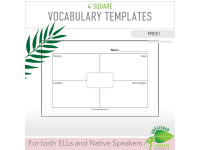
Wondering how to help ELL students in your mainstream classroom? Start explicitly teaching academic vocabulary using these 4-square vocabulary templates.
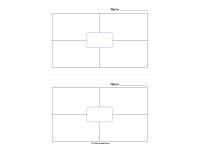
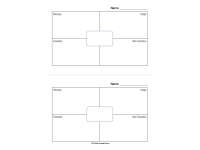
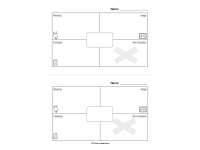
This free product contains three templates.
Template 1: No labels-you can write in or have students write in labels.
Template 2: Labels for word, image, meaning, examples, and non-examples are included.
Template 3: Labels and small images that relate to the labels are included.
Suggested ways to use:
•Select the template that is appropriate for your students and lead them through the completion of the template with selected vocabulary word(s).
•Ask students to share what they included in the boxes.
•Avoid information overload: one to two words in a given day might be a reasonable amount.
•Use the blank template to write in your own prompts. Other commonly used ideas include:
Use the word in a sentence.
Synonyms/antonyms
Word families
Prefix/suffix
Parts of speech
•Use with interactive notebooks.
•Use as an interactive study tool; cover up the word in the middle and have students quiz each other to guess the word using information from the form.
•Use as a quiz or formative assessment; provide a student with a blank version with only the word in the center and have the student fill in the rest.
•Scaffold the activity for different learners; fill in some or all of the information and provide to students instead of having them fill in all the boxes.
Related resources
More resources teachers may find useful
24 related resources were found using this product's title, contributor, categories and tags.



In the classroom
Teaching tips & learning objectives

Learning objectives
Explain a word using its meaning, an image, examples and non-examples.

Teaching tips
Model a word together before asking students to complete a template.

Skills covered
Vocabulary development and conceptual comparison.
Good to know
Questions teachers ask about this resource
How do the three templates differ?
One leaves the headings blank, one supplies labels for the word, image, meaning, examples and non-examples, and one adds small visual cues to those labels.

No reviews yet
Downloaded this resource? Tell other teachers how it went.
Resource details
Concepts & topics
Core concepts
 Core concepts
Word meaning; examples; non-examples.
 Topics
Explore more
Categories this resource belongs to
Explore related searches
More to explore
You may also like