Associative Property Word Problems
- Grades
- Grade 3, Elementary
- File type
- Preparation
- Print ready


- Subject
- Math, Multiplication and Division
- Topic
- associative property, word problems
- Resource types
- Worksheets & Printables, Word Problems, Worksheets
- Preparation
- Print ready
- Standards
- 3.OA.B.5
About this resource
What's inside this resource
This is a set of Associative Property Word Problems.
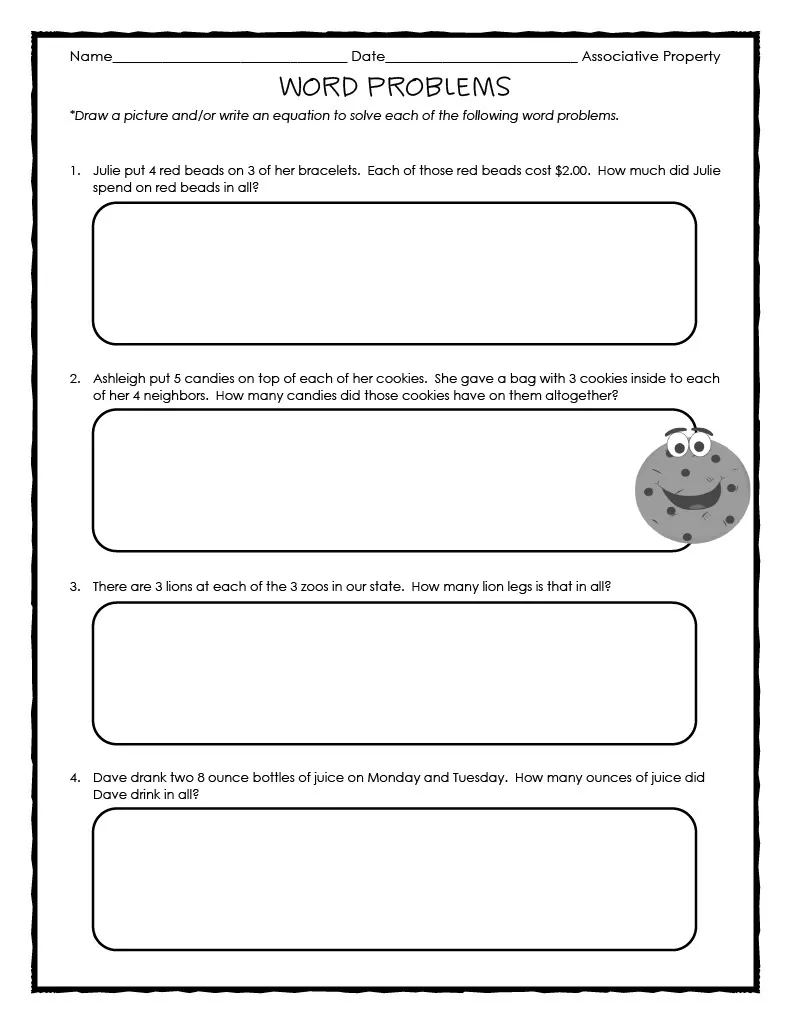
It has 4 pages and includes eight word problems on the first 2 pages. It gives students the space to solve each problem.
The word problems are as follows:
Julie put 4 red beads on 3 of her bracelets. Each of those red beads cost $2.00. How much did Julie spend on red beads in all?
Ashleigh put 5 candies on top of each of her cookies. She gave a bag with 3 cookies inside to each of her 4 neighbors. How many candies did those cookies have on them altogether?
There are 3 lions at each of the 3 zoos in our state. How many lion legs is that in all?
Dave drank two 8 ounce bottles of juice on Monday and Tuesday. How many ounces of juice did Dave drink in all?
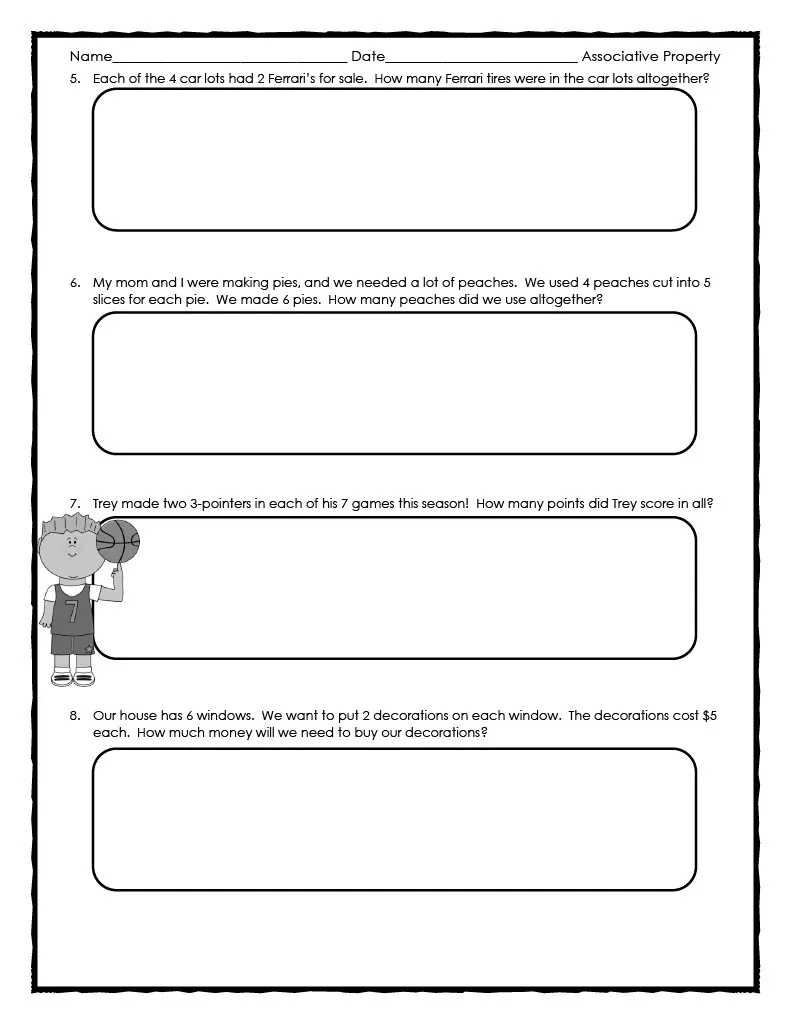
Each of the 4 car lots had 2 Ferrari’s for sale. How many Ferrari tires were in the car lots altogether?
My mom and I were making pies, and we needed a lot of peaches. We used 4 peaches cut into 5 slices for each pie. We made 6 pies. How many peaches did we use altogether?
Trey made two 3-pointers in each of his 7 games this season! How many points did Trey score in all?
Our house has 6 windows. We want to put 2 decorations on each window. The decorations cost $5 each. How much money will we need to buy our decorations?
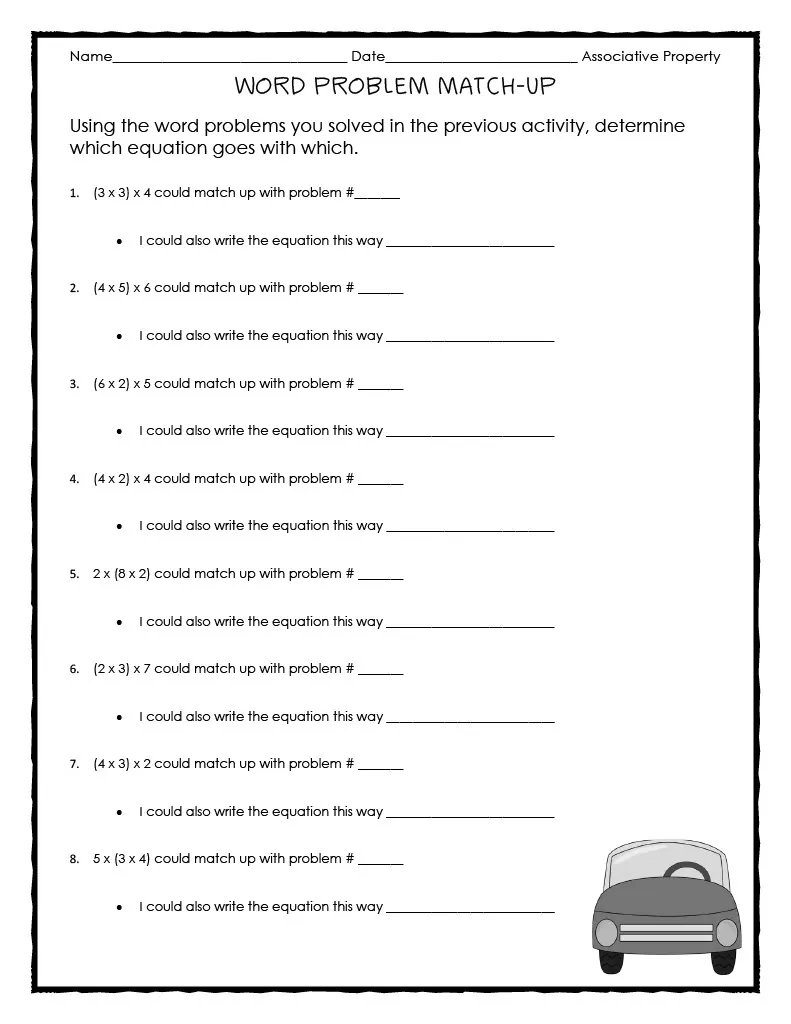
The third page is a word problem match-up sheet. On this page, students will use the word problems they have solved in the previous activity and determine which equation goes with which.
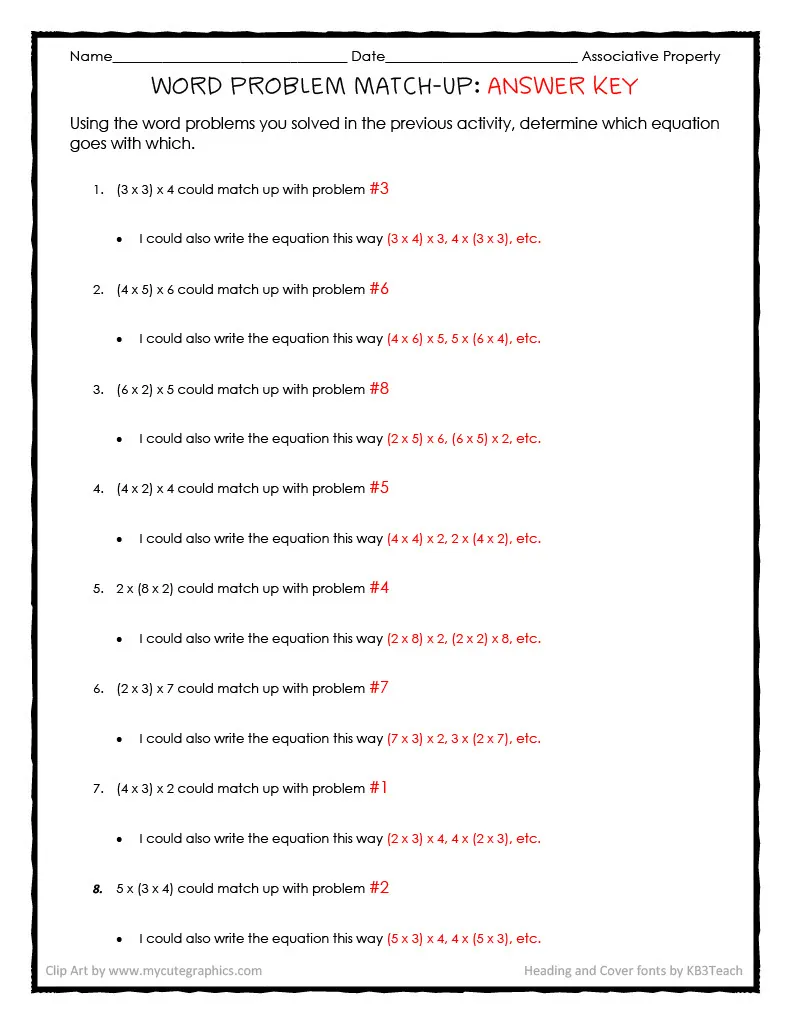
The fourth page is an answer key for the match-up worksheet.
Related resources
More resources teachers may find useful
24 related resources were found using this product's title, contributor, categories and tags.


In the classroom
Teaching tips & learning objectives

Learning objectives
Students translate a real-world multiplication scenario into an equation with three factors.
Students apply the associative property to regroup a three-factor multiplication equation and recognize it as equivalent to a given word problem.
Students write an alternate but equivalent grouping of the same three factors.

Teaching tips
Have students complete the eight word problems on pages 1-2 first, then use the match-up sheet on page 3 so the associative-property regroupings connect back to problems they already solved.
Use the answer key on page 4 to model one matched pair together before students work the remaining seven independently.
Ask students to explain out loud why their alternate equation, e.g. (3 x 4) x 3 instead of (3 x 3) x 4, still gives the same product.

Skills covered
Multiplication word-problem translation — students read a real-world scenario (beads on bracelets, pies from peach slices, Ferrari tires) and write it as a three-factor equation.
Associative property of multiplication — students match a regrouped equation such as (6 x 2) x 5 to the original word problem it solves.
Equivalent equation writing — students write a second, differently grouped equation for the same three factors.
Good to know
Questions teachers ask about this resource
How does the match-up sheet connect back to the word problems?
Each of the eight equations on the match-up sheet, such as (4 x 5) x 6, is a regrouped version of one of the eight word problems on pages 1-2; students identify which problem number the equation solves, then write it a second way.

No reviews yet
Downloaded this resource? Tell other teachers how it went.
Curriculum
Standards, concepts & topics
Standards
 Standards
- 3.OA.B.5 — Apply properties of operations as strategies to multiply and divide.2 Examples: If 6 × 4 = 24 is known, then 4 × 6 = 24 is also known. (Commutative property of multiplication.) 3 × 5 × 2 can be found by 3 × 5 = 15, then 15 × 2 = 30, or by 5 × 2 = 10, then 3 × 10 = 30. (Associative property of multiplication.) Knowing that 8 × 5 = 40 and 8 × 2 = 16, one can find 8 × 7 as 8 × (5 + 2) = (8 × 5) + (8 × 2) = 40 + 16 = 56. (Distributive property.)
Core concepts
 Core concepts
Associative property of multiplication
Multi-factor multiplication
Word problem to equation translation
 Topics
Explore more
Categories this resource belongs to
Explore related searches
More to explore
You may also like