Big Red Lollipop Read Aloud Book Companion Activities for IRA
- Grades
- Grades 2–4, Elementary
- File type
- Preparation
- Print ready
- Subject
- ELA, Reading, Reading Comprehension, Literature
- Topic
- IRA, picture book activities
- Resource types
- Read Alouds, Activities
- Preparation
- Print ready
About this resource
What's inside this resource
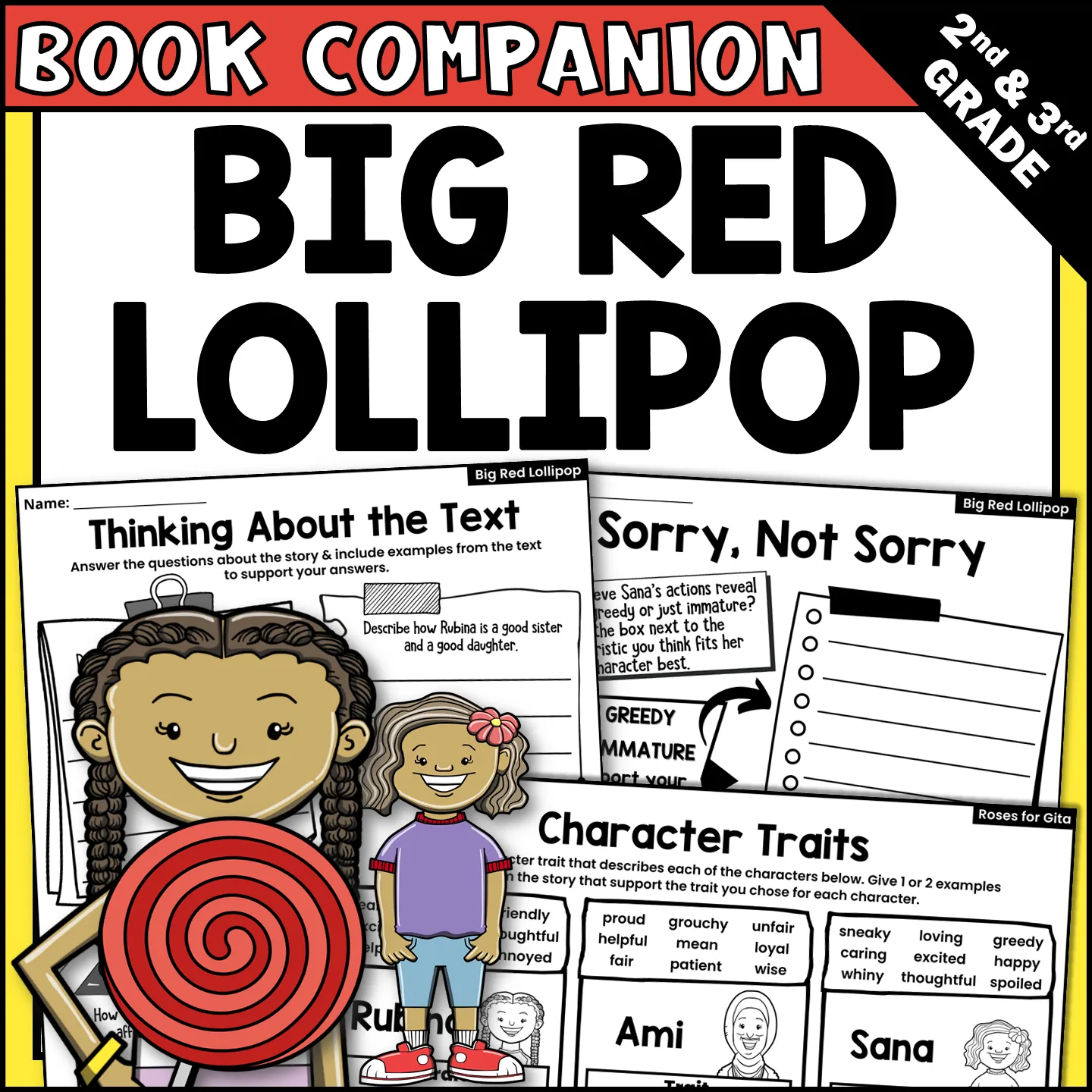
This picture book companion is a complete supplemental resource for the book Big Red Lollipop, by Rukhsana Khan.
With 30 print-and-go reading activities to choose from, this resource is ideal for customizing learning to your student's specific needs and academic abilities. Students will investigate characters, identify story elements, determine the theme, practice plotting story events, compare & contrast, make predictions, inferences, & connections, answer questions that require them to think beyond the text, and much more!
Students will love the engaging and fun activities, and you will appreciate the time saved hunting for high-level resources to teach reading concepts that students frequently struggle with. The activities provided are designed to enable students to apply higher-level thinking skills, encourage them to provide text evidence to support their thinking, and challenge them to express their own thoughts and/or perspectives.
⭐️This Resource Includes:⭐️
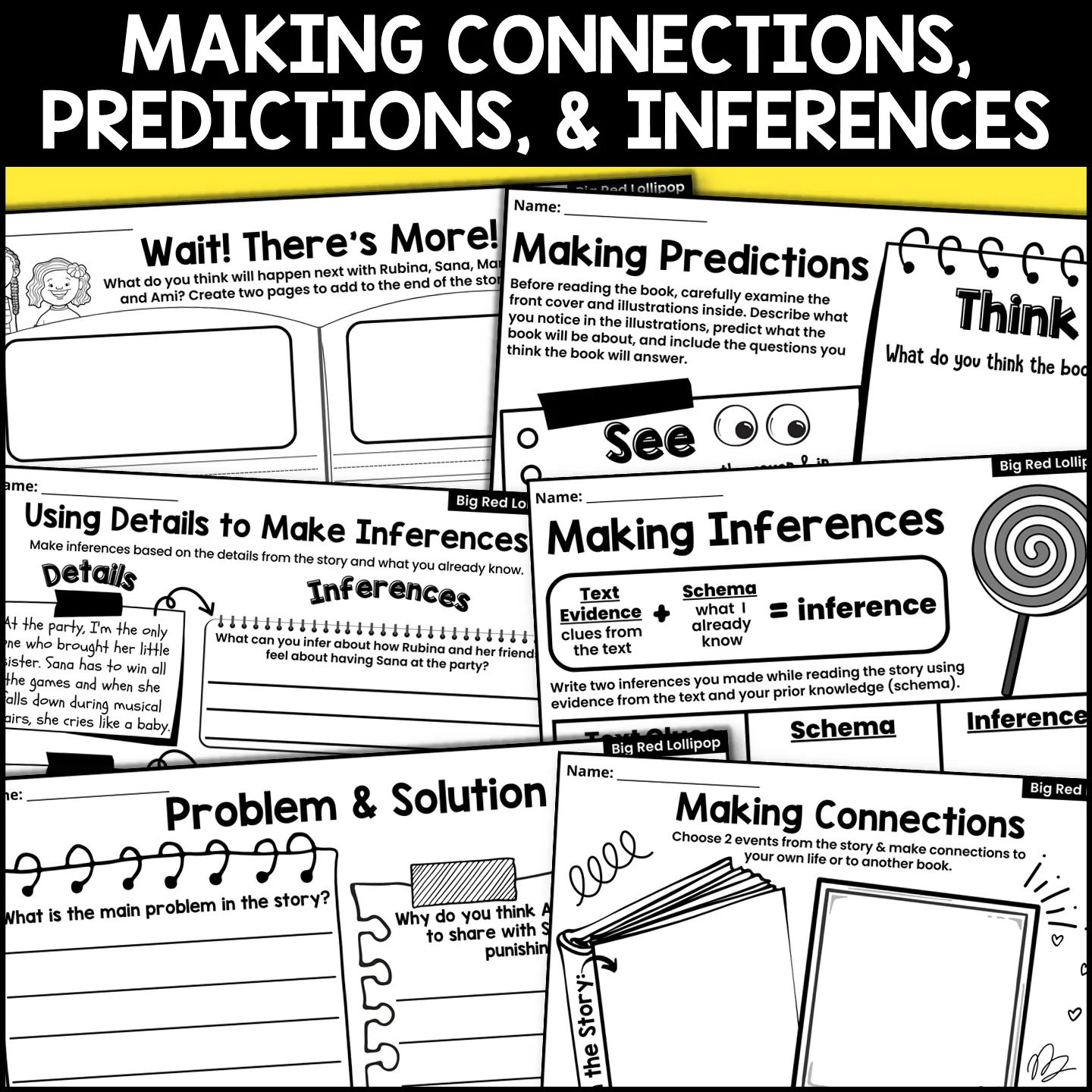
◾ Making Predictions: Before reading the book, students will make predictions about the text.
◾ Story Elements: Students fill in the boxes with words & pictures to represent the story elements.
◾ Sequencing: Students will retell & illustrate the important parts of the story.
◾ Story Plot: Students answer the questions in each section of the plot map to help them identify the plot's key events (ANSWER KEY included).
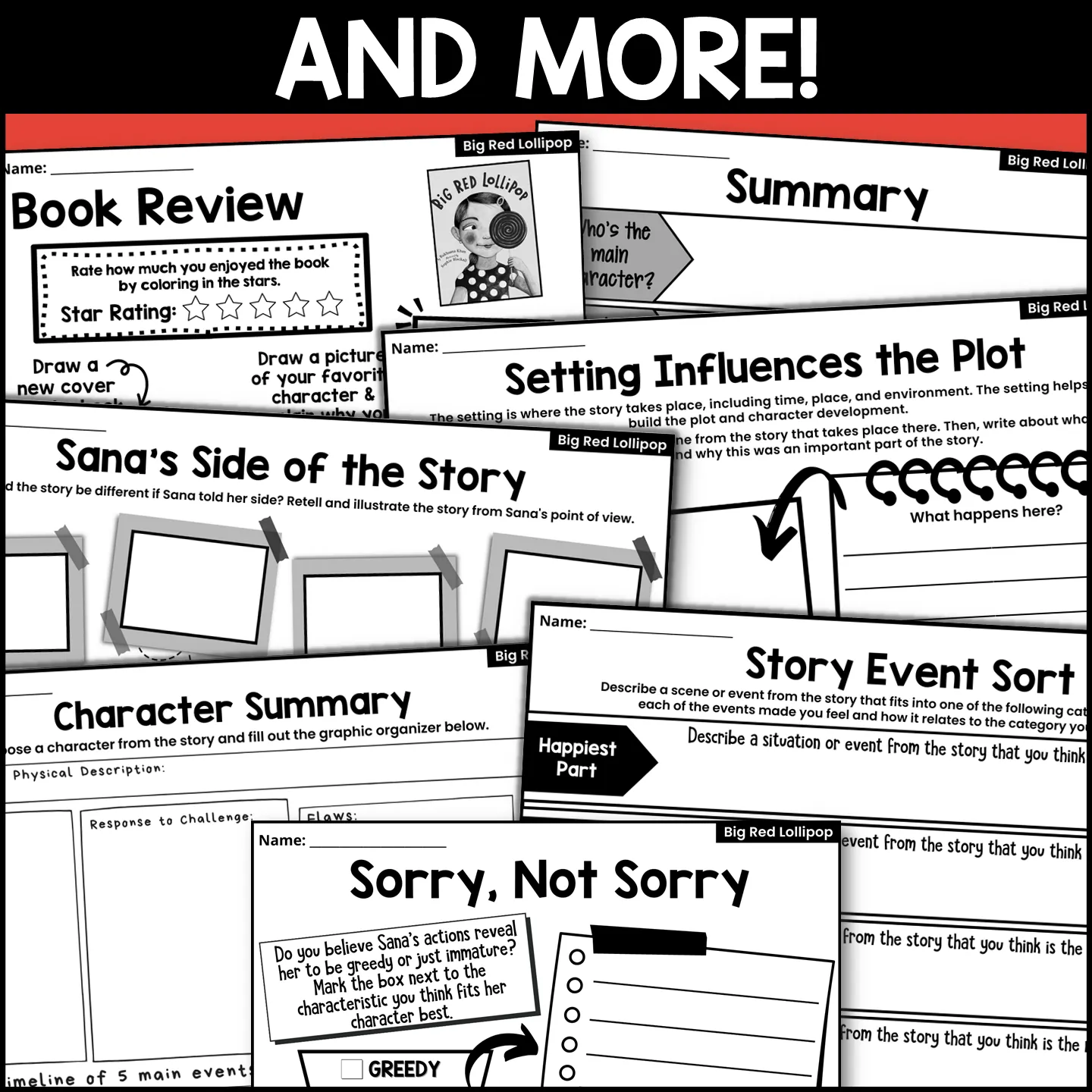
◾ Summary: Students complete the Somebody, Wanted, Because, But, So graphic organizer and write a summary of the story.
◾ Story Event Sort: Students will describe a scene or event from the story that fits into each of the categories & explain how the event made them feel & how it relates to the category.
◾ Making Inferences: Students use clues & schema to make inferences while reading the story.
◾ Using Details to Make Inferences: Students will make inferences using the provided details from the story.
◾ Making Connections: Students make connections to an event from the story.
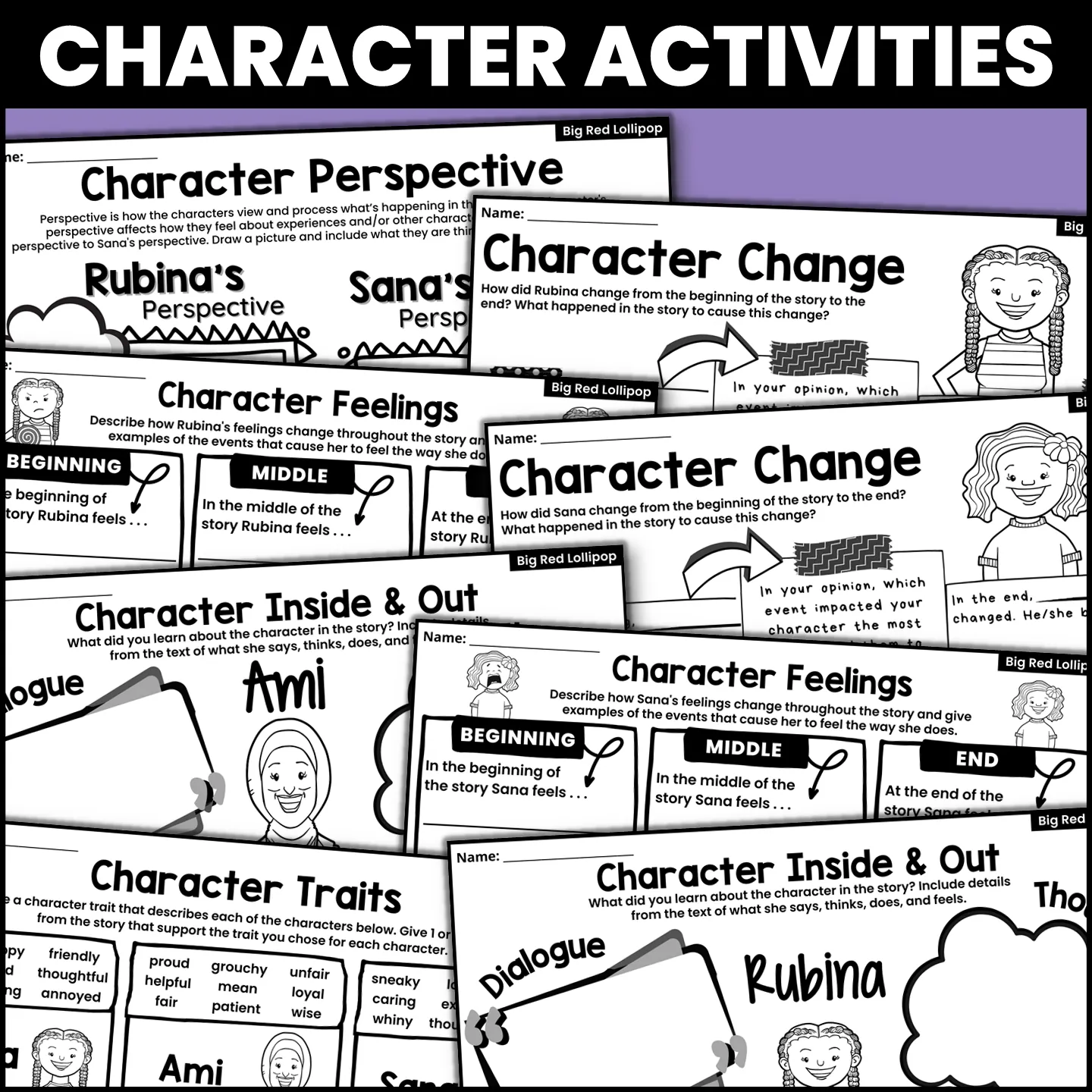
◾ Character Traits - Students will choose a character trait that describes each of the characters and provide evidence from the text to support those character traits.
◾ Character Inside & Out (Rubina): Students include details from the story to describe what the character says, thinks, does, and feels.
◾ Character Inside & Out (Sana): Students include details from the story to describe what the character says, thinks, does, and feels.
◾ Character Inside & Out (Ami): Students include details from the story to describe what the character says, thinks, does, and feels.
◾ Character Feelings (Rubina): Students describe how the character's feelings change throughout the story & give examples of the events that cause them to feel the way they do.
◾ Character Feelings (Sana): Students describe how the character's feelings change throughout the story & give examples of the events that cause them to feel the way they do.
◾ Character Feelings (Ami): Students describe how the character's feelings change throughout the story & give examples of the events that cause them to feel the way they do.
◾ Character Change (Rubina): Students will explain how the character changed from the beginning to the end of the story and describe the events that caused the change to happen.
◾ Character Change (Sana): Students will explain how the character changed from the beginning to the end of the story and describe the events that caused the change to happen.
◾ Character Change (Ami): Students will explain how the character changed from the beginning to the end of the story and describe the events that caused the change to happen.
◾ Character Summary: Students summarize the main character of the story.
◾ Character Perspective: Students will compare Rubina's perspective to Sana's perspective in the story by drawing a picture and adding words to the thought bubbles.
◾ Sketch a Scene From the Story: Students will draw a scene from the story and explain why it's important to the plot.
◾ Setting Influences the Plot: Students will draw a scene from the story that takes place in one of the settings and write about what happened there and why it was important to the plot.
◾ Problem & Solution: Students answer questions related to the problem & solution in the story.
◾ Theme: Students answer the questions to determine which theme best fits the story and provide text evidence to support their choice.
◾ Thinking About the Text: Students will answer the questions about the story & include examples from the text to support their answers.
◾ Wait... There's More!: Students will write about what happens next in the story.
◾ Sana's Side of the Story: Students retell and illustrate the story as if it were told from Sana's point of view.
◾ Vocabulary Word Search Puzzle: Students find the hidden words in the puzzle (ANSWER KEY included).
◾ Sorry, Not Sorry: Students state their opinion on whether Sana is greedy or just immature. Then, based on their opinion, students will write an apology note or a note to defend Sana's behavior.
◾ Book Review: Students will color in the stars to rate how much they enjoyed the book and draw a new cover & their favorite character from the story. Then, they will explain why other kids should or should not read it.
💡Need ideas for different ways you can implement these activities?
◾ Focus on different reading skills each day for targeted instruction, and have students complete a corresponding printable to check for understanding.
◾ During centers, students can independently read the story again and complete an activity that reviews a previously taught concept.
◾ Work with students on a reading concept they struggle with during guided reading or strategy groups.
◾ Students work with a partner or in literature circles to complete additional reading activities.
This resource is for extension read-aloud activities only. The book is not included.
⭐️You may also like:⭐
TEXT SET #1: "The Importance of Friendship"
◾ A Weekend With Wendell Read Aloud Book Companion Activities for IRA
TEXT SET #3: "Finding Your Way in a New Place"
◾ Grandfather Counts Read Aloud Book Companion Activities for IRA
◾ The Have a Good Day Cafe, Read Aloud Book Companion Activities for IRA
◾ Roses for Gita Read Aloud Book Companion Activities for IRA
◾ Mango, Abuela, and Me, Read Aloud Book Companion Activities for IRA
◾ Home at Last Read Aloud Book Companion Activities for IRA
TEXT SET #7: "Exploring Narrative Nonfiction"
◾ Cactus Hotel Read Aloud Book Companion Activities for IRA
◾ A Log's Life Read Aloud Book Companion Activities for IRA
◾ Salmon Stream Read Aloud Book Companion Activities for IRA
◾ Think of an Eel Read Aloud Book Companion Activities for IRA
✨Be sure to check out my storefront here: https://teachsimple.com/contributor/creatively-gifted
In the classroom
Teaching tips & learning objectives
Learning objectives
Analyze character traits, feelings, and change across three characters using text evidence
Determine the story's theme and problem/solution structure
Make predictions, inferences, and personal connections while reading
Compare two characters' differing perspectives on the same events
Form and support an opinion about a character's behavior in writing
Teaching tips
Spread the 30 activities across a week or more rather than assigning them all at once, as the included teacher tip page recommends.
Project the book's illustrations during the read-aloud, since the visuals are described as necessary for following the story.
Use the three parallel Character Inside & Out pages (Rubina, Sana, Ami) as a small-group rotation, with each group focusing on a different character before comparing notes as a class.
Pair the "Sorry, Not Sorry" opinion activity with a class discussion, since it asks students to take and defend a stance on whether a character's behavior was intentional or age-appropriate immaturity.
Skills covered
Character analysis — parallel activity sets for three named characters (Rubina, Sana, Ami) build traits, feelings, and change over the story's arc
Perspective-taking — the Character Perspective page has students compare Rubina's and Sana's viewpoints on the same events through drawings and thought bubbles
Theme and problem/solution — dedicated pages ask students to identify the story's theme and its central problem and resolution with text evidence
Opinion writing — the "Sorry, Not Sorry" page requires students to take a position on a character's behavior and write a supporting note
Inference and connection-making — separate activities have students use story clues and personal schema to infer meaning and connect to their own experiences
Good to know
Questions teachers ask about this resource
Does the download come with a copy of the Big Red Lollipop picture book?
No, this is a companion set of extension activities only; the Big Red Lollipop book is not included.
How many characters get individual activity pages?
Three characters — Rubina, Sana, and Ami — each get their own Character Inside & Out, Character Feelings, and Character Change pages.
No reviews yet
Downloaded this resource? Tell other teachers how it went.
Resource details
Concepts & topics
Core concepts
character analysis
theme
making inferences
story elements
perspective-taking
Explore more
Categories this resource belongs to
Explore related searches
More to explore