"Chasing Vermeer" S.T.E.A.M. Activity Packet
- Grades
- Grades 3–6, Middle School, Elementary
- File type
- Preparation
- Print ready


- Subject
- Creative Arts, Art, ELA, Art History, Reading, Reading Comprehension, Literature
- Topic
- math, art
- Resource types
- Worksheets & Printables, Novel Studies, Activities, Projects
- Preparation
- Print ready
About this resource
What's inside this resource
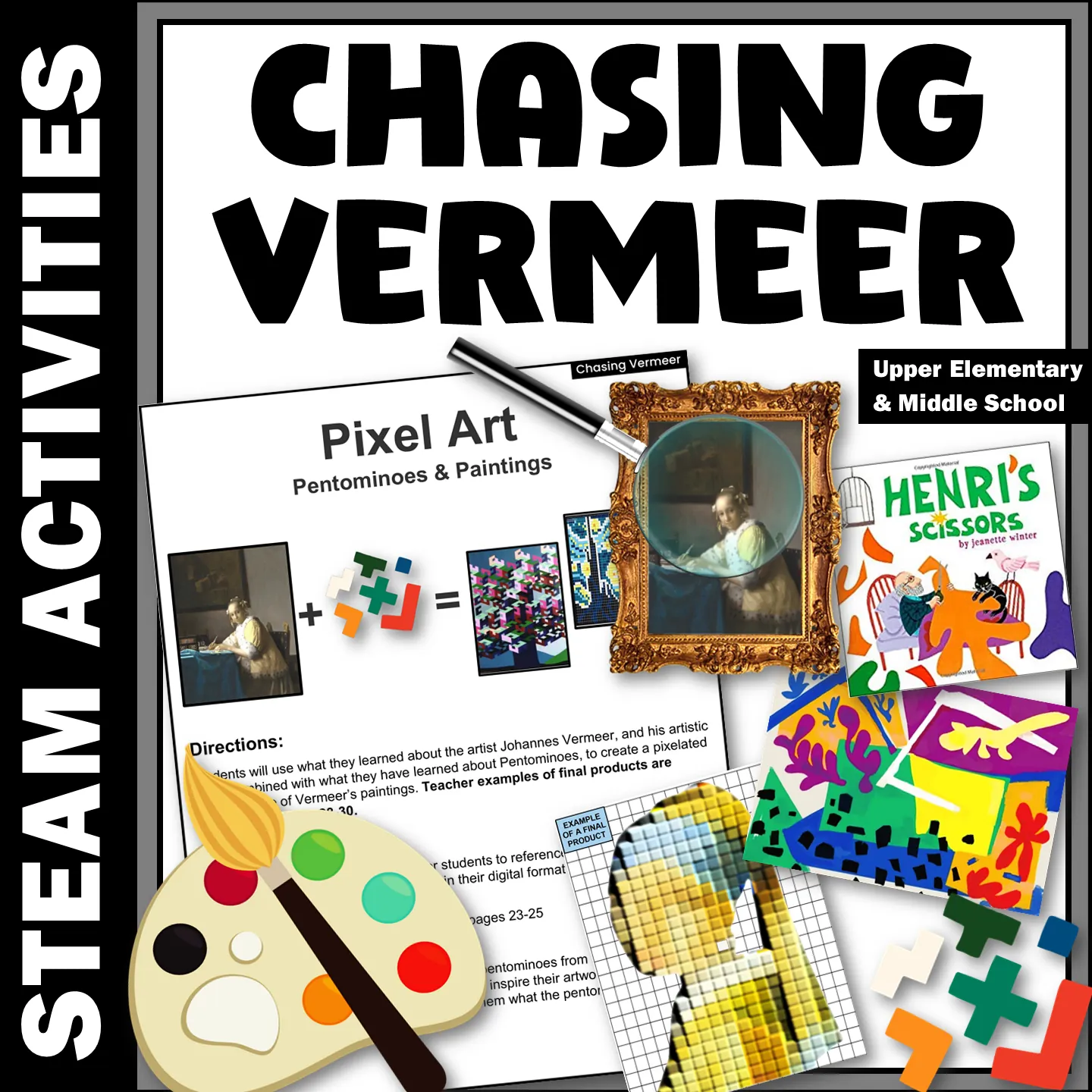
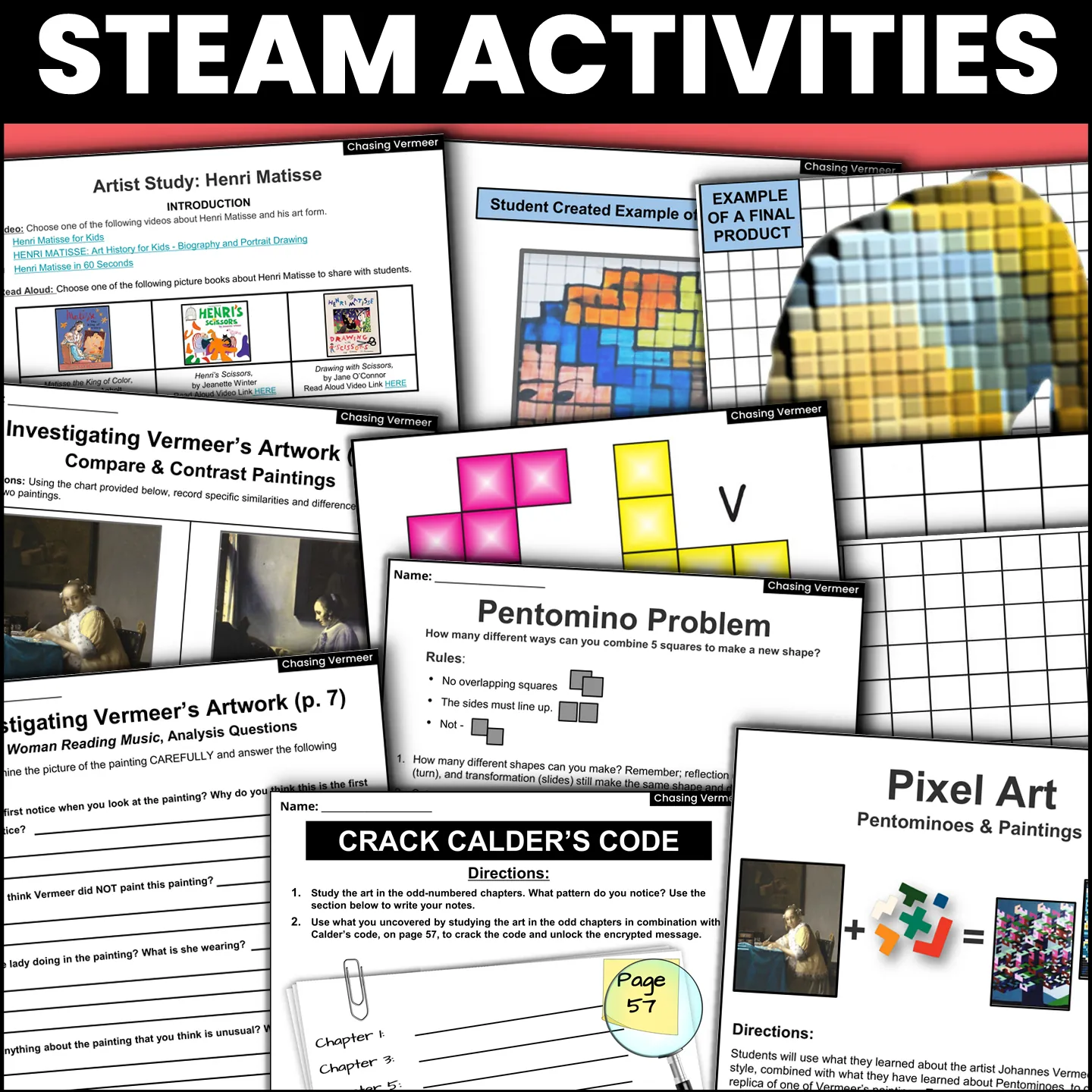
Influenced by the novel Chasing Vermeer, the S.T.E.A.M.-based activities included in this product focus on the content areas of math and art. Students will investigate Vermeer’s paintings, learn about pentominoes, complete a pentomino challenge, engage in an artist study, and mimic their style of art. Finally, students will integrate art and math using what they learned about pentominoes in combination with their knowledge regarding Vermeer’s artistic style to create a pixel art masterpiece.
⭐️This Resource Includes:⭐️
Math
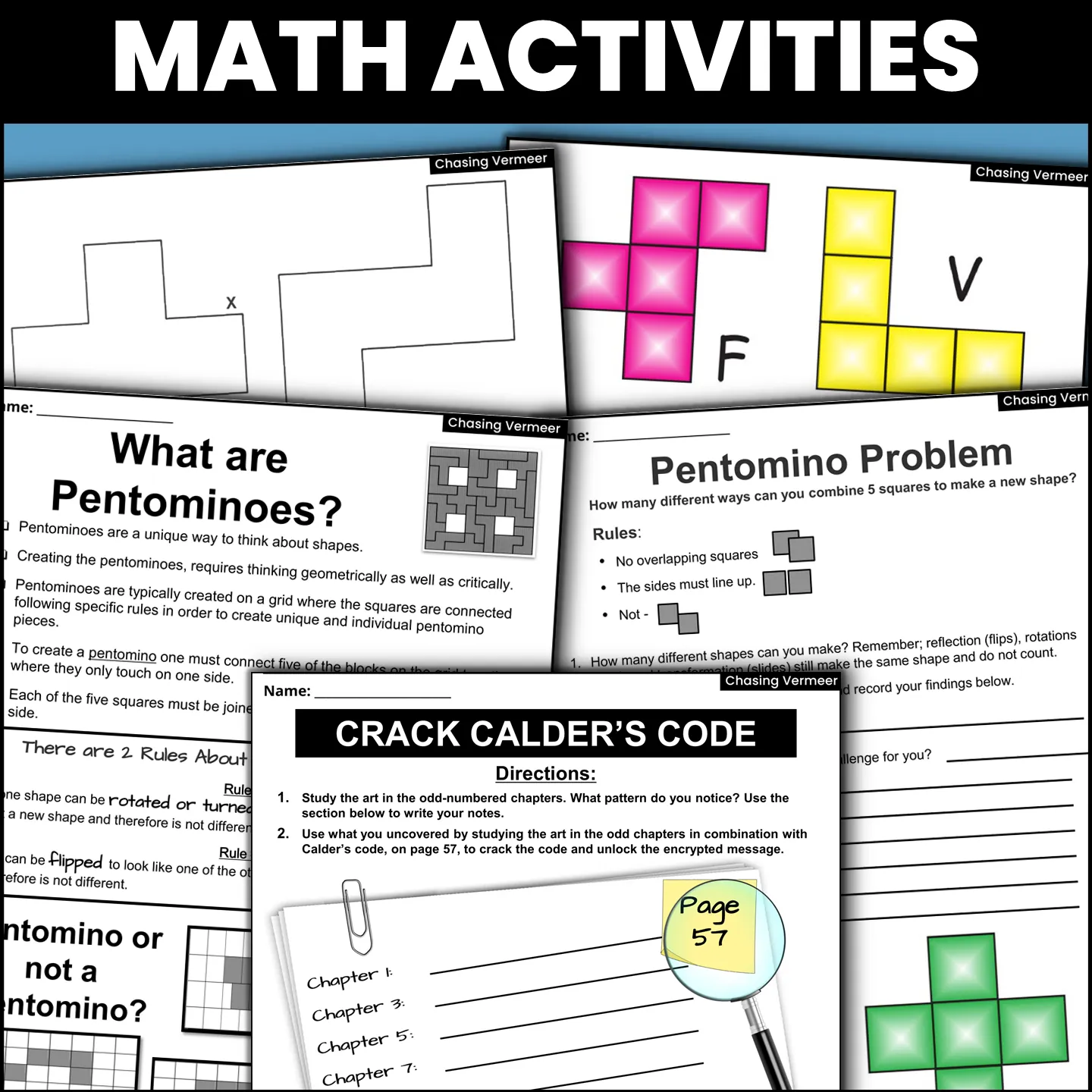
Crack Calder’s Code: Uncover Calder’s code by studying the art and patterns in the odd numbered chapters of Chasing Vermeer. (Includes Answer Key)
What Are Pentominoes?: An explanation of what pentominoes are, a guided pentomino challenge, pentominoes that can be cut out, on cardstock, and used as manipulatives.
Art
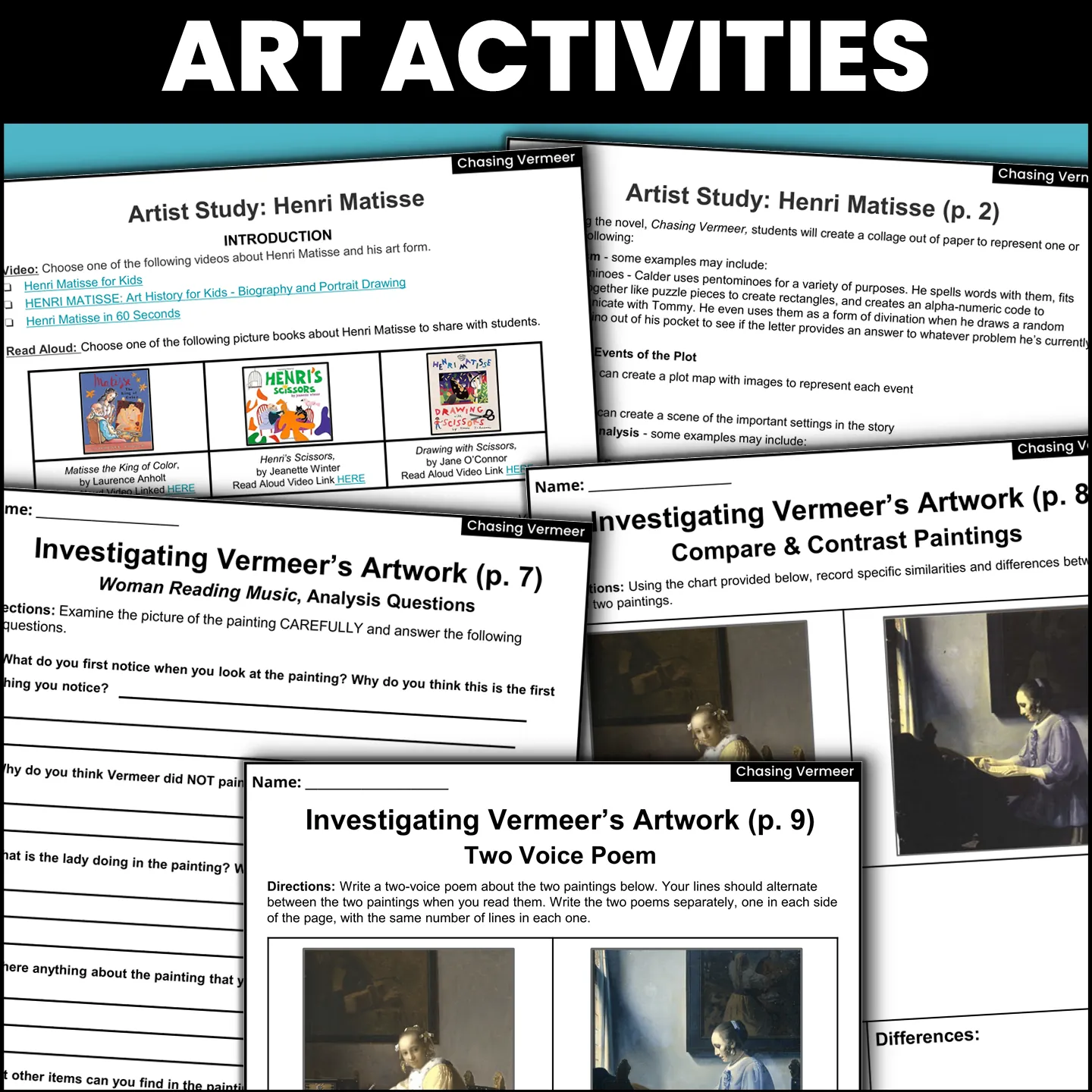
Investigating Vermeer’s Artwork: Using Vermeer’s art, students will analyze, compare and contrast, and use art to inspire poetry.
Artist Study, Henri Matisse: Students will watch a video introducing the artist and his artistic style. Picture books are suggested for a read aloud to get to know more about the artist and their work. For the activity component, students will create a Matisse-inspired paper collage to represent an idea from the novel, Chasing Vermeer.
Math & Art Combined
Pixel Paintings: Students will synthesize what they have learned about Vermeer, his artistic style, and artwork in combination with their knowledge about pentominoes, to create a pixelated replica of one of Vermeer's famous paintings.
Related resources
More resources teachers may find useful
24 related resources were found using this product's title, contributor, categories and tags.


In the classroom
Teaching tips & learning objectives

Learning objectives
Identify a visual pattern across the illustrations of a novel and use a key from the text to decode a hidden message
Work out how many distinct pentominoes exist, treating rotations, reflections and slides of the same shape as one shape
Analyse a painting from close observation, answering what is noticed first, what the subject is doing, and what is unusual about it

Teaching tips
The packet's own advice is to spread the activities across a week or more and to pick the ones that fit; the maths and art strands stand alone until the closing pixel painting, which needs both
Project the novel's illustrations under a document camera as the teacher tips page suggests — the code-cracking activity depends on students seeing the art clearly enough to spot the pentominoes and frogs
Print the three painting handouts in colour, laminate a set for shared use, and give students black-and-white copies to write on, which is exactly the workflow the packet recommends

Skills covered
Pattern recognition and decoding — students find the repeated pentomino-and-frog motif across the odd-numbered chapters and convert it to letters using the code printed on page 57 of the novel.
Geometric reasoning about congruence — the pentomino challenge asks how many distinct shapes five joined squares make, with rotations, reflections and slides ruled out as duplicates.
Close visual analysis — each painting comes with its own question set asking what is noticed first, what the subject is doing and wearing, and what is unusual.
Good to know
Questions teachers ask about this resource
How does cracking Calder's code actually work?
Through the novel's illustrations. Each odd-numbered chapter hides one pentomino and between one and three frogs; the pentomino gives the letter shape and the frogs give the number, so a V pentomino with two frogs reads V:2, which maps to T on the code printed on page 57 of the book. Chapter three's V pentomino with one frog gives V:1 and the letter H.
Which paintings are used for the artwork analysis?
Three, and one of them is deliberately not a Vermeer. A Lady Writing (1665-1666) and The Geographer (1668-1669) each get their own analysis question set; Woman Reading Music by Henricus Anthonius van Meegeren (1935-1936) is the forgery used in the compare-and-contrast chart against a genuine Vermeer.
What is needed beyond the packet itself?
A copy of the novel, since the code activity depends on the illustrations and on the code table printed on page 57; a colour printer for the three painting handouts; scissors and paper for the collage and the pentomino tiles; and internet access for the suggested Matisse videos and the four linked Vermeer research resources. Graph paper is supplied in three sizes.

No reviews yet
Downloaded this resource? Tell other teachers how it went.
Resource details
Concepts & topics
Core concepts
 Core concepts
Pentominoes
Art analysis
Novel study
STEAM
Symmetry and transformation
 Topics
Explore more
Categories this resource belongs to
Explore related searches
More to explore
You may also like