Cold War Overview: Graphic Organizer


- Grades
- Grades 7–11, Middle School, High School
- File type
- Preparation
- Print ready


- Subject
- Social Studies, History, History: Europe, History: World
- Topic
- Cold War, Stalin
- Resource types
- Teacher Tools, Graphic Organizers
- Preparation
- Print ready
About this resource
What's inside this resource
The Cold War was a time of tension and rivalry between the United States and the Soviet Union that lasted from the end of World War II in 1945 until 1991. The two superpowers never fought a direct war against each other, but they were involved in many proxy wars, such as the Korean War and the Vietnam War. The Cold War started because the United States and the Soviet Union had different ideas about how countries should be run. The United States believed in democracy, where the people elect their leaders and have individual freedoms. The Soviet Union believed in communism, where the government controls everything and everyone is equal. The United States and the Soviet Union both wanted to spread their ideas and influence around the world, which led to a lot of tension between them. They also built up huge military forces, including nuclear weapons, to try to scare each other into backing down. The most dangerous time during the Cold War was in 1962, during the Cuban Missile Crisis. The Soviet Union had secretly put nuclear missiles in Cuba, which is very close to the United States. The United States demanded that the missiles be removed, and there was a tense standoff between the two superpowers. Eventually, the Soviet Union agreed to remove the missiles, and the crisis was over. The Cold War ended in 1991 when the Soviet Union collapsed. The United States emerged as the world's only superpower, and there was a lot of hope for peace and cooperation between countries. While there are still tensions between countries today, the world is much more peaceful than it was during the Cold War.
Teacher-prepared notes show students what is important and how ideas relate, and offer a model for how students should take notes themselves (Marzano et al., 2001). These teacher-created notes will help your students grasp the major events of the Cold War era. These notes work well as a supplement to class readings!
Thumbnail and product clipart credit: By Prince Padania and by Dandy Doodles
This product provides students with an easy-to-understand overview of the major issues, leaders, and events associated with the Cold War.
Related resources
More resources teachers may find useful
24 related resources were found using this product's title, contributor, categories and tags.


In the classroom
Teaching tips & learning objectives

Learning objectives
- Describe the origins of the Cold War after the Second World War
- Contrast American and Soviet aims for postwar Europe
- Identify the American and Soviet leaders of the Cold War era and their terms

Teaching tips
- Everything is pre-filled, so this reads as a study guide or reference packet rather than something students complete - plan your own questions to go with it
- The leader tables work well as the basis for a timeline activity students build themselves
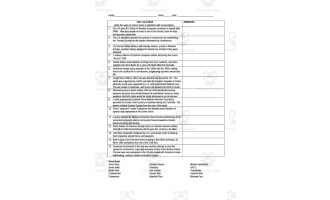
- The events table is written in summary paragraphs, so it suits a jigsaw reading in small groups

Skills covered
- Cold War content knowledge
- Comparing perspectives
- Reading a historical timeline
Good to know
Questions teachers ask about this resource
Do students fill anything in?
No. Every section is already written out; the only blanks are the name and date lines at the top of each page.
What period and events does it cover?
From the 1945 Yalta Conference through to the fall of the Berlin Wall in 1989.
Does it cover both sides?
Yes - it sets US aims beside Soviet aims and gives a leader table for each country.
Is there an answer key?
No, and none applies - the packet contains no questions.

No reviews yet
Downloaded this resource? Tell other teachers how it went.
Resource details
Concepts & topics
Core concepts
 Core concepts
- The Cold War as a prolonged nonmilitary superpower conflict
- Ideological and economic differences as causes
- Containment through the Marshall Plan and NATO
- Key flashpoints: Berlin, Korea, Cuba, Vietnam, arms control
 Topics
Explore more
Categories this resource belongs to
Explore related searches
More to explore
You may also like