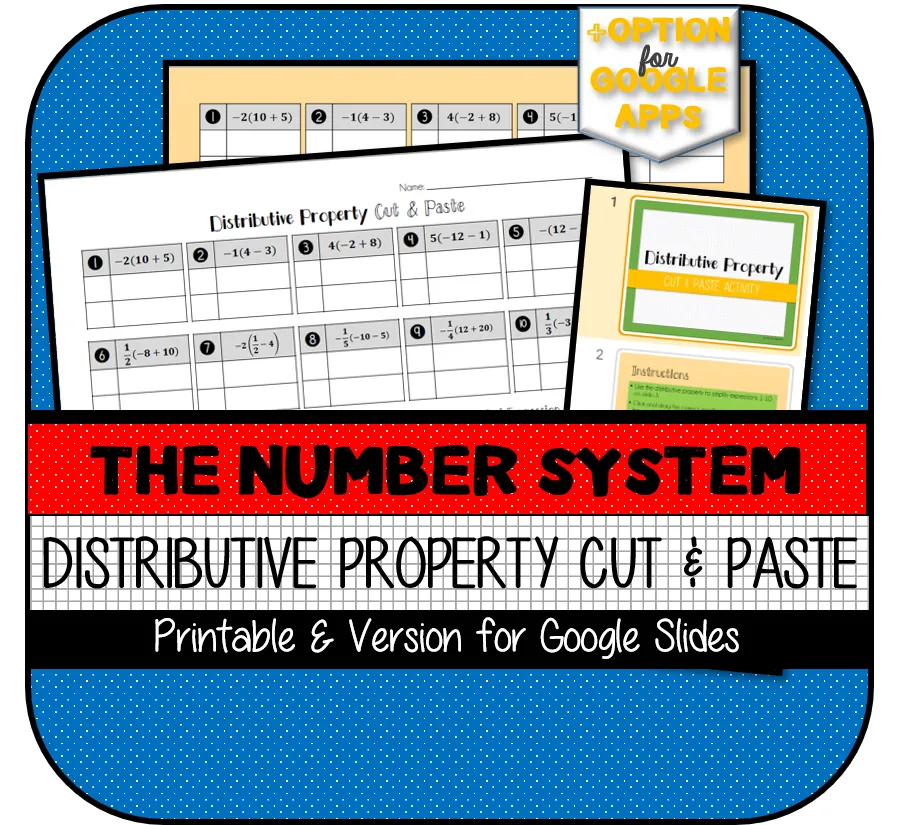
Distributive Property CUT & PASTE Activity
- Grades
- Grade 7, Middle School
- File type
- Preparation
- Print ready


- Subject
- Math, Numbers, Algebra
- Topic
- Distributive Property, Hands-on Learning
- Resource types
- Activities, Worksheets
- Preparation
- Print ready
About this resource
What's inside this resource
The Distributive Property CUT & PASTE Activity: An Engaging Tool for 7th-grade Mathematics
This practical teaching resource focuses on enhancing comprehension of the distributive property, primarily featured in CCSS.MATH.CONTENT.7.NS.A.2.A. It revolves around understanding how multiplication extends from fractions to rational numbers.
Uniquely Interactive Design
- Reinforces rules about operations, highlighted through results like (-1)(-1) = 1 and multiplication of signed numbers.
- Encourages interpretative analysis by applying products of rational numbers into real-world contexts.
- Inclusive design provides printable and Google Slides versions – apt for traditional classrooms or homeschool setups alike.
The Distributive Property CUT & PASTE Activity is extensively useful in various learning scenarios – as a guide for structured lessons, small group activities, or even as individual homework assignments.
A Comprehensive Resource Paired with Detailed Solutions
An inclusive answer key allows teachers to evaluate student work confidently and ensures students’ adequate comprehension of the given problems. Constructed according to 7th-grade concepts this activity also proves beneficial when revising concepts with senior graders or challenging advanced learners on lower grade levels thanks to its adaptable nature.
The ready-to-use PDF format ensures effortless integration into any lesson plan - making it an enriching addition whether it serves traditional classroom instruction or homeschool curriculums alike.
Related resources
More resources teachers may find useful
24 related resources were found using this product's title, contributor, categories and tags.


In the classroom
Teaching tips & learning objectives

Learning objectives
Apply the distributive property when the multiplier is negative, as in −2(10 + 5) and 5(−12 − 1)
Read a bare minus sign in front of a bracket as multiplication by −1, as in −(12 − 7)
Distribute a fraction across a sum or difference, as in −¼(12 + 20) and ⅓(−3 + 15)

Teaching tips
Each problem takes two cards, so twenty pieces are cut for ten problems; sorting them into the two banks before gluing saves a lot of confusion
The distractors are deliberately close — −4 + 5, −4 + 3, −1 + 5 and −1 + 8 all sit in the same bank — so a dropped sign lands on a plausible-looking card rather than an obvious one
Items 6 to 10 all put a fraction outside the bracket; hold them back for a second round if fraction multipliers are being introduced after the integer work

Skills covered
Distributive property with integers — students expand expressions such as −2(10 + 5), 4(−2 + 8) and 5(−12 − 1) into two-term form.
Distributive property with fractional multipliers — the second half of the sheet uses ½, −⅕, −¼ and ⅓ outside the bracket, so each term is multiplied by a fraction.
Sign rules for multiplication — negative multipliers and negative terms combine throughout, including a bare minus sign standing in for −1 in −(12 − 7).
Good to know
Questions teachers ask about this resource
How many cards does each problem take?
Two. Every expression is matched with a simplified form from the A-to-J bank and an evaluated total from the K-to-T bank, so item 1, −2(10 + 5), takes D for −20 − 10 and Q for −30.
How close together are the answer choices?
Very. The simplified bank holds −4 + 5, −4 + 3, −1 + 5, −1 + 8 and −3 − 5 side by side, and the evaluated bank holds −8, −5, −1, 1, 3 and 4, so a dropped sign or an unmultiplied second term produces something that still looks like an answer.
Do all ten expressions use whole numbers?
The first five do. Items 6 to 10 place a fraction outside the bracket — ½(−8 + 10), −⅕(−10 − 5), −¼(12 + 20) and ⅓(−3 + 15) — so the second half asks for fraction multiplication on top of the sign work.

No reviews yet
Downloaded this resource? Tell other teachers how it went.
Resource details
Concepts & topics
Core concepts
 Core concepts
Distributive property
Rational numbers
Integer operations
Simplifying expressions
 Topics
Explore more
Categories this resource belongs to
Explore related searches
More to explore
You may also like