Facts About the White House for Kids: Read, Match and Color
Students in grades 3–4 use a White House fact file to match numbers, test facts against fibs and name four people from its history, then color the building on a page of its own.


- Grades
- Grades 3–5, Elementary
- Pages
- 4
- File type
- Answer key
- Included


- Subject
- Social Studies, ELA, History, History: USA, Reading, Reading Comprehension
- Topic
- White House, White House activities
- Resource types
- Worksheets & Printables, Worksheets
- Answer key
- Included
About this resource
What's inside this resource
The President’s home and office at 1600 Pennsylvania Avenue is the subject of a three-part fact file for grades 3–4. It covers the Oval Office in the West Wing, George Washington choosing the place without ever living there, the plans drawn by Irish-born architect James Hoban, John Adams moving in during 1800, the 1814 fire set by British soldiers and Theodore Roosevelt making the name official in 1901. A last section counts 132 rooms, 35 bathrooms and 28 fireplaces on 6 levels.
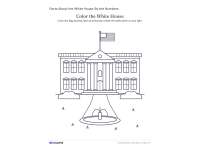
Students match six clues to an eight-number bank with two extras, mark four statements as fact or fib, match four first-person clues to Washington, Adams, Hoban and Roosevelt, and write a question they would ask the President. A full-page outline of the White House, with its columns, flag, bushes and fountain, follows for coloring.
Every fib is corrected in the answers, and the two extra numbers are explained. A teacher tip adds 412 doors, 147 windows, 8 staircases and 3 elevators for a clue-writing follow-up, and two talk-about-it questions close the set.
Related resources
More resources teachers may find useful
24 related resources were found using this product's title, contributor, categories and tags.



In the classroom
Teaching tips & learning objectives

Learning objectives
- Match numbers from a text, such as 1600 and 1814, to the facts they describe.
- Decide whether a statement about the White House is a fact or a fib, using the fact file.
- Identify George Washington, John Adams, James Hoban and Theodore Roosevelt from first-person clues.

Teaching tips
- Point out that the number bank has two extra numbers, so students can cross off each one as they use it.
- Have students underline each year in the How it was built section before part A; three of the bank numbers are years from that section.
- After part A, try the follow-up from the teacher tip: students write a clue for one of the tip’s added numbers, such as 412 doors, and trade with a partner.

Skills covered
- Locating number facts — students search the fact file for the address, two key years and the counts of rooms, bathrooms and fireplaces.
- Fact versus fiction — students test four statements against the text, including whether Washington lived there.
- Inference from clues — students match first-person quotes to four people from the building’s history.
Good to know
Questions teachers ask about this resource
Why are 6 and 1901 in the number bank if no clue uses them?
They are the two extra numbers. In the fact file, 1901 is the year Theodore Roosevelt made the name official, which returns in the Who am I? clues, and 6 is the number of levels, which the last fact-or-fib statement checks.
How can students go beyond the six numbers in part A?
The teacher tip lists more White House numbers: 412 doors, 147 windows, 8 staircases and 3 elevators. Students write their own clue for one of them and trade with a partner to solve.
What does the coloring page show?
The front of the White House, with its columns, two rows of windows, a flag on the roof, bushes, a path and a fountain on the lawn. Students color the flag, bushes, lawn and fountain and keep the walls white or very light.

No reviews yet
Downloaded this resource? Tell other teachers how it went.
Resource details
Concepts & topics
Core concepts
 Core concepts
- White House
- American symbols
- The President
- U.S. history
 Topics
Explore more
Categories this resource belongs to
Explore related searches
More to explore
You may also like