Four Types of Sentences Interactive Notebook Templates and Posters
- Grades
- Grades 3–6, Elementary, Middle School
- Pages
- 58
- File type
- Preparation
- Print ready


- Subject
- ELA, Grammar
- Topic
- Types of sentences, Kinds of sentences
- Resource types
- Templates, Teacher Tools
- Preparation
- Print ready
- Standards
- CCSS.L.3.1 CCSS.L.4.1
Product description
From the author
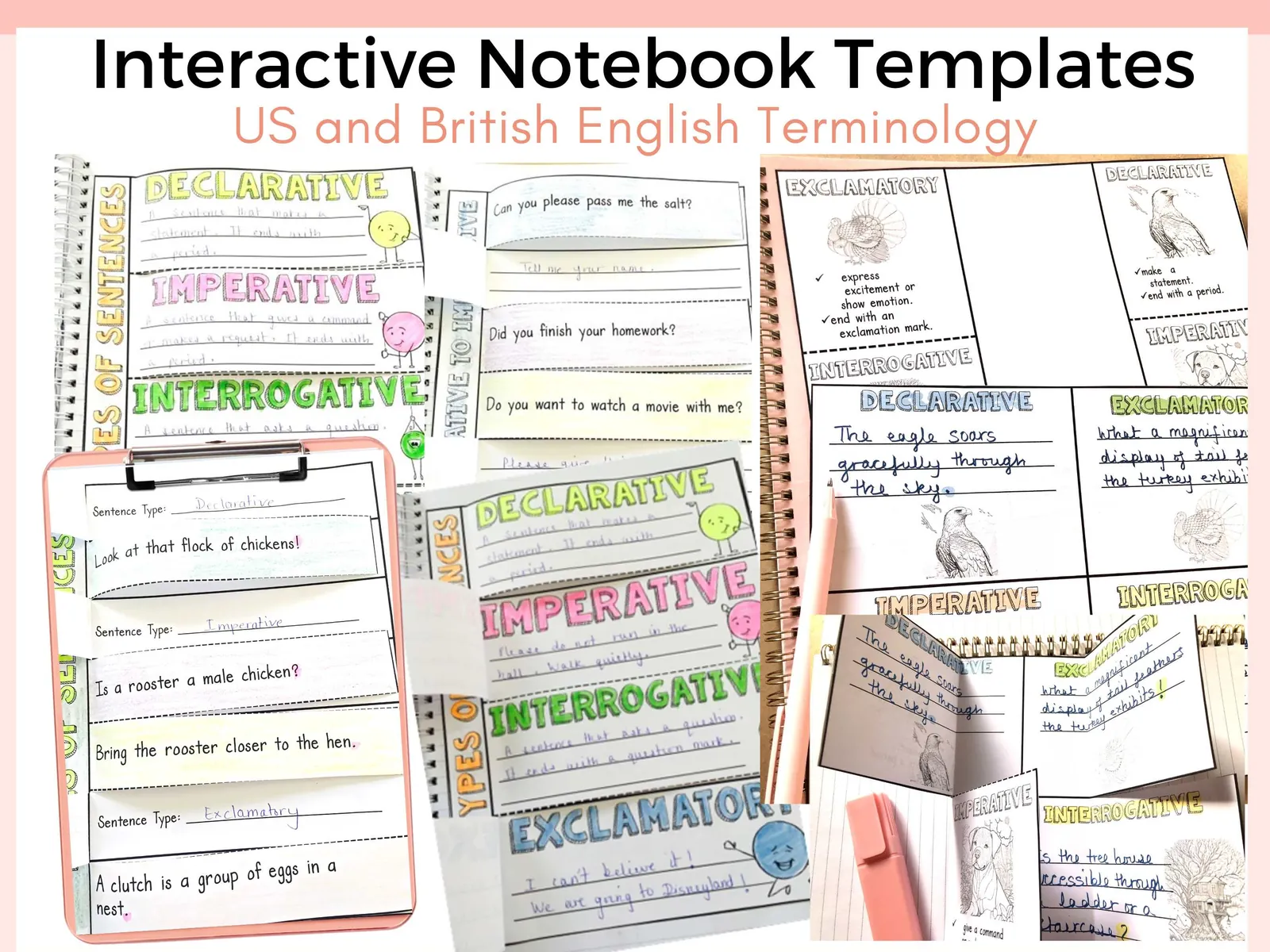
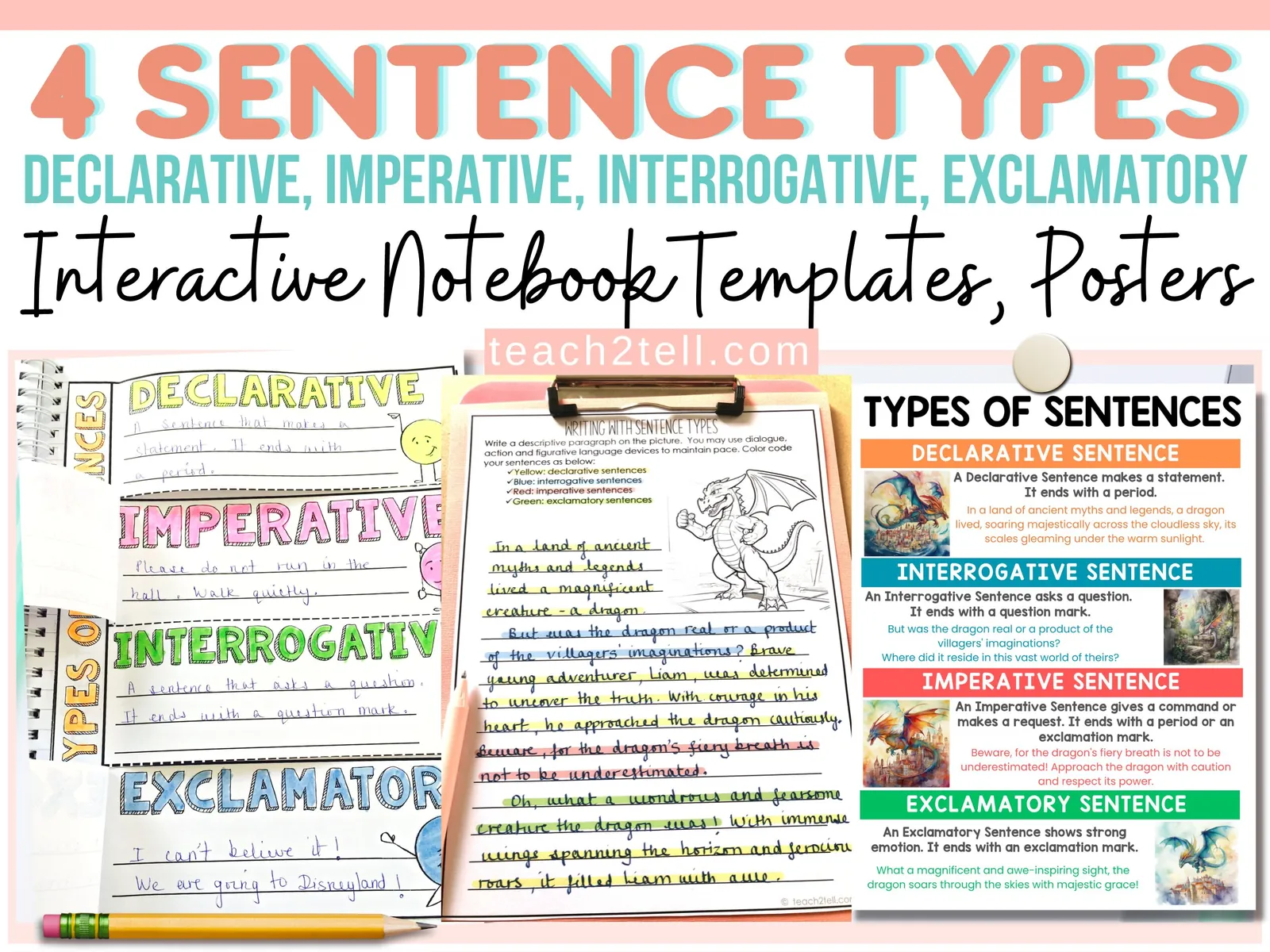
Enhance your students' learning with these captivating notebook templates and educational posters. These interactive resources engage students, making their learning process enjoyable and effective.
Explore the nuances of declarative, imperative, interrogative, and exclamatory sentences with practical exercises.
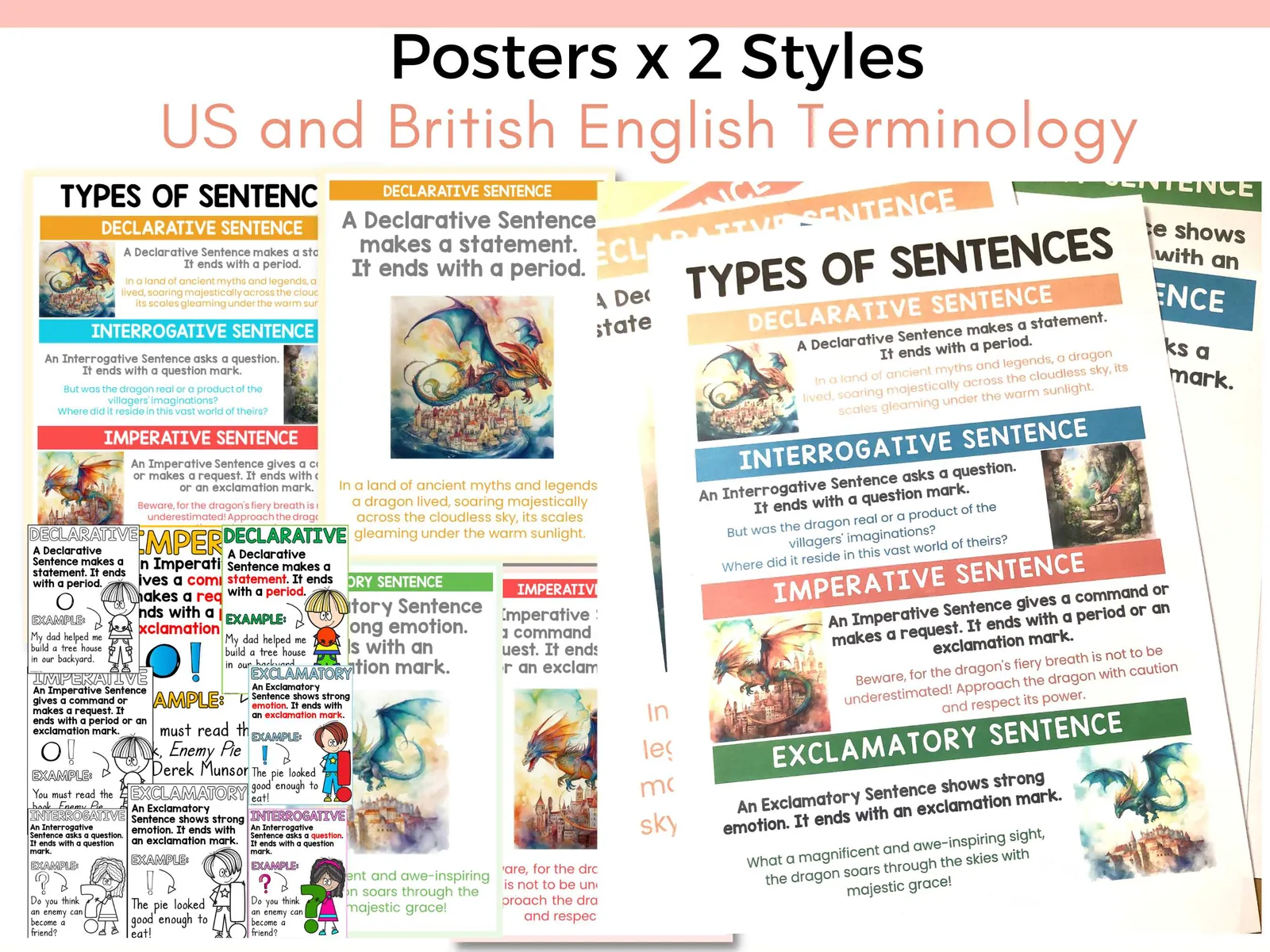
The vibrant and informative posters reinforce essential aspects of each sentence type, ensuring a deeper understanding.
Available in both American and British English, catering to different spelling and terminology preferences.
Contents:
1 Interactive Notebook Template in PDF format (American English)
1 Interactive Notebook Template in PDF format (British English)
8 Dual-style Posters (color and black & white) featuring explanations and examples for the four sentence types
8 Additional Color Posters with definitions and examples
Poster dimensions are 8.5x11 inches and A4, suitable for diverse settings.
Overview of Notebook Templates
Notebook Templates 1 & 2: Include a cover sheet for defining the four sentence types and a response sheet for writing examples. Two variations are available.
Notebook Templates 3 & 4: The cover sheet provides definitions, and the response sheet is for writing examples. Two variations are available.
Notebook Template 5: Features visuals on the cover sheet, with the response sheet designed for writing example sentences.
Notebook Template 6: Interrogative sentences are presented on the cover sheet, with a response sheet for writing imperative sentences.
Notebook Template 7: Declarative sentences are on the cover sheet, and the response sheet is for writing interrogative sentences.
Notebook Template 8: Displays all four sentence types on the cover sheet, with a response sheet for sentence type identification.
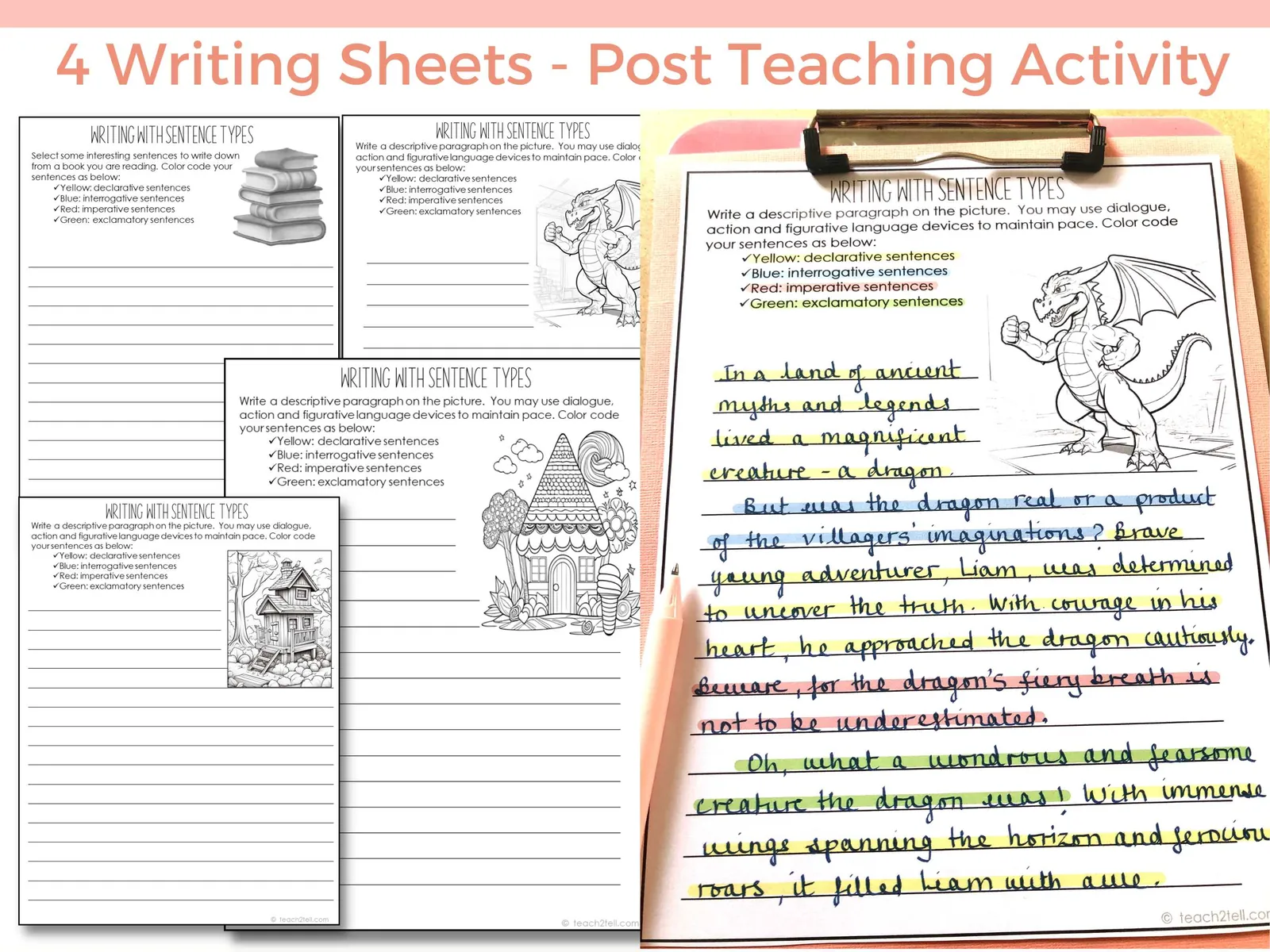
Templates 9-12: These are designed for writing descriptive paragraphs based on picture prompts, using the four sentence types, with color coding for sentence identification.
Related Resources
Related resources
More resources teachers may find useful
24 related resources were found using this product's title, contributor, categories and tags.


In the classroom
Teaching tips & learning objectives

Learning objectives
Define four sentence purposes
Write and identify examples of each sentence type

Teaching tips
Assemble the four flaps before learners add definitions, examples, and their color-coded reflection.

Skills covered
Four types of sentences — Define four sentence purposes
Interactive notebook reflection — Write and identify examples of each sentence type

No reviews yet
Downloaded this resource? Tell other teachers how it went.
Curriculum
Standards, concepts & topics
Standards
 Standards
- CCSS.L.3.1 — Demonstrate command of the conventions of standard English grammar and usage when writing or speaking. a. Explain the function of nouns, pronouns, verbs, adjectives, and adverbs in general and their functions in particular sentences. b. Form and use regular and irregular plural nouns. c. Use abstract nouns (e.g., childhood). d. Form and use regular and irregular verbs. e. Form and use the simple (e.g., I walked; I walk; I will walk) verb tenses. f. Ensure subject-verb and pronoun-antecedent agreement.* g. Form and use comparative and superlative adjectives and adverbs, and choose between them depending on what is to be modified. h. Use coordinating and subordinating conjunctions. i. Produce simple, compound, and complex sentences.
- CCSS.L.4.1 — Demonstrate command of the conventions of standard English grammar and usage when writing or speaking. a. Use relative pronouns (who, whose, whom, which, that) and relative adverbs (where, when, why). b. Form and use the progressive (e.g., I was walking; I am walking; I will be walking) verb tenses. c. Use modal auxiliaries (e.g., can, may, must) to convey various conditions. d. Order adjectives within sentences according to conventional patterns (e.g., a small red bag rather than a red small bag). e. Form and use prepositional phrases. f. Produce complete sentences, recognizing and correcting inappropriate fragments and run-ons.* g. Correctly use frequently confused words (e.g., to, too, two; there, their).*
Core concepts
 Core concepts
Four types of sentences
Interactive notebook reflection
 Topics
Explore more
Categories this resource belongs to
Explore related searches
More to explore
You may also like