24 related resources

God Created Bugs and Insects Activity Pack
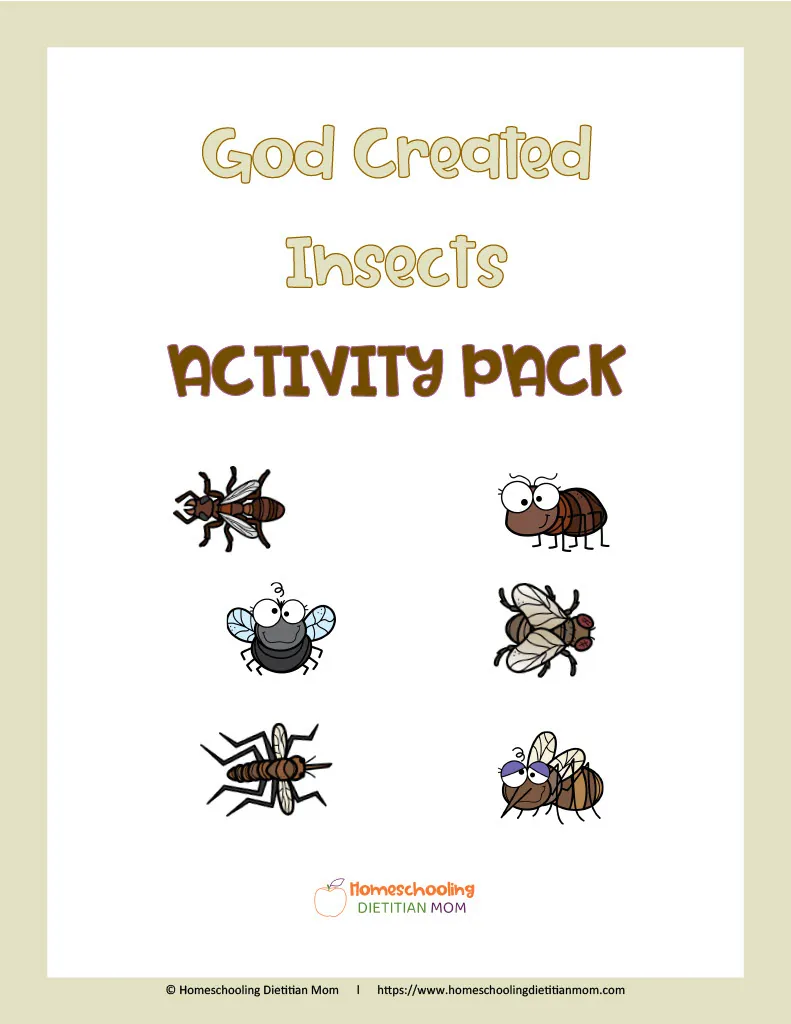
Ants, flies and mosquitoes each get a colouring page, a body-part labelling diagram and a life-cycle ordering task, joined by Spanish insect words, five habitat drawing prompts, Genesis Day Six writing pages and a ten-page key section.
Grades
Grades 1–3, Not Grade Specific, Elementary
File type
PDF
Preparation
Print ready

Updated May 23, 2023

Subject
Life Studies, Religion, Science, Life Sciences, Insects
Topic
bugs and insects, science education
Resource types
Workbooks, Worksheets & Printables
Preparation
Print ready

About this resource

What's inside this resource

God Created Bugs and Insects Activity Pack
The God Created Bugs and Insects Activity Pack is an educational resource par excellence, presenting an exceptional blend of science and Bible lessons through its 45 pages of enriching content. This pack takes students on a journey into the intriguing world of bugs and insects from a refreshing biblical context.
This versatile resource is designed to cater to different grade levels, presenting a medley of exciting activities alongside substantial scientific studies. The pack comprises:

  • Lifecycle studies,
  • Coloring tasks,
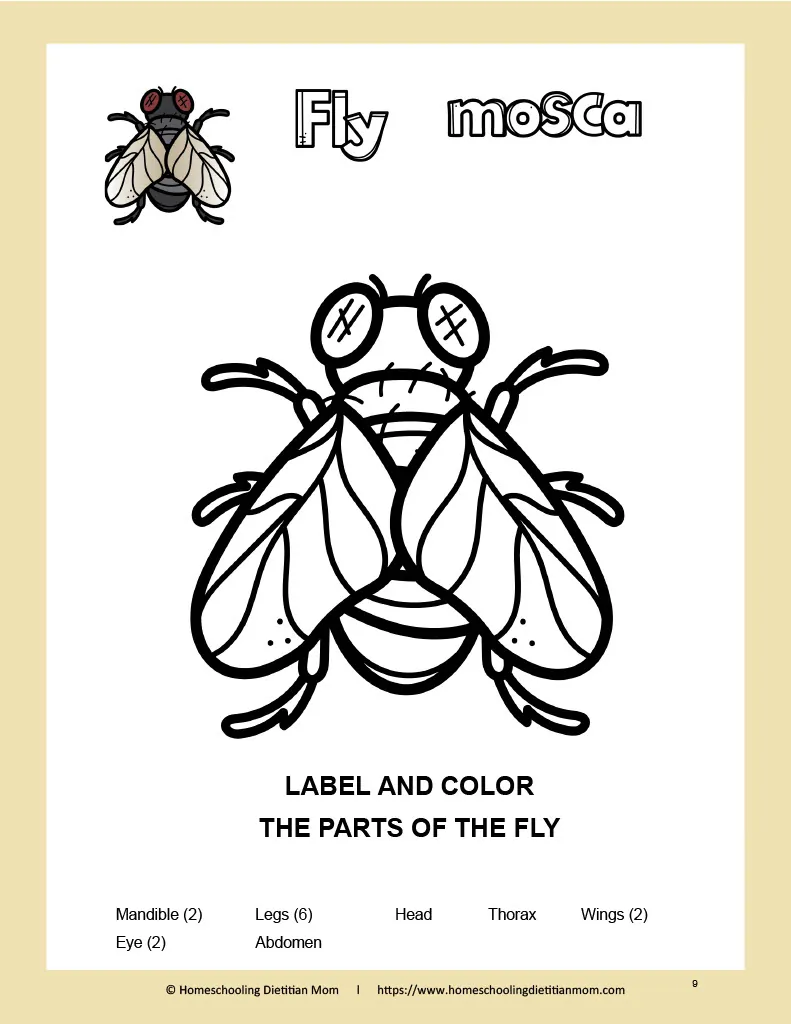
  • Labeling assignments on ants, mosquitoes, and flies.

To keep engagement levels high, there are two contrasting depictions for each insect: one showcasing scientific accuracy; the other triggering imagination with its whimsical charm.

Bilingual Learning & Creative Exercises

In addition to vividly understanding the life-cycles of various insects, this science pack encourages bilingual (Spanish/English) learning. What’s more? There are engaging drawing tasks where students can illustrate insect habitats while improving their sentence structuring proficiency.

Bible Incorporation in Learning Activities

The scriptures are made meaningful by merging them with everyday subjects. Assignments include writing exercises around Genesis chapters along with thought-provoking questions such as: Were insects part of Noah’s Ark's journey?

Educational Objectives Embedded

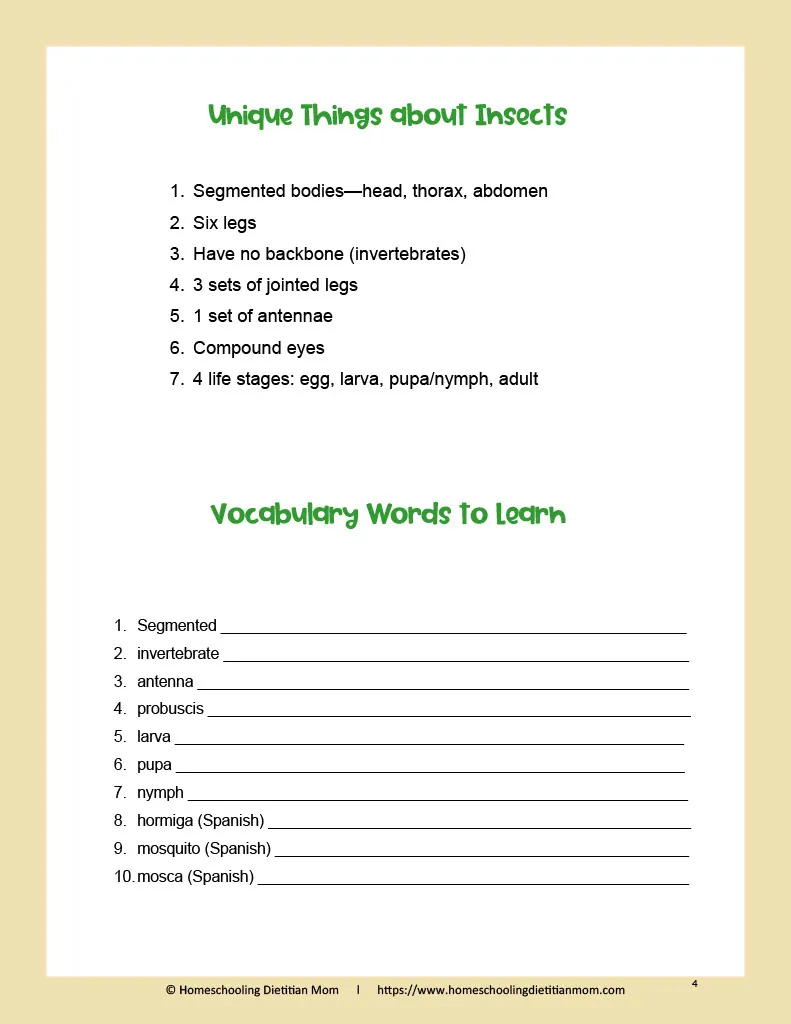
This high-quality activity pack encourages students to identify distinctive characteristics – six legs; four life stages; segmented bodies; compound eyes - of various insects while simultaneously learning important verses from the Bible.
There's plenty opportunities for critical thinking too: whether bugs needed an ark for survival – and much more!

Seasonal Activities with Bible Verses

Apart from teaching about insects, the pack includes activities based on seasons. Each season-related activity is cleverly linked to a respective Bible verse, helping children understand changes in ecosystems along with biblical contexts.

Bilingual Language Learning:

The pack boosts vocabulary as students learn new Spanish words associated with bugs and insects. Grades are not a barrier! Elementary learners can form sentences; intermediate ones write paragraphs which writing essays cater to advanced learning levels.

In summation, the God Created Bugs and Insects Activity Pack is simplistic yet power-packed approach wherein biblical lessons meet scientific knowledge in perfect concordance. Ideal for classroom or homeschooling scenarios.
It comes as a PDF file ensuring accessibility across different platforms endorsing smooth learning.

Suitable predominately for grades 1 through 3 but its utility extends beyond specific grades to nourishes the universal thirst for knowledge.

In the classroom

Teaching tips & learning objectives

Learning objectives

  • Name at least three insects and describe two features that make an insect an insect - six legs, a segmented head, thorax and abdomen, compound eyes or four life stages

  • Label the mandibles, legs, head, thorax, wings, eyes and abdomen on an ant, a fly and a mosquito

  • Put the stages of an ant, fly and mosquito life cycle into the correct order and recognise that all three pass through egg, larva, pupa and adult

  • Define the pack's science vocabulary - segmented, invertebrate, antenna, proboscis, larva, pupa, nymph - and match three Spanish insect names to their English equivalents

  • Write a short story about the insects a named habitat would hold, and copy out Genesis 1:24-25 from the creation account

Teaching tips

  • Work one insect straight through its three pages before starting the next; the ant, fly and mosquito sets use the identical layout, so the comparison between their life cycles is the point of doing all three

  • The colouring pages double as handwriting practice - each traces the insect's name in English and again in Spanish, so keep them for a session where writing is the goal rather than colouring

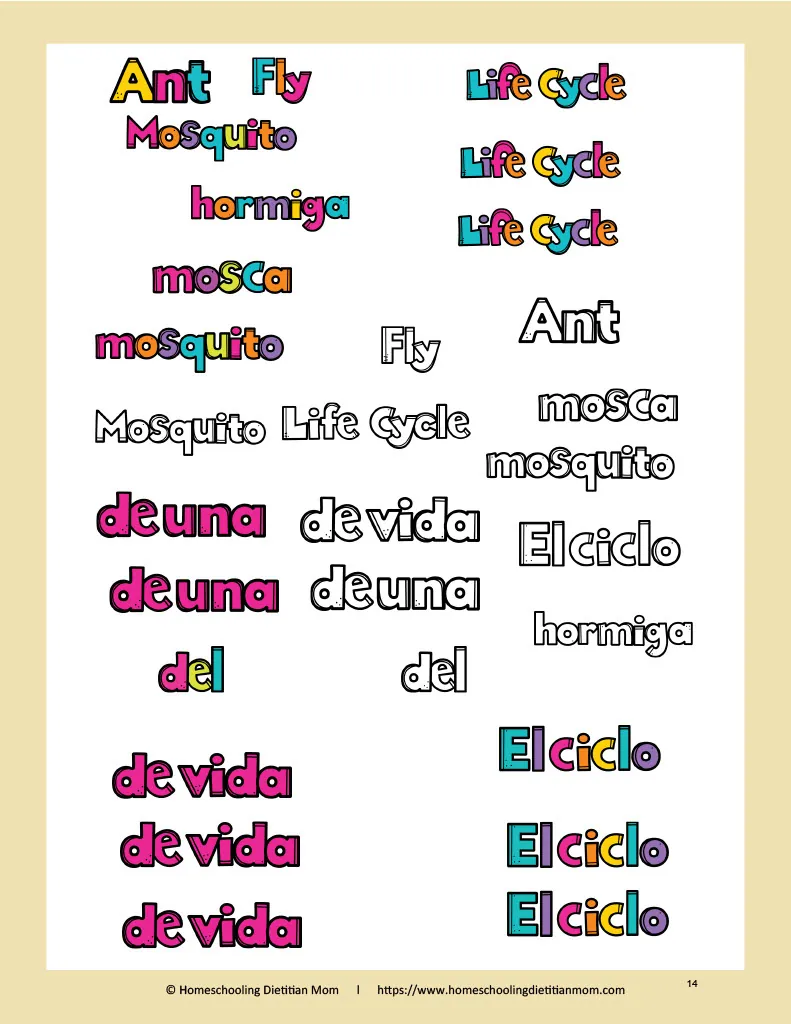
  • Cut the Spanish-English phrase strips before the lesson; the ordering page carries only the direction to put the words from the previous page in order

  • The five habitat pages work well spread across a week as morning work, since each is self-contained and needs nothing but the drawing and a few sentences

  • Genesis 1:24-25 is set for copying and one objective asks for it to be memorised, so introduce the verse early in the unit rather than at the end

  • The Spanish Génesis 1 page is a full-chapter reading text rather than a task, and suits a bilingual family or a Spanish-language read-aloud alongside the English pages

Skills covered

  • Insect anatomy labelling - children place mandible, legs, head, thorax, wings, eye and abdomen onto ant, fly and mosquito diagrams from a printed word list.

  • Life-cycle sequencing - each insect's stages are numbered into order, with the ant page also naming the worker, queen and male forms.

  • Science vocabulary - segmented, invertebrate, antenna, proboscis, larva, pupa and nymph are written out with definitions on the facts page.

  • English-Spanish word pairing - each colouring page traces the insect's name twice, once as Ant, Fly or Mosquito and once as hormiga, mosca or mosquito, and a cut-and-paste page reorders Spanish-English phrases.

  • Descriptive story writing - five habitat pages ask children to draw the insects of a forest, farm, desert or beach and then write a story about what they see.

  • Scripture copying and recall - Genesis 1:24-25 is written out in full and five seasonal bonus pages each carry a verse to copy.

Good to know

Questions teachers ask about this resource

How is Spanish used through the pack?

Three ways. Each colouring page traces the insect's name in English and again in Spanish - Ant and hormiga, Fly and mosca, Mosquito and mosquito. The vocabulary list adds those three Spanish words to its ten entries, a cut-and-paste page reorders Spanish-English phrases, and the bonus section carries the whole of Génesis 1 in the Reina-Valera 1960 translation.

What do the five habitat pages ask for?

A drawing and a story each time, with the setting changing: the insects you think live in the forest, on a farm, in the desert, in the desert during the day, and at the beach. Each page gives ruled lines under the drawing space, so the same task scales from a sentence to a paragraph.

How are the Bible pages connected to the insect content?

Through the sixth day of creation. Children draw what they think God did on day six, circle the day on a numbered wheel marked GOD and INSECTS, copy Genesis 1:24-25, and complete the sentence "God created insects on the sixth day" with different words removed each time. The Suggested Objectives page also poses an open question about whether insects were on the Ark.

No reviews yet

Downloaded this resource? Tell other teachers how it went.

Resource details

Concepts & topics

Core concepts

  • Insects

  • Life cycles

  • Insect anatomy

  • Habitats

  • Bible creation account

  • Spanish vocabulary

Explore more

Categories this resource belongs to

Explore related searches

More to explore

You may also like