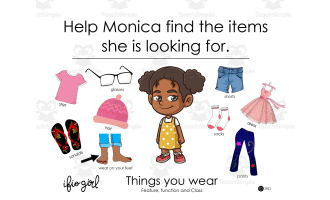
Things You Wear Sorting Activity

Special Resources, Special Education Needs (SEN), Speech Therapy, Life Skills, Math, Early Math, Science, Basic Science
Kindergarten, Preschool, Grade 1, 2


About This Product
Why we sort by FEATURE - FUNCTION - CLASS
Teaching children to sort or group items by feature, function, and classification is important for several reasons:
Cognitive development: Sorting and grouping require children to think critically and make connections between items based on their characteristics. This helps to develop their cognitive abilities and improve their problem-solving skills.
Organization: Sorting and grouping items based on their features, function, or classification can help children to organize information and make sense of their environment. This can improve their memory and make it easier for them to retrieve information later.
Language development: Sorting and grouping can also help to develop children's language skills by providing them with the vocabulary to describe different features, functions, and classifications. This can improve their ability to communicate effectively and express their ideas clearly.
Mathematical skills: Sorting and grouping can also help to develop children's mathematical skills, such as counting, categorizing, and comparing. This can lay the foundation for more complex mathematical concepts later on.
This activity involves sorting clothing items based on their features, functions, and classes - the items in this activity are commonly seen as "girl" clothes.
The learners will be presented with a collection of various clothing items such as shirts, pants, jackets, sweaters, and so on. The objective of the activity is to categorize these items based on their unique features, functions, and classes.
To begin the activity, the instructor will introduce the concept of feature, function, and class, providing examples and a brief description of each. The learners will then be given a set of clothing items and asked to sort them into categories based on FEATURE- describing something 'the shirt is red' 'things with zippers' FUNCTION - what it is used for 'wear a coat when it is cold' CLASS - a category 'all shirts' or 'all socks'
*For example, the learners could sort clothing items based on the feature of long sleeves, the function of keeping warm, or the class of pants.
Overall, teaching children to sort and group items by feature, function, and classification can provide them with a range of cognitive, organizational, language, and mathematical benefits that can support their development in various areas.
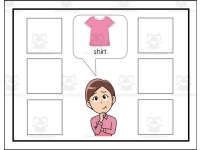
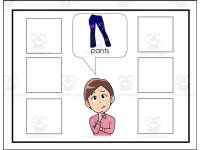
This activity is easy to create - Print and laminate all cards, cut out the individual sorting cards and velcro to the corresponding activity mat. You can hole punch the mats and put them in a binder for many years of teaching and learning.
Enjoy,
IFIO girl
I'll Figure It Out
What's Included
A PDF with 36 pages with 23 categories
shirt
pants
shoes
dress
shorts
boots
sandals
hat
socks
coat
gloves
wear when its cold
wear on your feet
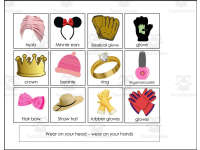
wear on your head
wear on your hands
glasses
clothing with zippers
clothing with strings
clothing with long sleeves
clothing with short sleeves
clothing that is red
clothing that is blue
wear when it is hot
Resource Tags
0 Reviews
Check out these other great products