Intro to Calculus Word Wall
- Grades
- High School
- Pages
- 40
- File type
- Preparation
- Print ready


- Subject
- Math
- Topic
- Calculus, Limits
- Resource types
- Posters
- Preparation
- Print ready
Product description
From the author
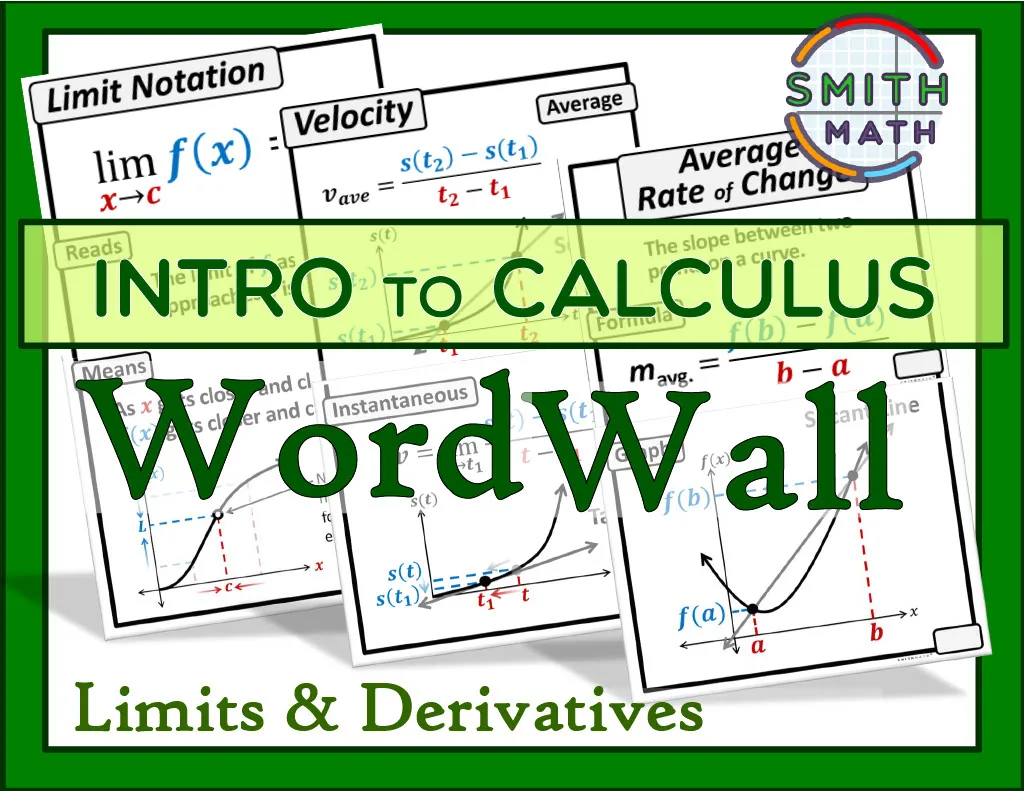
This is an Intro to Calculus Word Wall that includes limits and derivatives. Your pre-calculus/calculus students will find this word wall beneficial as it provides them with many skills that will be covered in your course. As a teacher, you will find it helpful to quickly reference topics on the wall that were covered last week (or last semester).
Each sheet features a title, a subtopic, and a sheet number. This will help you keep cards organized. The box for the sheet number is left blank on each sheet to give you the flexibility to rearrange sheets and number them however you like.
Some sheets will need to be combined because they are too big to fit on one sheet. An “incomplete” border on the sheet indicates topic extends to multiple pages.
For a long lasting resource, after printing, I suggest laminating each one of the pages. If wall space allows, post sheets as you cover them in class and leave them up throughout the year. If space is limited, print sheets half-size or replace sheets after completing a unit of study.
In addition to using them as posters, this resource may be used in math centers, or as guidance for individual work, or for group work.
The topics included are:
1. Limits & Derivatives
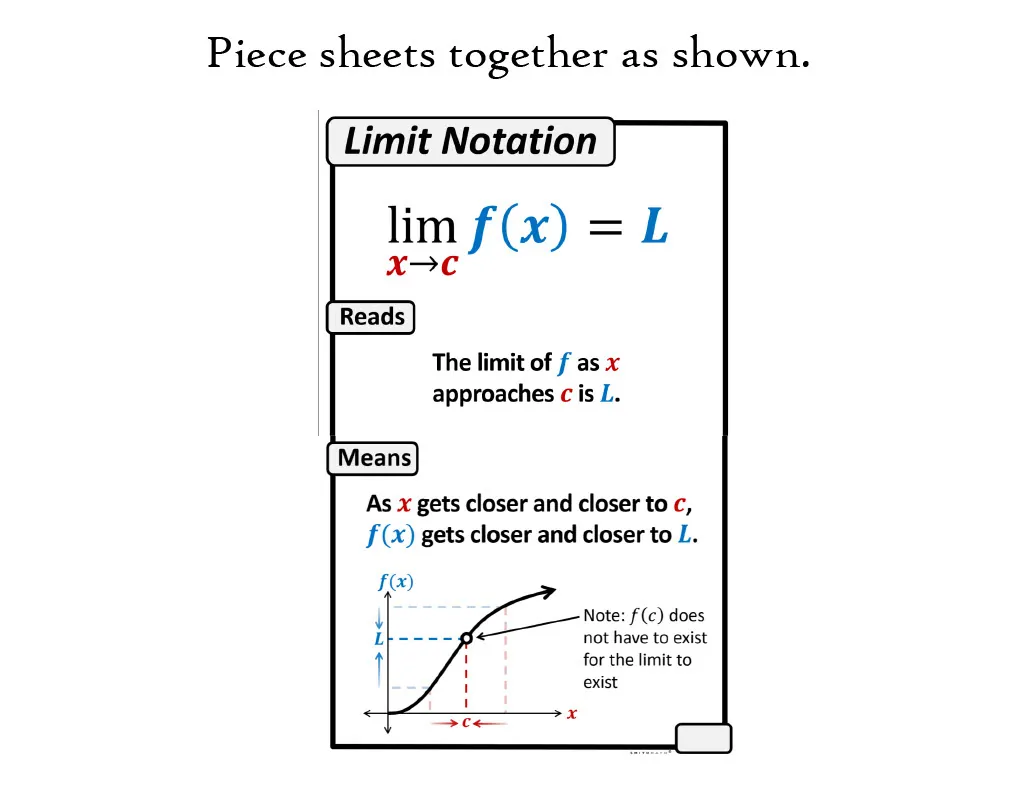
– Limit Notation
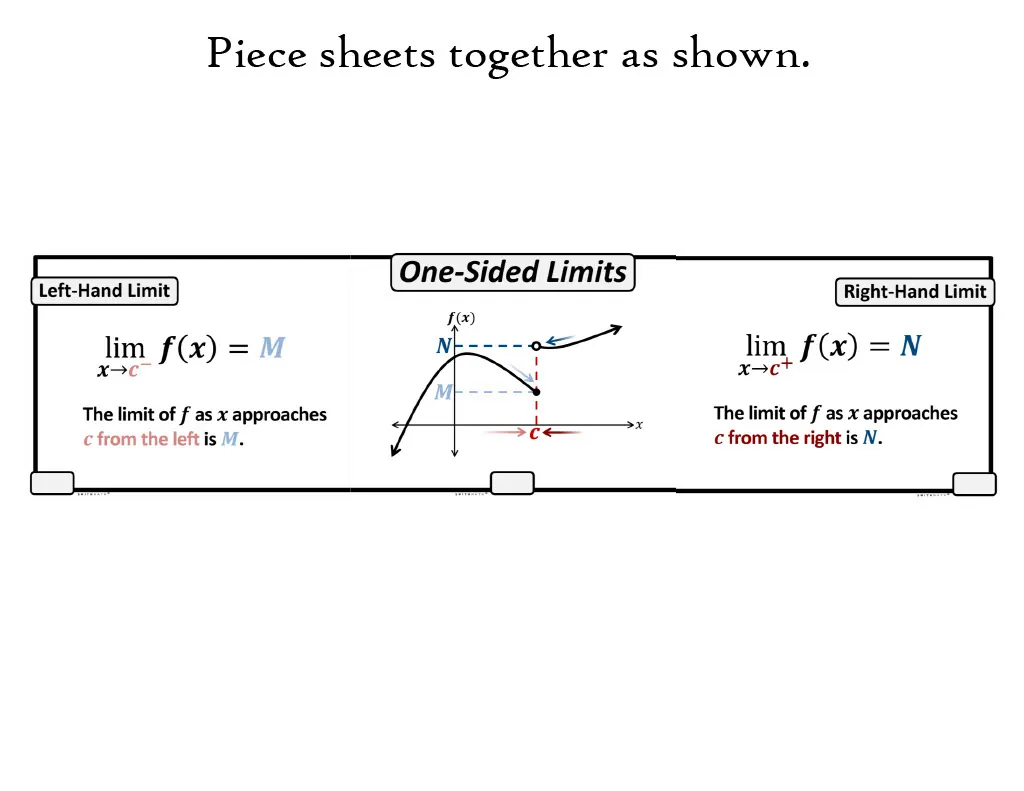
– One-Sided Limits: Left-Hand & Right-Hand Limits
– Average Rate of Change: Formula & Graph
– Instantaneous Rate of Change: Formula & Graph
– Derivative: Formula & Graph
– Properties of Limits:
• Sum Rule
• Difference Rule
• Product Rule
• Quotient Rule
• Constant Multiple Rule
• Power Rule
• Root Rule
– Finding Limits: Graphs & Tables
– Velocity: Average & Instantaneous
– Limits at Infinity: Graph & Table
– Infinite Limits: Graph & Table
Related resources
More resources teachers may find useful
24 related resources were found using this product's title, contributor, categories and tags.


In the classroom
Teaching tips & learning objectives

Learning objectives
Read limit notation aloud correctly and state what it asserts about f(x) as x approaches c
Distinguish left-hand from right-hand limits and explain why a two-sided limit fails when they disagree
Tell average rate of change from instantaneous rate of change by their formulas and by the secant and tangent lines that represent them

Teaching tips
Number the sheets after choosing your display order.
Use the limits-and-derivatives topics alongside the corresponding calculus lessons.
Direct students to a relevant numbered sheet when they need a reference during independent practice.

Skills covered
Notation reading - the limit notation sheet gives the symbol, the sentence that reads it aloud, and the meaning, so students can decode the notation from the wall during practice.
Distinguishing secant from tangent - paired sheets put the average rate of change beside its secant line and the instantaneous rate beside its tangent line, making the difference visual rather than verbal.
Limit law recall - the sum, difference, product, quotient, constant multiple, power and root rules sit together across three sheets as a permanent reference.
Good to know
Questions teachers ask about this resource
How do you know which sheets belong together?
By the border. An incomplete border around the edge of a sheet indicates it is meant to be combined with others, and the file interleaves pages reading "Piece sheets together as shown" before each multi-sheet topic. Limit notation, one-sided limits, the rate-of-change pairs and the limit properties all span more than one sheet.
Why is the sheet-number box empty?
Arrange the sheets to suit your wall, then number them in that order. Use those numbers to direct students to a relevant sheet during independent practice.
Which calculus topics does the set cover?
The set focuses on limits and derivatives: limit notation, one-sided limits, average and instantaneous rates of change, the derivative, limit properties, limits from graphs and tables, average and instantaneous velocity, limits at infinity and infinite limits.

No reviews yet
Downloaded this resource? Tell other teachers how it went.
Resource details
Concepts & topics
Core concepts
 Core concepts
Limits
Derivatives
Rate of change
Limit laws
Calculus notation
Topics
 Topics
Explore more
Categories this resource belongs to
Explore related searches
More to explore
You may also like