Introduction to the concept of limits - Worksheet


- Grades
- Grade 12, High School
- File type
- Preparation
- Print ready


- Subject
- Math, Calculus
- Topic
- limits, calculus
- Resource types
- Worksheets & Printables, Worksheets
- Preparation
- Print ready
About this resource
What's inside this resource
18 questions Worksheet, along with the answers, to be used in the lesson Introduction to the concept of limits.
Related resources
More resources teachers may find useful
24 related resources were found using this product's title, contributor, categories and tags.

In the classroom
Teaching tips & learning objectives

Learning objectives
Evaluate the limit of a rational function as x approaches a finite value using direct substitution
Factor and simplify a 0/0 indeterminate form to find a limit at a removable discontinuity
Determine when a limit is infinite or does not exist (DNE) from a rational function's behavior near the target value

Teaching tips
Group the problems by technique before assigning: problems 1-13 mostly require factor-and-cancel simplification, while problems 14-18 test recognizing infinite or nonexistent limits — useful for splitting a lesson in two.
Have students attempt direct substitution first on every problem, since several (e.g. problem 1) look like they will produce a 0/0 form until factored, which mirrors the worksheet's core skill.
Use the answer key's DNE and infinity notations as a discussion point — ask students to explain in words why a given limit is undefined rather than just checking the final numeral.

Skills covered
Direct substitution — students plug the target x-value directly into expressions that are already defined there, such as problem 12's (3x²−24x+36)/(x−6).
Factoring rational expressions to remove a removable discontinuity — problem 1's (x²−25)/(x−5) simplifies by canceling the (x−5) factor before substituting.
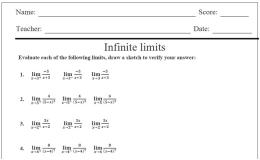
Recognizing infinite limits — problem 17's 1/(x−3)² grows without bound as the denominator approaches zero from both sides.
Good to know
Questions teachers ask about this resource
What technique do most of the problems require?
Most problems present a rational expression that evaluates to an indeterminate 0/0 form at the target x-value, so students must factor the numerator and denominator to cancel the common term before substituting.
How does the worksheet distinguish a limit that is infinite from one that does not exist?
1/(x−3)² as x→3 is marked infinite because both sides of the function grow without bound in the same direction, while 1/(x−3) as x→3 is marked DNE because the two sides diverge toward opposite signs.

No reviews yet
Downloaded this resource? Tell other teachers how it went.
Resource details
Concepts & topics
Core concepts
 Core concepts
limits
rational functions
factoring
removable discontinuity
 Topics
Explore more
Categories this resource belongs to
Explore related searches
More to explore
You may also like