search
user.png
vertical menu

Kepler's Laws of Planetary Motion - Earth and Space Lesson

Kepler's Laws of Planetary Motion - Earth and Space Lesson preview
Kepler's Laws of Planetary Motion - Earth and Space Lesson preview 2
Kepler's Laws of Planetary Motion - Earth and Space Lesson preview 3

Look Inside · 10 pages

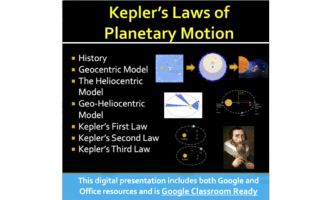
Kepler’s Laws of Planetary Motion opening slide lists history, three solar system models, and three laws
Opening slide and lesson topic overview
Lesson instructions explain filling student copy blanks, finding video links, and taking main-idea notes
Instructions for student notes and lesson videos
History slide introduces Galileo’s telescope observations and Jupiter’s moons as evidence against Earth-centered views
First history slide: Galileo’s observations
History slide covers Galileo’s support for a Sun-centered system, the Inquisition, and his house arrest
Second history slide: opposition to Galileo
Historical follow-up slide describes the Pope’s 1992 acknowledgment of the Church’s treatment of Galileo
Historical follow-up: Galileo and the Church
Geocentric model introduction defines Earth-centered motion and names Greek philosophers Ptolemy and Aristotle
First geocentric model slide: definition and origins
Geocentric model continuation explains celestial spheres for the Moon, Sun, planets, and stars around Earth
Second geocentric model slide: celestial spheres
Heliocentric model slide introduces Copernicus, his Sun-centered model, and his astronomy book published in 1543
Heliocentric model introduction: Copernicus
Copernicus follow-up slide describes objections to his theories and introduces Tycho Brahe’s alternative model
Transition from Copernicus to Tycho Brahe
Geo-heliocentric model slide explains Brahe’s Earth-centered system, with the other planets orbiting the Sun
Brahe’s combined solar system model explained
Attributes
Add To Collection
Add to collection Add to collection

About This Product

Kepler's Laws of Planetary Motion - Earth and Space Lesson

This delightful teaching resource is specifically designed for science educators instructing students from grades 10 to 12. Kepler's theories about the relationship between planets and their motion serve as the cornerstone of this lesson.

The highlights of this lesson include its comprehensive nature, promoting theory-based learning fused with interactive discussions.

The course plan unfolds as:

  • A brief history
  • Introduction to Geocentric and Heliocentric models
  • Deep dive into:
    • Kepler’s First Law
    • Kepler’s Second Law
    • Kepler’s Third Law

An adaptable structure makes it effective for whole group instruction or smaller groups. Student handouts, education videos, and auto-graded exit tickets round up this robust package.

Focusing on accessibility, material compatibility extends to Google applications (Docs & Slides) as well as Microsoft Office applications (Word & PowerPoint), catering conveniently to varying technology preferences among school districts.

Sneak peek into student engagement features:

This unique presentation keeps students engaged by assigning classroom blanks that prompt them to fill out during discussions—an optimal way towards maintaining active involvement. Following this module on Kepler's Laws of Planetary motion, a further curriculum casts light onto:
  • The Big Bang Theory,
  • Celestial Objects,
  • Astronomical Distances,
  • Electromagnetic Spectrum/ Radiation,Spectroscopy Star Classification, and several fascinating subjects within our Solar System!
To sum up, Kepler's Laws of Planetary Motion - Earth and Space Lesson artfully blends technology with traditional teaching methods to create an educational experience that is academically rigorous and highly engaging. It doesn't just teach, but encourages systematic inquiry into our Earth and Space Science.

0 Reviews

Explore related searches