Letter M: PowerPoint and Worksheets: Lesson 13
- Grades
- Preschool–K, Homeschool Resources
- Pages
- 36
- File type
- Multiple File Types
- Editable
- Yes


- Subject
- Special Resources, ELA, Special Education Needs (SEN), Language Development, Phonics, Speech Therapy
- Topic
- phonics, learn to read
- Resource types
- Worksheets, Worksheets & Printables, Presentations, Teacher Tools
- Editable
- Yes
- Standards
- CCSS.RF.K.3.a CCSS.RF.K.1d
About this resource
What's inside this resource
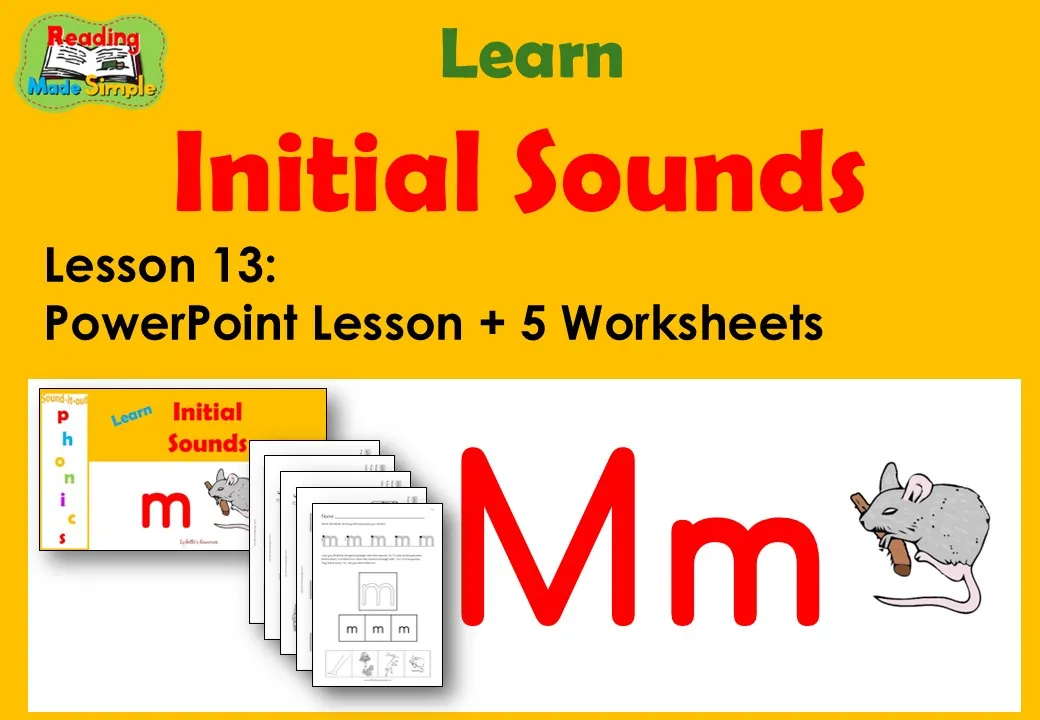
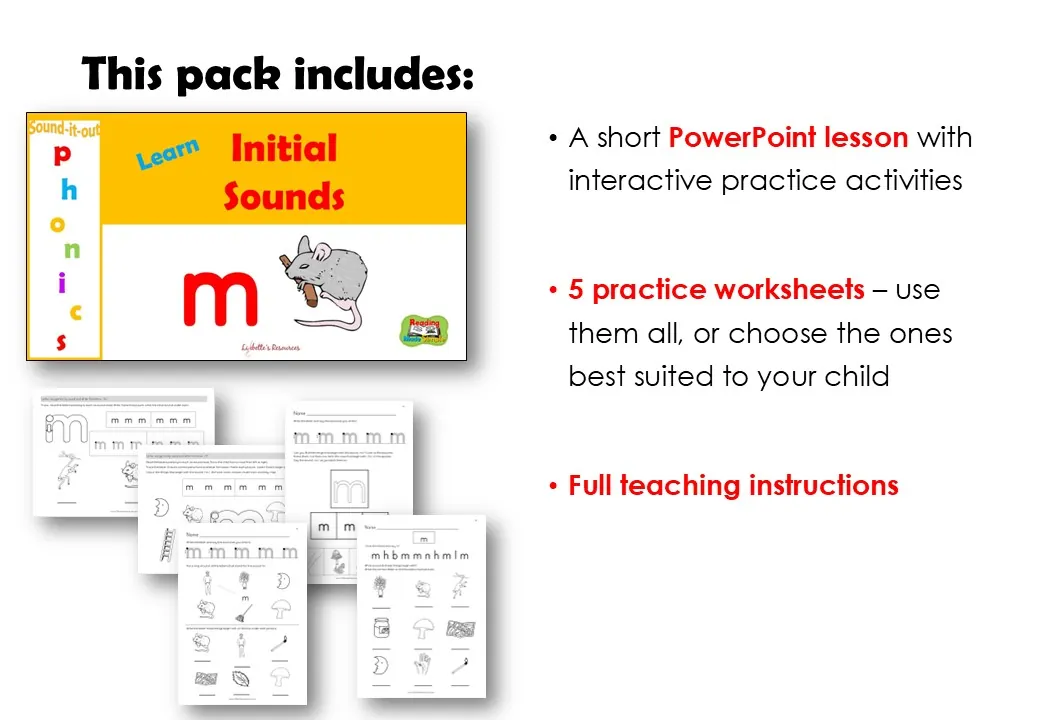
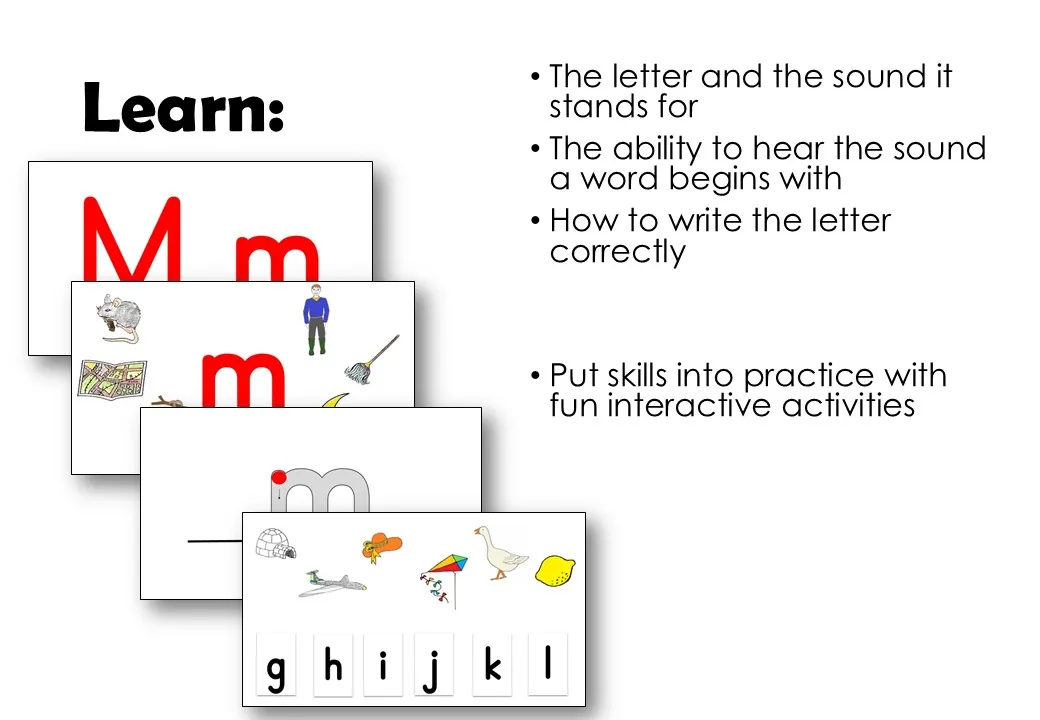
Learn Initial Sounds M: Lesson 13 teaches the letter Mm and its related phonic sound through a 31-slide PowerPoint lesson, and 5 follow-up activity worksheets.
All you need to teach the phonic letter M! Whether in school or at home, this series of phonic presentations can help you effectively teach initial/beginning sounds to all pupils, including those with special needs/dyslexia.
This lesson is part of a synthetic, systematic phonics programme for all abilities including those suspected of being dyslexic.
This lesson is in the first stage of the Reading Made Simple programme where we teach the initial, or beginning, sounds.
The ability to hear the initial/beginning sound is stressed throughout, while we learn to associate each letter with its sound.
Each lesson can stand alone but the activities will presume knowledge of the previous letters in the alphabet as Reading Made Simple teaches the initial sounds in alphabetical order.
Special features of the Learn Initial Sounds M: Lesson 13
The PowerPoint is silent so that you can interact with your child in the best way for them: full instructions are provided at the bottom of each slide - be sure to show 'Notes'. The PowerPoint is editable so that you can make it fit your pupils.
Science of Reading Aligned
Truly phonetic; no 'i' for 'ice-cream'.
We focus heavily on phonemic awareness which is so necessary for a head start in phonics
The child is given plenty of opportunities to learn the necessary skills - perfection is not expected in lesson 1. Still, the teacher will look for the development of the necessary skills as the child works through the alphabet.
What is included in the Learn Initial Sounds M: Lesson 13?
A 35-slide PowerPoint which teaches phonemic awareness, letter/sound correspondence and letter formation along with practice games
5 follow-up worksheets
How can the Learn Initial Sounds M: Lesson 13 be used?
It can be used in multiple ways:
As the child learns each sound, you can use the PowerPoint lesson to reinforce your lesson
It can be sent home for a child to watch with his/her parents after being taught the letter Mm in class - this will then act as revision as well as training the parent as to what is necessary to help the child.
Use in class
Use at home by parents or for home education
Suggested Method:
Introduce each letter in turn to your pupil. Have a flashcard of the letter ready.
Say each letter's sound to the child and ask him/her to repeat it thrice. Explain that some words begin with this sound. Give an example.
Use the lesson as teacher training for yourself, to see how to teach your child, or use it with the child.
Choose suitable activities (matching your child's ability) from the pack of worksheets.
Notes are suggestions only - use language appropriate to your pupil and be sure to interact naturally. However, could you make sure that you focus on the child's hearing of the sounds at the beginning of words as this is much overlooked in the quest to help children learn the initial sounds as quickly as possible?
Technical help:
Use the PowerPoint in normal mode so that you can see the notes and use the 'Draw' tool when prompted.
Some slides are interactive.
More:
Teachers: Find more Initial Sounds Worksheets here: https://teachsimple.com/product/beginning-sounds-phonics-worksheets
Find FREE revision/practice initial sounds slides here: https://teachsimple.com/product/learn-initial-sounds-powerpoint
Related resources
More resources teachers may find useful
24 related resources were found using this product's title, contributor, categories and tags.


In the classroom
Teaching tips & learning objectives

Learning objectives
Identify the /m/ sound at the beginning of spoken words
Trace and form the letter m with correct pencil hold and formation
Distinguish pictures whose names begin with /m/ from those that do not

Teaching tips
Use the worksheet's picture-naming step (moon, mouse, mushroom, monkey, map) as a listening check before moving to the coloring step, since the activity explicitly separates 'name the picture' from 'color if it starts with /m/'
Pair the tracing worksheet with the PowerPoint's letter-formation slides, since both independently practice forming 'M' and 'm'
Preview the PowerPoint before class, since most of its slides are image-based and best reviewed firsthand before teaching

Skills covered
Initial sound identification — students listen for and identify the /m/ sound at the start of picture names.
Letter formation — students trace and practice writing both 'M' and 'm' across the worksheet and PowerPoint slides.
Visual discrimination — students color only the pictures whose names begin with /m/, screening out non-matching pictures.
Good to know
Questions teachers ask about this resource
Which pictures does the worksheet use to practice the /m/ sound?
Moon, mouse, mushroom, monkey, and map — students name each picture, then color only the ones that begin with the /m/ sound.

No reviews yet
Downloaded this resource? Tell other teachers how it went.
Curriculum
Standards, concepts & topics
Standards
 Standards
- CCSS.RF.K.3.a — Demonstrate basic knowledge of one-to-one letter-sound correspondences by producing the primary sound or many of the most frequent sounds for each consonant.
- CCSS.RF.K.1d — Recognize and name all upper- and lowercase letters of the alphabet
Core concepts
 Core concepts
Initial /m/ sound
Letter formation (Mm)
Picture-sound matching
 Topics
Explore more
Categories this resource belongs to
Explore related searches
More to explore
You may also like