Magnetism Dominoes Learning Game for Middle Schoolers


About This Product
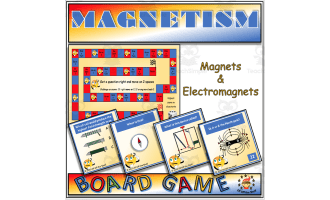
No numbers on these dominoes, just questions and answers. The game is suitable for all abilities as it can be played by matching two of the same question or a question with its answer. An animated PowerPoint explains how the game is played. This game is so much fun, pupils will forget they are learning!
Prior Knowledge
Composition of Magnets: Magnets are constructed using magnetic materials. Common materials include Iron, Cobalt, Nickel, and their corresponding alloys.
Pole Interactions: Magnets have two types of poles - North and South. When two like poles (e.g., North and North) come close to each other, they repel. Conversely, when opposite poles (e.g., North and South) are brought together, they attract each other.
Magnetic Fields: Surrounding every magnet is an invisible force field known as the magnetic field. This field can be visualized through field lines.
Field Line Density: The density of these field lines determines the strength of the magnetic field. A region with closely spaced field lines indicates a stronger magnetic field than a region where they're spread out.
Visualization of Field Lines: It's essential to understand and recognize the pattern of field lines around two bar magnets, especially when they have the same or opposite poles facing each other.
Field Strength at Poles: The magnetic field is strongest at the poles of a magnet due to a higher concentration of field lines.
Distance and Field Strength: The strength of the magnetic field diminishes as one moves farther from the magnet.
Direction of Field Lines: Field lines emanate outward from the magnet's south pole and point inward toward the north pole.
Magnetization Process: When a non-magnetized magnetic material becomes a magnet, the tiny regions within it called domains, which were initially oriented in random directions, align themselves to point uniformly in the same direction.
Earth's Magnetic Properties: The Earth behaves like a large magnet. Interestingly, there appears to be a south-type magnetic pole near the Earth's geographic North Pole and a north-type magnetic pole near the Earth's geographic South Pole.
Application in Devices: It would be beneficial to have a basic understanding of how magnets and magnetic fields operate within certain devices. Familiarize yourself with the structure and functioning of electric bells, relays, and circuit breakers, as they use these principles.
What You Get
90 dominos
Animated PowerPoint explaining the rules and how to play.
How to Play
Each player chooses seven dominos from the top of the face-down pile and holds them in their hand like playing cards.
The player who has the longest full name starts and play proceed in a clockwise direction.
Players match a question exactly or a question with its answer with the answer.
A player can challenge a match if they think it is wrong.
Pupils are encouraged to check their books for the correct answer and consult their teacher if a consensus is not reached.
If the challenge is correct, the challenger gives one of their cards to the other player. If the challenge is wrong, the challenged player gives one of their cards to the challenger.
If a player cannot play a domino, they pick up from the face down pile and can play if possible or add it to their hand.
See more Elf Off the Shelf resources on this topic and many others.
Explore the ideas hands-on with this magnetic poles and fields activity.
Resource Tags
0 Reviews
Check out these other great products